Blockchain Sanctions: What They Are and How They Impact Crypto
When we talk about blockchain sanctions, government actions that restrict crypto transactions, wallets, or exchanges to enforce financial policies. Also known as crypto compliance measures, these are no longer theoretical—they’re actively shutting down access to digital assets for millions. Unlike traditional banking, where you can freeze an account, blockchain sanctions target public addresses, smart contracts, and even decentralized protocols that can’t be easily shut down.
These sanctions aren’t random. They’re driven by agencies like the FATF, Financial Action Task Force, an international body that sets anti-money laundering standards for crypto, and national regulators like the U.S. Treasury’s OFAC. Their goal? Stop criminals, ransomware gangs, and sanctioned nations from using crypto to move money undetected. But the side effects are real: exchanges like Binance and Kraken have delisted privacy coins like Monero and Zcash because they can’t verify user identities on-chain. That’s not just a business decision—it’s a legal requirement.
And it’s not just about big players. If you hold crypto in a wallet tied to a sanctioned address—even by accident—you could lose access. Some platforms now block entire IP ranges or require KYC just to send small amounts. Countries like Cambodia and Pakistan are rolling out their own rules, forcing users into government-approved systems like Bakong or PVARA-licensed platforms. Meanwhile, projects that once promised anonymity are vanishing from exchanges, and airdrops are excluding users from high-risk regions. This isn’t a temporary trend. Blockchain sanctions are reshaping who can use crypto, where, and under what conditions.
What you’ll find in the posts below aren’t just news updates—they’re real-world case studies. From the delisting wave that wiped out privacy coins to how Cambodia’s banking ban forced users into a state-controlled digital currency, these stories show exactly how sanctions play out on the ground. You’ll also see how scams exploit regulatory confusion, how users adapt when their wallets get flagged, and why some projects die overnight just because they can’t comply. This isn’t theory. It’s what’s happening right now.
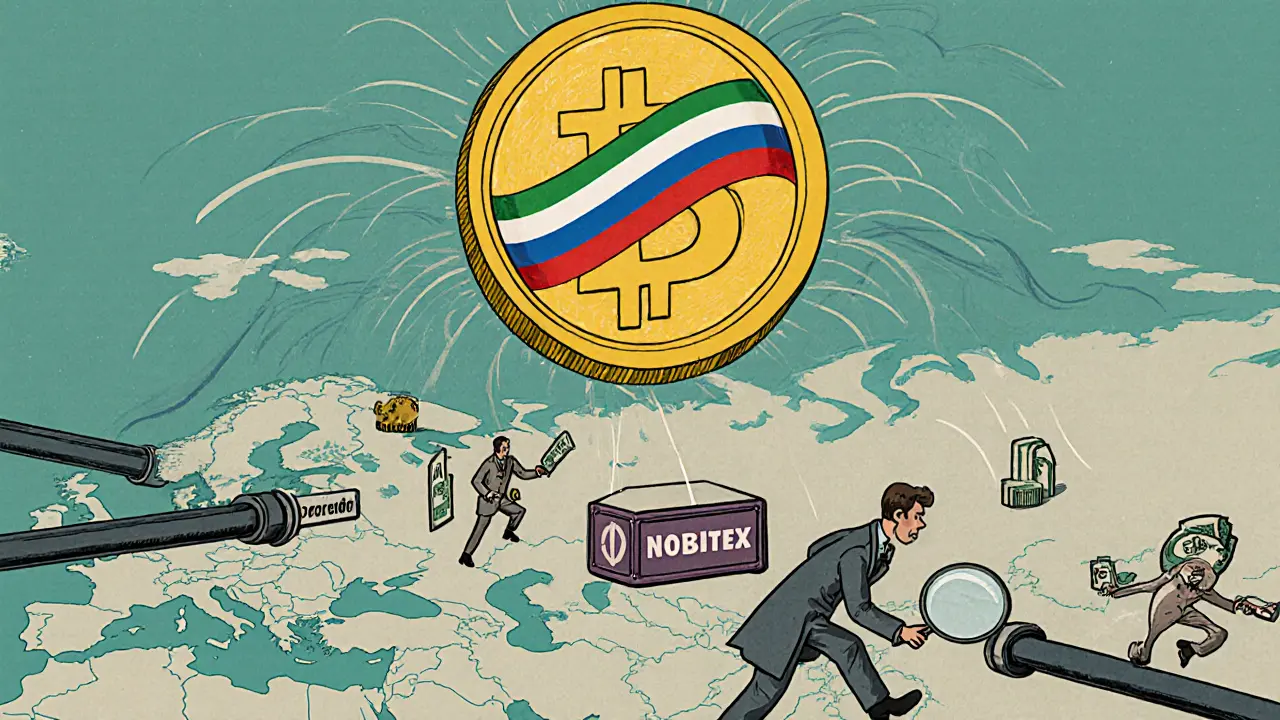
How $15.8 Billion in Sanctioned Crypto Transactions Exposed the Limits of Crypto Enforcement in 2024
In 2024, $15.8 billion in crypto transactions flowed to sanctioned entities, mostly from Iran and Russia. Bitcoin dominated the flow, while DeFi and cross-chain bridges made evasion easier than ever. Enforcement is struggling to keep up.