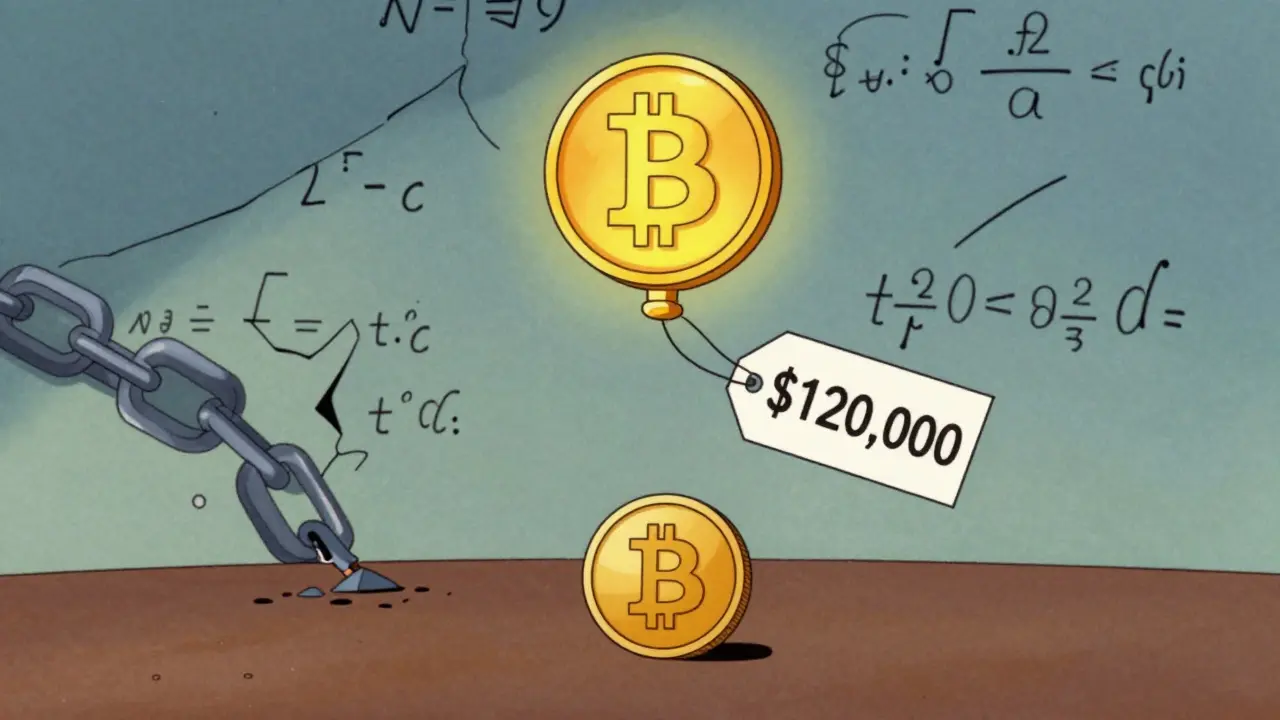
What if you saw a cryptocurrency claiming to be Bitcoin-but priced at over $120,000 per coin, while actual Bitcoin sits around $60,000? That’s teleBTC (TELEBTC). At first glance, it sounds like a breakthrough: a decentralized way to bring Bitcoin onto other blockchains. But dig deeper, and the numbers don’t add up. They break. They collapse under their own weight.
teleBTC claims to be wrapped Bitcoin. It’s not.
Wrapped Bitcoin tokens exist to let Bitcoin be used on other blockchains like Ethereum or Polygon. WBTC, renBTC, sBTC-they all follow one rule: 1 token = 1 Bitcoin. Simple. Predictable. Economically sound.
teleBTC claims to do the same. But according to data from CoinMarketCap and LiveCoinWatch in October 2025, it was trading at $115,000 to $122,000 per token. That’s not a slight fluctuation. That’s a 100% premium over Bitcoin itself. If teleBTC is supposed to represent Bitcoin, why is it worth twice as much? There’s no reason. No economic model explains it. No user demand justifies it. It’s mathematically impossible for a wrapped asset to trade at a 100% premium and still be functional.
The contract exists. The project doesn’t.
The contract address for teleBTC is real: 0xC58C1117DA964aEbe91fEF88f6f5703e79bdA574. It’s on Binance Smart Chain. You can look it up. But that doesn’t mean it’s alive.
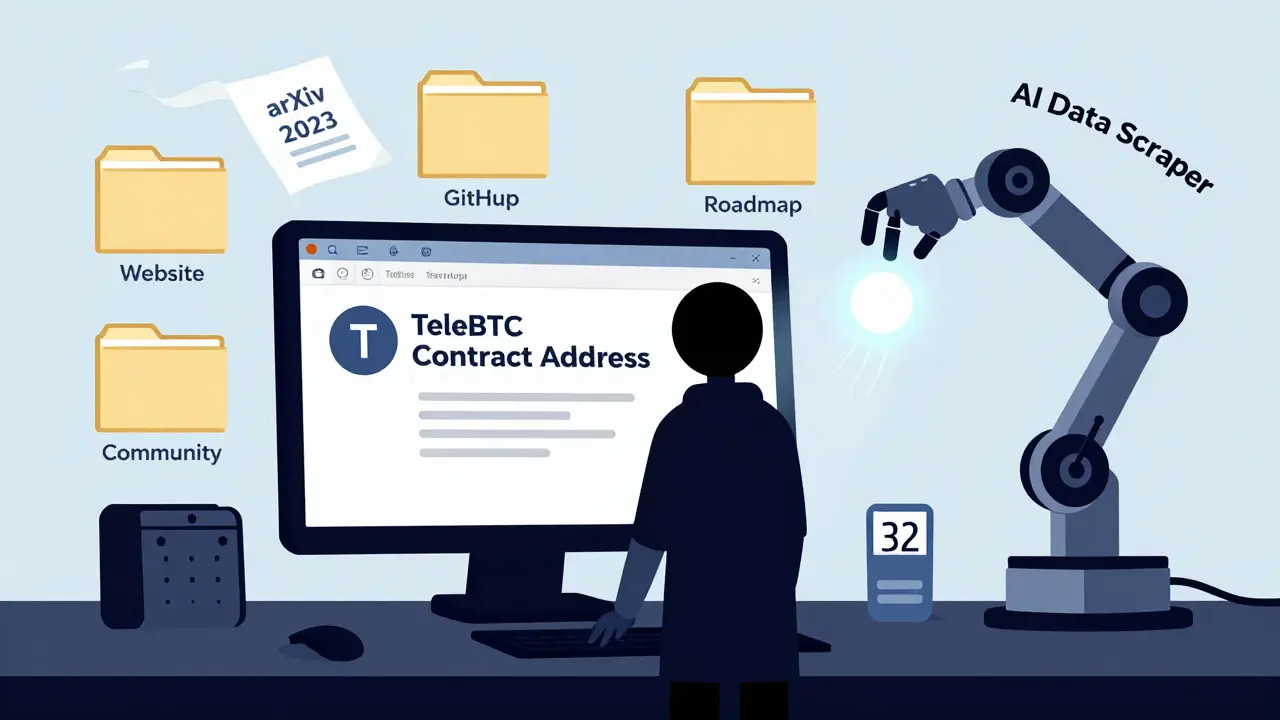
There’s no official website. No GitHub repository with recent commits. The last update to the code referenced in the original arXiv paper was August 2023. No documentation. No developer updates. No roadmap progress. The only real thing here is a smart contract with a price tag that makes no sense.
Compare that to WBTC. It’s audited seven times by top security firms. It’s integrated into Aave, Uniswap, Compound. It’s held by institutional custodians like Fidelity and Coinbase. teleBTC? Nothing. Zero integration. Zero liquidity. Zero community.
Market data is broken
Here’s where it gets weirder. LiveCoinWatch says teleBTC’s market cap is $0.00. Yet, it lists the price at $120,000. How is that possible? Only if there are one or two tokens in circulation. Maybe even one. A single token bought at $120,000 by a bot or a single wallet could inflate the price-and then vanish from the market.
Trading volume tells the same story. LiveCoinWatch reports $26 in 24-hour volume. CoinGecko says $800,984. That’s a 30,000% difference. One source says it’s dead. The other says it’s active. Neither can be trusted. This isn’t normal market noise. This is data corruption. Or worse-manipulation.
No one is using it
Check Reddit. Search r/CryptoCurrency, r/Bitcoin, r/DeFi. Nothing. Zero threads. Zero questions. Zero discussions.
Look at CoinGecko’s user reviews. Three ratings. Average score: 1.7 out of 5. Comments like: “Price chart looks manipulated.” “Tried to swap 0.001 BNB and the transaction failed.”
On Twitter, there were 12 mentions in 30 days. All from accounts with fewer than 50 followers. Meanwhile, WBTC gets over 1,200 mentions daily. That’s not a difference in popularity. That’s a difference between a real asset and a ghost.
It’s not listed anywhere
Want to buy teleBTC? You can’t on Binance. Not on Coinbase. Not on Kraken. Not on KuCoin. It’s not on any major centralized exchange.
On decentralized exchanges? Maybe. But only in tiny, illiquid pools. No one’s trading it. No one’s providing liquidity. The few who tried say their transactions failed. The liquidity is so thin, a single trade could wipe it out.
For a token that claims to enable cross-chain Bitcoin utility, it’s not usable in any DeFi protocol. No lending. No staking. No yield farming. No swaps. Just a price on a screen that doesn’t reflect reality.
Why does this even exist?
The arXiv paper from July 2023 is real. It’s academic. It’s well-written. It describes a theoretical protocol for trustless wrapped Bitcoin. But papers don’t build products. Code does.
There’s no evidence the researchers ever launched this. No testnet. No mainnet deployment. No community. No team. Just a paper and a contract address that someone-maybe a bot, maybe a scammer-put on a price tracker.
It’s a perfect example of how AI-generated content can mislead. CoinMarketCap’s AI listed teleBTC as a real project in July 2025, with a fake description, based on nothing but the paper and a contract address. No verification. No due diligence. Just data scraping and assumptions.
What’s the risk?
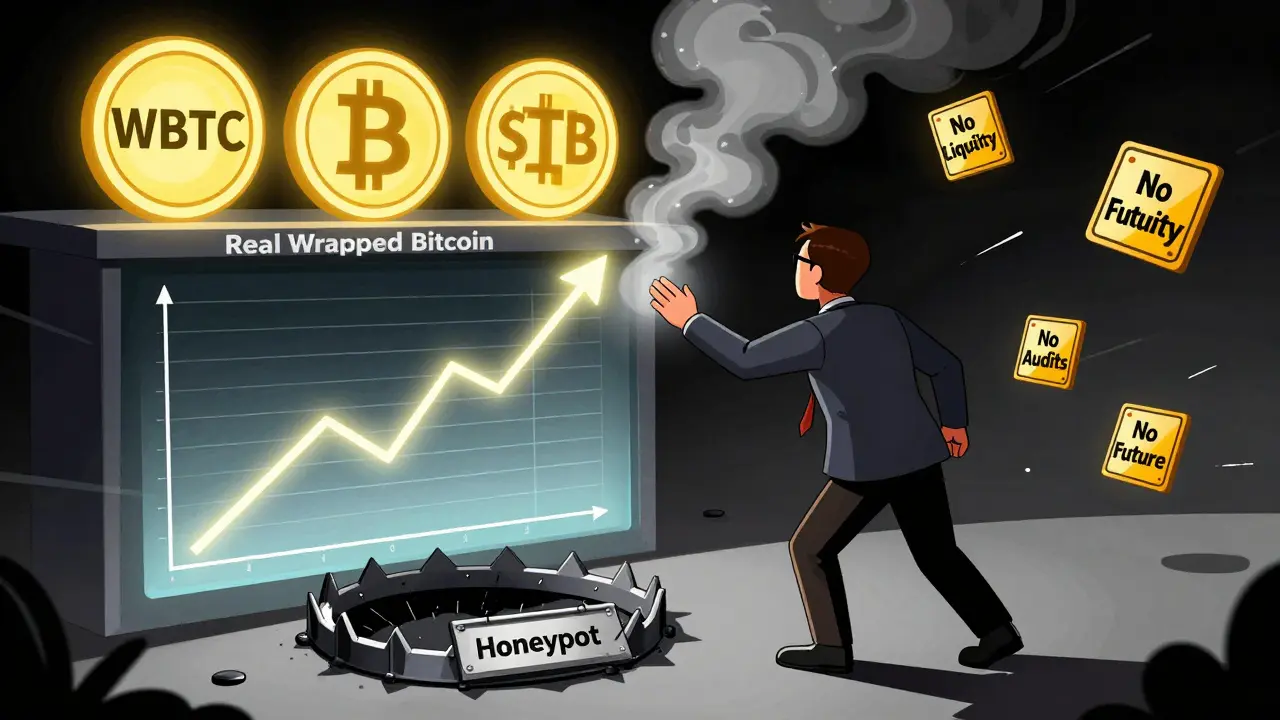
If you buy teleBTC, you’re buying a token with no utility, no liquidity, no backing, and no future. The price is either a glitch, a trap, or a honeypot.
Many crypto scams work like this: create a token with a plausible story, pump the price with bots, get it listed on low-quality trackers, then vanish. The people who bought in are left holding worthless tokens. The contract might even be designed to prevent withdrawals-common in honeypots.
And the SEC’s July 2025 guidance is clear: any token claiming to represent Bitcoin must be fully backed and redeemable 1:1. teleBTC fails that test completely. It’s not just risky-it’s non-compliant by design.
What should you do?
Don’t buy teleBTC. Don’t trade it. Don’t even look at it.
If you want wrapped Bitcoin, use WBTC, renBTC, or sBTC. They’re audited, liquid, integrated, and priced correctly. They’re real.
teleBTC is a ghost. A glitch. A warning sign. It exists because crypto is still wild west. Algorithms scrape papers and contracts and call them assets. People see a high price and assume it’s valuable. They’re wrong.
Remember: in crypto, if the math doesn’t add up, it’s not innovation. It’s a trap.
8 Comments
This isn't a coin-it's a crypto zombie. A bot scraped an arXiv paper, slapped a contract address on it, and called it a project. The price? A honeypot rigged to lure in the gullible. If you're holding this, you're not investing-you're feeding the algorithm.
Look, I get the outrage, but let’s not pretend this is some novel revelation. The crypto space has been a hall of mirrors since 2017. Every time someone finds a contract address with a price tag, they scream "scam!" like it’s shocking. But here’s the truth: the market doesn’t care about logic. It cares about perception. If enough people believe in the illusion, the illusion becomes real-until it doesn’t. And then? It evaporates. This isn’t about teleBTC. It’s about how we’ve outsourced our critical thinking to CoinMarketCap’s AI and then panic when it glitches. The real scam isn’t the token-it’s the belief that price = value. That’s the rot at the core of this whole ecosystem.
bro this is wild 😅 i thought i was the only one who saw this. i checked the contract, tried to swap 0.001 bnb, got slapped with a 90% slippage error and then my wallet just... froze. like wtf. i thought i was gonna get rich, turns out i almost got rug-pulled by a ghost. also why does coinmarketcap even list this? 🤡
Don't panic, stay calm, but don't touch this with a 10ft pole 🚫
Real crypto moves on liquidity, community, and utility. This? Zero. Zero. Zero.
Stick to WBTC. You'll thank yourself later 💪
THIS IS THE MOST DANGEROUS THING I’VE SEEN SINCE THE TERRA LUNA COLLAPSE. I’M NOT EVEN KIDDING. SOMEONE JUST SPENT $50K ON 0.0004 OF THIS THING AND NOW THEY’RE POSTING ON REDDIT CRYING. THE CONTRACT IS A TRAP. THE PRICE IS A LIE. THE WHOLE THING IS A SCAM FED BY AI AND DESPERATION. DON’T BE THE NEXT VICTIM.
The existence of teleBTC reflects a deeper epistemological crisis in digital asset valuation. When empirical verification is replaced by algorithmic inference, the boundary between ontology and illusion dissolves. The contract address is a syntactic artifact; the price, a semantic hallucination. We mistake the representation for the referent, and in doing so, we abdicate our responsibility as rational agents. This is not merely a fraudulent token-it is a mirror held up to the epistemic decay of the crypto community.
I actually thought this was real at first. I mean, the paper looked legit, the contract existed... I almost bought a tiny bit. Then I checked the volume and saw $26. That’s less than I spent on coffee this week. I’m just glad I didn’t jump in. This is why I only use WBTC now. Stay safe out there, folks.
Just wanted to say thanks for writing this. I was about to look into teleBTC after seeing it pop up on a Discord channel. Your breakdown saved me from a dumb mistake. I’ve been in crypto since 2018 and I still get fooled sometimes. It’s scary how easy it is to be misled. Keep doing this kind of work.