
You might have seen the ticker TAI flash across your screen or heard whispers in crypto Discord servers about "Solana’s answer to AI." It sounds promising on paper: a project bridging artificial intelligence with blockchain. But if you look closer at the numbers from mid-2026, the picture gets complicated fast.
TARS AI (TAI) isn't just another meme coin hoping for a lucky pump. It claims to be serious infrastructure built on the Solana blockchain. However, its journey from a hyped launch in late 2024 to its current status in July 2026 tells a story of extreme volatility, supply confusion, and the harsh reality of early-stage Web3 projects. Before you buy even one token, you need to understand what this protocol actually does, where the money goes, and why the price has dropped so drastically.
The Core Concept: What Actually Is TARS AI?
At its heart, TARS AI is a modular AI infrastructure protocol designed to run on the Solana blockchain. Think of it as an attempt to create a marketplace for AI services directly within the crypto ecosystem. The goal is to let developers build AI applications and let users access them without relying solely on traditional cloud providers like AWS or Google Cloud.
The project positions itself as a bridge between Web2 (the internet we use today) and Web3 (the decentralized web). It received a grant from the Solana Foundation, which gives it some initial credibility. This support suggests that Solana sees potential in TARS AI helping onboard its user base-currently over one million active wallets-to AI-driven tools.
But what does the technology actually look like? TARS AI offers three main components:
- AI Console: A super-app interface where consumers can access various AI tools.
- AI Aggregator: A system that routes your queries to hundreds of different language models, allowing you to pick the best tool for the job.
- AI Commodities: A framework for tokenizing AI assets, meaning AI models or outputs could theoretically be bought and sold like digital goods.
The pitch is cost efficiency. By leveraging Solana's high speed and low fees, TARS AI claims it can deliver these services up to 90% cheaper than traditional cloud computing. That’s a bold claim. While specific benchmark data against giants like OpenAI or Azure is scarce, the theoretical advantage of blockchain-based compute distribution is real-if people actually use it.
Tokenomics: How the TAI Token Works
To make this ecosystem function, you need a currency. That’s where the TAI token comes in. It is a utility token built on the Solana SPL standard. This means you need a Solana-compatible wallet (like Phantom or Solflare) to hold it.
The token serves four distinct purposes within the network:
- Governance: Holders vote on proposals regarding protocol upgrades and future development directions.
- Staking: Users lock up their TAI tokens to help secure the network and validate AI models. In return, they earn rewards.
- Payments: You pay with TAI to access AI models, computational power, and other services inside the TARS AI Hub.
- Incentives: Developers who contribute new AI models to the platform are rewarded with TAI tokens.
This structure is typical for DeFi projects. It tries to align the interests of users, developers, and investors. If the network grows, the demand for TAI should theoretically rise because everyone needs it to participate.
The Supply Problem: Conflicting Data
Here is where things get tricky for any investor. When looking at token supply-the total number of coins that exist-you will find wildly different numbers depending on which website you check. This discrepancy is a major red flag for due diligence.
| Data Source | Total Supply Claimed | Circulating Supply | Date of Data |
|---|---|---|---|
| Bitstamp / Official Docs | 1,000,000,000 TAI | Not specified clearly | April 2025 |
| CoinGecko | 894,996,126 TAI | 590,000,000 TAI | July 5, 2026 |
| Binance Live Tracker | N/A | 892,200,000 TAI | July 2, 2026 |
| BitMart | 895,876,752 TAI | 439,257,131 TAI | February 17, 2025 |
Notice the difference? CoinGecko says there are roughly 590 million tokens circulating, while Binance says nearly 892 million are out there. That is a massive gap. Why does this matter? Because market capitalization is calculated by multiplying the price by the circulating supply. If the supply number is wrong, the valuation is wrong.
Furthermore, the official documentation states a fixed total supply of 1 billion tokens. Yet, CoinGecko lists the total supply under 900 million. This suggests that either some tokens were burned (destroyed), locked permanently, or that data aggregators are tracking different pools of liquidity. For an investor, this lack of clarity makes it hard to assess true scarcity.
Market Performance: From Hype to Crash
If you missed the launch window in late 2024, you probably dodged a bullet-or you’re sitting on heavy losses. Let’s look at the price action, because it defines the current risk profile of TAI.
In December 2024, TARS AI was having a moment. Trading volume spiked to over $161 million in a single day. The price hit approximately $0.41 per token. At that height, the market cap was around $283 million. Whales were buying millions of tokens, and exchange AMAs (Ask Me Anything sessions) on KuCoin and Binance Square generated buzz.
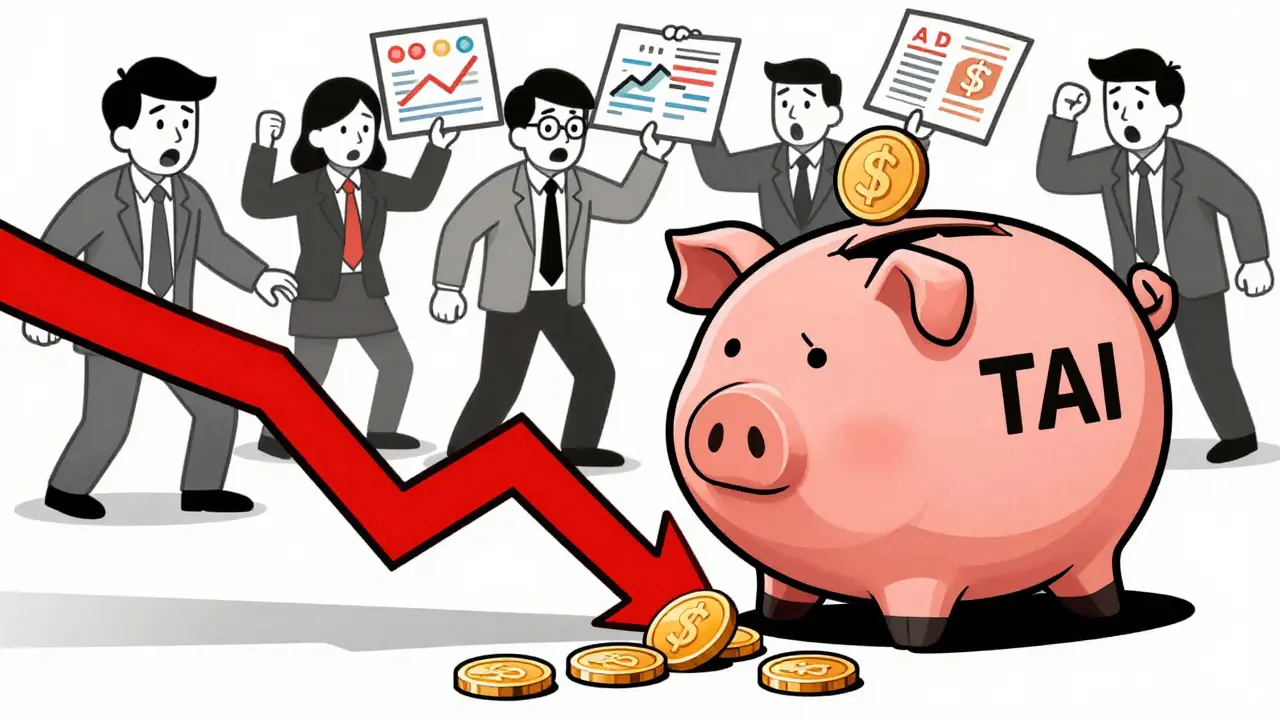
Fast forward to July 2026. The price hovers around $0.0097. That represents a decline of roughly 97.6% from its peak. The market cap has shrunk to between $5.7 million and $8.7 million, depending on the tracker. Daily trading volume is now under $500,000.
This isn’t just a normal correction; it’s a severe drawdown. In crypto terms, this is often called a "rug" effect, even if no actual theft occurred. It reflects a loss of confidence. Early buyers likely exited, and new interest hasn’t been enough to push the price back up. The community sentiment on Reddit has shifted from excitement to frustration, with many users questioning whether the project is still viable.
Risks and Practical Challenges
Buying TAI right now isn’t like buying Bitcoin or Ethereum. There are significant hurdles you need to be aware of.
Liquidity and Exchange Access: TAI is not listed on major centralized exchanges like Binance’s main spot market. To buy it, you typically have to use a decentralized exchange (DEX) via a Web3 wallet, or smaller centralized exchanges like BitMart or Bybit. This creates friction. If you want to sell quickly during a crash, you might not find enough buyers at a good price.
Wallet Compatibility Issues: Some users have reported problems moving TAI tokens. For example, reports from January 2025 showed holders using Tangem hardware wallets unable to swap or send their TAI. This indicates that not all Solana-compatible wallets fully support the token’s specific implementation. Always test with a small amount first.
Adoption Uncertainty: The value of TAI depends entirely on people using the AI Console and paying for services with the token. Right now, there is little evidence of mass adoption. Without real-world usage driving demand for the token, the price relies purely on speculation.

Is TARS AI Legitimate?
Legitimacy doesn’t mean safety. TARS AI appears to be a legitimate software project with a working team, updated documentation (last checked July 2026), and backing from the Solana Foundation. It is not a simple scam site designed to steal your wallet seed phrase.
However, "legitimate" does not mean "good investment." The project faces intense competition from larger AI companies and other crypto protocols. Its promise of being cheaper than cloud providers is unproven at scale. The severe price drop suggests that the market has voted with its feet, prioritizing more established assets.
If you are a developer interested in building on-chain AI, TARS AI might offer interesting tools and incentives. If you are an investor looking for quick gains, the historical data suggests high risk and low probability of recovery to previous highs.
How to Buy TAI (If You Still Want To)
If you’ve read the risks and still decide to proceed, here is the general process:
- Get a Solana Wallet: Download Phantom, Solflare, or another reputable Solana wallet. Secure your private keys offline.
- Fund with SOL: Buy Solana (SOL) on a major exchange and transfer it to your wallet. You’ll need SOL to pay for transaction fees and to swap for TAI.
- Use a DEX: Connect your wallet to a decentralized exchange like Raydium or Jupiter. Search for the TAI token pair (usually TAI/SOL).
- Verify the Contract Address: This is crucial. Scammers create fake tokens with the same name. Double-check the contract address against official TARS AI sources before swapping.
- Execute the Swap: Set your slippage tolerance appropriately (often higher for low-cap tokens) and confirm the transaction.
Avoid buying from random links in Telegram or Twitter DMs. Only use verified interfaces.
What is the current price of TAI token?
As of July 2026, the TAI token trades around $0.0097 USD. Prices vary slightly between exchanges like CoinGecko, CoinMarketCap, and Binance, but generally stay within this narrow range after dropping significantly from its 2024 highs.
Is TARS AI a scam?
TARS AI is not considered a outright scam in the sense of a phishing scheme, as it has a functional protocol, documentation, and Solana Foundation support. However, it carries high financial risk due to extreme price volatility, low liquidity, and mixed community sentiment regarding its long-term viability.
Can I stake TAI tokens?
Yes, staking is a core feature of the TARS AI ecosystem. Users can stake TAI to help validate AI models and secure the network, earning rewards in return. You must use a compatible Solana wallet and connect to the official TARS AI staking interface.
Why did the TAI price drop so much?
The price dropped approximately 97% from its late 2024 peak due to a combination of factors: post-hype sell-offs, lack of widespread adoption of its AI services, limited listing on major exchanges, and broader market cooling in the AI-crypto sector.
Which exchanges list TARS AI?
TAI is primarily traded on decentralized exchanges (DEXs) on the Solana network. It has also been listed on smaller centralized exchanges like BitMart and Bybit. It is not currently available on major tier-1 exchanges like Binance’s central spot market.