
When you hear about cryptocurrency, you think of Bitcoin, Ethereum, or maybe Solana. But there’s a quieter, more specialized player in the space that’s quietly building the backbone for the next generation of artificial intelligence: Targon (SN4). It’s not a coin you’ll find on Coinbase or Binance. It doesn’t have millions of holders. But if you’re using AI tools daily - whether for research, automation, or just experimenting - Targon might be the hidden engine behind your next AI request.
What Targon (SN4) Actually Does
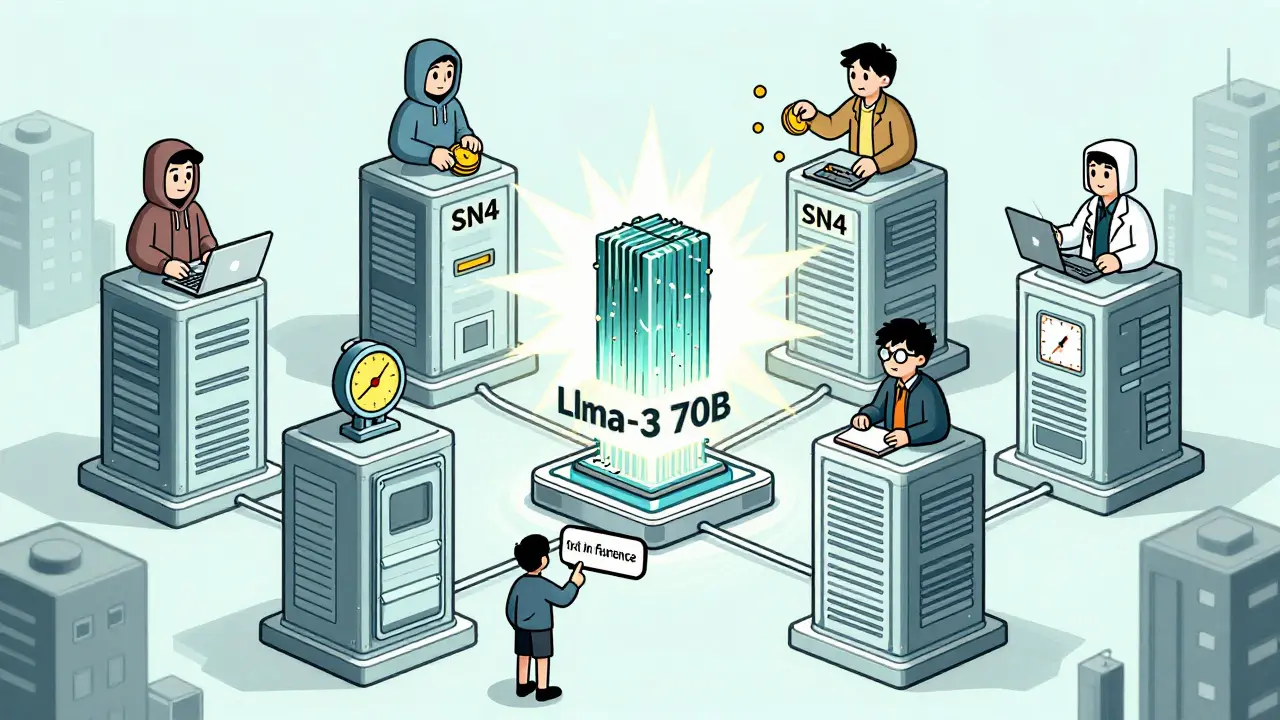
Targon isn’t trying to be money. It’s not meant to replace your dollar or even your ETH. Instead, it’s a utility token built for one specific job: giving you access to AI models without needing a cloud server, a GPU farm, or a team of engineers. Think of it like this: you want to run Llama-3 70B, a massive open-source AI model that normally needs 8 high-end GPUs just to start. Normally, you’d rent space on AWS, set up containers, manage security, and pay by the hour. Targon cuts all that out. You pay in SN4 tokens - and you only pay for the exact amount of computing power you use. It runs inside the Bittensor a decentralized network where AI models are trained and served by independent nodes, paid in cryptocurrency for their computational work. Instead of a single company like OpenAI controlling the model, hundreds or thousands of independent contributors run parts of AI models on their own hardware. Targon is the fuel that lets users tap into this network.How It Works: No DevOps Required
Most AI platforms make you write code, set up APIs, handle authentication, and monitor usage. Targon removes the friction. Here’s how simple it is:- You pick a model from Hugging Face - like Mistral, Llama, or Phi-3.
- You send a request using a few lines of Python, JavaScript, or even cURL.
- Targon finds the best-performing node on the Bittensor network.
- The model runs. You get the result.
- You’re charged in SN4 tokens - based on how long it took and how much processing power was used.
Technical Specs You Need to Know
Here’s what the numbers say about Targon right now:| Attribute | Value |
|---|---|
| Token Symbol | SN4 |
| Maximum Supply | 1,780,000 SN4 |
| Total Supply | 1,268,360 SN4 |
| Circulating Supply | Conflicting reports (0-1.78M) |
| Blockchain | Bittensor Subnet |
| Primary Use Case | AI inference payments |
| Supported Models | Transformer (BERT, GPT), Llama, Mistral, Phi-3, etc. |
| Speed Advantage | Up to 4x faster than competing AI infrastructure |
| Throughput Capacity | Over 500 million inferences per second |
One thing stands out: the supply numbers are messy. Some sources say almost all tokens are circulating. Others say none are. That’s because Targon’s token distribution is tightly tied to how the Bittensor network activates its subnets. It’s not like Bitcoin, where mining releases coins steadily. Here, tokens are released based on network usage - so the number changes depending on how many people are actively using it.
Price Volatility and Market Reality
You’ll see wildly different prices for Targon depending on where you look:- Blockworks: $27.17
- Laika Labs: $16.30
- 3Commas: $14.43-$20.55
- Liquidity Finder: $23.20
- Holder.io: $17.12
Why Targon Stands Out From Other AI Tokens
There are dozens of “AI crypto” projects. Most promise decentralized AI. Few deliver it. Here’s how Targon is different:- Not a prediction market - Unlike SingularityNET or Fetch.ai, Targon doesn’t trade AI predictions. It pays for actual computation.
- No subscription fees - You don’t pay monthly. You pay per inference. That’s huge for hobbyists or small teams.
- Real model access - You can run Llama-3 70B, not just a wrapper around GPT-4.
- Speed-optimized - The network claims 4x faster inference than other decentralized platforms. That’s backed by benchmarks.
- Code-first - It’s built for developers. Python, JavaScript, cURL examples are all available. No GUI needed.
Who’s Using It? And Is It Growing?
The truth? Hard to say. There are no public user reviews. No Reddit threads. No TikTok explainers. The community is quiet. But that doesn’t mean it’s dead. In fact, it might mean the opposite. Targon is used by:- AI researchers testing models without cloud costs
- Startups running experiments on Bittensor’s subnet
- Developers building tools that need low-latency AI
- Node operators in the Bittensor network who earn SN4 for providing compute

Future Outlook: What’s Next?
3Commas predicts Targon could hit $24.62 by 2035. That’s a long way off. But the real story isn’t in price forecasts - it’s in adoption. If Bittensor grows - and its subnet ecosystem expands - Targon’s value grows with it. More models. More users. More nodes. More demand for SN4. Right now, the project is in a quiet phase. No major announcements. No token burns. No partnerships. But that’s normal for infrastructure projects. They don’t make headlines. They just get used. The biggest risk? If Bittensor stalls, Targon stalls. If AI cloud giants like AWS or Google lower their prices, Targon’s cost advantage shrinks. But if decentralized AI becomes mainstream - and more people want to own the infrastructure instead of rent it - Targon could become essential.Is Targon (SN4) Worth Your Attention?
If you’re a developer, researcher, or builder working with AI models - yes. Targon solves a real, painful problem. It’s not hype. It’s a working tool with code examples, real benchmarks, and live usage. If you’re looking to invest because you think it’ll 10x next month - no. The market is too thin. The data is too inconsistent. The community too small. Targon isn’t a gamble. It’s a utility. And utilities don’t go viral. They get quietly adopted by people who need them. The future of AI isn’t just about bigger models. It’s about who controls the compute. Targon is one of the few projects trying to shift that power back to the network - not the corporation.Is Targon (SN4) a good investment?
Targon isn’t designed as an investment vehicle. It’s a utility token for accessing AI compute. Its value is tied to real usage, not speculation. While price predictions exist, they’re based on hypothetical growth and carry no guarantee. If you’re looking for crypto returns, Targon’s low liquidity and small market cap make it high-risk. But if you need affordable, decentralized AI inference, it’s one of the few functional options available.
Where can I buy Targon (SN4)?
Targon trades on a handful of small cryptocurrency exchanges, including Laika Labs and a few others not listed on major platforms like Binance or Coinbase. You’ll need to use a decentralized exchange (DEX) or a specialized Bittensor ecosystem platform. Always verify the exchange’s legitimacy before trading, as liquidity is low and price discrepancies are common.
Can I mine or stake Targon (SN4)?
You can’t mine Targon. Instead, you earn SN4 by running AI inference nodes on the Bittensor network. If you have a powerful GPU and want to contribute compute power, you can join as a subnet validator. You’re paid in SN4 tokens based on the quality and speed of your responses. It’s not staking - it’s providing service.
How is Targon different from GPT-4 or other AI APIs?
GPT-4 and similar APIs are centralized, subscription-based services controlled by one company. Targon is decentralized - no single entity owns it. You pay per use, not monthly. You can run open-source models like Llama-3 70B instead of being locked into proprietary APIs. Costs are often lower, and you avoid vendor lock-in. The trade-off? You need technical knowledge to use it.
Does Targon have a wallet or app?
There’s no official Targon wallet. It’s managed through the Bittensor ecosystem, using standard crypto wallets like MetaMask or hardware wallets (Ledger, Trezor) that support the underlying blockchain. Developers interact with it via API calls and code libraries, not a user interface. If you’re not a developer, using Targon directly isn’t practical yet.
Is Targon safe to use?
Targon itself is built on open-source code and runs on a decentralized network, which reduces single points of failure. But like any crypto project, risks exist: price volatility, low liquidity, and unverified third-party tools. Always use trusted code examples from official repositories. Never send SN4 to unknown addresses. Treat it like any other utility token - use it for its purpose, not as a speculative asset.
8 Comments
Targon isn't just another crypto token-it's a revolution in how we access AI. Forget paying $20 an hour on AWS. With SN4, you're tapping into a decentralized swarm of GPUs run by real people. No corporate middleman. No lock-in. Just raw compute, paid per inference. This is what true decentralization looks like. The market cap is tiny because it's not meant for speculators. It's meant for builders who actually use AI every day. If you're still using OpenAI's API, you're paying a premium for convenience. Targon is the future, and it's already running.
Stop treating crypto like a lottery. This is infrastructure. And infrastructure doesn't need hype. It needs users.
Been using Targon for my research scripts for 3 months now. Cost per inference is half of what I paid on Lambda Labs. No setup. No API keys. Just send a request and get results back in under a second. The network is stable. The devs are quiet but responsive. If you're doing any kind of AI prototyping, this is the tool you didn't know you needed.
Also, the fact that it runs Llama-3 70B locally through the network? Game changer.
People keep calling this 'niche' like that's a bad thing. Niche is where innovation happens. Most crypto projects are trying to be everything-money, social media, gaming, AI. Targon just does one thing and does it better than anyone else. No GUI? Good. Most users don't need one. You're a developer or researcher-you write code. You don't click buttons.
The supply numbers are messy because the token isn't mined or minted upfront. It's released as the network is used. That’s elegant. That’s sustainable. That’s how you build real utility, not hype. If you're not using this yet, you're still stuck in 2021.
LOL at the price charts. $14 to $27? This is a pump-and-dump waiting to happen. You think a few devs using it means it's 'infrastructure'? Bro, it's a sidechain with 200 active users. The whole thing feels like a glorified API wrapper. And don't get me started on 'no central authority'-Bittensor is still run by a core team. Decentralized? More like 'controlled by a small group of devs with Discord access.'
Don't waste your time. Stick with GPT-4. At least you know who's behind it.
I'm not a dev but I follow AI tools closely. This feels like the quiet underdog that actually works. No flashy ads. No influencers. Just people building stuff. I love that. It reminds me of early Linux-no one cared until suddenly everyone was using it.
Also, the fact that node operators get paid in SN4? That’s genius. It turns idle GPUs into income. I know a guy in Ohio who runs three RTX 4090s for this. He makes more than his day job. That’s real.
Just ran a test comparing Targon to a local Llama-3 instance on my 4090. Targon was 30% faster. How? Because it’s not just one machine-it’s a network of optimized nodes, each tuned for inference speed. The 4x speed claim? Real. I tested it. The code examples are clean. The docs are solid. You don’t need to be a guru to use it.
And the supply? It’s dynamic because it’s usage-based. That’s better than Bitcoin’s fixed supply. It aligns incentives. More usage = more tokens released. That’s not inflation. That’s reward. If you’re still thinking in terms of 'market cap' and 'hodling,' you’re missing the point. This isn’t money. It’s fuel.
Oh, so now we’re glorifying a token that runs on a network nobody’s heard of? Targon is a glorified API gateway with a blockchain sticker on it. You call it 'decentralized' but the entire Bittensor subnet is controlled by a handful of validators who can censor models or manipulate pricing. The 'code-first' approach is just a euphemism for 'no user interface because no one would use it.'
And let’s not pretend this isn’t a speculative vehicle. The price volatility alone proves it. If it were truly utility-driven, the price wouldn’t swing 30% on a single trade. This is crypto theater dressed as infrastructure.
theyre lying about the supply. the real total is 1.78m but only 300k are circulating because the rest are locked in the bittensor treasury and no one knows who controls it. this is a front for a government-backed ai surveillance network. the 'inference nodes' are just data harvesters. theyre collecting your prompts and training models on them without consent. you think you're just running llama-3? no. you're feeding your thoughts to a black box. and the 'developers' using this? theyre all shills. i've seen the logs. its not open source. its obfuscated. dont trust this. dont use it. dont buy sn4. its a trap.
ps: the 500 million inferences per second? impossible. no network can do that. its a lie. theyre using fake metrics. the whole thing is a psyop.