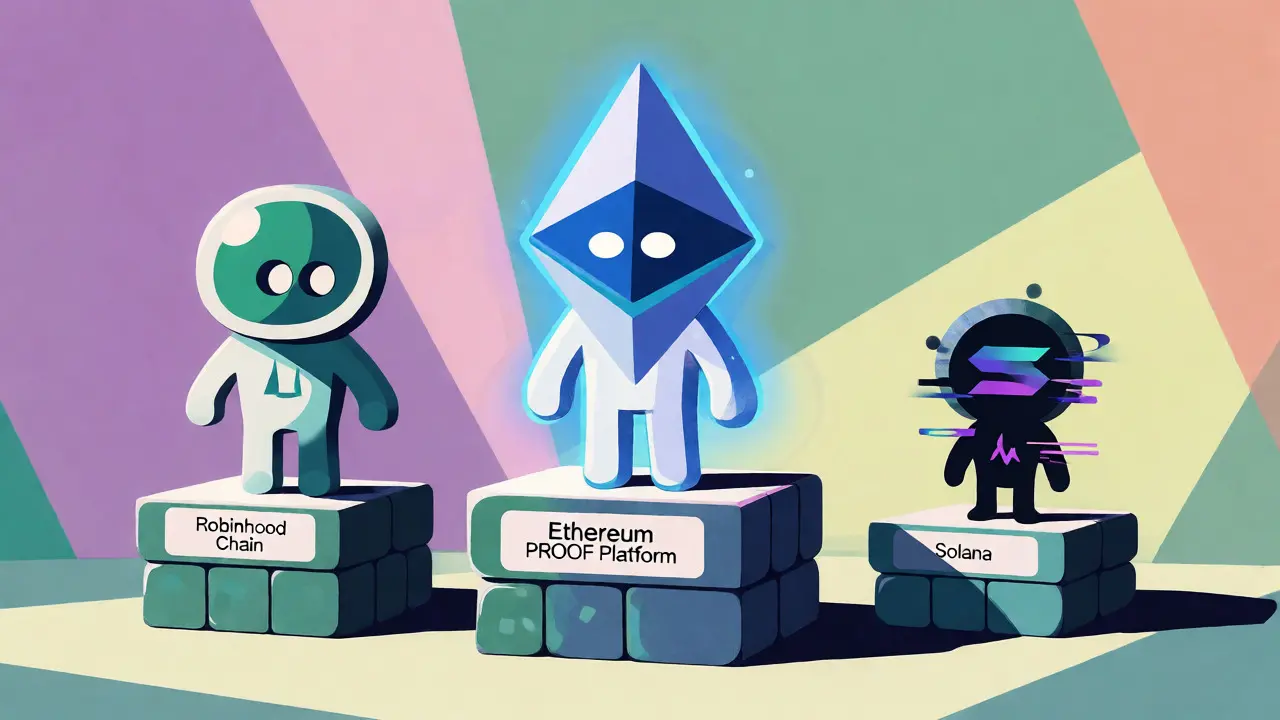
Imagine trying to buy a ticket for the next big thing in tech, but you can't find it on Amazon or even eBay. That’s roughly what buying PROOF feels like right now. It’s not a mainstream coin you’ll see on every billboard, and if you type "PROOF" into your exchange app, you might get confused because there are actually three different tokens using that ticker. The most prominent one, however, is PROOF Platform, an ERC-20 token on the Ethereum blockchain designed as a utility asset for a web3 startup incubator and token launchpad. If you’re digging into this micro-cap asset, you need to know exactly which PROOF you’re looking at, how it works, and why its price data looks so weird compared to other coins.
The Ticker Trap: Three Different PROOFs
Before you spend a single dollar, let’s clear up the confusion. In the crypto world, tickers aren’t unique identifiers; they’re just labels. As of late 2026, three distinct projects use the name PROOF:
- PROOF Platform (Ethereum): This is the main subject of our deep dive. It’s an ERC-20 token tied to a web3 incubator. Think of it as a membership card for a club where new crypto projects launch.
- Proofon PROOF (Robinhood Chain): A utility token for the Proofon trading ecosystem. It’s used for commitment and access rights, not really for speculative trading.
- Solana PROOF: A tiny, low-priced token on the Solana network, likely a meme or micro-cap asset with minimal documentation.
When people ask "what is PROOF," they usually mean the Ethereum-based PROOF Platform. Why? Because it has the most established infrastructure, including official documentation, a presence on major data aggregators like CoinMarketCap and CoinGecko, and a clear narrative around being a launchpad. The other two are niche players with limited public data. For the rest of this article, we’re focusing on the Ethereum PROOF Platform unless stated otherwise.
What Does PROOF Actually Do?
So, what’s the job description for this token? PROOF isn’t a currency you use to buy coffee. It’s a utility token. Its core purpose is to align the interests of three groups: the startups launching on the platform, the investors backing those startups, and the community members who stake their PROOF tokens.
Here’s the mechanism: PROOF Platform acts as an incubator. New web3 projects come here to launch their own tokens. To participate in these early-stage launches-often called Initial DEX Offerings or IDOs-users typically need to hold or stake PROOF. By locking up their tokens, users signal commitment. In return, they might get preferential access to buy new project tokens before the general public, often at a discounted rate. It’s a classic launchpad model, similar to what you’d see with platforms like DAO Maker or BSCPad, but on a much smaller scale.
The official docs emphasize that PROOF sits at the heart of this ecosystem. It’s not just about speculation; it’s about governance and incentive design. If the incubator succeeds in launching profitable projects, the demand for PROOF should theoretically rise because more people want access to those future opportunities.
| Attribute | PROOF Platform (Ethereum) | Proofon PROOF (Robinhood Chain) | Solana PROOF |
|---|---|---|---|
| Blockchain | Ethereum (ERC-20) | Robinhood Chain | Solana |
| Primary Use Case | Token launchpad & incubation access | Trading commitment & access rights | Speculative/Meme utility |
| Max Supply | 100,000,000 | 1,000,000,000 | Not clearly defined in public snippets |
| Liquidity Status | Thin (Uniswap v2 only) | Niche / Internal ecosystem | Very Low / Micro-cap |
| Transaction Tax | 5% Buy / 5% Sell | No inflationary rewards noted | Unknown |
Tokenomics: The Numbers Behind the Noise
If you look at different websites, the supply numbers for PROOF Platform seem to contradict each other. Don’t panic-that’s normal for micro-caps. Here’s the breakdown based on the latest data from September 2026:
- Max Supply: Capped at 100 million tokens. This is fixed, meaning no new tokens will ever be minted beyond this limit.
- Total Supply: Around 30.75 million tokens have been minted so far.
- Circulating Supply: Estimates vary wildly between 9.7 million and 22.5 million depending on whether locked tokens are counted. CoinMarketCap reports ~22.5 million circulating, while others report closer to 10 million.
- Holder Count: Fewer than 1,000 addresses hold PROOF. This is a tiny community.
Why the discrepancy? Some aggregators count all minted tokens as "total," while others try to subtract team allocations or locked staking contracts to find the "free float." For practical purposes, assume the circulating supply is roughly 10-20% of the max cap. This means the market cap is incredibly small-hovering around $300,000 USD. To put that in perspective, that’s less than 0.01% of the entire crypto market. You’re dealing with a true micro-cap.

Price and Liquidity: The Reality Check
Let’s talk money. As of late September 2026, PROOF trades in a narrow band between $0.024 and $0.027. But here’s the kicker: the volume is ghost-town quiet. On some days, the total 24-hour trading volume is under $20. Yes, twenty dollars. On better days, it might hit $500.
This creates two major problems for traders:
- Slippage: If you try to buy $1,000 worth of PROOF, you might move the price significantly against yourself because there aren’t enough sellers on the order book.
- Exit Difficulty: Selling large amounts can be hard without crashing the price temporarily.
Furthermore, PROOF carries a 5% tax on both buys and sells. So, if you buy $100 worth, you effectively pay $105, and when you sell, you keep 95% of the proceeds. This tax structure is common in launchpad tokens to fund operations and reward stakers, but it makes short-term trading expensive. You need a significant price increase just to break even.
How to Buy PROOF (Step-by-Step)
You won’t find PROOF on Coinbase’s spot trading page or Binance’s main order books. Those sites list it for reference, but you can’t trade it there directly. Instead, you have to go decentralized. Here’s how to get started:
- Get an Ethereum Wallet: Install MetaMask or another ERC-20 compatible wallet.
- Fund with ETH: Buy Ethereum on a centralized exchange and send it to your wallet. Remember, you’ll need extra ETH for gas fees.
- Go to Uniswap V2: PROOF is primarily traded on Uniswap version 2, not version 3. Navigate to the swap interface.
- Paste the Contract Address: Search for PROOF by its contract address:
0x9b4a69de6ca0defdd02c0c4ce6cb84de5202944e. This ensures you’re buying the right token and not a fake clone. - Swap ETH for PROOF: Select the amount, check the slippage settings (you may need to increase them due to low liquidity), and confirm the transaction.
Be prepared for high gas fees if the Ethereum network is congested. Since the token value is low, a $50 gas fee could eat up 20% of your investment if you’re only buying $250 worth.

Risks and Red Flags
Is PROOF a scam? Not necessarily. It has official documentation, a verified smart contract on Etherscan, and consistent listings on major data aggregators. However, it carries significant risks typical of micro-caps:
- Low Adoption: With fewer than 1,000 holders, the community is small. If the incubator doesn’t attract high-quality projects, demand for PROOF could dry up.
- Liquidity Risk: Thin markets mean you might not be able to exit your position quickly during a downturn.
- Data Discrepancies: Conflicting supply numbers suggest poor transparency or complex vesting schedules that aren’t fully explained to retail investors.
- Tax Drag: The 5% buy/sell tax penalizes frequent traders.
There’s also no public roadmap detailing upcoming partnerships or audit results in the accessible snippets. Without regular updates, it’s hard to gauge momentum.
Key Takeaways
- Identify the Right Token: Ensure you are looking at the Ethereum ERC-20 PROOF Platform, not the Robinhood Chain or Solana variants.
- Utility Over Speculation: PROOF is designed for access to early-stage launches, not as a payment method.
- Micro-Cap Volatility: Expect extreme price swings and very low daily trading volumes.
- Decentralized Access Only: You must use Uniswap V2 and hold ETH to trade PROOF.
- Community Size Matters: With under 1,000 holders, growth depends heavily on successful incubated projects.
Which blockchain does PROOF run on?
The primary PROOF Platform token runs on the Ethereum blockchain as an ERC-20 standard token. There are other tokens with the same ticker on Robinhood Chain and Solana, but the Ethereum version is the most documented and widely tracked.
Can I buy PROOF on Coinbase or Binance?
No, you cannot directly trade PROOF on major centralized exchanges like Coinbase or Binance. They may list it for price tracking, but actual trading occurs on decentralized exchanges, specifically Uniswap V2, using Ethereum (ETH).
What is the maximum supply of PROOF?
The maximum supply of PROOF Platform is capped at 100,000,000 tokens. However, the circulating supply is much lower, estimated between 10 million and 22 million depending on the data source and date.
Does PROOF have a transaction tax?
Yes, according to official documentation, PROOF imposes a 5% tax on buys and a 5% tax on sells. These funds are typically directed toward treasury operations or community incentives.
Why do price sources show different values for PROOF?
Different aggregators pull data from different sources and times. Additionally, because liquidity is extremely thin, prices can vary significantly between venues. Always check the real-time price on the primary trading venue, Uniswap V2, via a block explorer like Etherscan.