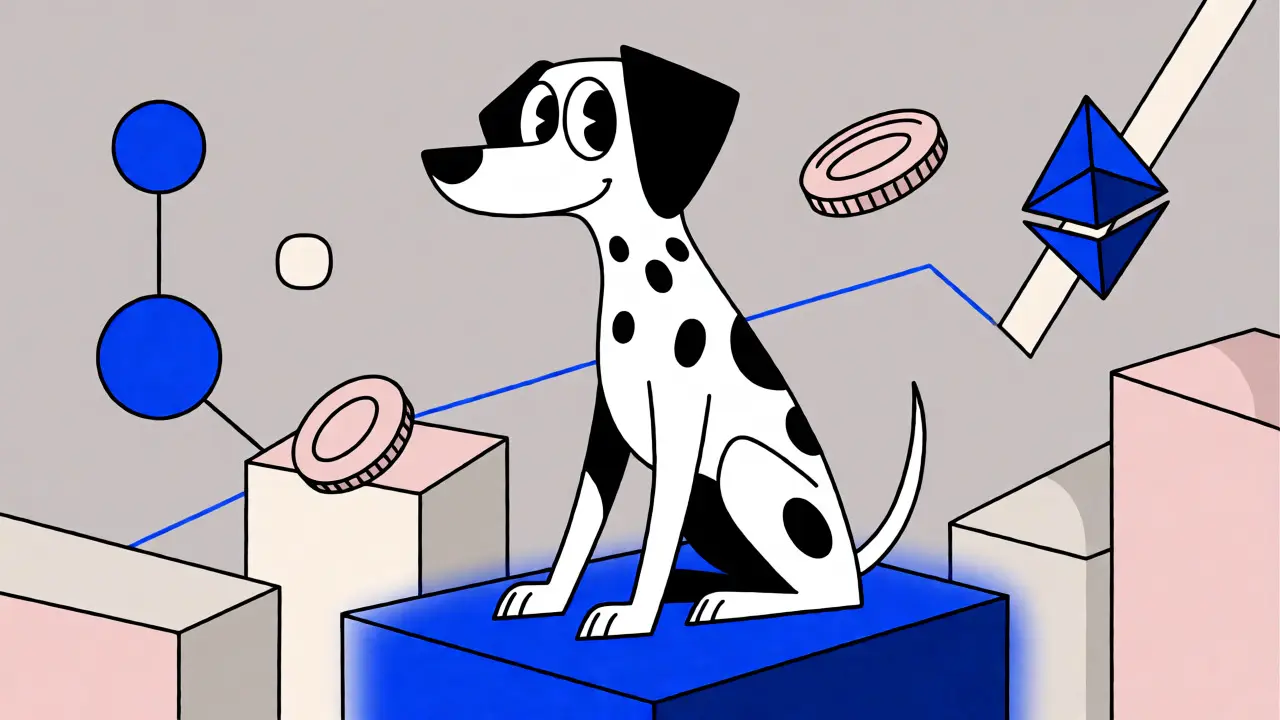
You see the ticker PONGO trending on a social feed, and you wonder if this is the next big thing or just another fleeting internet joke. It’s a common dilemma in the crypto world. Before you connect your wallet, you need to know exactly what you are buying. Is it a robust financial instrument with real utility, or is it a speculative asset driven purely by community hype? The answer lies in understanding its technical roots and market behavior.
Pongo is an Ethereum-based ERC-20 meme token that launched in 2024. Unlike Bitcoin, which runs on its own blockchain, or Ethereum, which powers smart contracts, Pongo lives entirely within the Ethereum ecosystem. It draws inspiration from the Dalmatian character in Disney’s 101 Dalmatians, aiming to ride the wave of popularity created by giants like Dogecoin and Shiba Inu. But here is the catch: while those coins have established histories and massive liquidity, Pongo is a much newer, smaller player with significantly less data backing its value.
Key Takeaways
- Network: Runs on Ethereum as an ERC-20 token, not its own blockchain.
- Supply: Fixed total supply of approximately 1.01 trillion tokens.
- Risk Level: Extremely high due to low liquidity and lack of verified development team.
- Ticker Warning: Multiple different tokens use the "PONGO" symbol; always verify the contract address.
- Utility: Primarily speculative; no confirmed real-world applications or governance systems found.
Understanding the Technical Structure
When you buy Pongo, you aren’t buying a piece of a new network. You are buying a token deployed on the existing Ethereum infrastructure. This means it inherits Ethereum’s security model but also its transaction fees (gas). The project claims to have renounced ownership of the smart contract, implying that the developers can no longer change tax rates or mint new tokens. They also claim to have sent all liquidity to a "dead wallet," meaning they cannot pull the rug by removing the trading pool. However, these are self-reported claims. Without a third-party audit confirming every line of code, you are trusting the word of anonymous creators.
The token specifications are straightforward but massive. There are 1,010,101,010,101 tokens in existence. Because the circulating supply equals the maximum supply, there is no future inflation planned. Every token is already out in the wild. This structure is typical for meme coins, where the goal is often wide distribution rather than controlled emission schedules like Bitcoin’s halving events.
The Ticker Collision Problem
This is the most critical part of buying any small-cap altcoin. The name "PONGO" is not unique. If you search for it on major aggregators like CoinGecko or CoinMarketCap, you will find multiple assets sharing the same ticker. Confusing them can lead to buying the wrong asset entirely.
| Asset Name | Network | Total Supply | Approx. Price (Oct 2026) | Market Cap |
|---|---|---|---|---|
| Pongo (Classic) | Ethereum (ERC-20) | ~1.01 Trillion | $0.0000000617 | ~$62,300 |
| PONGO-3 | Robinhood Chain | 1 Billion | $0.0004294 | ~$429,000 |
| XRP-Pongo Variant | XRP Ledger | Varies | N/A | N/A |
The article focuses on the Ethereum version with the contract address ending in 041E6. The Robinhood Chain variant trades at a completely different price point and has different liquidity dynamics. Always copy-paste the full contract address into your wallet or exchange interface. Never rely solely on the three-letter ticker.

Market Performance and Liquidity Risks
Let’s look at the numbers. As of late October 2026, the Ethereum Pongo token trades at roughly $0.0000000617. That sounds cheap, but remember, there are trillions of them. The market capitalization hovers around $62,000. To put that in perspective, a single mid-sized company might have a market cap in the billions. This tiny valuation makes the price extremely volatile.
Liquidity is the lifeblood of any tradeable asset. For Pongo, daily trading volume has been reported as low as $66.85 in recent snapshots. Imagine trying to sell $1,000 worth of stock in a market where only $60 trades hands each day. You would crash the price trying to exit. This is the reality for Pongo holders. With such thin order books, even a moderate sell-off can cause severe slippage, meaning you receive far fewer dollars than the quoted price suggests.
The token hit its all-time high in May 2024. Since then, it has dropped nearly 99% from that peak. This pattern-rapid launch, spike, and long-term decay-is classic for unproven meme coins. While some investors hope for a second wind, the historical trend suggests that without new catalysts or massive community growth, the price may continue to drift lower.
Who Is Behind Pongo?
If you dig deep, you won’t find a CEO named John Doe or a registered LLC in Delaware. The public records do not identify a named founder, a venture capital backer, or a formal development team. This anonymity is common in crypto, especially among meme projects, but it raises the risk profile. When you invest in Bitcoin, you trust Satoshi Nakamoto’s code and the global node network. When you invest in Pongo, you trust anonymous individuals who may disappear tomorrow.
There is no whitepaper detailing complex algorithms or partnership agreements. No academic papers cite it. No major news outlets cover its quarterly earnings because there are none. The primary communication channel appears to be social media accounts, such as @pongoklassic on X. Relying on social sentiment alone is dangerous because bots and paid influencers can artificially inflate hype without adding real economic value.

How to Buy and Store Pongo Safely
Since Pongo is an ERC-20 token, you don’t buy it directly from a centralized exchange like Coinbase or Binance in most cases. You typically need to use a Decentralized Exchange (DEX) like Uniswap. Here is the step-by-step process to minimize errors:
- Set up a Wallet: Install MetaMask or another Ethereum-compatible wallet extension or app.
- Fund Your Wallet: Purchase Ethereum (ETH) to pay for gas fees and swap funds.
- Connect to Uniswap: Go to the official Uniswap interface and connect your wallet.
- Import Token: Paste the specific contract address (
0x7C68e725b0B2FfCBa8947FdEd4198C3d1Db041E6) to ensure you are selecting the correct Pongo token. - Check Slippage: Due to low liquidity, set your slippage tolerance higher than usual (perhaps 1-3%) to ensure the transaction goes through.
- Test Small: Buy a very small amount first. Try selling it immediately to confirm the token is liquid and not a "honeypot" (a token you can buy but not sell).
Storing Pongo is easy since it lives in your Ethereum wallet. Just make sure you keep your private keys secure. Hardware wallets like Ledger or Trezor offer better protection against phishing scams than browser extensions.
Is Pongo a Good Investment?
That depends on your risk tolerance. If you are looking for a stable store of value, Pongo fails the test. Its volatility and lack of fundamentals make it unsuitable for conservative portfolios. If you are a speculator willing to lose 100% of your capital for a chance at a 10x return, it might fit your strategy. But treat it like a lottery ticket, not a savings account.
Compared to Dogecoin, which has Elon Musk’s occasional endorsement and years of cultural relevance, Pongo lacks staying power. Compared to Shiba Inu, which has built an entire ecosystem including a layer-2 chain and NFTs, Pongo offers no tangible utility. It is purely a bet on community attention. And community attention is fickle.
Final Verdict
Pongo is a textbook example of a modern meme coin: technically simple, socially driven, and financially risky. It exists on Ethereum, has a fixed supply, and relies entirely on trader interest for its price. The lack of transparency regarding its creators and the absence of audited utility mean you should approach with extreme caution. Verify the contract address, test the liquidity, and never invest money you cannot afford to burn.
What is the contract address for Pongo (PONGO)?
The Ethereum contract address for the main Pongo token is 0x7C68e725b0B2FfCBa8947FdEd4198C3d1Db041E6. Always verify this address before trading, as other tokens share the PONGO ticker.
Is Pongo available on Coinbase or Binance?
As of late 2026, Pongo is primarily traded on decentralized exchanges like Uniswap. It is not widely listed on major centralized exchanges like Coinbase or Binance, so you will likely need to use ETH and a Web3 wallet to purchase it.
Does Pongo have real-world utility?
Currently, there is no documented real-world utility for Pongo. It does not have a confirmed payment system, staking rewards, or governance voting mechanisms. Its value is derived almost exclusively from speculation and community sentiment.
Why are there multiple tokens called PONGO?
Cryptocurrency tickers are not exclusive. Different projects can choose the same three-letter symbol. One PONGO is on Ethereum, another is on the Robinhood Chain, and others exist on different networks. They are completely separate assets with different prices and supplies.
Is Pongo a honeypot?
A honeypot is a token you can buy but not sell. Some analysis tools have flagged warnings for Pongo, but it is not definitively proven to be one. To be safe, always execute a small buy and immediate sell test before committing significant funds.
7 Comments
The liquidity metrics cited here are frankly embarrassing for anyone still holding this bag. Daily volume of $66 is not a market, it's a graveyard where exit liquidity goes to die.
When you look at the order book depth on Uniswap, the slippage tolerance required just to offload a position worth three digits suggests that the 'community' aspect is largely an illusion maintained by bot activity and wash trading. The tokenomics show a fixed supply, sure, but without verified development or audited utility, we are essentially looking at a speculative derivative with no underlying asset backing.
Most retail investors fail to understand that low market cap does not equal high upside; it equals high volatility and near-zero institutional interest. The contract address confusion mentioned in the article is a classic red flag indicating poor project management and lack of brand protection.
If the developers had actually renounced ownership properly, we would see consistent transaction patterns rather than sporadic spikes followed by weeks of dead air. The anonymity of the team means there is no accountability when the chart inevitably bleeds out.
I have seen this exact pattern with dozens of ERC-20 meme coins from 2024. They launch with hype, hit an ATH within weeks, and then enter a death spiral as early adopters dump on latecomers who mistake cheap unit price for value.
The comparison to Dogecoin is misleading because DOGE has network effects and cultural inertia that PONGO simply cannot replicate. Shiba Inu built an ecosystem; Pongo built nothing but a ticker symbol collision.
Anyone buying this now is providing exit liquidity for the insiders who minted the initial supply. The risk-adjusted return is negative when you factor in gas fees and the probability of total loss.
Until there is a third-party audit confirming the honeypot status and liquidity lock, this asset should be treated as gambling capital, not investment capital.
The fact that multiple tokens share the PONGO ticker creates unnecessary friction for new users, which further stifles adoption. This is amateur hour in crypto marketing.
It breaks my heart to see so much skepticism directed at these smaller community-driven projects. While the risks are real, the spirit of decentralization often starts with small, grassroots movements like this one.
We must remember that every giant in the crypto space started as a joke or a small experiment. The empathy we show towards these communities can foster a more inclusive financial future for everyone.
Perhaps the lack of formal structure is actually a feature, allowing for rapid adaptation and genuine human connection among holders. We should encourage open-minded exploration rather than immediate dismissal.
Let us try to find peace in the uncertainty and support those who believe in the vision, even if the data seems sparse right now.
Actually, the technical analysis provided is slightly incomplete regarding the specific mechanics of the liquidity burn. If the LP tokens were truly sent to a dead wallet, the rug pull vector via liquidity removal is mitigated, though not eliminated due to potential code vulnerabilities.
You also need to consider that Ethereum gas fees act as a natural filter for low-value transactions, which explains the low daily volume figures to some extent. It isn't necessarily dead, just expensive to trade.
Furthermore, the ticker collision issue is standard across all non-exclusive naming conventions in blockchain technology, not unique to Pongo. It requires user diligence, not project failure.
Mitigated? Please. A dead wallet only prevents the developer from pulling the pool, it doesn't prevent them from dumping their personal holdings into the thin liquidity.
Gas fees don't explain why volume is $66. If people wanted to buy, they would pay the gas. Low volume means low demand, period.
And yes, ticker collisions are common, but successful projects secure their branding. This is just lazy execution.
This whole situation feels morally questionable! 🤔 Buying into anonymous tokens with no clear purpose is basically throwing money away that could help others. 😟
We should focus on ethical investments that have transparency and real-world impact. It makes me sad to see people risking their savings on such vague promises. 😢
Absolutely pathetic state of affairs. British standards for financial regulation would have shut this nonsense down years ago. These American-style casino tokens lack any serious governance framework.
We need proper oversight, not anonymous dev teams hiding behind smart contracts. It is a disgrace to serious economic principles. 🇬🇧
Do not let the negativity discourage you! Every great journey begins with a single step, and Pongo represents the bold spirit of innovation!
Stay strong, stay motivated, and keep believing in the power of community resilience! Your energy is your greatest asset in this volatile market!