You’ve probably heard the buzz about ParallelAI (PAI) being the next big thing in the intersection of artificial intelligence and blockchain. But what exactly is it? Is it a serious infrastructure play or just another speculative token riding the AI hype wave? If you are looking at the charts, you might see a price hovering around $0.0023 as of late September 2026, which feels like a far cry from its highs in 2024. So, why does this coin exist, and what problem is it actually trying to solve?
The short answer is that ParallelAI is a computing platform that uses blockchain technology to create a marketplace for high-performance computing resources. Think of it as an "Airbnb for GPUs." Instead of tech giants hoarding all the powerful graphics cards needed to train massive AI models, ParallelAI aims to let anyone with spare processing power rent it out to developers who need it. The PAI token is the fuel for this engine-it’s how you pay for compute, how providers get rewarded, and how the network stays secure.
The Core Problem: Why We Need Decentralized Compute
Artificial intelligence is hungry. Training large language models or running complex simulations requires enormous amounts of computational power, specifically from Graphics Processing Units (GPUs). Right now, the market for these GPUs is tight and expensive. Major cloud providers charge premium rates, and there’s often a bottleneck where researchers can’t access the hardware they need quickly enough. This is where ParallelAI enters the picture. It attempts to democratize access to this power by tapping into idle resources across the globe.
The project claims to automate the parallelization of code, meaning it can split a heavy computational task across multiple processors automatically. In theory, this could speed up tasks by up to 20 times compared to traditional single-threaded execution. For a developer struggling to train a neural network on a laptop, offloading that work to a decentralized network of gaming PCs and data centers could be a game-changer. The goal isn't just to buy chips; it's to optimize how we use them.
How the PAI Token Works
At the heart of this ecosystem is the PAI token. It’s not just a speculative asset; it has specific jobs to do within the network. First, it serves as a payment method. When a developer wants to run an AI model, they pay in PAI. Second, it acts as an incentive. Users who contribute their GPU power to the network earn PAI rewards. This creates a circular economy where supply meets demand without needing a central bank or intermediary.
There is also a governance aspect. Holders of PAI tokens may have voting rights on future protocol upgrades or feature developments, although the transparency around current governance structures remains limited. The total supply is fixed at 100 million tokens, with 100% currently in circulation. This means there are no locked tokens waiting to be dumped on the market later, which is a positive sign for long-term holders worried about inflationary pressure.
Technical Architecture and Networks
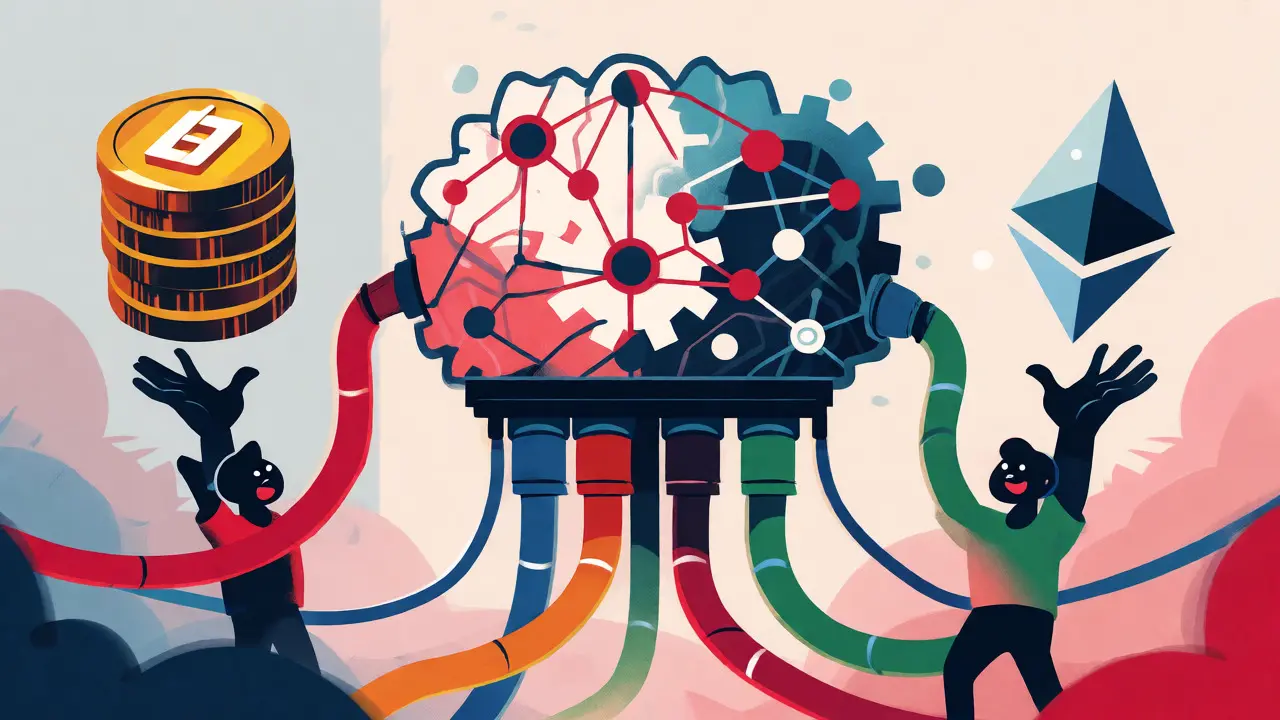
ParallelAI doesn't operate in a vacuum. It relies on existing blockchain infrastructure to handle transactions and smart contracts. Initially launched on the BNB Smart Chain in early 2024, the token also exists as an ERC-20 asset on Ethereum. This multi-chain presence allows it to tap into liquidity pools and user bases on both major networks. By leveraging established chains, ParallelAI inherits their security protocols, such as proof-of-stake validation, rather than building a new consensus mechanism from scratch.
However, the technical details remain somewhat opaque. While marketing materials highlight features like automatic code parallelization and integration with decentralized GPU marketplaces, there are few public audits or detailed whitepapers easily accessible through major aggregators. This lack of deep technical documentation can make it hard for independent developers to verify the "up to 20x speedup" claims. Are these benchmarks tested under real-world conditions, or are they theoretical best-case scenarios? That distinction matters when you're deciding whether to invest your time or money.
Market Performance and Volatility
If you look at the price history, the story is one of extreme volatility. In late 2024 and early 2025, PAI traded above $0.08, with some exchanges reporting volumes over $1 million. Fast forward to September 2026, and the price sits near $0.0023. That’s a drawdown of roughly 97%. This pattern is common for micro-cap cryptocurrencies, especially those tied to trending narratives like AI. When the hype cools, liquidity dries up fast.
| Metric | Value | Context |
|---|---|---|
| Current Price | ~$0.0023 USD | Down ~97% from 2024 peaks |
| Total Supply | 100,000,000 PAI | Fully circulating, no vesting locks |
| Market Cap | ~$230,000 USD | Micro-cap segment |
| Major Exchanges | Binance, Gate.io, Bitget | Listed on multiple centralized platforms |
| Risk Rating | BB (Moderate) | Legitimacy checks passed, but low liquidity |
The drop in trading volume is perhaps more concerning than the price drop itself. Daily volumes have shrunk to a few hundred dollars on some platforms. Low volume means high slippage-if you try to sell a large amount of PAI, you might crash the price further because there aren't enough buyers on the other side. For investors, this highlights the risk of entering a position based solely on the AI narrative without considering exit liquidity.

Competitors and Alternatives
ParallelAI isn't alone in the decentralized compute space. It competes with larger, more established projects like Render Network (RNDR), Akash Network (AKT), and Golem (GLM). These projects have been around longer, have clearer roadmaps, and often boast higher market caps and better liquidity. So, why would someone choose PAI?
The differentiation lies in its focus on automated parallel processing. While other networks act primarily as rental markets, ParallelAI claims to offer software-level optimization that makes the compute more efficient. If their technology works as advertised, developers might prefer PAI because they get more performance per dollar spent. However, until more third-party developers adopt the platform and publish case studies, this advantage remains largely unproven against competitors with stronger communities.
Who Should Consider Investing?
This isn't a blue-chip investment like Bitcoin or Ethereum. ParallelAI is a high-risk, high-reward play in the niche sector of AI-infrastructure crypto. It suits investors who:
- Believe in the thesis: You think decentralized GPU marketplaces will eventually disrupt cloud computing.
- Can stomach volatility: You are comfortable seeing your portfolio value swing 50% or more in a week.
- Do your own research: You are willing to dig deeper than CoinGecko stats to find team updates or GitHub activity.
For casual traders, the low liquidity and small market cap make it a dangerous place to park significant capital. There’s no guarantee of a rebound if the AI hype cycle shifts again. But for those who understand the mechanics of distributed computing and want exposure to a smaller, potentially undervalued player, it offers a unique angle.
Is ParallelAI (PAI) a scam?
Not necessarily. Independent risk assessment sites rate it as "BB," indicating moderate risk. It passes basic legitimacy checks and is listed on reputable exchanges like Binance and Gate.io. However, the lack of transparent founder information and public audits means it carries higher operational risk than established projects.
What is the total supply of PAI tokens?
The total supply is capped at 100,000,000 PAI tokens. As of September 2026, 100% of these tokens are in circulation, meaning there are no locked tokens that will be released gradually over time.
Which blockchains support ParallelAI?
ParallelAI is primarily deployed on the BNB Smart Chain (as a BEP-20 token) and also exists on the Ethereum network (as an ERC-20 token). This allows users to hold and trade PAI using wallets compatible with either chain.
Why did the price of PAI drop so much?
Like many small-cap AI tokens, PAI experienced a surge in interest during the AI boom of 2024-2025. As the broader crypto market cooled and investor attention shifted, liquidity dried up, leading to a significant price correction of approximately 97% from its peak.
Can I stake PAI tokens?
Yes, staking is part of the token utility model. Users can stake PAI to participate in network governance or earn rewards, though specific staking mechanisms and yields can vary depending on the platform and current protocol rules.