
Have you ever wondered who actually runs the decentralized exchanges you trade on? In traditional finance, big corporations hold your money and make the rules. In DeFi, that model is breaking down, but it’s not always clear how the new systems work. Enter Level Finance, an omnichain platform that lets users trade perpetual contracts without giving up control of their funds. But here is the part most people miss: Level Finance isn’t just a trading interface. It has a complex dual-token system where one token handles utility and another handles power. That second token is LGO, the governance token that gives holders a voice in the protocol’s future and a share of its profits. If you are looking at LGO charts or seeing mentions of LEVEL DAO, you need to understand what this token actually does. It is not just a speculative asset; it is a key to a treasury that grows as the platform makes money. Let’s break down exactly what Level Finance is, how LGO fits into the picture, and why this structure matters for your portfolio.
The Core Problem Level Finance Solves
Before we talk about tokens, we have to look at the platform itself. For years, centralized exchanges like Binance or FTX dominated the market. They offered speed and ease of use, but they also held your keys. When those platforms failed or faced regulatory crackdowns, users lost access to their funds. This created a massive trust deficit in the crypto space. Level Finance was built to fix this by being fully non-custodial and on-chain. This means your funds never leave your wallet until you execute a trade. Every position, every balance, and every liquidity pool is visible on the blockchain. You can verify the data yourself. No black boxes. No hidden reserves. The team behind Level Finance didn’t just fork an existing codebase. They wrote an original architecture designed from the ground up for perpetual trading. This custom build allows them to implement features that generic forks can’t support, particularly in risk management. They leverage Chainlink Oracles for price feeds, ensuring that the prices you see are accurate and tamper-proof. This transparency is the foundation that makes the LGO token valuable.
LVL vs. LGO: The Dual-Token Ecosystem
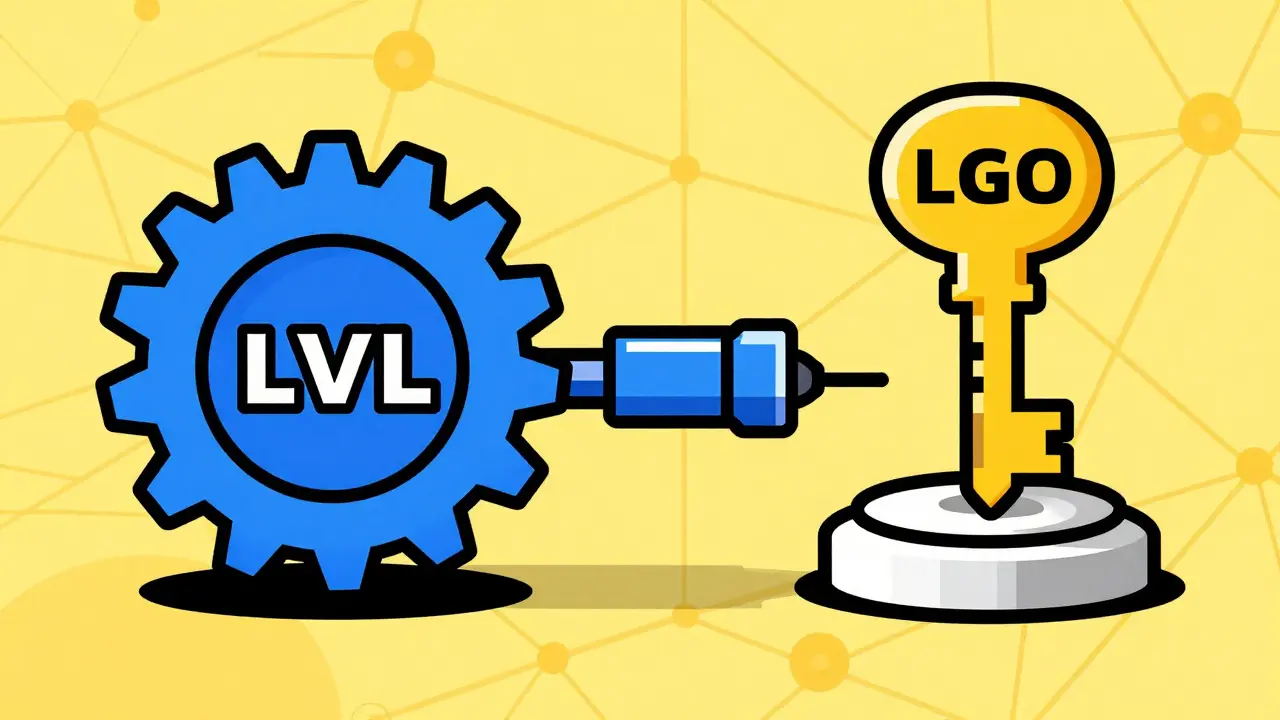
This is where things get interesting. Most DeFi protocols use a single token for everything. Level Finance uses two. Understanding the difference between LVL and LGO is critical if you want to participate effectively. LVL is the utility token. You use LVL to pay for fees, provide liquidity, and access basic platform functions. Think of it as the fuel that keeps the engine running. LGO is the governance token. You cannot buy LGO directly on the open market in the same way you buy Bitcoin. Instead, you earn LGO by staking your LVL tokens. This creates a hierarchical system that rewards long-term commitment. By requiring you to lock up LVL to get LGO, the protocol aligns incentives. People with skin in the game are more likely to vote responsibly and care about the platform’s health. Here is how the relationship works:
- Staking Requirement: You must stake LVL tokens to mint LGO.
- Governance Rights: Holding LGO gives you voting power in the LEVEL DAO.
- Treasury Access: LGO holders benefit from the revenue generated by the protocol.
How LGO Generates Value: The DAO Treasury
So, why would anyone want to stake their LVL to get LGO? The answer lies in the revenue-sharing model. Level Finance takes a cut of the trading fees and other protocol revenues. Instead of hoarding this cash or sending it to venture capitalists, 30% of all protocol revenue flows directly into the LEVEL DAO Treasury. These funds are held in the form of Senior LLP tokens. These tokens continue to generate yield over time. As the DAO Treasury grows, the value backing each LGO token increases. This creates a compounding effect for holders. You aren’t just hoping the token price goes up because of hype; you are holding a claim on a growing pool of real assets. The mechanism works like this:
- Traders pay fees on the platform.
- 30% of these fees go to the DAO Treasury.
- The Treasury accumulates value via Senior LLP yields.
- LGO holders can redeem their tokens for a share of this treasury.
| Feature | LVL (Utility) | LGO (Governance) |
|---|---|---|
| Purpose | Pay fees, provide liquidity | Voting rights, treasury access |
| Acquisition | Buy on exchanges or earn via trading | Minted by staking LVL |
| Revenue Share | No direct share | Yes, via DAO Treasury |
| Liquidity | High (tradable anytime) | Low (2-week redemption window) |
Risk Management and Liquidity Pools
One of the biggest challenges in decentralized perpetual exchanges is managing risk. If a trader gets liquidated, someone has to absorb the loss. In many older DeFi models, this falls unfairly on liquidity providers, wiping out their capital. Level Finance solves this with the Risk Management Liquidity Pool (RMLP). This system provides sophisticated tools for both traders and liquidity providers. For LPs, it offers granular control options that traditional Automated Market Makers (AMMs) don’t have. You can set specific parameters to protect your capital. For traders, this means better stability and deeper liquidity. The RMLP ensures that large trades can be executed with minimal slippage. This technical advantage is a major reason why institutional interest in Level Finance is growing. It bridges the gap between the safety of DeFi and the efficiency users expect from centralized platforms.
Omnichain Strategy and Arbitrum Integration
Speed and cost matter in trading. Ethereum mainnet is secure but often too slow and expensive for frequent trading. Level Finance addresses this by adopting an omnichain strategy, with a heavy focus on Arbitrum, a leading Ethereum Layer 2 scaling solution. By deploying on Arbitrum, Level Finance offers users faster transaction finality and significantly lower gas fees. This makes high-frequency trading viable in a decentralized environment. However, this multi-chain approach adds complexity. Users need to manage assets across different networks, which can be confusing for beginners. While the technology is robust, the user experience requires a bit more technical know-how than clicking "Buy" on a centralized app. Despite the learning curve, the benefits are clear. You get the security of Ethereum’s base layer with the performance of a Layer 2 network. As Arbitrum continues to gain adoption, Level Finance is well-positioned to capture traffic from users seeking cheaper alternatives to mainnet-based DEXs.

User Experience and Getting Started
Is Level Finance easy to use? It depends on your background. If you are a seasoned DeFi user, you will appreciate the transparency and control. Advanced traders love the ability to verify all protocol metrics independently. Liquidity providers praise the flexibility of the RMLP system and the passive income potential from LGO staking. However, newer users might find the steep learning curve challenging. You need to understand concepts like leverage ratios, liquidation prices, and the LVL-to-LGO staking process. The platform supports major wallets like Metamask, WalletConnect, and Ledger, which helps with accessibility. But connecting your wallet is only the first step. Managing your risk parameters effectively requires study. To get started, you typically follow these steps:
- Connect a compatible Web3 wallet.
- Acquire LVL tokens through trading or liquidity provision.
- Stake your LVL tokens to mint LGO.
- Participate in governance or wait for redemption windows to claim rewards.
Market Position and Future Outlook
As of mid-2026, Level Finance holds a unique spot in the perpetual DEX market. It ranks around #7455 by market cap, but raw numbers don’t tell the whole story. The platform is building infrastructure rather than chasing viral trends. Its focus on transparency and risk management aligns with broader regulatory trends that favor proof-of-reserves models. The collapse of centralized lenders in 2022 accelerated the shift toward non-custodial solutions. Level Finance is riding this wave. Its innovative approach to governance and revenue sharing makes it attractive to serious investors. However, success depends on execution. The team must continue improving the user interface to attract mainstream adoption while maintaining the technical rigor that advanced users demand. If you are considering LGO, remember that it is a long-term play. The value accrues through treasury growth and protocol usage, not just speculation. It rewards patience and participation. For those willing to engage deeply with the ecosystem, LGO offers a compelling blend of governance power and financial yield.
Can I buy LGO directly on a centralized exchange?
No, LGO is not typically traded directly on centralized exchanges like Binance or Coinbase. You must first acquire LVL tokens and then stake them within the Level Finance protocol to mint LGO. This design ensures that governance rights are tied to active participation and long-term commitment.
What happens to my LGO if I want to sell it?
You can redeem your LGO for a share of the DAO Treasury, but there is a two-week redemption window. This means you must initiate the redemption process and wait 14 days before receiving your assets. This mechanism helps stabilize the token supply and prevents rapid sell-offs.
How does Level Finance differ from GMX or dYdX?
Level Finance uses a unique dual-token system (LVL and LGO) that separates utility from governance, whereas many competitors use a single token. Additionally, Level Finance emphasizes a fully on-chain, non-custodial model with a custom-built Risk Management Liquidity Pool (RMLP), offering more granular control for liquidity providers compared to traditional AMM structures.
Is Level Finance safe to use?
Level Finance is non-custodial, meaning you retain control of your funds in your wallet until you trade. It uses Chainlink Oracles for secure price feeds and operates on audited smart contracts. However, all DeFi protocols carry inherent risks, including smart contract vulnerabilities and market volatility. Always do your own research and manage your leverage carefully.
Why does Level Finance use Arbitrum?
Arbitrum is an Ethereum Layer 2 scaling solution that offers faster transaction speeds and significantly lower gas fees than the Ethereum mainnet. By deploying on Arbitrum, Level Finance provides a more cost-effective and efficient trading experience, making it viable for high-frequency perpetual trading.