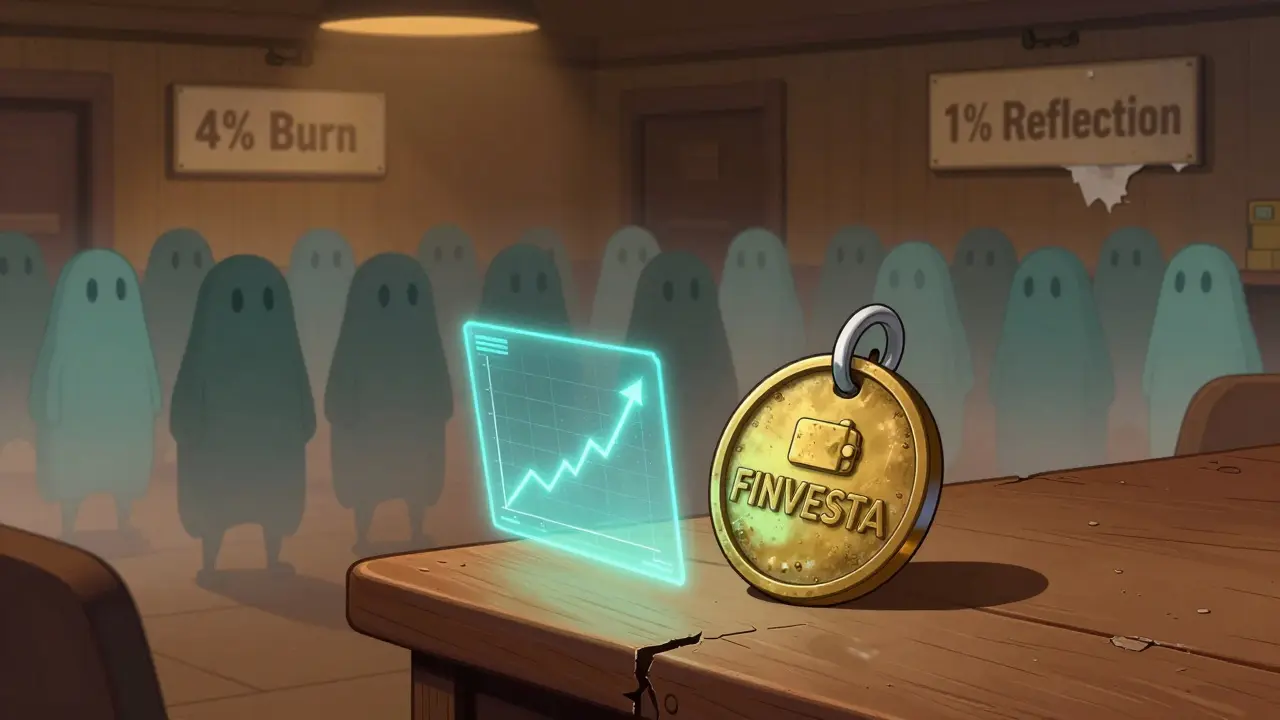
Finvesta (FINVESTA) isn't another Bitcoin or Ethereum. It's a tiny, high-risk cryptocurrency built entirely on the PulseChain blockchain. If you're wondering whether it's worth your time or money, the data tells a clear story: extreme volatility, almost no liquidity, and a project that's barely moving forward.
What exactly is Finvesta?
Finvesta (FINVESTA) is a PRC20 token on PulseChain - meaning it only works on that specific blockchain. It was launched with a simple pitch: make money by holding. Every time someone buys or sells FINVESTA, 4% of the transaction is burned forever, and 1% is automatically sent to everyone who already owns the token. That’s called a reflection. The idea is simple: as fewer tokens exist, each one should be worth more. And if you hold, you get paid just for sitting still.
But here’s the catch: this system only works if people are actively trading. And right now, they’re not.
The numbers don’t add up
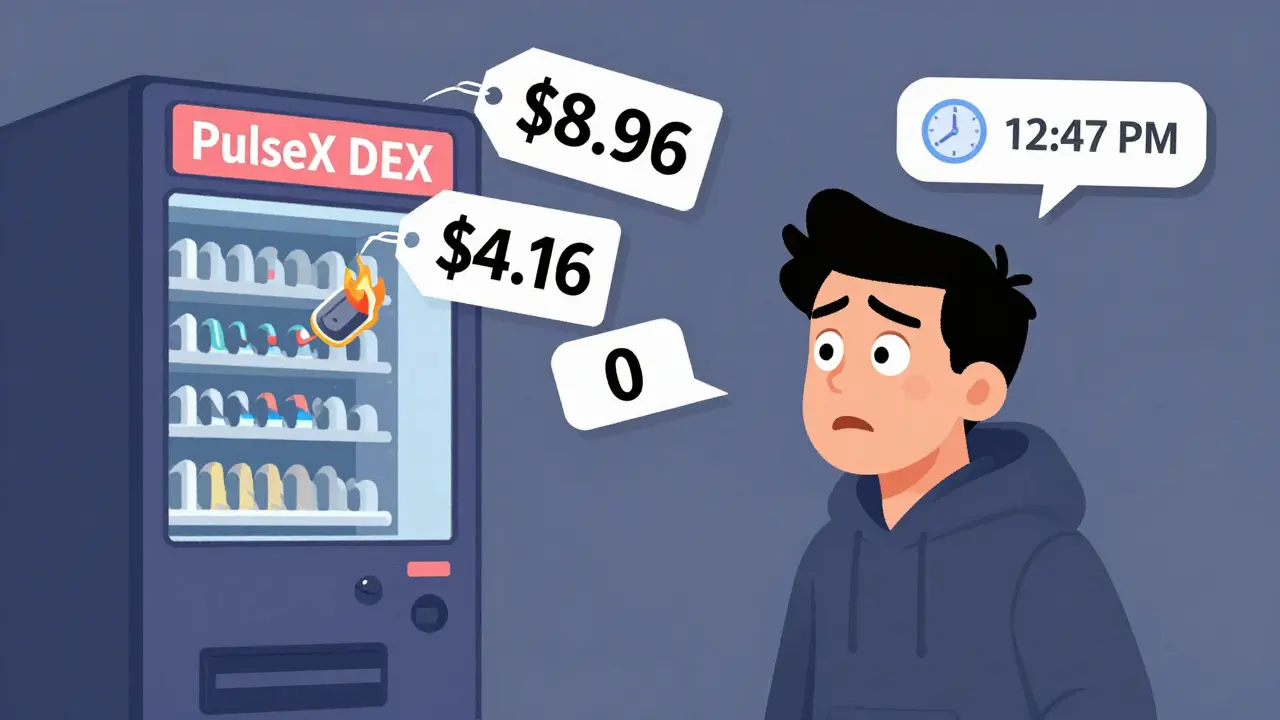
As of February 25, 2026, Finvesta’s price is a mess. CoinGecko shows it hovering between $8.96 and $10.24. CoinMarketCap says $4.16. Crypto.com lists $4.62. Binance doesn’t even list it. That’s not a glitch - that’s a red flag. When prices vary this wildly across platforms, it means there’s almost no real trading happening. Low volume = price manipulation waiting to happen.
Market cap? Same story. CoinGecko says $10.2 million. CoinMarketCap says $3.1 million. Binance says $0. That’s not a discrepancy - it’s a sign that nobody trusts the data. The circulating supply is around 1.09 million tokens out of a max supply of 21 million. But even that number is shaky. Some sources claim 1,000+ tokens are burned daily. Blockchain explorers show only 217 burned in a full day. That’s not a 90% error - it’s a lack of transparency.
Why does Finvesta keep falling?
Finvesta hit its all-time high of $89.41 on March 6, 2025. That’s over 88% higher than today’s price. In just five months, it lost nearly 90% of its value. That’s not a correction - it’s a collapse.
Compare that to the broader crypto market. In the same period, Bitcoin and Ethereum rose slightly. Even other meme coins like SHIB or DOGE held steady. Finvesta? It dropped 12.3% in just one week. That’s worse than the market - and worse than most tokens on its own blockchain.
Why? Because there’s no reason to buy it. No app. No game. No real-world use. Just a burn and reflection system that only works if volume surges - and volume has been dropping for months. Trading volume on PulseX, its main exchange, is under $7,000 a day. That’s less than what a single large investor might trade in one day on Coinbase.
Who’s holding it - and why?
Only 1,842 unique wallets own FINVESTA. Just 382 of them have moved it in the last 30 days. That’s not a community - that’s a ghost town.
Reddit threads are full of complaints. One user, 'PulseDeFiMaster,' said: 'Bought at $12.03, tried to sell 5 minutes later - price dropped to $8.40. Slippage is insane.' That’s not a bug. That’s what happens when 50 people are trying to trade a token with 100 buyers.
On the flip side, a few holders swear by the 1% reflection. One user, 'CryptoBurner88,' claimed to earn 500 tokens in reflections just from holding 50,000 FINVESTA. But here’s the thing: that only works if someone else is selling. And if no one is selling, the reflections dry up.
The technical nightmare
If you want to buy Finvesta, you need to do three things:
- Set up a PulseChain-compatible wallet (like MetaMask with custom RPC settings).
- Buy PulseChain’s native token (PLN) - usually by bridging Ethereum, which can take 7-14 days.
- Trade on PulseX, where every transaction costs you 5% in fees (4% burned, 1% reflected).
And even then, you’re not safe. Over 28% of trades fail because users don’t have enough gas. Trades under $500 often suffer 15%+ slippage. That means if you try to buy $100 worth, you might end up paying $115 because the price moves while your order processes.
There’s no customer support. No help desk. Just a Discord channel with 12 active users during European business hours. If you mess up your wallet, you’re on your own.
What’s the roadmap? Nothing.
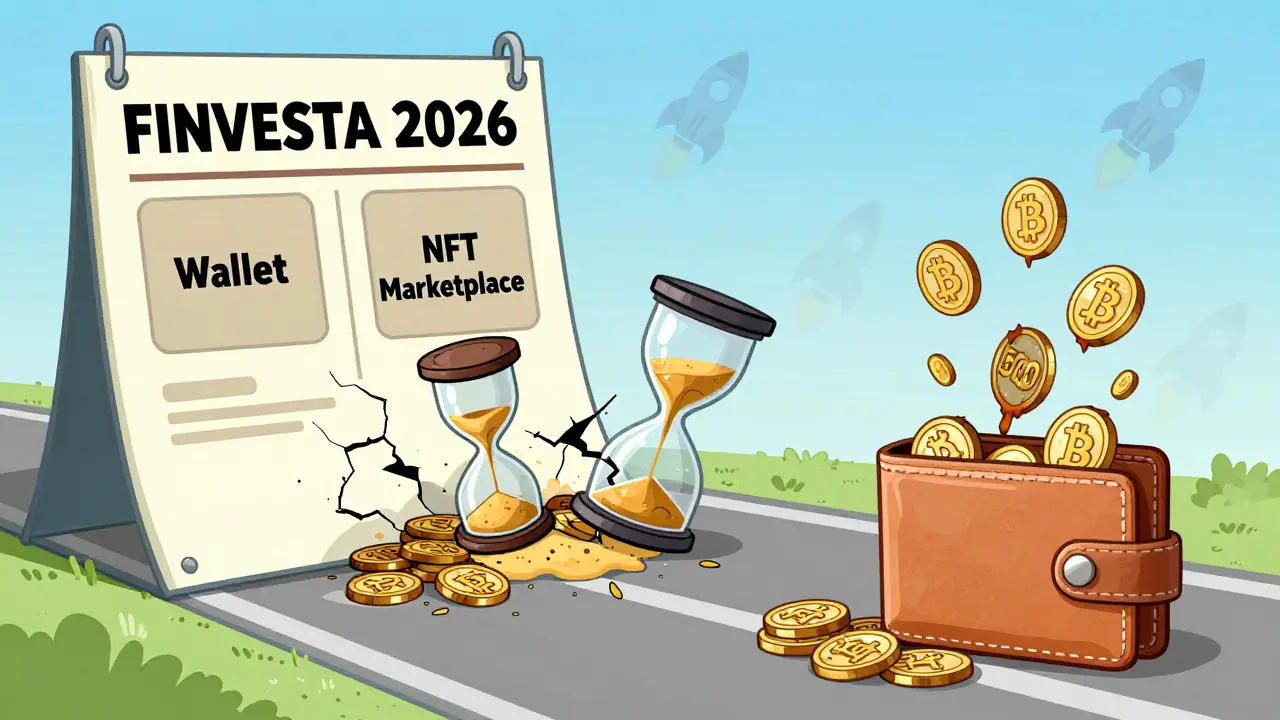
The Finvesta website (finvesta.eco) last updated its roadmap on November 17, 2025. It promised a FINVESTA wallet and an NFT marketplace by Q1 2026. It’s now February 2026. Neither exists. No code. No announcements. No updates.
Compare that to other PulseChain tokens. PulseChainFloki and PulseRabbit have active teams, regular updates, and real features. Finvesta? It’s just a token with a fancy burn formula and no follow-through.
Is Finvesta a good investment?
Some analysts say yes. CoinCodex predicts a 228% price jump by April 2026. They’re using historical patterns, not fundamentals. That’s like predicting a lottery winner based on last year’s numbers.
Real experts aren’t buying it. Maria Chen of CryptoSlate said: 'Tokens with single-chain presence, no utility, and inconsistent volume have a 92% failure rate within 18 months.' Finvesta fits that profile perfectly.
Here’s the truth: Finvesta isn’t a cryptocurrency. It’s a speculative bet on a dying meme. It has no utility, no team, no roadmap, and almost no users. The burn mechanism sounds smart - until you realize it’s only working because people are still selling into a dead market.
If you’re looking for a high-risk, high-reward play, you’re better off with tokens that have real traction. Finvesta? It’s a lottery ticket with no numbers.
Is Finvesta (FINVESTA) a real cryptocurrency?
Yes, but only technically. Finvesta is a PRC20 token on the PulseChain blockchain, which makes it a real cryptocurrency by definition. However, it lacks the key traits of a functional crypto asset: no utility, no real adoption, no exchange listings beyond one DEX, and no active development. It’s more of a speculative experiment than a serious project.
How does the 4% burn and 1% reflection work?
Every time someone trades FINVESTA - whether buying or selling - 4% of the total amount is permanently destroyed (burned), and 1% is distributed to all existing holders. For example, if you sell 1,000 FINVESTA, 40 tokens vanish forever, and 10 tokens are split among all wallets that own FINVESTA. The goal is to reduce supply over time (deflation) while rewarding long-term holders. But if no one is trading, the reflections stop, and the burn rate drops far below what’s claimed.
Why is Finvesta’s price so different on each exchange?
Because there’s almost no trading volume. With only $20,000-$50,000 traded daily across all platforms, even small buy or sell orders can swing the price dramatically. One exchange might show $4.16 because only a few people traded there. Another might show $12 because a single large wallet moved tokens. This inconsistency makes it impossible to know the real price - and dangerous to trade.
Can I buy Finvesta on Coinbase or Binance?
No. Finvesta is not listed on any major centralized exchange like Coinbase, Binance, or Kraken. The only place you can trade it is PulseX, a decentralized exchange on PulseChain. That means you need a compatible wallet, PLN tokens to pay for gas, and the technical know-how to bridge assets from Ethereum - which takes days. It’s not beginner-friendly.
Is Finvesta a scam?
It’s not labeled a scam, but it ticks every box for a high-risk, low-value project. There’s no team, no roadmap updates, no transparency on burns, and almost zero user activity. The project’s website hasn’t changed in months. Community sentiment on Reddit is 62% negative. While there’s no evidence of fraud, the lack of progress and transparency makes it a dangerous gamble - not an investment.
8 Comments
This Finvesta thing is a ghost town with a burn rate and a dream
4% burned? Cool. But if no one’s trading, you’re just burning air
1% reflection? Yeah, right - like the 382 people who moved tokens in 30 days are gonna send you free cash
I bought 10k at $12 and now I’m holding a digital napkin with a fancy contract
The liquidity vacuum here is insane. $7k/day on PulseX? That’s not a DEX, that’s a garage sale
Price discrepancies across platforms aren’t bugs - they’re symptoms of zero market depth
Also, the fact that Binance doesn’t list it says more than any whitepaper ever could
I get why people are drawn to the reflection model - it feels like passive income 🤍
But you can’t eat reflections. You can’t pay bills with burned tokens.
It’s like getting a thank-you note every time someone else loses money
I held for 3 months, earned 200 tokens in reflections, and still lost $800 on the entry price
Maybe next time I’ll just buy a lottery ticket and skip the blockchain drama 😅
I think the real tragedy here is how much hope people put into projects like this
It’s not about the numbers - it’s about the story they want to believe
‘If I just hold, I’ll be rich’ - sounds like a fairy tale wrapped in smart contract code
And honestly? I kinda get it. We all want to believe in something that rewards patience
But sometimes, the kindest thing you can do is walk away 🌿
I read the whole thing and still feel like I need to sit with it
It’s not that Finvesta is evil - it’s just… absent
No team, no updates, no voice
It’s like a house with all the right furniture but no one living in it
I’m not mad at the people who bought it
I’m just sad they believed it had a future
The structural deficiencies of Finvesta are unequivocally apparent. The absence of centralized exchange listings, coupled with demonstrably negligible daily trading volume, renders the token functionally inert. Furthermore, the ostensible deflationary mechanism is contingent upon active market participation - a condition demonstrably unmet. The variance in pricing across aggregators is not an anomaly; it is a consequence of market fragmentation and illiquidity. One cannot reasonably regard this as an investment vehicle. It is, in its current state, a speculative artifact.
yall actin like this is a scam when its just how crypto works
you think bitcoin was always worth somethin? nah
you think ethereum had devs in 2015? lol
finvesta aint dead - its just sleepin
the burn is real the refl is real
you just too weak to hold
if u dont get it u a noob
im holding 200k and im waitin for the pump
its comin trust me
I appreciate the detailed breakdown - it’s rare to see someone lay out the cold facts without hype
But I’ll say this: I’ve seen this movie before. A token with a clever mechanism, zero utility, and a community that refuses to admit it’s over
What I find more interesting than the price is the psychology behind it
People don’t just invest in tokens - they invest in the idea that this time, it’ll be different
And maybe… just maybe… that’s the most dangerous part
Because if you believe hard enough, you can convince yourself the ghost is real
But eventually, the lights go out - and the reflection stops
Keep holding if you need to. But don’t pretend you’re building something - you’re just waiting for someone else to pay you for your hope