
Imagine a computer that thinks like a human brain but solves problems faster than a supercomputer. That’s the core promise of Dynex. It isn’t just another cryptocurrency trying to replace Visa or store value in a digital vault. Dynex is a decentralized supercomputing network designed to tackle complex mathematical and scientific problems using neuromorphic quantum computing principles. If you’ve ever wondered how blockchain can actually help cure diseases or optimize flight paths instead of just moving money around, this is where it gets interesting.
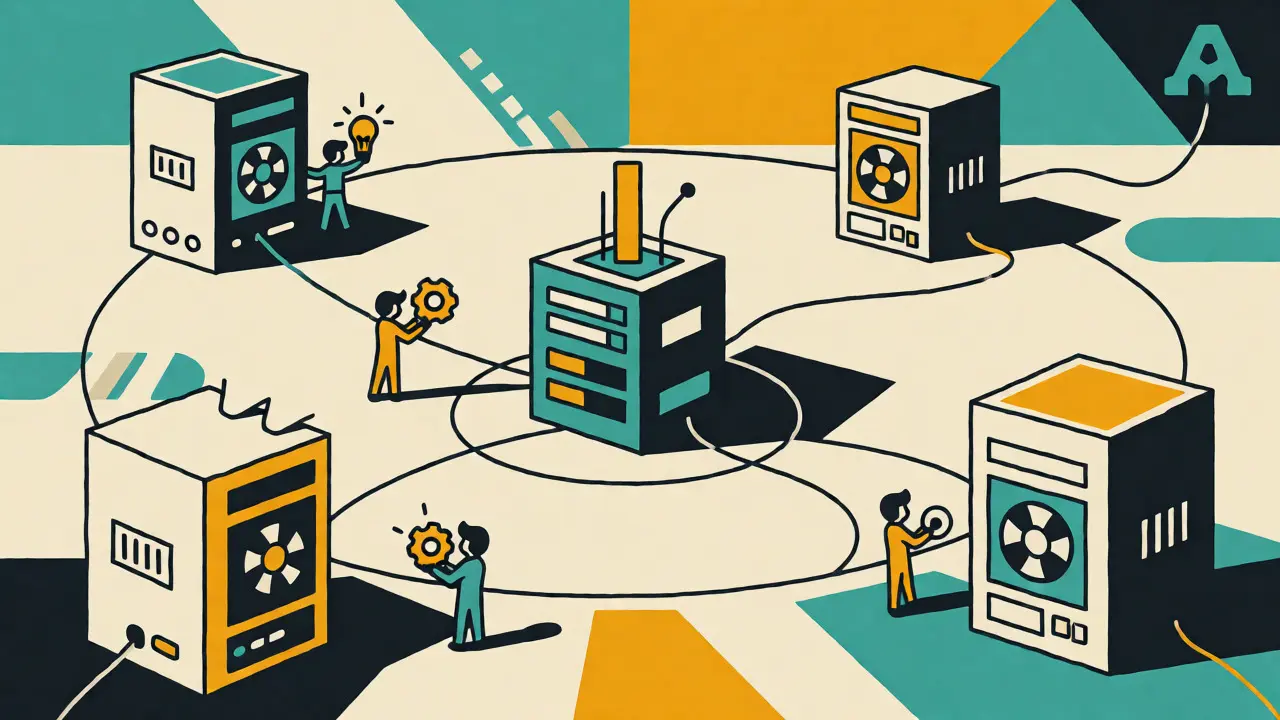
The project launched in September 2022 with a specific mission: to make high-performance computing accessible without requiring billions of dollars in infrastructure. Traditional quantum computers are massive, expensive, and hard to maintain. Dynex flips that model by using thousands of ordinary GPUs connected via blockchain to create a "digital twin" of a quantum computer. This approach aims to solve real-world problems at scale, leveraging effects like quantum entanglement and tunneling through its proprietary algorithm, DynexSolve.
How Dynex Works: Beyond Standard Mining
Most cryptocurrencies use Proof-of-Work (PoW), which burns energy to secure the network but often does little else useful. Dynex uses Proof-of-Useful-Work (PoUW). Unlike standard mining, where your GPU solves random hash puzzles, PoUW miners contribute computational power to solve actual scientific and AI-related tasks. Think of it as renting out your gaming PC’s spare horsepower to researchers who need it for drug discovery or financial modeling.
This mechanism creates a dual-sided marketplace. On one side, miners earn DNX tokens by providing their hardware resources. On the other side, AI professionals, researchers, and enterprises pay for access to this decentralized supercomputer. The network ensures security and integrity while ensuring every watt of electricity spent has utility beyond simple block validation. It’s a clever way to align incentives: miners get paid for doing work that matters, and users get affordable access to enterprise-grade computing.
The Technology Stack: PyTorch, TensorFlow, and Qiskit
One of the biggest hurdles for new tech platforms is adoption friction. If developers have to learn a brand-new coding language, they won’t bother. Dynex avoids this trap by maintaining compatibility with the industry standards everyone already uses. The platform integrates directly with PyTorch, Google TensorFlow, and IBM Qiskit.
This means data scientists can implement AI models on the Dynex network without rewriting their entire codebase. They can run machine learning tasks or quantum simulations using tools they’re already familiar with. This interoperability is crucial because it lowers the barrier to entry for businesses wanting to experiment with neuromorphic computing. You don’t need a PhD in quantum physics to start using the network; you just need to know how to write Python code.
Real-World Applications: Who Needs Dynex?
Why would anyone care about neuromorphic computing? Because traditional computers struggle with certain types of optimization problems. Dynex targets sectors where speed and efficiency translate directly into profit or saved lives.
- Pharmaceuticals: Accelerating drug discovery by simulating molecular interactions much faster than current methods allow.
- Aerospace & Automotive: Improving vehicle and aircraft design through complex aerodynamic simulations.
- Financial Services: Managing risk and optimizing trading algorithms in real-time.
- Telecommunications: Enhancing network efficiency and signal processing.
- Scientific Research: Advancing climate modeling and materials science.
For example, a pharmaceutical company might use Dynex to simulate how a new molecule binds to a protein target. Instead of waiting weeks for results from a centralized cloud provider, they could tap into the decentralized network for potentially faster and cheaper computations. This diversification across multiple high-value industries reduces the risk of relying on a single sector for growth.

Tokenomics: Supply, Price, and Market Reality
Let’s look at the numbers. As of early 2026, DNX trades at approximately $0.03217 per token. The total supply is capped at 110 million tokens, with roughly 103.8 million currently in circulation. This scarcity is designed to support long-term value, but market sentiment plays a huge role.
The token has seen significant volatility. It hit an all-time high of $1.23 in March 2024 but dropped to lows near $0.002 earlier that year. By December 2025, it had recovered slightly but remained far below its peak. The market capitalization sits around $2.74 million, ranking it as a micro-cap asset. Trading volume is modest, with CoinEx being the most popular exchange for DNX/USDT pairs, followed by MEXC and Gate.io.
| Metric | Value / Detail |
|---|---|
| Current Price | ~$0.032 USD |
| Market Cap | ~$2.74 Million |
| Total Supply | 103,824,541 DNX |
| Max Supply | 110,000,000 DNX |
| Consensus Mechanism | Proof-of-Useful-Work (PoUW) |
| Primary Exchanges | CoinEx, MEXC, Gate.io |
The fully diluted valuation (FDV) assumes all 110 million tokens are circulating, which helps investors understand the maximum potential market size. However, the emission schedule means not all tokens are available yet. This gradual release can impact price dynamics over time, as new supply enters the market alongside demand fluctuations.
Investment Risks and Future Outlook
Is Dynex a good investment? That depends on your risk tolerance and belief in the convergence of AI and blockchain. The project is still in its early stages. While the technology promises revolutionary capabilities, commercial adoption takes time. Many competitors exist in the DePIN (Decentralized Physical Infrastructure Network) space, such as Render or Akash, though none focus specifically on neuromorphic quantum computing.
Key catalysts for future growth include expanded partnerships with major AI firms, increased miner participation, and successful case studies in healthcare or finance. Conversely, risks include technical delays, competition from centralized cloud providers, and broader crypto market downturns. The recent price decline reflects market skepticism rather than fundamental failure, suggesting that the project needs more visible utility demonstrations to regain investor confidence.
If you’re considering buying DNX, treat it as a speculative bet on emerging tech. Don’t put in money you can’t afford to lose. Watch for updates on enterprise contracts and user activity metrics, not just social media hype. The team continues to develop the infrastructure, but the proof will be in whether researchers actually choose Dynex over AWS or Azure for their heavy lifting.
What makes Dynex different from Bitcoin?
Bitcoin uses Proof-of-Work primarily for security and consensus, burning energy to validate transactions. Dynex uses Proof-of-Useful-Work, where the energy spent solves real-world computational problems like AI training or scientific simulations. Additionally, Bitcoin is a currency/store of value, while Dynex is a utility token for accessing a decentralized supercomputing network.
Can I mine Dynex with my home PC?
Yes, Dynex is designed to be mined using consumer-grade GPUs. You don't need specialized ASIC hardware. As long as you have a decent graphics card, you can participate in the network and earn DNX rewards by contributing computational power to solve useful tasks.
Where can I buy DNX tokens?
DNX is listed on several exchanges, with CoinEx being the most active venue for trading. Other options include MEXC and Gate.io. You can typically buy DNX using USDT or other stablecoins via spot trading.
Is Dynex a quantum computer?
Not exactly. Dynex is a neuromorphic computing platform that uses quantum-inspired algorithms (like quantum entanglement and tunneling) to solve problems efficiently. It doesn't require physical qubits like traditional quantum computers. Instead, it simulates these effects on classical hardware distributed across a blockchain network.
What is the max supply of DNX?
The maximum supply of DNX is capped at 110 million tokens. This fixed supply helps prevent inflationary pressure on the token's value over the long term, assuming demand for the network's services grows.