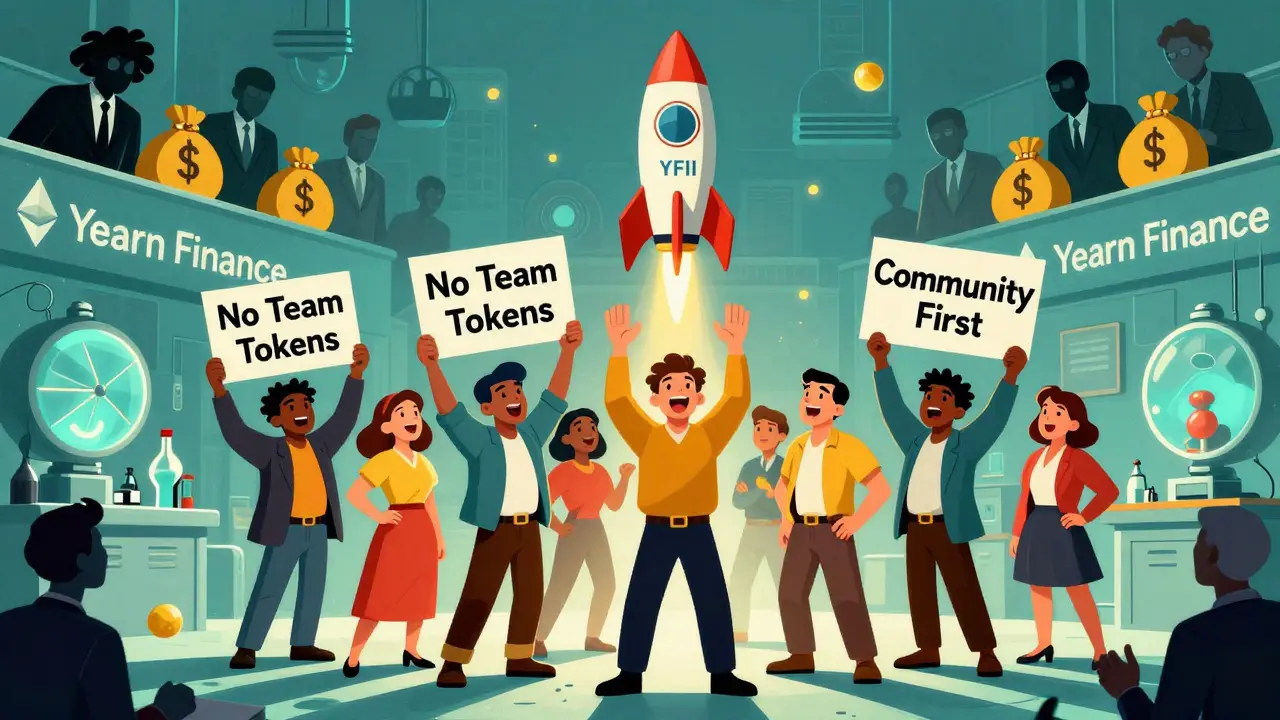
DFI.Money (YFII) isn't just another cryptocurrency. It was born out of a fight inside one of the most influential DeFi projects ever - Yearn Finance. When big holders blocked changes that the community wanted, a group of users didn't just complain. They built something better. DFI.Money is the result: a decentralized yield optimizer that runs on Ethereum, has no team tokens, and lets its users vote on everything. If you've ever wondered why someone would care about a coin with a price that crashed 99% from its peak, this is why.
How DFI.Money Started - The Yearn Finance Split
In July 2020, Yearn Finance was one of the hottest names in DeFi. Its automated yield farming vaults let users earn high returns without lifting a finger. But not everyone was happy. A proposal called YIP-8 aimed to change how liquidity was distributed across protocols. It would have made the system fairer, more transparent, and less dominated by large wallets. The problem? The biggest YFI token holders voted it down. They had too much power. So, a group of community members forked the code and launched DFI.Money - with one rule: no one gets special treatment. No pre-mined tokens. No team allocations. No venture capital backing. Every single YFII token was distributed to users who participated from day one.
What Is YFII? The Token Behind the Platform
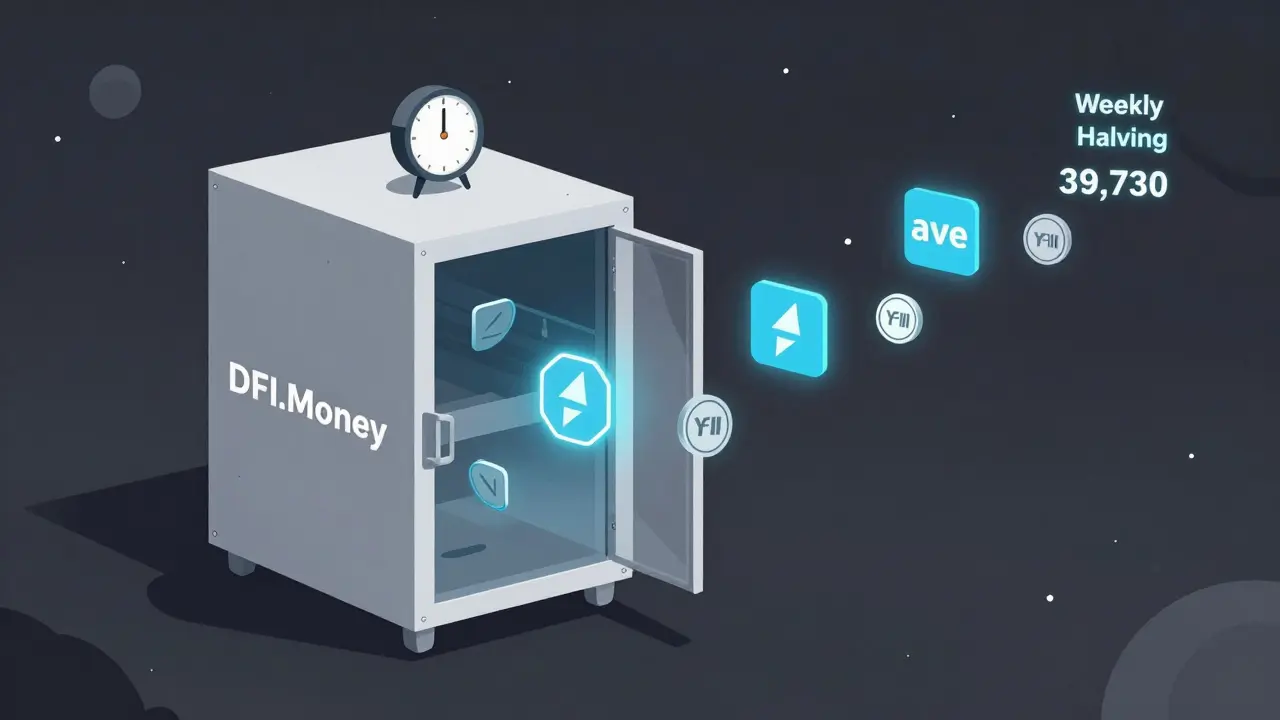
YFII is the native token of DFI.Money. Unlike most tokens that flood the market at launch, YFII has a hard cap: 40,000 tokens total. As of now, about 39,732 are in circulation. That’s almost the full supply. The token supply doesn’t just stay static - it shrinks. Every week, new token emissions are cut in half. This is called a weekly halving. It’s rare in DeFi. Most projects print more tokens forever. DFI.Money does the opposite. It’s designed to get scarcer over time.
YFII isn’t just a store of value. It’s your voting power. Holders can propose changes, vote on which yield strategies the platform should use, and even decide if a new blockchain should be added. There are no developers getting paid from the treasury. No salaries. No bonuses. The whole system runs on community votes. If you’re tired of DeFi projects where the team holds 20% of the supply and controls everything, this is the opposite.
How DFI.Money Makes Money for Users
DFI.Money doesn’t trade crypto for you. It doesn’t lend or borrow. It does something smarter: it finds the best yield automatically. Imagine you have 10 ETH. You could manually check 15 different DeFi protocols every day to see where the highest returns are. You’d need to track interest rates, gas fees, impermanent loss, and liquidity risks. Most people don’t have time for that. DFI.Money does it for you.
The platform uses smart contracts called vaults to move your funds between protocols like Aave, Compound, Curve, and others - all in real time. If one protocol’s yield drops, the system shifts your money to another that’s paying more. It finds arbitrage opportunities, exploits temporary imbalances, and reacts faster than any human could. The goal isn’t to be the biggest platform - it’s to be the most efficient. As of March 2026, the total value locked (TVL) in DFI.Money vaults is around $356,859. That’s small compared to giants like Aave or Uniswap, but it’s active, stable, and growing.
Why It’s Different - No Team, No Pre-Sale, No Central Control
Most DeFi projects start with a team that takes a big chunk of tokens upfront. They use that to fund development, pay salaries, or sell later. DFI.Money does none of that. There was no ICO. No private sale. No venture capital. No developer wallet. Every token went to early users who provided liquidity or participated in governance. This isn’t marketing. It’s coded into the protocol. The smart contracts don’t allow for any allocations outside of community-driven distribution. That’s why YFII holders feel ownership. They’re not investing in a company - they’re running a decentralized organization.
This design has consequences. It’s slower to update. It doesn’t have a marketing budget. It doesn’t have a CEO giving interviews. But it also can’t be shut down. No single entity controls it. No regulator can force it to freeze accounts. It’s as decentralized as code can make it.
Price History - From $9,250 to $40
YFII’s price tells a wild story. In September 2020, it hit an all-time high of $9,251.70. That was during the DeFi summer boom, when everyone was chasing yield. But as the market cooled, YFII dropped hard. By June 2025, it hit a low of $56.90 - a 99% drop from its peak. Many wrote it off.
But something changed in late 2025. The price started climbing. By March 2026, it was trading between $40.51 and $40.58. Over the past 30 days, it gained 48.7%. Over a year, it’s up 68.5%. Why? Two reasons. First, the deflationary model is finally working - fewer tokens in circulation means scarcity kicks in. Second, more people are rediscovering DFI.Money’s pure community model. In a world full of tokenized startups with VC backers, a no-team, no-premine, self-governing protocol looks like a breath of fresh air.
Where You Can Use YFII Today
YFII isn’t a payment coin. You won’t find it at your local coffee shop. But it has real utility:
- Yield farming - Deposit stablecoins or ETH into DFI.Money vaults and earn automated returns.
- Governance - Vote on proposals to change how the platform operates.
- Liquidity provision - Add YFII to liquidity pools on decentralized exchanges like Uniswap or SushiSwap to earn trading fees.
- Multi-chain access - DFI.Money now supports Ethereum, Polygon, and Arbitrum. You can optimize yields across multiple networks without switching wallets.
The platform’s interface is simple. You connect your wallet, pick a vault, deposit, and walk away. The system handles the rest. No need to learn how to use Aave or Curve. DFI.Money does it for you.
Is DFI.Money Worth Your Time?
If you’re looking for a coin to flip for quick profits, YFII isn’t it. Its trading volume is low - around $211,281 in 24 hours - so large moves are risky. But if you believe in decentralized governance, community ownership, and deflationary tokenomics, then DFI.Money is one of the purest examples left in crypto.
It’s not the biggest DeFi project. It doesn’t have a flashy website or a celebrity ambassador. But it’s honest. It was built by users, for users. And in a space full of hype, that’s rare.
Is DFI.Money (YFII) a good investment?
There’s no guaranteed return. YFII is a high-risk, high-volatility asset. Its price has dropped over 99% from its peak and still trades at low volume. But if you believe in community-run DeFi and deflationary token models, it’s one of the few projects where users truly control the future. It’s not for traders - it’s for believers in decentralization.
How is YFII different from YFI?
YFI is the original Yearn Finance token. YFII is its fork. The big difference? Governance. YFI’s largest holders blocked changes that the community wanted. YFII was created to fix that - with no team allocations, no pre-mined tokens, and full community control. Functionally, both platforms do similar yield optimization. But philosophically, YFII is more aligned with true decentralization.
Can I earn passive income with YFII?
Yes, but not by holding it. You earn by depositing assets into DFI.Money vaults (like ETH or USDC) and letting the platform auto-farm yields. YFII itself doesn’t pay staking rewards. But if you provide liquidity for YFII on a DEX like Uniswap, you can earn trading fees in return.
Why does YFII have a weekly halving?
The weekly halving reduces the number of new YFII tokens created over time. It started with 40,000 total supply and gradually reduces emissions until they stop. This makes YFII scarcer, which can increase value if demand stays steady or grows. It’s a deflationary model - the opposite of most cryptocurrencies that keep printing.
Is DFI.Money safe to use?
Like all DeFi platforms, it carries risk. The smart contracts have been audited and have operated without major exploits since 2020. But you’re still exposed to smart contract bugs, market volatility, and impermanent loss if you provide liquidity. Never invest more than you can afford to lose. Use only trusted wallets like MetaMask, and double-check contract addresses.
5 Comments
YFII is the only DeFi project that didn’t sell its soul for VC cash. Most of these 'decentralized' platforms are just LLCs with a blockchain skin. DFI.Money? No team wallet. No premine. No promises. Just code and a bunch of pissed-off YFI users who said 'fuck you' to the oligarchs. I don’t care if it’s at $40 - I’d rather hold this than 99% of the shitcoins with 20% allocated to 'founders'.
And yes, the weekly halving is genius. It’s like Bitcoin with a caffeine shot. Supply shrinks. Demand? It’s coming. Slowly. But it’s coming.
You know, in India, we have a saying: 'Jab tak jalti hai diya, tab tak koi nahi sojata' - as long as the lamp burns, no one sleeps. YFII is that lamp - flickering, dim, but still burning. People laugh at its price, call it dead, but they forget: decentralization isn’t a sprint; it’s a 100-year marathon run by ghosts.
There’s no CEO. No marketing team. No influencer post. Just a smart contract that says: 'You’re in charge.' And somehow… that’s enough. In a world where every coin has a VC whispering in its ear, this is the last whisper of true autonomy.
I’ve been tracking DFI.Money since 2021. The TVL is small, sure - but look at the stability. No rug pulls. No sudden dev dumps. No shady tokenomics. The vaults have been running without a hiccup for years. That’s more than you can say for half the DeFi projects out there.
And the governance? It’s clunky, slow, sometimes frustrating - but it works. Real people vote on real changes. No one gets paid. No one gets special treatment. That’s not just rare - it’s revolutionary.
I used to think YFII was a relic - a dead horse everyone rode once and forgot. But then I looked at what’s happening in crypto now. Every new project is trying to copy the YFI model… but they all end up with team allocations, private sales, and VC handshakes.
YFII is the anti-thesis. It’s not trying to be big. It’s trying to be pure. And in a world where 'decentralized' is just a marketing buzzword, purity matters. The price isn’t the story. The story is that 40,000 tokens were never owned by anyone who didn’t earn them. That’s poetry in code.
The weekly halving mechanism is an elegant implementation of hyper-deflationary tokenomics. Unlike inflationary models where emission schedules are arbitrarily extended, YFII’s emission decay follows a geometric progression with a fixed halving interval - effectively approaching asymptotic supply convergence. This creates a predictable scarcity curve that aligns with Nash equilibrium principles in economic game theory.
Combined with non-custodial governance via ERC-20 weighted voting, the protocol achieves a Pareto-optimal distribution of control. The low liquidity is a feature, not a bug - it minimizes speculative arbitrage and incentivizes long-term stakeholder alignment.