
Blockchain doesn't work because it’s decentralized. It works because it’s encrypted. Without cryptographic encryption, blockchain would be just a shared spreadsheet - easy to edit, easy to fake, easy to break. But with cryptography, every transaction becomes a locked box, every block a sealed chain, and every user a sole keeper of a digital key. This isn’t science fiction. It’s what keeps your Bitcoin safe, your Ethereum transfers verified, and your smart contracts trustworthy.
How Cryptographic Encryption Makes Blockchain Secure
Cryptographic encryption in blockchain isn’t one trick - it’s three core tools working together: hash functions, asymmetric cryptography (public and private keys), and digital signatures. Each plays a different role, but they all combine to create something nearly impossible to tamper with.
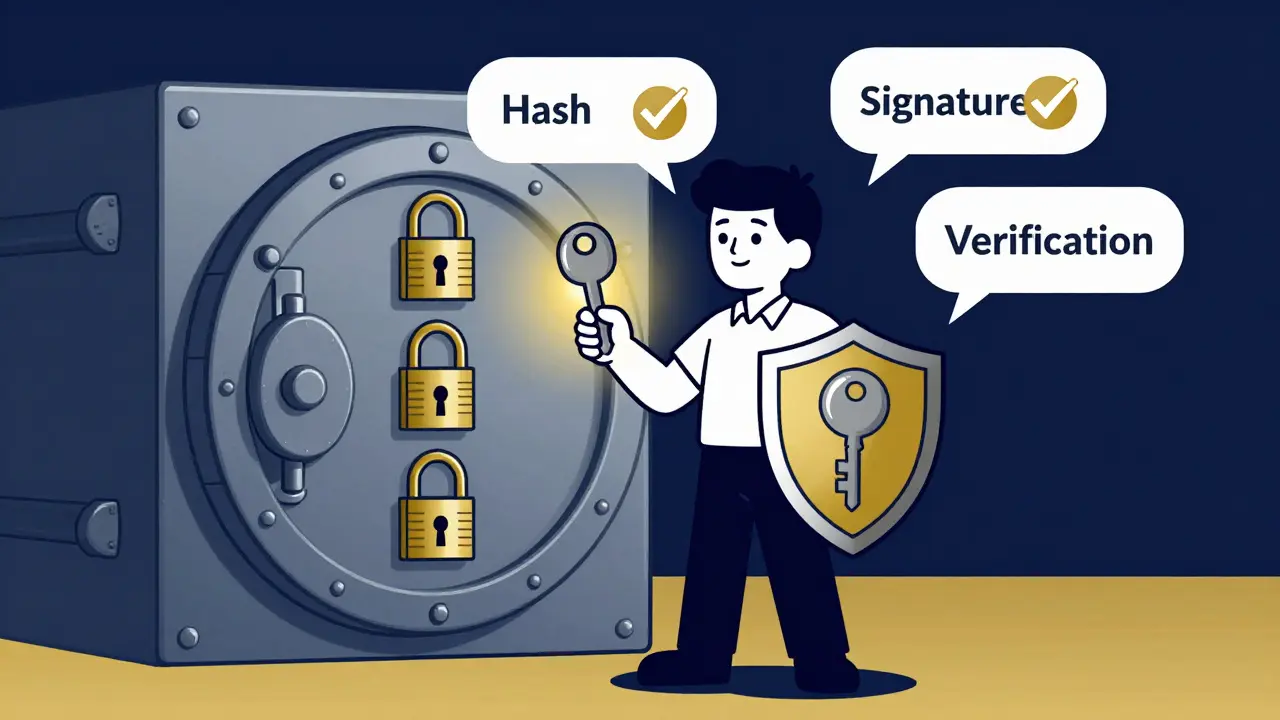
Think of it like a vault with three locks. One lock seals the contents so no one can change them. Another lock lets you prove you own the vault. The third lock lets others verify that you’re the only one who can open it - without ever seeing your key. That’s blockchain encryption in plain terms.
Hash Functions: The Immutable Seal
Every block in a blockchain contains a unique fingerprint - a hash. This isn’t just a number. It’s a fixed-length string of characters generated by a mathematical function from the block’s data. Bitcoin uses SHA-256, a hash function that turns any input - whether it’s a single word or a megabyte of data - into a 64-character string.
Here’s the magic: change even one letter in the data, and the hash changes completely. If you alter a transaction amount from 0.5 BTC to 0.6 BTC, the hash of that block becomes totally different. And because each new block includes the hash of the one before it, changing one block means you’d have to recalculate every single block after it. On a live blockchain with thousands of nodes, that’s computationally impossible.
This is immutability. Once a block is added, it’s locked in. No admin can delete it. No hacker can edit it. Not because of permissions - because of math.
Asymmetric Cryptography: Public Keys, Private Keys
Who owns a Bitcoin? Not a name. Not an account. A private key.
Every user on a blockchain has two keys: a public key and a private key. Your public key is like your bank account number - you can share it freely. Anyone can send funds to it. Your private key is like the password to that account. If someone gets it, they control your assets. It must stay secret.
This system is called asymmetric cryptography. Unlike symmetric encryption (where the same key encrypts and decrypts), here, one key locks, the other unlocks. Your public key can verify a signature made with your private key - but it can’t create one. That’s how transactions work.
You want to send 1 BTC? You sign the transaction with your private key. The network doesn’t need to know your key. It just checks: does this signature match the public key linked to the sender? If yes, the transaction is valid. No middleman. No bank. Just math.
Digital Signatures: Proof Without Identity
A digital signature isn’t a scanned name. It’s a cryptographic proof that you authorized something. When you sign a transaction, your private key runs a math operation on the transaction data. The result is a unique signature - a string that only your key could have produced.
Anyone can take that signature, your public key, and the transaction details, and run a verification algorithm. If they match, the system knows: this transaction came from you. And because the signature is tied to the exact data (amount, recipient, timestamp), no one can change the details after signing. Tampering breaks the signature.
This is why blockchain transactions are non-repudiable. You can’t say, “I didn’t send that.” If the signature checks out, you did. And the network records it forever.
Why Blockchain Encryption Is Different From Traditional Systems
Traditional databases - like your bank’s server or a cloud storage system - rely on passwords, firewalls, and access controls. If someone hacks the central server, they can change records, delete logs, or steal data.
Blockchain flips that. There’s no central server. Data is copied across hundreds or thousands of computers. And every piece of data is cryptographically sealed. To alter one transaction, you’d need to:
- Change the block containing that transaction
- Recalculate its hash
- Change the hash stored in the next block
- Recalculate every subsequent block’s hash
- And do all this faster than the network adds new blocks
That’s not just hard. It’s practically impossible on major blockchains like Bitcoin or Ethereum. That’s the power of combining hashing with decentralization.
Where Blockchain Encryption Falls Short
Just because it’s secure doesn’t mean it’s foolproof. The encryption itself is solid. But humans? They’re the weak link.
Most crypto thefts don’t happen because SHA-256 was cracked. They happen because someone:
- Lost their private key
- Stored it on an unsecured phone
- Clicked a phishing link and gave it away
- Used a weak password for their wallet
There’s also the quantum threat. Current public-key cryptography (like ECC and RSA) relies on math problems that classical computers can’t solve quickly. But quantum computers could. If a powerful enough quantum machine is built, it could reverse-engineer public keys to find private keys.
That’s why researchers are already working on quantum-resistant algorithms - like lattice-based cryptography and hash-based signatures. Ethereum and other networks are testing these for future upgrades.
Smart contracts are another risk. They run on blockchain, but if the code has a bug, attackers can exploit it. Encryption secures the chain - but not the logic built on top of it. A poorly written contract can leak funds even if the blockchain itself is untouched.
What Tools Do Developers Use?
If you’re building on blockchain, you don’t write encryption from scratch. You use battle-tested libraries:
- OpenSSL - for hashing and key generation
- Libsodium - a modern, easy-to-use crypto library
- Ethereum’s Web3.js - handles signing transactions in JavaScript
- Bitcoin Core - implements SHA-256 and ECDSA for Bitcoin transactions
These tools handle the heavy lifting. But developers still need to understand how they work. Using a library without knowing how keys are stored or how signatures are verified is like driving a car without knowing how brakes work.
Best Practices for Keeping Your Keys Safe
If you own crypto, your private key is your most important asset. Treat it like a physical will or a bank vault combination.
- Use a hardware wallet - devices like Ledger or Trezor store keys offline, away from hackers.
- Enable multi-signature - require 2 or 3 keys to move funds. Even if one is stolen, the money stays safe.
- Never store keys online - not in emails, cloud drives, or notes apps.
- Write down your recovery phrase - and keep it in a fireproof, waterproof place.
- Test small transfers first - before sending large amounts, send a tiny amount to verify the address and signature work.
Most crypto losses aren’t from broken encryption. They’re from poor habits. The math is strong. You have to be too.
The Future of Blockchain Encryption
Cryptography in blockchain isn’t static. It’s evolving.
Zero-knowledge proofs (ZKPs) are one of the biggest advances. They let you prove you know something - like a private key or a transaction amount - without revealing it. ZKPs are already used in privacy coins like Zcash and are being integrated into Ethereum to improve scalability and privacy.
Other innovations include:
- Threshold signatures - splitting private keys across multiple devices
- Post-quantum cryptography - algorithms designed to resist quantum attacks
- Decentralized identity - using blockchain to manage digital IDs without central authorities
As blockchain moves beyond crypto into supply chains, voting, and healthcare, encryption will become even more critical. The same principles that protect Bitcoin today will protect medical records, land titles, and voting data tomorrow.
What is the main purpose of cryptographic encryption in blockchain?
The main purpose is to ensure data integrity, prevent tampering, verify ownership, and secure transactions without needing a central authority. It makes blockchain immutable, verifiable, and trustless.
Does blockchain encrypt all data?
Not always. Most public blockchains like Bitcoin and Ethereum store transaction data in plain text - but they secure it with hashing and digital signatures. Privacy-focused blockchains (like Monero or Zcash) use encryption to hide transaction details, but that’s not the default.
Can blockchain be hacked through encryption?
The cryptographic algorithms themselves (SHA-256, ECDSA) haven’t been broken. But attacks happen through weak key management, flawed smart contracts, or social engineering - not by cracking the math.
What role does hashing play in blockchain?
Hashing creates a unique fingerprint for each block. It links blocks together, so any change to one block breaks the chain. This makes tampering detectable and practically impossible on large networks.
Is blockchain encryption quantum-resistant?
SHA-256 hashing is considered quantum-resistant. But public-key systems like ECDSA (used for digital signatures) are vulnerable to quantum attacks. Upgrades to quantum-safe algorithms are already in development.
Cryptographic encryption is the reason blockchain exists. It’s not just a feature - it’s the foundation. Without it, there’s no trust. No transparency. No decentralization. Just noise. With it, you get a system that can survive without a single authority - because the math itself enforces the rules.
5 Comments
This post nails it. Cryptography isn't just a layer-it's the spine. I've seen so many people think blockchain is about decentralization like it's some magic democracy. Nah. It's math enforcing trust. If you don't get hash chains and asymmetric keys, you're just playing with digital play money. And yes, quantum threats are real. We're not ready, and most retail users have no clue. Time to wake up.
The part about private keys being the weak link is the only truth here. Everything else is textbook fluff. People treat crypto like a bank account but store keys on iCloud. That’s not a system failure-it’s a personality flaw.
Love how this breaks it down so clearly. Seriously, if you're new to blockchain, read this twice. I remember when I first heard 'hash function' and thought it was a type of coffee. But once I got how SHA-256 locks each block like a chain link-boom-it clicked. And yeah, hardware wallets? Non-negotiable. Got mine last year and finally slept through the night. You got this.
What about threshold signatures? That’s where the real future is. Splitting keys across devices isn’t just safer-it’s smarter. Imagine needing 3 out of 5 trusted contacts to authorize a transfer. No single point of failure. No more ‘I lost my phone and my crypto is gone’ drama. Ethereum’s testing this hard. It’s not sci-fi anymore.
I really appreciate how you explained digital signatures... I come from India, where trust in digital systems is still growing, and this makes it so much easier to explain to my family... They used to think crypto was a scam... Now they get that it's not about the money, it's about the math... Thank you for making it feel human...