You might have stumbled upon BT.Finance while scanning your portfolio or researching low-cap gems in the crypto space. It’s a name that doesn’t scream "top 10" or even "top 500." In fact, it sits deep in the rankings, often buried under thousands of other tokens. But what exactly is this project, and is it worth your attention in 2026?
BT.Finance is a decentralized finance (DeFi) protocol built on the Ethereum blockchain that aggregates yield from multiple platforms to maximize returns for token holders. Launched in 2020, its core promise was simple: automate the complex process of yield farming so you don’t have to manually move assets between different protocols. However, like many projects from that era, it has faced significant challenges since the 2021 bull run peak.
How BT.Finance Works: The Vault System
To understand the value proposition, you need to look at how the money moves. BT.Finance uses a vault-based architecture. Instead of you picking which specific liquidity pool to farm, the protocol does it for you. It connects to major DeFi giants like Curve Finance, SushiSwap, and Lido. The goal is to harvest rewards from these platforms and reinvest them automatically.
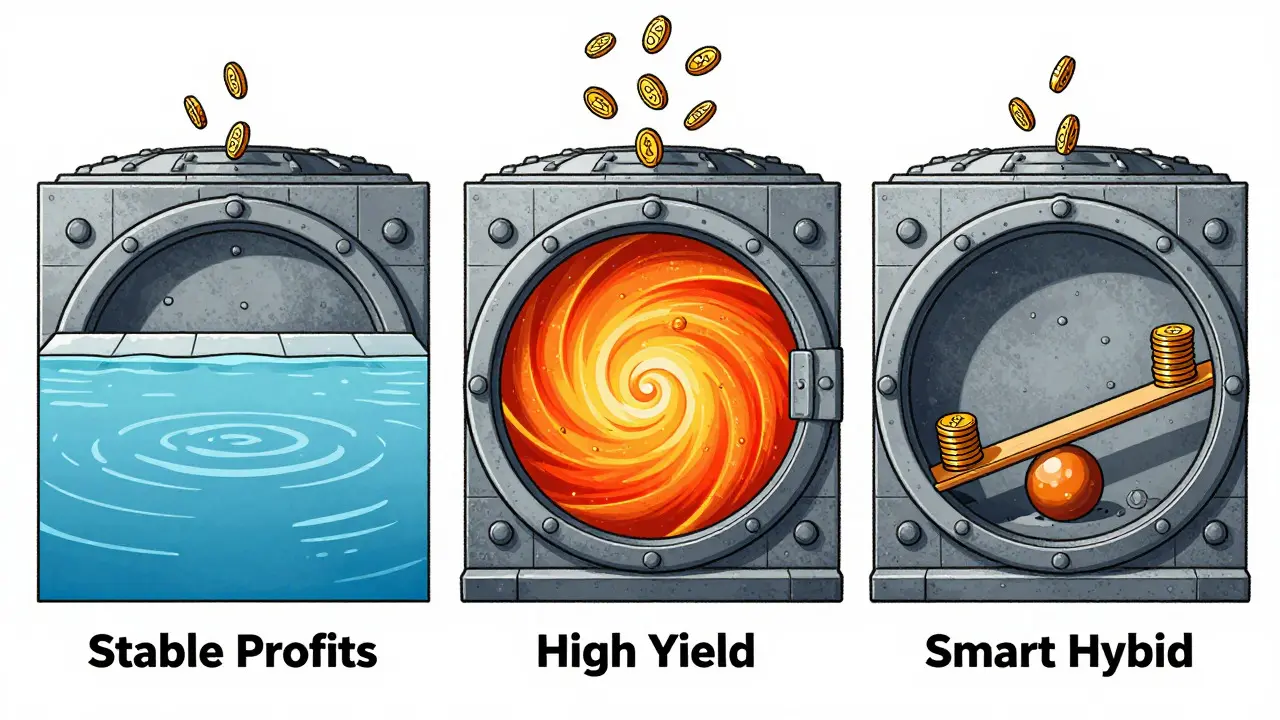
The platform segments users into three distinct risk profiles through its vaults:
- Stable Profits Pool: Designed for conservative investors who want lower volatility. This vault focuses on stablecoin pairs and less risky assets, aiming for consistent, albeit lower, yields.
- High Yield Pool: For those willing to take on higher impermanent loss risk in exchange for potentially massive returns. This vault farms more volatile asset pairs.
- Smart Hybrid Pool: A middle ground that balances stability with growth, mixing strategies from both the stable and high-yield approaches.
This structure allows the protocol to adapt to market conditions. If stablecoins are performing well, capital flows there; if altcoins surge, the high-yield vault captures that upside. The BT token serves as the governance key here. Holders vote on where capital should be allocated and set the fees for the vaults.
Technical Specs and Tokenomics
On the technical side, BT is an ERC-20 token operating exclusively on the Ethereum network. The contract address is 0x76c5449f4950f6338A393F53CdA8b53B0cd3Ca3a. If you’re looking to verify holdings or interact with the smart contracts, this is the string you’ll need.
Here is where things get interesting-and slightly confusing. Data across major tracking platforms shows inconsistencies regarding supply. Some sources report a circulating supply of zero, while others list a fully diluted valuation (FDV) around $69.5K. This discrepancy usually points to one of two things: either a significant portion of tokens is locked in staking or treasury wallets that aren't counted as "circulating," or there have been data synchronization issues on aggregators like CoinMarketCap.
As of mid-2026, the number of unique wallet holders hovers around 2,000. That is a small community for a project that launched five years ago. For context, established DeFi protocols typically have tens or hundreds of thousands of active holders. This small holder base suggests that much of the initial hype has faded, leaving behind a core group of loyalists or long-term holders waiting for a rebound.
Price Performance and Market Reality
Let’s talk numbers, because they tell a stark story. BT reached its all-time high of $70.66 on March 16, 2021. If you bought in during that frenzy, you’ve likely taken a hit. As of August 2026, the price sits between $0.16 and $0.26 depending on the exchange. That represents a decline of over 99% from its peak.
| Metric | Value | Context |
|---|---|---|
| All-Time High | $70.66 (Mar 2021) | Peak during the 2021 bull market |
| Current Price Range | $0.16 - $0.26 | Varies by exchange (Coinbase, Binance) |
| Market Cap | ~$20.9K - $69.5K | Micro-cap status; highly illiquid |
| 24-Hour Volume | Near $0.00 | Indicates very low trading activity |
| Ranking | #15,000+ | Far outside top 1,000 cryptocurrencies |
The most concerning metric isn't the price drop itself-crypto prices fluctuate wildly. It’s the volume. With 24-hour trading volumes reported as essentially zero on major exchanges, buying or selling large amounts of BT could result in significant slippage. You might see a price of $0.25 on the screen, but actually executing a trade could push the price down significantly due to lack of liquidity in the order book.

Risks and Current Status
Is BT.Finance dead? Not necessarily, but it is dormant. The lack of recent news, development updates, or community engagement raises questions about the project's future. In the fast-moving world of DeFi, silence often signals abandonment. Competitors like Yearn Finance and Convex Finance have maintained strong development cycles and user bases, capturing the majority of the yield aggregation market share.
If you are considering investing in BT today, you are taking on extreme risk. The primary risks include:
- Liquidity Risk: Getting out of your position could be difficult or expensive due to low trading volume.
- Development Risk: Without active development, the protocol may become vulnerable to bugs or outdated strategies as the DeFi landscape evolves.
- Adoption Risk: With only ~2,000 holders, the network effect is weak. Fewer users mean less TVL (Total Value Locked), which can lead to lower yields, creating a negative feedback loop.
Who Is BT.Finance For?
Honestly? Probably not the average retail investor. This token appeals to a very specific niche: traders looking for a potential "lottery ticket" play among micro-caps, or long-term believers who think the team will revive the project. It is not suitable for those seeking stable income or safe-haven assets.
If you do decide to allocate funds to BT, keep your position size small. Treat it as a speculative bet rather than a core holding. Monitor the official social channels for any signs of renewed activity, such as new vault launches, partnerships, or governance proposals. Until then, the safest strategy is often to wait and see if the dust settles.
Where can I buy BT.Finance (BT) tokens?
BT tokens are listed on several exchanges, including Coinbase, Binance, and Uphold. However, due to low liquidity, you may find better pricing or execution on decentralized exchanges (DEXs) directly on the Ethereum network if sufficient liquidity pools exist.
What is the main use case of the BT token?
The BT token is primarily a governance token. Holders use it to vote on protocol decisions, such as fee structures and capital allocation across the Stable, High Yield, and Hybrid vaults. It also incentivizes participation in the platform's yield farming strategies.
Why is the BT price so low compared to its all-time high?
The price dropped over 99% from its 2021 peak due to a combination of factors: the broader crypto market correction, intense competition from larger DeFi protocols, and a decrease in user activity and liquidity. The lack of recent development updates has also dampened investor confidence.
Is BT.Finance still active in 2026?
Activity appears minimal. Trading volumes are near zero, and there is little public information about recent development milestones. While the smart contracts remain live on Ethereum, the project seems to be in a state of dormancy rather than active growth.
What are the alternatives to BT.Finance?
If you are looking for yield aggregation services, consider established competitors like Yearn Finance, Convex Finance, or Beefy Finance. These projects have higher liquidity, larger user bases, and more active development teams, making them safer options for DeFi yield farming.
8 Comments
So this is the crypto equivalent of a 'maybe someday' promise. The vault system sounds nice in theory, like an automated robot that does your chores for you, but five years later and it's just sitting there gathering digital dust. I checked the volume on the DEXs and honestly, it looks like a ghost town out there. If you try to sell more than a few hundred dollars worth, good luck with that slippage. It's basically a lottery ticket where the odds are calculated by how much liquidity you can ignore.
Honestly, the data inconsistencies here are a huge red flag 🚩📉. When CoinMarketCap says zero circulating supply but others say it's locked up, that usually means the team is holding everything or the contracts are just broken. I've seen too many projects from 2020 die quietly like this while Yearn and Convex kept building. Don't let the 'governance token' label fool you into thinking it has real utility right now. It's mostly a historical artifact at this point 😔💸
Its not dead its HIBERNATING! You guys dont get it. The smart contracts are live which means the code is still running in the background harvesting yield even if no one sees it. This is a classic setup where the whales are accumulating before the next big bull run. Why would they list it on Binance and Coinbase if it was truly abandoned? Its a trap for the retail sheep who want to sell low. Wake up and smell the imminent 100x coming. The FDV is so low because the insiders know what we dont. #BTFinanceRevival
yeah i had some of these back in the day when the whole defi meta was crazy. remember when everyone was talking about auto-compounding? yeah. most of those projects either got rugged or just faded away. i think the main issue is that yearn finance basically did the same thing but way better and with way more marketing. so bt finance just kinda lost the race. its a shame really because the tech wasn't bad. just got outcompeted. lol
One must observe that the narrative surrounding this asset is largely decoupled from fundamental performance. While the article suggests dormancy, a contrarian perspective might argue that low volatility in price action could precede a significant re-rating event, provided the underlying smart contract security remains intact. However, without active development cycles or meaningful TVL growth, the probability of sustained recovery appears statistically negligible. It is prudent to view this as a speculative instrument rather than a core portfolio allocation. The governance mechanism, though theoretically sound, lacks the user base necessary to drive meaningful protocol upgrades. Thus, the investment thesis relies heavily on sentiment shifts rather than operational metrics. One should proceed with extreme caution and rigorous due diligence regarding counterparty risk on secondary markets. The liquidity profile is particularly concerning for institutional-sized positions. In essence, this is a high-risk, low-reward proposition in the current market environment. The absence of recent news flow further exacerbates the uncertainty. Investors should monitor on-chain activity closely for any signs of renewed engagement. Until such signals emerge, patience is likely the superior strategy. The opportunity cost of capital tied up in such illiquid assets is non-trivial. Therefore, diversification across more established DeFi protocols remains the rational choice. The historical peak of $70.66 serves as a reminder of the speculative excesses of the previous cycle. Current valuations reflect a sobering reality check. One must remain disciplined in their approach to micro-cap investments. The path forward for BT.Finance is uncertain at best.
Oh my god, look at this chart!! It’s absolutely tragic :O The fact that it dropped 99% is just heartbreaking. I feel for anyone who bought at the top, poor things. But hey, maybe this is the bottom? Who knows! It’s so exciting to watch something like this struggle. I hope the team comes back with a bang, wouldn’t that be dramatic? Let’s keep our fingers crossed for a miracle! ✨🙏
It’s interesting to consider the psychological aspect of holding onto a dormant asset. For many, it becomes less about financial return and more about a narrative of faith in the original vision. The 'lottery ticket' analogy used in the post is quite apt, but it also highlights the behavioral bias of loss aversion. People often hold onto losing positions hoping to break even, rather than reallocating capital to opportunities with higher expected value. It’s a common human trait, not necessarily a flaw in judgment, but certainly a challenge in portfolio management. The silence from the developers adds a layer of ambiguity that fuels both hope and fear in equal measure. It’s a fascinating case study in how community sentiment can persist long after technical relevance fades. We tend to anthropomorphize these projects, giving them lives and deaths similar to biological entities. In reality, they are just code and tokens, subject to market forces. Yet, the emotional attachment remains strong. This disconnect between technical reality and emotional perception is a key driver of crypto market dynamics. Understanding this helps in making more rational decisions. It’s not about being cynical, but about recognizing the patterns. The future of BT.Finance may indeed be uncertain, but the lessons it offers are clear. Patience and discipline are crucial in navigating such volatile landscapes. May we all learn from the quiet demise of once-promising projects. 🌱📊
i think its fair to say that the competition killed this project. yearn and convex have way more users and dev activity. its hard to compete when you are already behind. but who knows maybe a new update will change things. its always good to keep an eye on small caps. sometimes they surprise you. just make sure you dont put too much money in. treat it like a fun experiment. that is the only way to enjoy the ride. stay optimistic friends. the next bull run might bring new life to old projects. we will see. time will tell. keep learning and growing. the crypto space is full of surprises. never stop exploring. good luck to all holders. maybe one day we will look back and smile. for now just wait and see. the dust is settling. peace out.