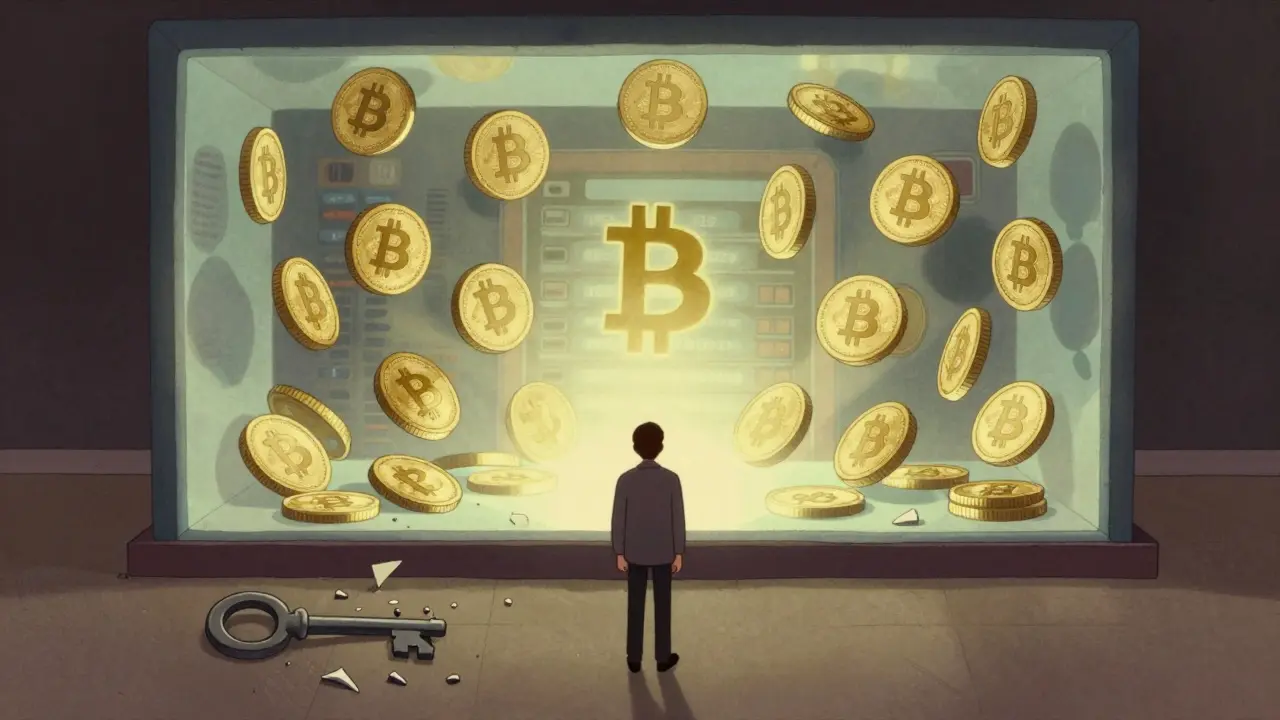
When you lose your private key, you don’t just lose access to your cryptocurrency-you lose it forever. There’s no reset button. No customer service line. No ‘forgot password’ option. If you don’t have the key, the money is gone. Not locked. Not frozen. Not hidden. Permanently gone.
This isn’t a hypothetical scenario. Around 3.7 million Bitcoin-worth roughly $248 billion as of early 2026-has been lost forever because someone misplaced or forgot their private key. That’s more than the GDP of most countries. And every single one of those coins is still sitting on the blockchain, untouched, unmovable, and completely inaccessible.
Why Can’t You Just Recover It?
Cryptocurrency works because of cryptography. Your private key is a 256-bit number, usually shown as a 64-character string of letters and numbers, or as a 12- to 24-word recovery phrase. That phrase is your password, your signature, your ownership document. It’s mathematically linked to your wallet address. And here’s the catch: the system is designed so that no one can reverse-engineer the key from the public address-not even the creators of Bitcoin.
Think of it like a safe with a combination lock. Only you know the combo. If you forget it, the safe stays locked. The company that made the safe doesn’t have a master key. The bank doesn’t have a copy. Even if you call them, they’ll say, “Sorry, we can’t help.” That’s not a flaw-it’s the whole point. Decentralization means no middleman. No one can override your control. But it also means no one can save you from yourself.
What Does “Losing Your Key” Actually Mean?
Losing your private key doesn’t always mean your phone got stolen or your hard drive crashed. More often, it’s something simple:
- You wrote down your 12-word phrase but misremembered one word.
- You saved the key as a text file, then accidentally deleted it.
- You trusted a friend to store it for you, and they lost it.
- You forgot the PIN to your hardware wallet and didn’t write down the recovery phrase.
- You threw away a USB drive thinking it was just an old backup.
According to the OSL Academy, 68.7% of lost access cases come from forgetting passwords or recovery phrases. Only 22.4% are due to hardware failure. The rest? Human error. Simple. Preventable. And irreversible.
There’s No Recovery Option-Here’s Why
Some people think exchanges like Coinbase or Binance can help. They can’t. Those platforms only control wallets they create for you. If you moved your crypto off their platform to your own wallet, you’re on your own. As AnchorWatch bluntly put it: “If you lose the private keys that control your Bitcoin, no one else can access it. And no one can help you recover it.”
Even blockchain analysis firms like Elliptic, which can trace stolen funds with over 90% accuracy, can’t do anything when the key is lost. The coins are still there, but without the key, no transaction can be signed. No movement. No access. Just digital dust.
And it’s not just Bitcoin. Ethereum, Solana, Dogecoin, NFTs-all of them rely on the same principle. Lose the key, lose the asset. No exceptions.

Real Stories: The Cost of Forgetting
On Reddit, a user named “CryptoWidow2024” shared how her husband passed away without telling her the recovery phrase for their wallet. It held $1.2 million. She called Coinbase, Chainalysis, even lawyers. No one could help. “It felt like watching money evaporate,” she wrote.
On Bitcointalk.org, someone named “WalletWarrior” lost 25 BTC-$1.66 million-after deleting their Electrum wallet file. They thought they had a backup. They didn’t.
There are rare success stories, like GitHub user “KeySaver,” who recovered $85,000 by finding an old backup stored in a safety deposit box. But those are the exceptions. The rule? Once it’s gone, it’s gone.
What’s the Difference Between Losing a Key and Having It Stolen?
This is important. If your crypto is stolen, there’s a chance-however slim-it can be traced. Exchanges sometimes freeze stolen funds. Law enforcement sometimes recovers them. Chainalysis can track where the money went. But if you lost the key? No one can trace it because there’s no crime. No theft. No hacker. Just a forgotten password.
And here’s the legal nightmare: courts struggle with cases where someone claims they lost their key to avoid paying debts or taxes. The Northwestern Journal of Technology and Intellectual Property (2023) found people using “I lost my key” as a legal defense-knowing no one can prove they didn’t. That’s why regulators like the CFPB say 38% of crypto complaints are about access issues.
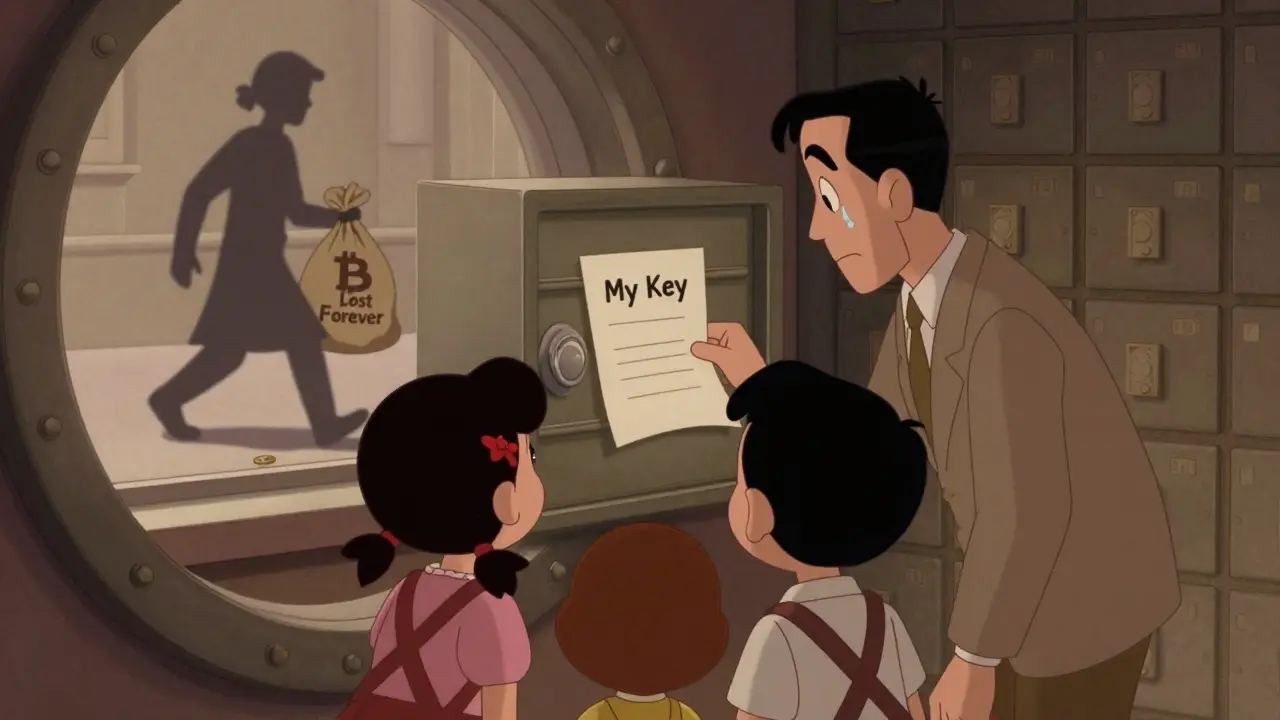
How to Prevent This From Happening to You
You can’t undo a lost key. But you can prevent it. Here’s what works:
- Write it down-on paper, not on your phone or computer. Use a pen, not a printer. Ink lasts. Digital files don’t.
- Use the 3-2-1 rule: Three copies. Two different storage types (paper + metal plate). One stored offsite (like a safety deposit box).
- Test your backup. Before you put it away, try restoring your wallet using the recovery phrase on a clean device. If it doesn’t work, you have a problem now-not later.
- Avoid mobile wallets for large amounts. They’re convenient, but they’re also easy to delete or lose. Use a hardware wallet like Ledger Nano X or Trezor.
- Consider social recovery wallets. Products like Argent let you name trusted contacts who can help restore access if you lose your key. It’s not perfect, but it’s better than nothing.
And if you’re just starting out? Spend at least 8-12 hours learning how to manage keys. The University of Cambridge found that’s how long it takes most people to get it right. Don’t rush. Don’t assume you’ll remember. Write it down. Twice.
What About New Tech? Can We Fix This?
There are new ideas. Ethereum’s Vitalik Buterin proposed “social recovery” systems. Coinbase is testing a pilot for institutional clients that uses time-locked multi-signature setups. Some wallets now let you recover with a friend’s approval. But none of these change the core rule: the blockchain still requires the private key to move funds.
Gartner predicts that by 2030, 95% of consumer wallets will have some kind of recovery feature. But the underlying blockchain? It won’t change. The system was built to be unbreakable. That’s why it’s secure. And that’s why it’s unforgiving.
Final Reality Check
If you’re holding crypto, you’re now responsible for your own bank. No FDIC. No insurance. No safety net. Your private key is your only proof of ownership. Treat it like your last living will. Like your house deed. Like your passport.
There’s no going back. No second chances. If you lose it, you lose everything.
So ask yourself: Where is your recovery phrase right now? Is it written down? Is it secure? Is it tested? If you’re not 100% sure, you’re already at risk.
Can I recover my cryptocurrency if I lose my private key?
No. Once you lose your private key or recovery phrase, there is no way to recover your cryptocurrency. The blockchain has no central authority, no password reset, and no backdoor. The funds remain on the network but are permanently inaccessible. This is by design-for security, not convenience.
What’s the difference between losing a key and having crypto stolen?
If your crypto is stolen, someone else accessed your wallet using your key. Blockchain analysts can sometimes trace the movement, and exchanges may freeze the funds. If you lost your key, no one else had access-you simply can’t sign transactions anymore. There’s no crime to investigate, no trail to follow. The money is still there, but it’s locked forever.
Can exchanges like Coinbase help me recover my lost key?
Only if your crypto is still on their platform and you used their wallet. If you transferred your coins to your own wallet (which you should), then Coinbase has zero access to it. They cannot reset your password, recover your phrase, or restore your funds. They will tell you exactly that: “We can’t help.”
Is there any insurance for lost private keys?
Some crypto insurance policies exist, but they almost always exclude losses from user negligence-like forgetting your phrase or deleting a backup. The $612 million crypto insurance market in 2025 mostly covers exchange hacks, not personal mistakes. You can’t insure against human error.
What’s the safest way to store a private key?
The safest method is the 3-2-1 backup rule: three copies, on two different media (paper + metal), with one stored offsite. Never store it digitally unless encrypted and offline. Never take a photo of it. Never email it. Never upload it to the cloud. Pen and steel are the most reliable tools for long-term security.
Are there any wallets that can recover lost keys?
No wallet can recover a lost key. But some newer wallets, like Argent or Fireblocks, offer social recovery-where you name trusted contacts who can help you regain access if you lose your key. These aren’t magic fixes. They still require you to set up the system ahead of time. You can’t use them after the fact.
How many people have lost crypto because of lost keys?
Approximately 3.7 million Bitcoin-worth $248 billion as of early 2026-have been lost due to forgotten or misplaced private keys. This number grows each year. Chainalysis estimates that about 20% of all Bitcoin in circulation is permanently inaccessible. That’s more than the entire market cap of most major cryptocurrencies.
Is it possible to brute-force a private key?
No. A Bitcoin private key has 1.1579209 x 10^77 possible combinations. That’s more than the number of atoms in the observable universe. Even with the world’s fastest supercomputers, brute-forcing a single key would take longer than the age of the universe. It’s not a matter of time or power-it’s mathematically impossible.
9 Comments
Lost my keys once. Thought I had a backup. Didn’t. Still wake up in a sweat thinking about it. 😅
Yeah man. This isn't a game. Your keys = your bank. No one's coming to save you. Just write it down. On paper. In two places. Done.
so if i lose my phone with the app i lose all my money? thats wild. why cant they just reset it like normal bank?
i just dont get why people make such a big deal. its just crypto. i mean, its not like its real money. also i typoed my phrase once and lost 2 btc. oops. 🤷♀️
bro i lost 5 btc in 2021. still cry sometimes. 🥲
my friend lost his whole portfolio because he threw away a usb he thought was empty. he didnt even know it had the key. now he works at starbucks. life is weird
the fundamental tension here lies in the ontological architecture of decentralized autonomous systems versus human cognitive fallibility. we have engineered a trustless environment that, by design, precludes recourse mechanisms for epistemic failure. the result is a tragic asymmetry between cryptographic certainty and biological imperfection.
Oh wow, a 12-word phrase is too much to remember? How quaint. I suppose you also forget where you put your keys to your car, right? Or maybe your house? I mean, if you can't handle the responsibility of owning a private key, maybe you shouldn't be playing with assets that require actual literacy. 🤷♀️
There's something deeply human about this. We built systems that demand perfection, then act surprised when we fail. We don't design for forgetting. We design for control. But humans forget. We misplace things. We die. We get sick. We get distracted. The blockchain doesn't care. It doesn't forgive. It doesn't adapt. And maybe that's the point - not because it's clever, but because it's cold. The real question isn't how to store your key. It's whether we should build systems that treat human error as a fatal flaw. Or if we could, just maybe, design a little more mercy into the machine.