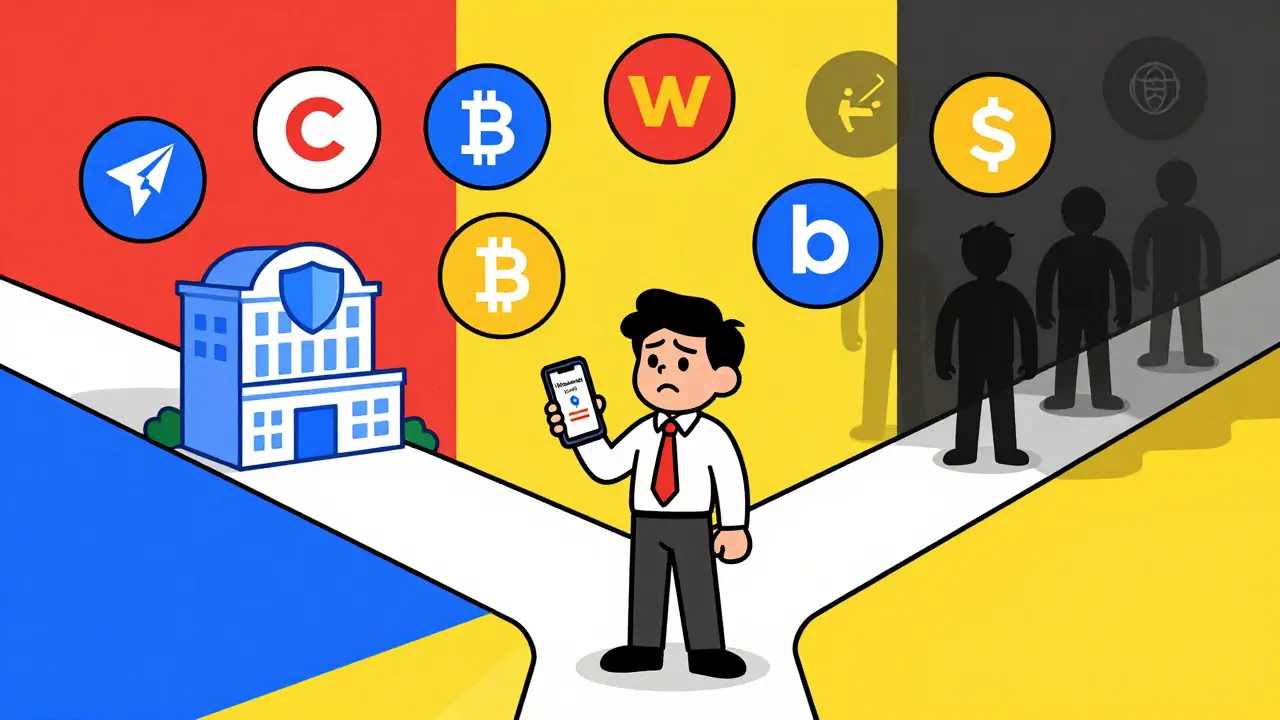
You want to move your digital assets freely. Maybe you hit a withdrawal limit on your main platform. Maybe you live in a region where certain tokens are blocked. Or maybe you just want better trading fees by splitting your portfolio across different platforms. It sounds like a smart way to take control of your finances. But there is a dark side to this strategy that many users overlook.
Using multiple cryptocurrency exchanges to avoid restrictions has become a massive concern for regulators worldwide. While some traders use this method for legitimate arbitrage or risk management, others use it to bypass sanctions, hide money from authorities, or launder illicit funds. The line between 'smart trading' and 'illegal evasion' is thinner than you think. If you are not careful, you could find yourself frozen out of the financial system-or worse, facing legal action.
The Mechanics of Multi-Exchange Trading
At its core, using multiple exchanges means holding accounts on several platforms simultaneously. For a legitimate trader, this might look like keeping Bitcoin on Binance is a leading global cryptocurrency exchange known for high liquidity and a wide variety of supported coins for spot trading, while using Coinbase is a regulated US-based exchange often used for fiat on-ramps and institutional custody for dollar conversions. This diversification protects you if one platform goes down or gets hacked.
However, the term 'avoiding restrictions' often points to more complex setups. Criminals and sanctioned entities use a technique called 'nesting.' A Nested Exchange is a crypto platform that operates without its own banking relationships, instead using accounts on other compliant exchanges to process trades and withdrawals. These platforms act as middlemen. You deposit funds with them, and they trade on your behalf using their own accounts on larger, regulated exchanges. This obscures the trail of where your money came from and where it is going.
Why do people use nested exchanges? Because they often have weak or non-existent Know Your Customer (KYC) checks. They fill the gap for users who cannot get approved on major platforms due to geographic restrictions or suspicious activity history. But here is the catch: you are trusting these shadowy intermediaries with your assets. They offer fewer security guarantees than established players. If a nested exchange disappears with your funds, you have no recourse.
How Criminals Bypass Sanctions and Limits
Regulators like the U.S. Treasury's Office of Foreign Assets Control (OFAC) have identified specific methods used to evade sanctions through multiple exchanges. Understanding these helps you recognize what looks illegal versus what is just aggressive trading.
- Compromised Wallets: Criminals steal accounts from legitimate users who have already passed KYC checks. They then use these clean identities to move dirty money. If you buy an account or wallet from someone online, you are likely buying a compromised identity.
- Non-Compliant Exchanges: Some platforms operate in countries with loose regulations or actively ignore international sanctions. They serve as 'exit nodes' where criminals convert illicit crypto into cash or other assets. Merkle Science, a blockchain analytics firm, tracks these entities closely.
- Decentralized Exchanges (DEXs): Platforms like Uniswap or SushiSwap operate via smart contracts without a central authority. Governments cannot force a piece of code to comply with sanctions. This makes DEXs attractive for moving funds peer-to-peer with minimal detection. However, using a DEX itself is not illegal; it is how you fund it and what you do with the proceeds that matters.
- Coin Swaps: Services that allow instant swapping of crypto for cash or other currencies without signup requirements are red flags. These are often used to break the chain of custody quickly.
In March 2025, we saw a clear example of enforcement against this behavior. The U.S. Secret Service took down Garantex, a notorious non-compliant exchange. Immediately after, its employees created a successor entity called Grinex. OFAC designated Grinex shortly after, noting that it was built specifically to continue sanctions evasion efforts. This shows that regulators are watching for 'zombie' platforms that pop up right after a crackdown.

The Regulatory Hammer: OFAC and SEC Actions
The regulatory landscape in 2026 is stricter than ever. The U.S. Securities and Exchange Commission (SEC) has made it clear that most crypto tokens are securities. This means that any platform bringing together buyers and sellers must register as an exchange. If you are using unregistered platforms to avoid limits, you are interacting with entities that may be operating illegally.
OFAC requires virtual currency firms to implement robust internal controls. This includes screening transactions against sanctions lists and monitoring for 'red flags.' What are these red flags?
| Red Flag Indicator | What It Means | Risk Level |
|---|---|---|
| Near-instant trading without KYC | The platform is likely skipping compliance checks to attract restricted users. | High |
| Opaque ownership structure | You cannot find who runs the exchange or where it is legally registered. | High |
| Frequent changes in domain names | The platform may be rebranding to escape bans or law enforcement attention. | Medium-High |
| No transparent fee schedule | Fees may be hidden in spreads or charged arbitrarily to extract value from trapped users. | Medium |
If you see these signs, step back. Legitimate exchanges take time to verify your identity. They provide clear terms of service. They do not ask you to communicate via encrypted messengers to 'prove' your loyalty. The fact that crypto can move without a bank does not mean exchanges are exempt from financial regulations. As attorney Hailey Lennon notes, exchanges are accountable for compliance because they sit at the intersection of traditional finance and digital assets.
Security Risks for the Average User
Let's talk about your safety. When you use multiple exchanges, especially those with lax rules, you expose yourself to significant security risks. Nested exchanges hold your assets in custody, but they lack the insurance and security infrastructure of major platforms. If a hacker breaches their systems, your funds are gone. There is no FDIC insurance for crypto.
Furthermore, engaging with sanctioned platforms can lead to 'guilt by association.' If your wallet address interacts with a blacklisted exchange, even indirectly, your funds could be frozen by downstream services. Banks and payment processors monitor blockchain flows. If they detect links to illicit activity, they may close your bank accounts or flag your transactions for investigation. This is known as de-risking, and it can make everyday financial life very difficult.
Consider the case of A7A5, a ruble-backed digital token issued by Kyrgyzstani firms to facilitate sanctions evasion. Users who held or traded this token found themselves entangled in complex legal webs. Even if you did not intend to break laws, holding assets tied to evasion schemes can trigger automatic blocks on compliant exchanges. Your freedom to trade depends on the cleanliness of your transaction history.
Legitimate Strategies vs. Illegal Evasion
Not all multi-exchange usage is bad. Many professional traders use multiple platforms for legitimate reasons. Here is how to distinguish safe practices from dangerous ones:
- Arbitrage: Buying Bitcoin on one exchange where it is cheaper and selling it on another where it is more expensive. This is legal and common, provided you comply with tax reporting and transfer rules.
- Liquidity Access: Using smaller exchanges to access niche tokens not available on major platforms. Ensure these smaller exchanges still perform basic KYC and AML checks.
- Risk Management: Spreading assets across different custodians to reduce the impact of a single platform failure. This is prudent, but ensure each custodian is reputable and regulated.
The key difference is transparency. Legitimate strategies involve platforms that are open about their operations, subject to audits, and compliant with local laws. Illegal evasion involves hiding your identity, using mixers, or routing funds through jurisdictions known for ignoring sanctions.
Future Outlook and Best Practices
The industry is evolving. Regulators are developing better tools to track cross-chain movements and identify nested structures. In 2026, we expect more international cooperation to shut down non-compliant platforms. The days of anonymous, unrestricted trading are fading.
To protect yourself:
1. Stick to regulated exchanges in your jurisdiction.
2. Complete KYC fully and honestly.
3. Avoid platforms that promise 'no questions asked' services.
4. Monitor your wallet addresses for any interaction with sanctioned entities.
5. Keep records of all transactions for tax and compliance purposes.
Using multiple exchanges is not inherently wrong. But using them to avoid restrictions imposed by law is a risky game. The penalties include frozen assets, criminal charges, and permanent exclusion from the financial system. Play it safe, stay compliant, and let your profits come from market skill, not regulatory loopholes.
Is it illegal to use multiple crypto exchanges?
No, it is not illegal to use multiple exchanges for legitimate trading, arbitrage, or risk management. However, using multiple exchanges specifically to evade sanctions, hide assets from authorities, or launder money is illegal. The intent and the platforms you choose matter significantly.
What is a nested exchange?
A nested exchange is a crypto platform that does not have its own direct relationship with banks or other financial institutions. Instead, it uses accounts on other compliant exchanges to process trades and withdrawals. This structure allows them to offer services to users who might be restricted elsewhere, but it also increases the risk of fraud and regulatory action.
Can I use decentralized exchanges (DEXs) to avoid restrictions?
You can use DEXs, but they do not offer anonymity in the way many believe. All transactions are recorded on the public blockchain. If you fund a DEX with money from a sanctioned source or use it to move illicit funds, regulators can still trace and penalize you. Using a DEX is not a shield against legal responsibility.
What happens if I accidentally trade on a sanctioned exchange?
If you inadvertently interact with a sanctioned entity, your funds may be frozen by compliant exchanges or banks that detect the link. You should immediately stop all transactions, consult with a legal expert specializing in crypto regulation, and cooperate with any inquiries from authorities. Ignoring the issue can worsen the situation.
How do regulators track multi-exchange evasion?
Regulators use blockchain analytics tools to trace fund flows across different wallets and exchanges. They look for patterns such as rapid movement between platforms, use of mixing services, and interactions with known blacklisted addresses. Companies like Chainalysis and Merkle Science provide data to help authorities identify and interdict illicit activities.