
The United States finally has a real federal framework for cryptocurrency regulation - and it’s not what most people expected. After years of regulatory chaos, where the SEC chased crypto companies one by one and states passed conflicting laws, everything changed on July 18, 2025, with the passage of the GENIUS Act. This isn’t just another rule update. It’s the first time the U.S. government created a clear, nationwide system for how digital money works - but only for one type of crypto: payment stablecoins.
What the GENIUS Act Actually Does
The GENIUS Act doesn’t regulate Bitcoin, Ethereum, or Solana. It only applies to payment stablecoins - digital tokens pegged to the U.S. dollar, like USDC or USDT, that people use to move money quickly without volatility. The law says these tokens must be 100% backed by real cash or short-term U.S. Treasury bonds. No guessing. No risky investments. No magic.Issuers of these stablecoins now have to do monthly public reports showing exactly what’s in their reserves. If they’re holding $10 billion in USDC, they must prove they have $10 billion in cash or Treasuries. And they can’t pay interest to users. That’s a big deal. For years, platforms like Coinbase and BlockFi gave users 5% or 6% APY on their stablecoins. That’s gone. The law bans it outright.
But here’s the twist: the ban doesn’t apply to third-party apps or DeFi protocols. So if you want to earn yield on your stablecoin, you can still go to an unregulated lending platform. That’s creating a loophole regulators are already worried about. Banks are complaining that people are pulling money out of their accounts and putting it into these shadowy DeFi apps to chase higher returns. The Federal Reserve is watching closely.
Who Regulates What? The Federal-State Split
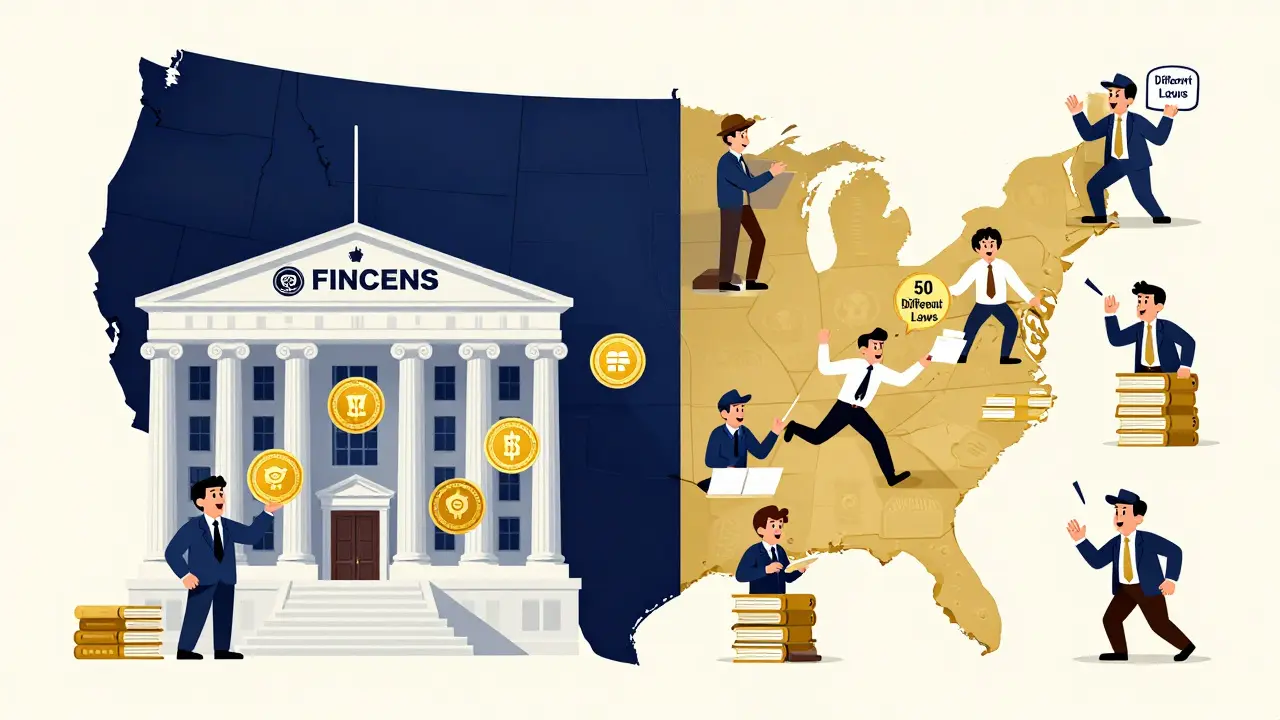
This isn’t a top-down federal takeover. It’s a hybrid system. If a stablecoin issuer has more than $10 billion in circulation, the federal government steps in - specifically, the Treasury’s FinCEN and the Office of the Comptroller of the Currency (OCC). They handle licensing, audits, and enforcement.But if you’re a smaller player - say, a startup issuing $2 billion in stablecoins - you’re regulated by your state. That means a company in Texas could face different rules than one in New York. Some states, like Wyoming and Nevada, have already passed their own crypto-friendly laws. Others are scrambling to catch up.
This dual system was designed to encourage innovation without sacrificing safety. But it’s messy. Smaller issuers are spending millions just to navigate 50 different rulebooks. A Deloitte report from September 2025 found that compliance costs for small firms range from $2 million to $5 million a year. That’s not a startup budget. It’s a bank’s expense.
What Happens If a Stablecoin Issuer Goes Bankrupt?
One of the most important parts of the GENIUS Act is what happens when things go wrong. In the past, if a stablecoin issuer collapsed - like TerraUSD in 2022 - users lost everything. The GENIUS Act fixes that. It gives stablecoin holders first claim on assets in bankruptcy. No more waiting in line behind bondholders or creditors. If the company’s reserves are frozen, your dollars come out first.This was a direct response to the collapse of FTX and the chaos that followed. Investors needed certainty. Now, if you hold USDC and the issuer fails, you’re not a random user. You’re a priority claimant. That’s a game-changer for institutional adoption.
How the SEC Is Changing the Game
While the GENIUS Act handles stablecoins, the SEC is busy with everything else. In Spring 2025, they announced six major rule changes targeting digital assets. These include:- New rules for how crypto tokens are offered to investors
- Updated definitions of what counts as a “dealer” in crypto
- Modernized custody rules for holding digital assets
- Changes to how exchanges report trades
- Updates to transfer agent rules to work with blockchain tech
- Revisions to books and records requirements for crypto firms
The SEC’s goal? To bring crypto into the same regulatory sandbox as stocks and bonds - but without killing innovation. They’ve also officially rescinded Staff Accounting Bulletin 121, which had blocked banks from holding crypto on behalf of clients. Now, JPMorgan, State Street, and Bank of New York Mellon can offer custody services. JPMorgan launched its Onyx Digital Assets platform in March 2025, and it’s already handling billions in transactions.
How This Compares to the Rest of the World
The U.S. didn’t copy Europe’s MiCA law. MiCA treats all crypto assets the same - Bitcoin, Ethereum, stablecoins - under one big rulebook. The U.S. took a narrow approach. Only stablecoins. Nothing else.That’s intentional. The U.S. wanted to secure the dollar’s global dominance. Stablecoins are digital dollars. If they’re safe, transparent, and trusted, they can replace the need for SWIFT or other international payment systems. The Federal Reserve chair, Jerome Powell, called this a win for the U.S. dollar.
But it’s not perfect. The EU allows interest-bearing stablecoins. Singapore lets crypto firms operate under clear licensing. Japan has a full licensing system for all virtual currencies. The U.S. leaves Bitcoin and altcoins in a gray zone. That’s why 23 crypto firms that were considering moving to the U.S. chose the EU instead, according to CoinDesk.

Who’s Happy? Who’s Not?
Circle, the company behind USDC, says their user base grew 37% after the GENIUS Act passed. Institutional investors are pouring in. Fidelity reports a 214% jump in digital asset custody clients since July 2025. Big finance is finally on board.But smaller players are struggling. Coinbase’s CEO called the monthly reserve disclosures a “heavy burden.” Tether’s CEO called the reserve rules “excessively restrictive.” And the crypto community is divided on the interest ban. Reddit threads are full of complaints. One user, u/CryptoBanker2025, wrote: “They’re stopping banks from competing, but letting DeFi do whatever it wants. That’s not regulation - that’s hypocrisy.”
Even experts disagree. MIT’s Neha Narula says the interest ban will push people toward unregulated platforms, increasing risk. Georgetown’s Hilary Allen says the state-federal split will create confusion and enforcement gaps. But the Chamber of Digital Commerce says this is the clearest path forward the U.S. has ever had.
What’s Next? The Loopholes and Coming Changes
The GENIUS Act isn’t the end. It’s the beginning. The CFTC plans to propose rules for crypto derivatives by December 2025. The SEC is expected to release guidance on security tokens in early 2026. And Congress is already working on fixes.Representative French Hill introduced the Stablecoin Innovation Preservation Act in October 2025. It would create a legal way for stablecoins to pay interest - under strict conditions. If it passes, the interest ban could be lifted for compliant issuers.
The Treasury Department’s Office of Financial Research warned in November 2025 that the interest ban might be accelerating the shift to DeFi. That’s a red flag. If people start moving billions into unregulated lending protocols, the whole system could become unstable again.
Right now, U.S.-issued stablecoins make up 68% of the global market. That’s up from 52% in 2024. USDC sits at $32.7 billion in market cap. The U.S. is now the third-most crypto-friendly country in the world, behind Singapore and Switzerland. But if the loopholes aren’t closed, that lead could vanish.
What This Means for You
If you’re holding stablecoins in the U.S., you’re safer now. Your money is backed 1:1, and you’re first in line if something goes wrong. But you won’t earn interest from regulated platforms anymore.If you’re a developer or startup, you now have clear rules - but only if you’re building a stablecoin. If you’re building a DeFi app, a token, or a wallet, you’re still in the gray zone. The SEC hasn’t given you a green light. You’re still playing by old rules.
If you’re an investor, this is the most stable U.S. crypto environment in history. But it’s not complete. The system is built around dollars, not decentralization. The government wants control, not disruption.
The GENIUS Act didn’t solve everything. But it solved the most urgent problem: making sure digital dollars don’t crash. Everything else? That’s still being written.
Does the GENIUS Act regulate Bitcoin and Ethereum?
No. The GENIUS Act only applies to payment stablecoins - digital tokens pegged to the U.S. dollar, like USDC or USDT. Bitcoin, Ethereum, Solana, and other cryptocurrencies are not covered by this law. They’re still regulated under existing securities and commodities laws by the SEC and CFTC, but without a clear federal framework. This creates a gap where non-stablecoin crypto projects operate in legal uncertainty.
Can I still earn interest on my stablecoins in the U.S.?
You can’t earn interest from regulated stablecoin issuers like Circle or Coinbase. The GENIUS Act bans them from paying yield. But you can still earn interest through unregulated DeFi platforms like Aave or Compound. These platforms operate outside federal oversight, which is why regulators are concerned. The law doesn’t stop you from using them - it just makes them riskier and less protected.
What happens if my stablecoin issuer goes bankrupt?
Under the GENIUS Act, stablecoin holders have first priority in bankruptcy. That means if the issuer runs out of money, your claim to the underlying cash or U.S. Treasuries comes before bondholders, employees, or other creditors. This was a direct fix for the FTX and TerraUSD collapses, where users lost everything. Now, your dollars are protected.
Are U.S. stablecoins safer than those from other countries?
Yes - for now. The GENIUS Act requires 100% reserve backing, monthly public disclosures, and strict anti-money laundering rules. These are stricter than most other countries. For example, the EU’s MiCA law allows 90% backing in some cases. The U.S. rules are designed to prevent another TerraUSD collapse. However, if DeFi platforms start offering higher yields and regulators don’t close the loophole, users might move money to less regulated systems, reducing overall safety.
Why does the U.S. regulate stablecoins but not Bitcoin?
The U.S. sees stablecoins as digital dollars - a threat to the dollar’s global dominance if they’re unstable. Bitcoin is seen as a speculative asset, not a currency. The government wants to control the digital version of the dollar, not regulate every crypto token. This is a strategic choice: secure the dollar, leave the rest to the markets. Critics say this creates a two-tier system where stablecoins get safety while Bitcoin remains vulnerable to manipulation.
Is the U.S. crypto regulation framework good for innovation?
It’s mixed. For stablecoin issuers, yes - legal clarity has attracted big banks and institutional investors. Fidelity and JPMorgan are now in the game. But for other crypto startups, it’s harder. The lack of clear rules for non-stablecoin tokens makes it risky to build new products. Many developers are moving to Europe or Asia where the rules are broader and more predictable. The U.S. is winning the stablecoin race but losing ground in broader crypto innovation.
10 Comments
So let me get this straight - the government bans interest on stablecoins but says 'lol fine' to DeFi platforms that literally have zero oversight? That’s not regulation, that’s regulatory cosplay. You’re telling me JPMorgan can’t pay 5% but some anonymous guy in a Telegram group with a smart contract can? And we wonder why people get scammed. This isn’t protection - it’s a tax on responsibility.
ok so i just read this whole thing and my brain is like 🤯🤯🤯. so u can’t earn interest from coinbase but u can from some random app that dont even know ur name? and the goverment is like ‘we got this’ while the whole thing is basically a giant loophole shaped like a DeFi protocol. also who’s gonna audit these shadow platforms? lol. #cryptoisntsafe
Biggest thing people are missing - this isn’t about crypto. It’s about the dollar. The U.S. didn’t regulate stablecoins to protect users. They did it to stop other countries from replacing the dollar with digital alternatives. If you think this is about fairness or innovation, you’re not seeing the chessboard. They’re building a digital dollar fortress - and everyone else is just trying to sneak in the backdoor. The interest ban? That’s not to protect you. It’s to keep your money in the system.
USA wins. 🇺🇸
Other countries? Still playing with toys.
Stablecoins = digital USD.
USD = world money.
DeFi? Not our problem.
Done.
Honestly? This is the most balanced crypto law we’ve ever had. Yes, the DeFi loophole is scary - but at least now we have a baseline. People who want safety? They’ve got it. People who want yield? They’re taking risk - and they know it. This isn’t perfect, but it’s progress. And progress beats chaos any day.
so like… if i put my money in usdc and the issuer goes bust i get my cash first? but if i put it in aave and it crashes i lose evrything? so… the government is saying ‘trust us’ but also ‘go ahead and gamble on the wild west’? i love america.
It is imperative to acknowledge that the regulatory architecture established by the GENIUS Act constitutes a paradigmatic shift in the governance of digital asset ecosystems. While the exclusion of non-stablecoin instruments may appear incongruous with principles of market neutrality, it is, in fact, a strategically calibrated intervention designed to preserve monetary sovereignty. The bifurcated federal-state oversight structure, though administratively complex, affords both macroprudential stability and micro-innovation flexibility. One must not conflate regulatory restraint with regulatory failure.
As a financial institution executive with over 27 years of experience in compliance and digital asset custody, I must commend the precision and foresight embedded in the GENIUS Act. The 100% reserve requirement, coupled with mandatory public disclosures and bankruptcy priority for holders, establishes a gold standard for financial integrity. The decision to defer regulation of non-stablecoin assets is not a lapse - it is a deliberate pause to allow market mechanisms to evolve without premature statutory interference. This is not regulation as punishment. This is regulation as stewardship.
the fact that they banned interest but didn’t touch DeFi is so… american. like, ‘we’ll make the rules for the banks but you kids do whatever you want in the backyard’ 😅
also, why is everyone acting like this is the end? this is just round one. wait till the CFTC drops their derivatives rules in december - that’s when the real chaos starts.
They made digital dollars safe but made them boring
They gave us protection but took away the gamble
They secured the system but killed the spirit
Is this progress or just control dressed up as safety?
Who decides what’s worth protecting?
And who gets left behind when the rules are written by people who never held a private key?
Maybe the real question isn’t what the law says
But who it was written for