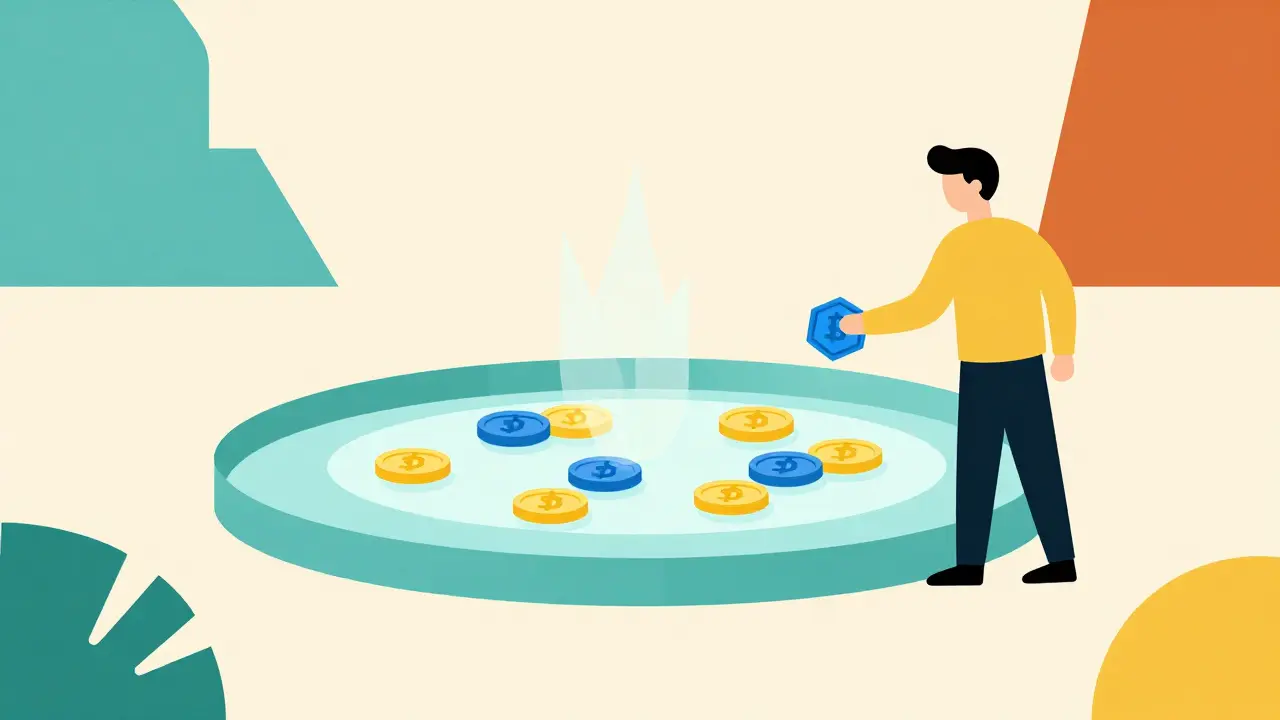
Imagine a world where you want to swap one digital token for another, but there is no one on the other side of the trade. No order book, no waiting for a buyer, and no central company taking a cut of your money. That was the gamble Uniswap V1 is the first version of the Uniswap decentralized exchange protocol that introduced the Automated Market Maker (AMM) model to the world. Launched in November 2018, it didn't just offer a new way to trade; it fundamentally broke the traditional mold of how financial exchanges work by removing the middleman entirely.
The Magic of the Automated Market Maker
Before V1, most trading happened on centralized exchanges that used order books. If you wanted to sell a token, you had to wait for someone else to want to buy it at your price. Uniswap V1 flipped this script. Instead of matching buyers and sellers, it used a mathematical formula to determine the price of assets. This meant you were trading against a pool of tokens, not a person. This mechanism, known as an Automated Market Maker or AMM, ensured that there was always liquidity available for a trade, provided someone had deposited tokens into the pool.
For the average user, this felt like magic. You connected your Ethereum wallet, picked two tokens, and swapped them instantly. There were no sign-up forms, no email verifications, and absolutely no KYC (Know Your Customer) hurdles. It was the purest expression of the "permissionless" ethos of blockchain technology.
How it Worked: Liquidity and Fees
But where did the tokens come from? This is where Liquidity Providers entered the picture. Regular users could deposit an equal value of two different tokens into a pool. In exchange for providing this "liquidity," they earned a slice of the trading fees. Every single swap on the platform carried a 0.3% fee, which went directly to these providers.
This created a self-sustaining loop: more liquidity attracted more traders because it reduced price slippage, and more traders generated more fees for the providers. It turned passive holders into active participants in the ecosystem. Later, the introduction of the UNI governance token added another layer, allowing holders to vote on how the protocol should evolve, effectively turning the exchange into a digital democracy.
| Feature | Specification/Value |
|---|---|
| Trading Model | Automated Market Maker (AMM) |
| Trading Fee | 0.3% per swap |
| Supported Assets | ~100 Ethereum-based tokens |
| Network | Ethereum (Mainnet) |
| Onboarding | No KYC / Wallet connection only |
The Critical Flaws and Learning Curves
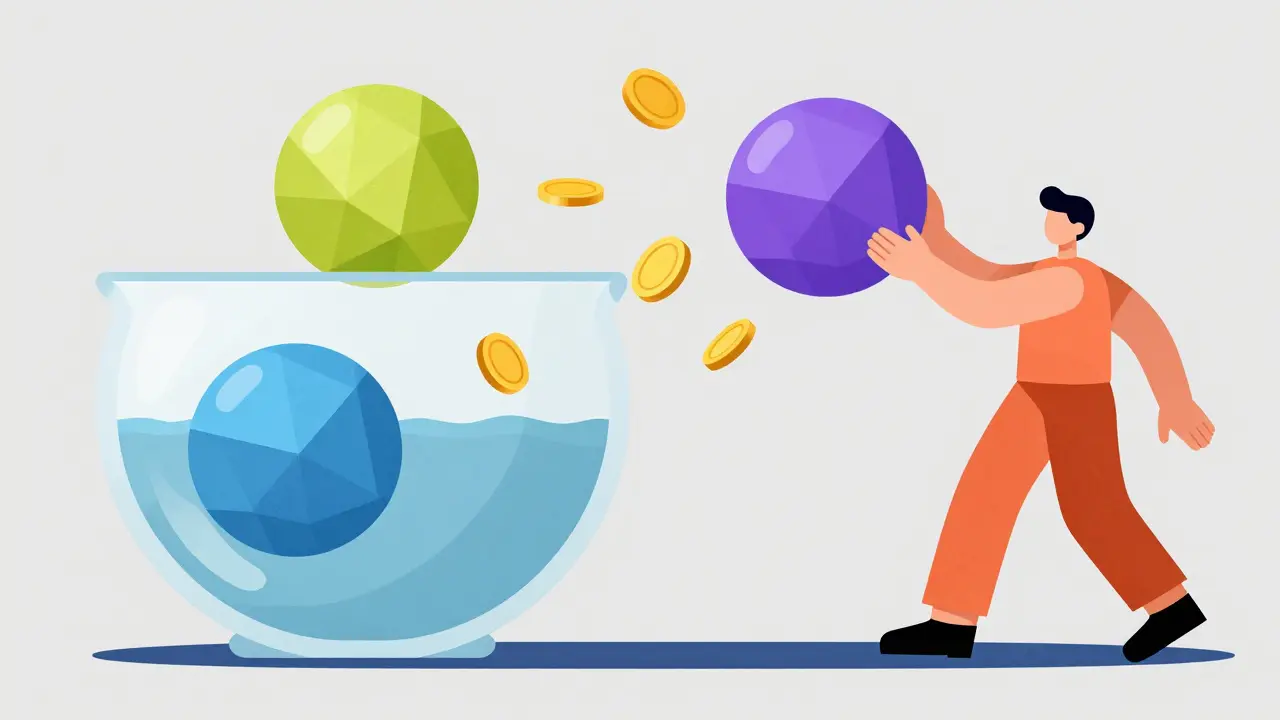
If it was so great, why did it need V2 and V3? Because V1 was essentially a massive, live experiment, and it had some glaring holes. The biggest issue was its Ethereum-centric routing. Every single trade had to pass through ETH. If you wanted to trade Token A for Token B, the protocol actually traded A for ETH and then ETH for B. This was inefficient and drove up the cost for users.
Then there were the "invisible" costs. While Uniswap only charged 0.3%, the Gas Fees on the Ethereum network could be brutal. During times of high congestion, a simple swap could cost dozens of dollars in gas. Even worse, if a transaction failed due to a price shift, the network still took the gas fee, leaving the user with nothing but a loss and a failed trade.
Security wasn't perfect either. The price oracle-the mechanism the protocol used to report the current price of a token-was insecure and could be manipulated. It was also susceptible to reentrancy attacks, a common vulnerability in early smart contracts where a malicious token could "trick" the contract into executing a function multiple times. These weren't just technical glitches; they were expensive lessons that shaped the entire DeFi landscape.
Comparing the Evolution: V1 vs. Its Successors
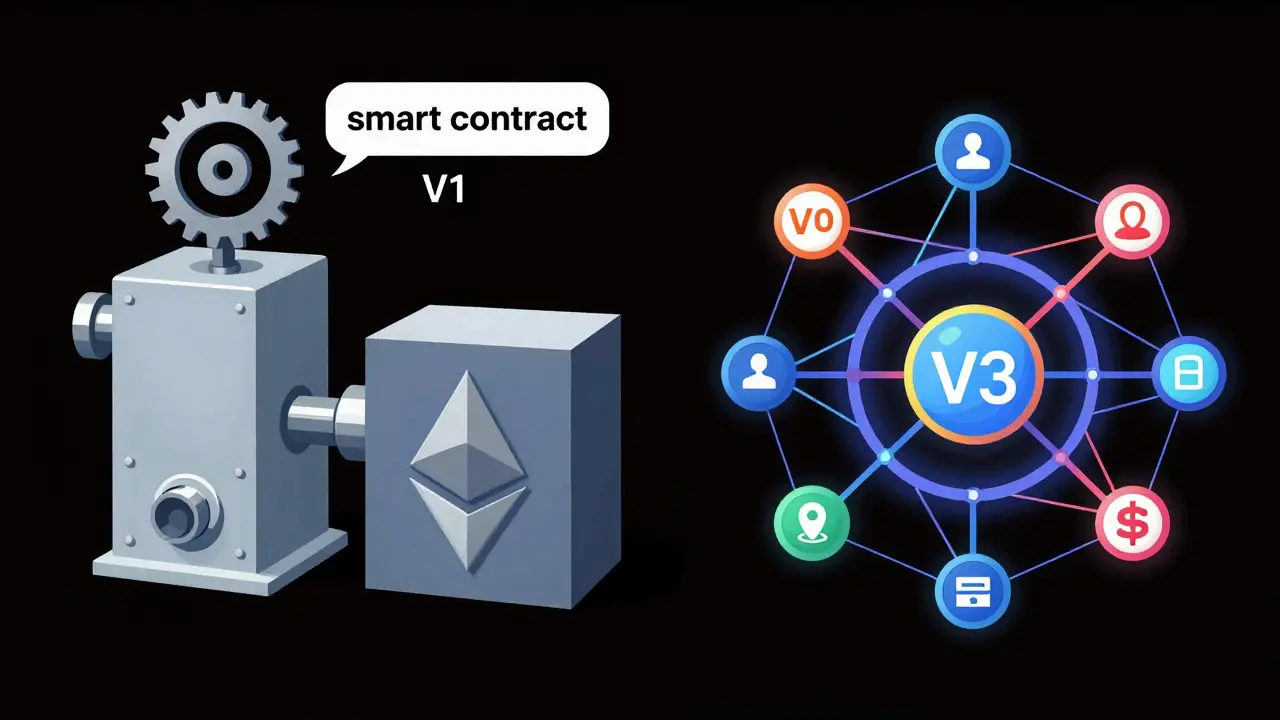
The jump from V1 to V2 was all about flexibility. V2 removed the requirement to route everything through ETH, allowing for any ERC-20 token pair to exist. It also fixed the gas efficiency issues and introduced a more secure oracle system. By the time V3 arrived, the game changed again with "concentrated liquidity," allowing providers to target specific price ranges rather than spreading their capital across the entire price curve.
Looking back at V1, it's like looking at the first mobile phone. It was bulky, limited, and sometimes crashed, but it proved that the concept worked. It showed that you didn't need a centralized company like Coinbase or Binance to facilitate a trade; you just needed a smart contract and a pool of assets.
The Verdict: Was it a Success?
If you judge Uniswap V1 by today's standards-where we have instant Layer 2 scaling and sophisticated risk management-it looks primitive. But in 2018, it was a revolution. It proved that Decentralized Finance (DeFi) could actually scale. It absorbed massive amounts of liquidity from traditional exchanges and gave power back to the users.
The lack of customer support was a known trade-off. If you lost your keys or sent tokens to the wrong address, there was no "Help" ticket to save you. Your only support was a Twitter thread or a community forum. This was the price of total autonomy. For those who valued privacy and control over a polished user experience, V1 was exactly what the crypto world needed.
Did Uniswap V1 require any personal identification?
No, Uniswap V1 was completely decentralized and required no KYC or identity verification. Users only needed to connect a compatible Ethereum web wallet to start trading.
How did users earn money on Uniswap V1?
Users earned money by becoming Liquidity Providers. By depositing pairs of tokens into the pools, they received a proportional share of the 0.3% trading fee charged to every user who swapped tokens in that pool.
What was the biggest technical weakness of V1?
The biggest weaknesses included an insecure spot price oracle, susceptibility to reentrancy attacks, and inefficient ETH-centric routing which forced all trades to pass through Ethereum.
Could you trade non-Ethereum tokens on V1?
No, Uniswap V1 was limited exclusively to tokens built on the Ethereum blockchain (ERC-20 tokens). To trade assets from other chains, users had to bridge them to Ethereum first.
Why were gas fees so high on V1?
Gas fees were not charged by Uniswap itself but by the Ethereum network. Because V1 operated on the Ethereum mainnet, users had to pay for the computational power required to execute smart contracts, which spiked during high network traffic.
Next Steps for Traders
If you are looking to trade today, don't go searching for a V1 interface; it's a relic of the past. Instead, look into the current Uniswap iterations (like V3) or explore platforms on Polygon, Arbitrum, or Optimism to avoid the heavy gas fees that plagued the early days of V1. If you're interested in the technical side, studying the V1 smart contracts is still a great way to understand the foundations of AMMs before moving on to more complex concentrated liquidity models.
8 Comments
most people forget that the constant product formula x*y=k was the real breakthrough here
it basically killed the need for market makers to manually adjust quotes and let the math handle the liquidity gaps
imagine thinking a 0.3% fee was a gift from the heavens while the gas fees were basically stealing your soul
pure poetry
The author fails to mention that the impermanent loss for V1 liquidity providers was absolutely catastrophic for those holding volatile pairs. It is quite naive to describe it as a "self-sustaining loop" when many early adopters essentially paid the traders for the privilege of providing liquidity. This is a textbook example of survivor bias in DeFi reporting.
it is so cool to see how much we have grown since then. just think about how those early mistakes paved the way for the L2s we use now. keep exploring the basics everyone it really helps
USA made this tech better than any other place. Only Americans really get why this is the best way to trade. The rest of you are just lagging behind because you don't have the same drive we do. Simple as that.
while we discuss the technicals we must ask if the removal of the middleman is a liberation of the spirit or just a shift in who holds the power
perhaps the true middleman is now the algorithm itself and we have merely traded a human master for a mathematical one
too long didn't read but looks boring
I absolutely love the synergy here!!! The way the AMM optimizes the slippage-to-liquidity ratio is just breathtaking!!!! We are witnessing a paradigm shift in asynchronous financial settlement, and it is so inspiring to see the community embrace such a robust, permissionless framework!!!!