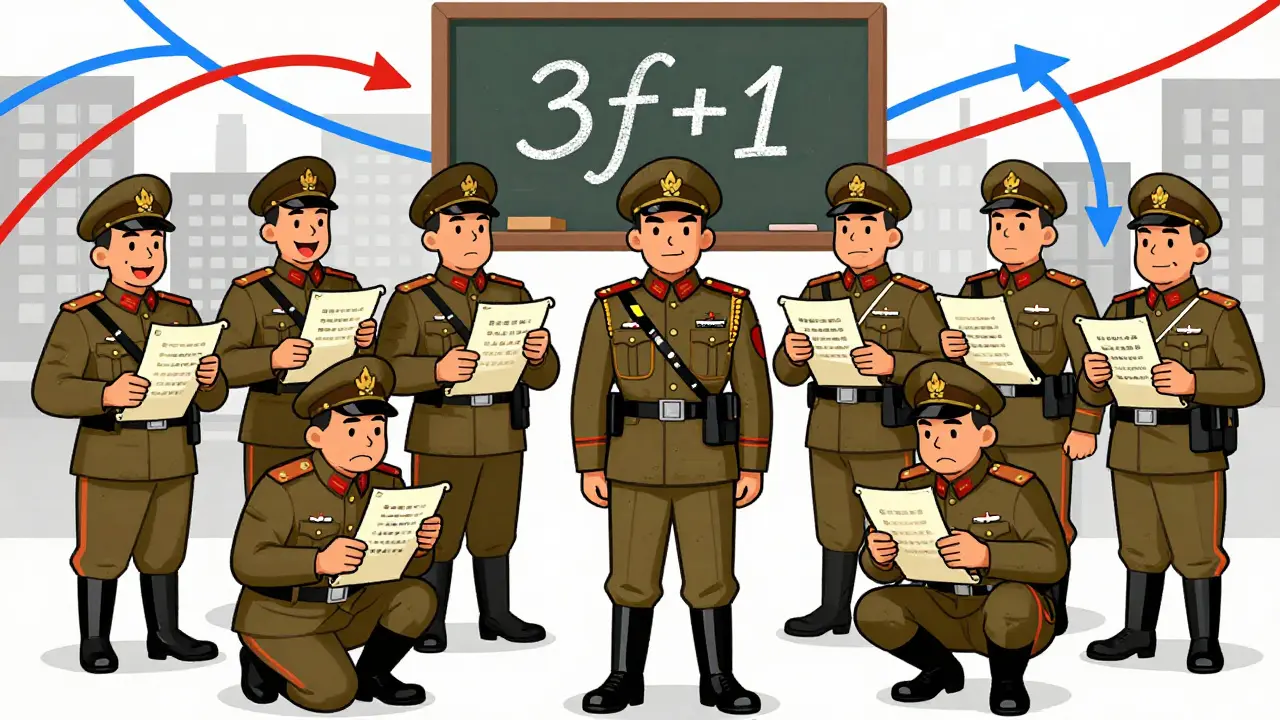
The Byzantine Generals Problem isn't just a historical analogy-it's the reason your Bitcoin transactions work without a bank. Imagine you're one of ten generals surrounding a city. You need to attack at the same time to win. But some of your generals are traitors. They might send conflicting messages: "Attack now!" to one group, "Retreat!" to another. You don't know who’s lying. How do you agree on a plan? This isn’t a war story-it’s the core problem that makes decentralized networks like Bitcoin and Ethereum possible.
What Exactly Is the Byzantine Generals Problem?
In 1982, computer scientists Leslie Lamport, Robert Shostak, and Marshall Pease wrote a paper that changed how we think about trust in machines. They didn’t talk about armies. They talked about computer nodes-each one a "general"-trying to agree on a single piece of data, like whether a transaction happened. The catch? Some nodes could be broken, or worse, actively lying. That’s a Byzantine fault: not just crashing, but sending fake data on purpose. The problem has two rules:- All honest nodes must agree on the same decision.
- No small number of liars can trick the honest ones into choosing a bad plan.
Why This Matters More Than Ever
Before this problem was solved, distributed systems relied on trusted centers-banks, servers, governments. But blockchains are different. They’re open. Anyone can join. No one is in charge. That’s great for freedom, terrible for trust. How do you stop someone from double-spending your coins? Or flooding the network with fake transactions? The answer is Byzantine Fault Tolerance (BFT). It’s the set of rules and protocols that let honest nodes outvote the liars-even when those liars are trying to look honest. Bitcoin’s solution? Proof-of-Work. Satoshi Nakamoto didn’t mention the Byzantine Generals Problem directly, but he solved it. By making it expensive to mine blocks, he made lying economically irrational. Why waste millions on hardware and electricity to fake a transaction when you could earn more honestly? It’s not perfect-Bitcoin uses 100x more energy than Ethereum-but it works. Ethereum switched to Proof-of-Stake in 2022. Now, instead of miners, you have validators who lock up ETH as collateral. If they misbehave, they lose their stake. That’s economic punishment instead of computational cost. It’s faster, greener, and still BFT-compliant.How It’s Different From Other Consensus Problems
Not all distributed systems have traitors. Many just have crashes. A server goes offline. A network cable gets cut. That’s a "crash fault." Algorithms like Paxos and Raft handle those fine. You just need a simple majority: if you have five nodes and one fails, the other four can still decide. But Byzantine faults? They’re worse. A node doesn’t just go silent-it lies. It says "yes" when it meant "no." It sends different answers to different people. That’s why you need 3f+1 nodes, not 2f+1. A simple majority isn’t enough. You need enough honest nodes to outvote even the most coordinated group of liars. Think of it like a jury. If one juror is corrupt, you need at least four honest ones to override them. But if three are corrupt, you need ten honest jurors to be safe. That’s the math.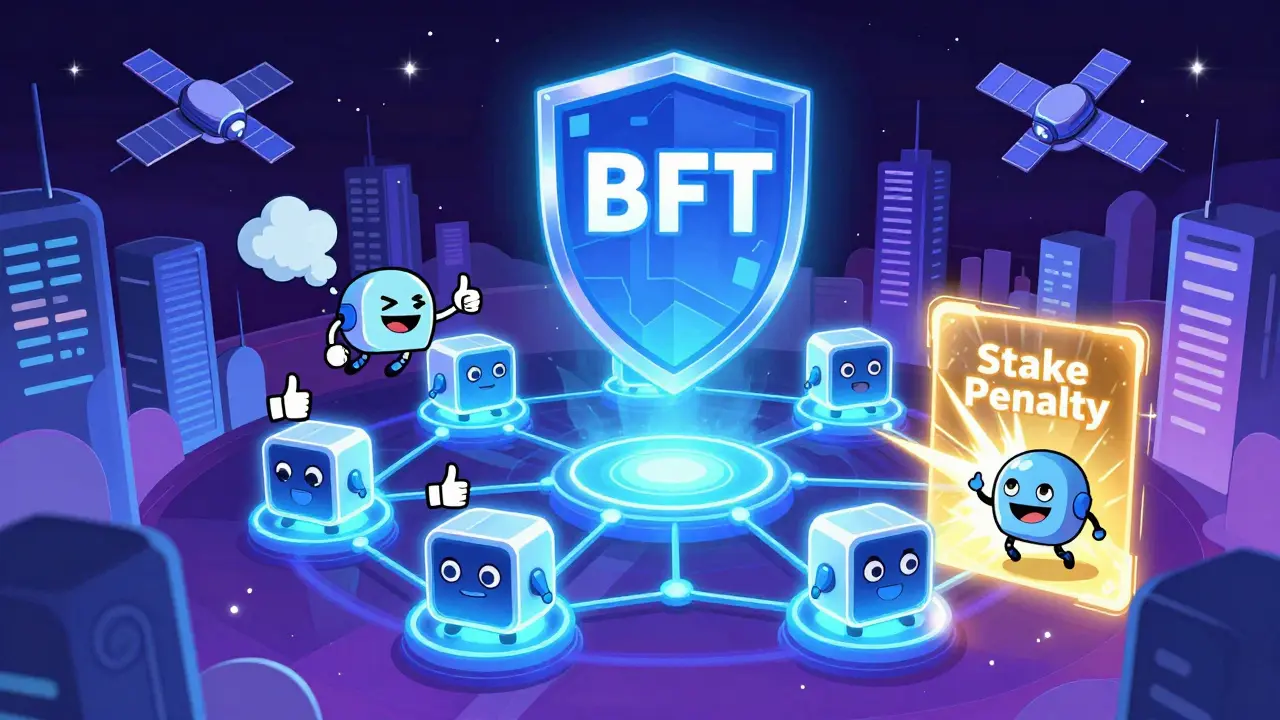
Real-World Examples of BFT in Action
You don’t need to be a blockchain expert to see BFT working every day.- Ethereum uses a modified BFT protocol called LMD-GHOST with over 5,000 validators. It reaches consensus every 12 seconds. If 1,666 validators go offline or turn malicious, the network still works.
- Tendermint, the engine behind Cosmos, requires at least seven nodes to handle one faulty validator. Developers on GitHub reported that their four-node testnet failed constantly-until they scaled to seven.
- Hyperledger Fabric, used by banks and supply chains, lets companies pick their own BFT algorithm. One financial firm told us it took three months to implement PBFT-twice as long as a crash-tolerant system.
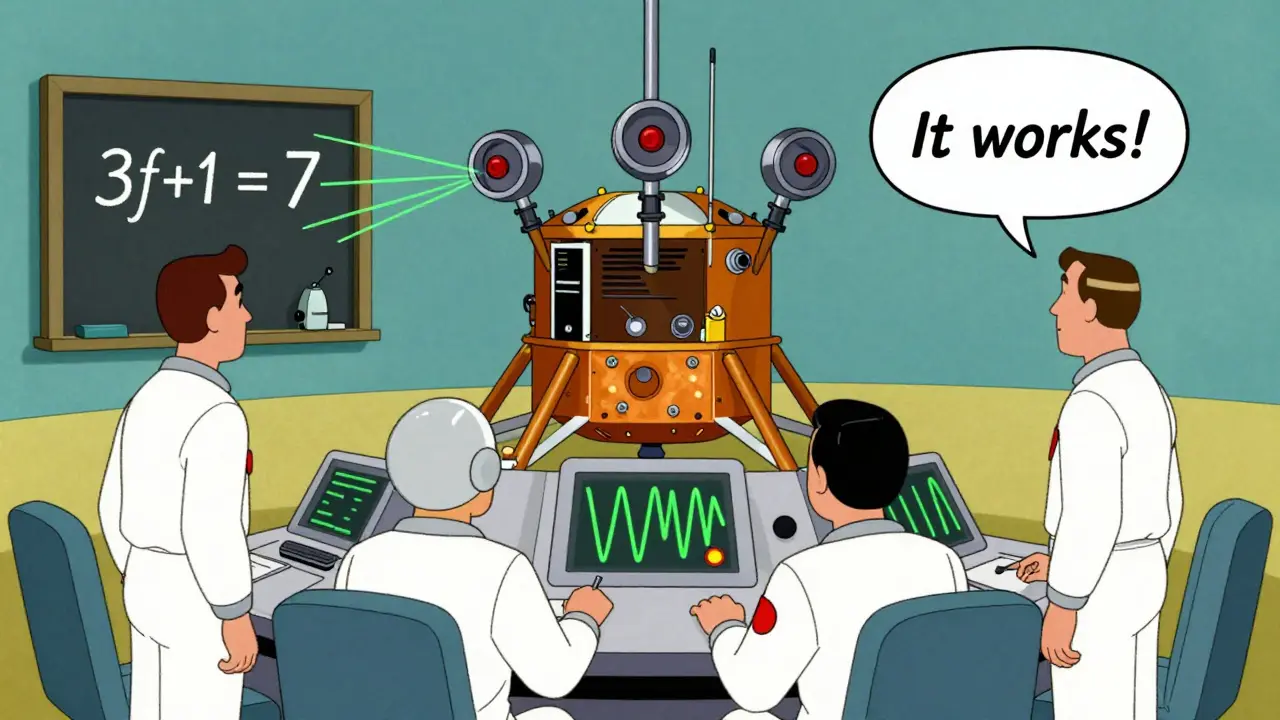
- Even NASA uses BFT in spacecraft control systems. If a sensor sends false data during a lunar landing, the system must ignore it. The Artemis program mandates 3f+1 redundancy for critical systems.
What Happens When BFT Fails?
It’s rare-but it happens. In 2021, a small blockchain called Kadena had a network split because of a software bug. One group of nodes thought a transaction was valid. Another group thought it wasn’t. The network forked. It took 14 hours to fix. No coins were lost, but trust took a hit. The problem isn’t always the algorithm. It’s the implementation. A 2022 survey of 65,000 developers found that 78% struggled with BFT design. Common issues:- Network partitions-when nodes lose connection and start making different decisions.
- Latency spikes-every extra node adds delay. Beyond 100 nodes, throughput drops 15-20% per node.
- Poor documentation-many BFT libraries have confusing guides. Ethereum’s consensus docs scored 3.8/5. Hyperledger’s got 4.2/5.
The Future: Faster, Greener, Quantum-Proof
BFT isn’t stuck in the past. It’s evolving.- HotStuff, developed by Facebook’s Diem team, cut message complexity from O(n²) to O(n). That means networks with 10,000+ nodes can still reach consensus quickly. Chia Network and Libra use it.
- Quantum-resistant BFT is already being tested. IBM announced Q-BFT in 2023-a protocol designed to survive attacks from future quantum computers.
- Energy use dropped 99.95% on Ethereum after switching to PoS. That’s the same as turning off 150,000 homes.
Why You Should Care
You might not be running a blockchain. But you’re using one every time you:- Send crypto to a friend.
- Use a digital wallet.
- Verify a smart contract.
- Pay with a stablecoin.
What is the Byzantine Generals Problem in simple terms?
It’s a puzzle about how a group of people can agree on a plan when some of them might be lying. In blockchain, each computer (node) is a general. They need to agree on which transactions are real. But some nodes could be hacked or malicious. The problem asks: how do you make sure the honest nodes still reach the right decision, even if some are trying to trick them?
Why do you need 3f+1 nodes for Byzantine Fault Tolerance?
If you have f traitors, you need at least 3f+1 total nodes to outvote them. For example, if one node is lying, you need four total-three honest ones can outnumber the one bad one and agree on the truth. If two nodes are traitors, you need seven. It’s math: the honest nodes must be more than twice the number of liars to prevent deception from winning.
Is Bitcoin’s Proof-of-Work a solution to the Byzantine Generals Problem?
Yes. Bitcoin doesn’t rely on trust between nodes. Instead, it makes lying expensive. To fake a transaction, you’d need to control more than half the network’s computing power-which costs millions in hardware and electricity. The cost of cheating is higher than the reward, so most nodes play fair. It’s an economic solution to a trust problem.
How does Ethereum’s Proof-of-Stake solve the Byzantine Generals Problem?
Ethereum replaced mining with staking. Validators must lock up ETH as collateral. If they try to cheat-like approving fake transactions-they lose their stake. This creates a strong financial incentive to be honest. Ethereum’s consensus protocol (LMD-GHOST) combines this with BFT logic to reach agreement across thousands of nodes without massive energy use.
Can the Byzantine Generals Problem be solved without blockchain?
Yes. BFT is used in aerospace (NASA spacecraft), finance (banking ledgers), and even car safety systems. Any system where machines must agree on critical data-without trusting each other-uses BFT. Blockchain just made it famous. The math is the same whether you’re landing on the moon or sending Bitcoin.
What’s the biggest challenge in implementing BFT today?
Complexity. Setting up BFT requires deep knowledge of cryptography, network timing, and message ordering. Many teams spend months just getting it right. Performance also drops as you add more nodes-each extra node adds delay. And if the documentation is bad (which it often is), you’re stuck paying consultants.
Will quantum computers break Byzantine Fault Tolerance?
Not the consensus part. BFT relies on node behavior and economic incentives, not cryptography alone. But digital signatures used in many BFT systems could be broken by quantum computers. That’s why new protocols like IBM’s Q-BFT are being built with quantum-resistant cryptography. The structure of BFT will survive-it’s just the tools that need updating.
Is BFT only used in public blockchains?
No. Private blockchains like Hyperledger Fabric use BFT too. In fact, most enterprise adoption is in private networks-banks, supply chains, government systems. Public blockchains like Bitcoin and Ethereum get the headlines, but BFT is quietly running behind the scenes in critical infrastructure worldwide.
How do you test if a BFT system is working correctly?
You simulate failures. Inject malicious nodes. Cut network connections. Delay messages. See if honest nodes still agree on the same outcome. Tools like Hyperledger Caliper and Ethereum’s consensus test suites do this automatically. Real-world testing often reveals edge cases-like what happens when 30% of nodes go offline at once. That’s why many teams run testnets for months before going live.
What’s next for Byzantine Fault Tolerance?
Faster, smaller, and more adaptable protocols. Projects are exploring ways to reduce message overhead, improve recovery after network splits, and integrate BFT into edge devices like sensors and cars. The goal: make BFT as easy to use as a cloud API-so any system, from a smart thermostat to a satellite, can trust itself without a central server.
5 Comments
Bro this is actually one of the most clear explanations of BFT I've ever read. I used to think blockchain was just crypto hype, but now I get why it's not just a fancy database. The 3f+1 rule is wild when you think about it-like, you need more honest people than twice the number of liars? That's not math, that's survival instinct.
And yeah, PoW is energy hogging, but at least it doesn't need a trust fund to work. PoS is slick, but what happens when the rich get richer and just vote for themselves? Food for thought.
This post is basically a 2000-word LinkedIn post dressed up as a blog. 🙄
Byzantine Generals? Yeah cool. But let's be real-most blockchains today are just centralized servers with a fancy name. NASA uses BFT? So does your microwave. Everyone’s just slapping ‘decentralized’ on stuff to raise funding. PoS isn’t magic-it’s just trust but with more tokens.
Also, 99.95% energy drop? Bro, Ethereum still uses more power than my entire neighborhood. Stop selling fairy tales.
So let me get this straight-you’re telling me we built a global financial system on the idea that if you have enough people, the liars will get outnumbered? And we call that progress?
Meanwhile my grandma still thinks crypto is a pyramid scheme and she’s probably right. But hey, at least now we have 5000 validators voting on whether my cat video NFT is legit. 🤡
Also, NASA uses this? Cool. I hope their moon rover doesn’t get into a 14-hour argument with itself over whether it saw a rock or a shadow.
I really appreciate how this breaks down something so complex without making people feel dumb. It’s rare to see tech explained like this-like you’re talking to a friend over coffee, not reading a textbook written by someone who hates humans.
Also, the part about quantum-resistant BFT? That’s the future. We’re not just building apps-we’re building the new rules for trust. And honestly? That’s kind of beautiful.
This is so basic I’m surprised anyone still talks about it like it’s groundbreaking. Everyone knows PoW is a joke and PoS is just Wall Street with a blockchain tattoo. The real issue? Nobody actually understands the math behind 3f+1 and just copy-pastes it from Wikipedia like it’s a magic spell.
Also, Hyperledger’s docs are trash. I spent three weeks trying to get PBFT working and ended up crying into my coffee. No one should have to suffer like this. And don’t even get me started on testnets. They’re just glorified simulations where everyone pretends they’re not broke.