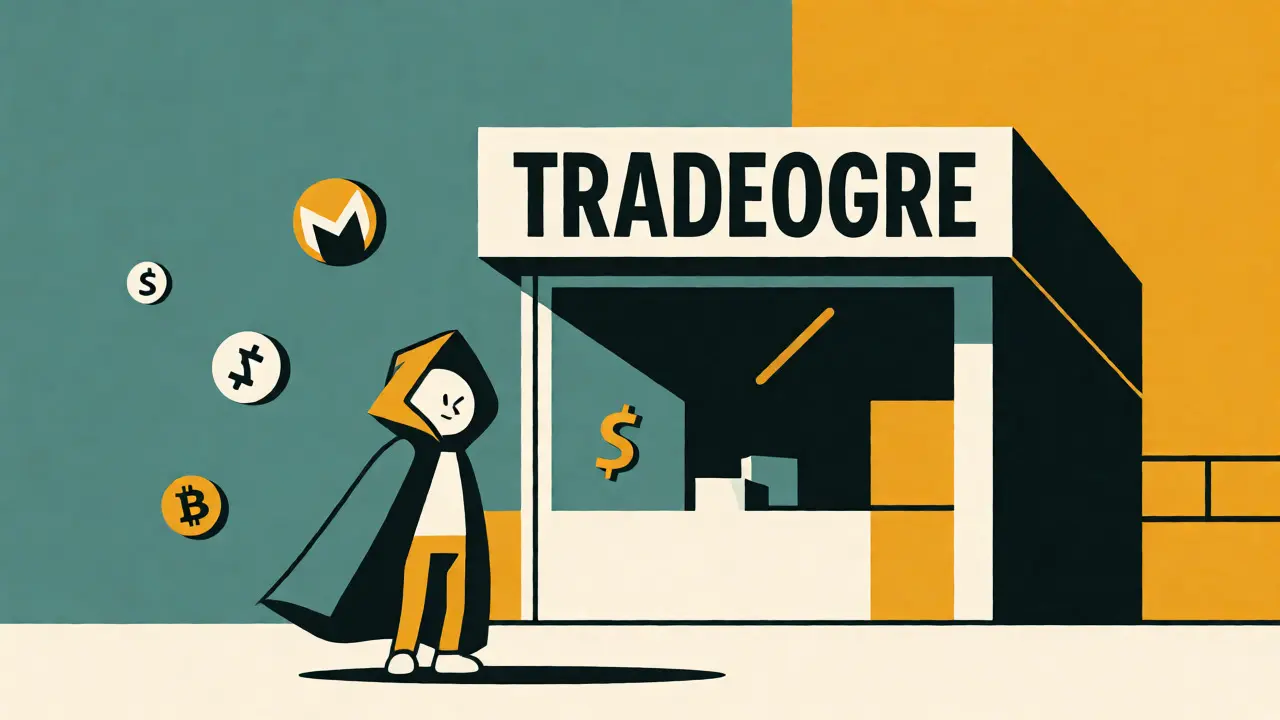
Imagine waking up to find your favorite niche crypto exchange has vanished overnight. No warning, no withdrawal window, just a seized website and $40 million in assets frozen by authorities. That’s exactly what happened to TradeOgre, a platform that served as a sanctuary for privacy-focused traders for seven years before its abrupt end in July 2025. If you were one of the thousands who used it to trade Monero or obscure altcoins without handing over your passport, this story hits close to home. But even if you never traded there, understanding why TradeOgre failed is crucial for anyone navigating the current crypto landscape.
This isn't just a eulogy for a dead exchange. It's a case study on the collision between financial privacy and global regulation. By late 2025, the era of easy, anonymous centralized exchanges is effectively over in regulated jurisdictions. Here is what actually happened to TradeOgre, why it mattered, and what its demise tells us about where crypto is heading next.
What Was TradeOgre?
TradeOgre was a cryptocurrency-to-cryptocurrency exchange launched in 2018 that specialized in privacy coins and operated without Know Your Customer (KYC) verification. Unlike giants like Coinbase or Binance, which require government IDs and proof of address, TradeOgre asked only for an email address. This simplicity made it incredibly popular among users who valued speed and anonymity above all else.
The platform didn’t support fiat currencies. You couldn’t deposit dollars or withdraw euros. Instead, you traded Bitcoin (BTC), Litecoin (LTC), or other major cryptos against a wide array of altcoins. At its peak, the exchange listed over 120 cryptocurrencies, with a heavy emphasis on privacy-centric tokens like Monero (XMR), Dero, Heron, and Pirate Chain. For many, it was the go-to place to acquire privacy coins when mainstream exchanges delisted them due to regulatory pressure.
| Feature | Details |
|---|---|
| KYC Requirement | None (Email only) |
| Fiat Support | No (Crypto-to-Crypto only) |
| Trading Fee | Flat 0.2% |
| Primary Focus | Privacy Coins & Altcoins |
| Status (Oct 2026) | Defunct (Seized by Canadian Authorities) |
The Appeal: Why Traders Loved It
For privacy-conscious users, TradeOgre wasn't just an option; it was often the only option. As major exchanges bowed to pressure from the Financial Action Task Force (FATF) and local regulators, they began delisting privacy coins. Monero, in particular, faced repeated removals from platforms like Kraken and Binance. TradeOgre remained steadfast, maintaining decent liquidity for XMR/BTC pairs even when competitors dropped out.
Reddit user 'xmr_trader42' noted in early 2024 that TradeOgre consistently maintained 15-20 BTC daily volume for XMR/BTC pairs, whereas other no-KYC exchanges had dropped below 5 BTC. That level of activity mattered. It meant you could actually sell your holdings without crashing the price. The interface was basic-some might say ugly-but it worked. You logged in, placed an order, and got out. No lengthy verification processes, no waiting days for approval.
The fee structure was also competitive. A flat 0.2% trading fee aligned with industry averages, but the real draw was the withdrawal costs. While not always transparent, Bitcoin withdrawal fees were reportedly as low as 0.00005 BTC at certain points, significantly cheaper than the 0.0005-0.001 BTC charged by larger, compliant exchanges. For small traders moving funds frequently, these savings added up quickly.
The Cracks in the Foundation
If everything was so great, why did people complain? Because "basic" often crossed the line into "broken." Liquidity issues plagued less popular altcoins. Users reported situations where their sell orders would simply disappear from the order book, or they couldn't execute trades despite setting competitive prices. One particularly scathing review on Slashdot in February 2024 described the experience with Kaspa as "the worst crypto experience I have had in 4 years," citing an inability to bail out of positions even at a loss.
Support was another pain point. With no live chat or phone support, users relied on email tickets that took anywhere from 72 to 96 hours to get a response. In a market that moves in seconds, waiting three days for help is an eternity. Withdrawal delays averaged 12-24 hours, which, while not unusual for some chains, felt excessive given the lack of transparency during the process.
Security concerns also lingered. Industry commentators, including YouTube analyst The Crypto Father, frequently warned that TradeOgre was "a risky place to keep your crypto." The platform lacked the insurance funds and cold storage protocols seen at top-tier exchanges. Many users treated it as a transit point rather than a vault, moving funds in, trading, and immediately withdrawing to self-custody wallets. Those who held large balances on the exchange were playing a high-stakes game of trust.
The End of the Road: Regulatory Seizure
The writing was on the wall long before the final crash. By 2024, the number of no-KYC centralized exchanges serving US customers had dwindled from over 50 in 2021 to roughly 12. Global coordination against non-compliant services intensified, driven largely by the FATF’s Travel Rule implementation. This rule requires financial institutions to collect and share customer data for transfers above certain thresholds, making true anonymity difficult to maintain on centralized platforms.
In May 2025, TradeOgre’s website and social media accounts went silent. Then, on July 30, 2025, ICO Bench reported that Canadian authorities had seized approximately $40 million USD in cryptocurrency assets and shut down the exchange entirely. This marked Canada’s biggest crypto bust and the first-ever full exchange shutdown under such strict enforcement actions.
Why Canada? While specific violations weren't detailed publicly, the move signaled a broader trend. Regulators were no longer content with fining exchanges; they were shutting them down. For users, the impact was immediate. Funds left on the platform became inaccessible, turning digital assets into legal disputes. The seizure highlighted the inherent risk of using unregulated intermediaries: you don't own your keys, and in this case, you didn't even control your exchange.
Lessons for Today’s Trader
TradeOgre’s rise and fall offers several critical takeaways for anyone still active in crypto markets today.
- Regulatory Risk is Real: Even established platforms with loyal user bases can vanish if they fail to comply with evolving laws. The assumption that "too big to fail" applies to niche exchanges is dangerous.
- No-KYC is Becoming Rare: Gartner predicted in late 2025 that centralized no-KYC exchanges would be near-total eliminated in regulated jurisdictions by 2027. If you value anonymity, decentralized exchanges (DEXs) are becoming the primary alternative.
- Liquidity Matters More Than Fees: Low fees mean nothing if you can't exit your position. Always check the depth of the order book for the specific coin you’re trading, especially for smaller caps.
- Self-Custody is King: The safest place for your crypto is a wallet where you hold the private keys. Exchanges should be viewed as bridges, not banks.
The closure of TradeOgre didn't happen in a vacuum. It reflected a maturing industry where compliance is no longer optional. For privacy advocates, the challenge now is finding ways to maintain financial confidentiality within a framework that demands transparency. Decentralized solutions offer a path forward, but they come with their own complexities and risks.
Frequently Asked Questions
Is TradeOgre still operating in 2026?
No, TradeOgre is completely defunct. The platform was shut down by Canadian authorities in July 2025 following a seizure of approximately $40 million in assets. Its website and API remain offline.
Can I still withdraw funds from TradeOgre?
Direct withdrawals via the platform are no longer possible. Users with funds remaining on the exchange at the time of the shutdown must navigate legal proceedings or liquidation processes initiated by Canadian regulators to recover their assets.
Why did TradeOgre require no KYC?
TradeOgre positioned itself as a privacy-centric alternative to mainstream exchanges. By requiring only an email address, it catered to users who wanted to avoid identity verification, a feature that became increasingly rare as global regulations tightened around cryptocurrency transactions.
What were the main complaints about TradeOgre?
Common complaints included poor liquidity for certain altcoins (such as Kaspa), slow customer support response times (often 72+ hours), and occasional withdrawal delays. Some users also reported difficulty selling assets during periods of low market activity.
Are there good alternatives to TradeOgre for privacy coins?
Since most centralized no-KYC exchanges have closed or implemented KYC, decentralized exchanges (DEXs) like Uniswap or atomic swap platforms are now common alternatives. However, note that privacy coin availability on DEXs varies, and you may need to use bridge services or specific privacy-focused DEXs.