Ethereum nonce: What it is and why it matters for your transactions
When you send ETH or interact with a smart contract on Ethereum, your transaction needs a Ethereum nonce, a sequential number that identifies each transaction from your wallet. Also known as a transaction nonce, it ensures your transactions are processed in the exact order you send them—no more, no less. Without it, your wallet could accidentally send the same transaction twice, or someone could replay an old transaction to steal your funds.
The nonce starts at 0 for a brand-new wallet and increases by one with every transaction you send. If you send three transactions in a row, they’ll have nonces 0, 1, and 2. If you skip one—say, you send nonce 0, then nonce 2—the network will hold nonce 2 until nonce 1 clears. This is why your transaction might get stuck: not because the gas fee is too low, but because an earlier one is hanging. It’s not a bug—it’s how Ethereum keeps everything orderly.
This system also protects against replay attacks, where someone tries to reuse your transaction data on another network like Ethereum Classic. Because each nonce is tied to your wallet address and the Ethereum chain, a transaction signed for Ethereum won’t work on a forked chain. That’s why tools like MetaMask automatically track your nonce—you don’t have to guess it.
But here’s the catch: if you’re using multiple wallets or apps at once, or if you cancel a transaction manually, the nonce can get out of sync. That’s when you see errors like "nonce too low" or "transaction underpriced." You don’t need to be a coder to fix it—you just need to know where to look. Most wallets now let you manually adjust the nonce if you’re feeling confident. If you’re not, just wait—or send a new transaction with higher gas to override the stuck one.
It’s not just about sending ETH. Every time you stake, swap on a DEX, or mint an NFT, the nonce is working behind the scenes. Even if you don’t see it, it’s the reason your $50 swap didn’t turn into two $50 swaps. It’s the quiet enforcer of order in a chaotic system.
What you’ll find in the posts below aren’t guides on nonce math or blockchain theory. They’re real-world stories about what happens when things go wrong—like a user losing $3,000 because they didn’t understand nonce sequencing, or how a failed transaction on Arbitrum tied up funds for days. You’ll also see how nonce issues show up in DeFi lending, DEX trades, and even airdrop claims. Some of these posts are about coins like XPET or RACA, but the root of their transaction problems? Often, it’s a nonce.
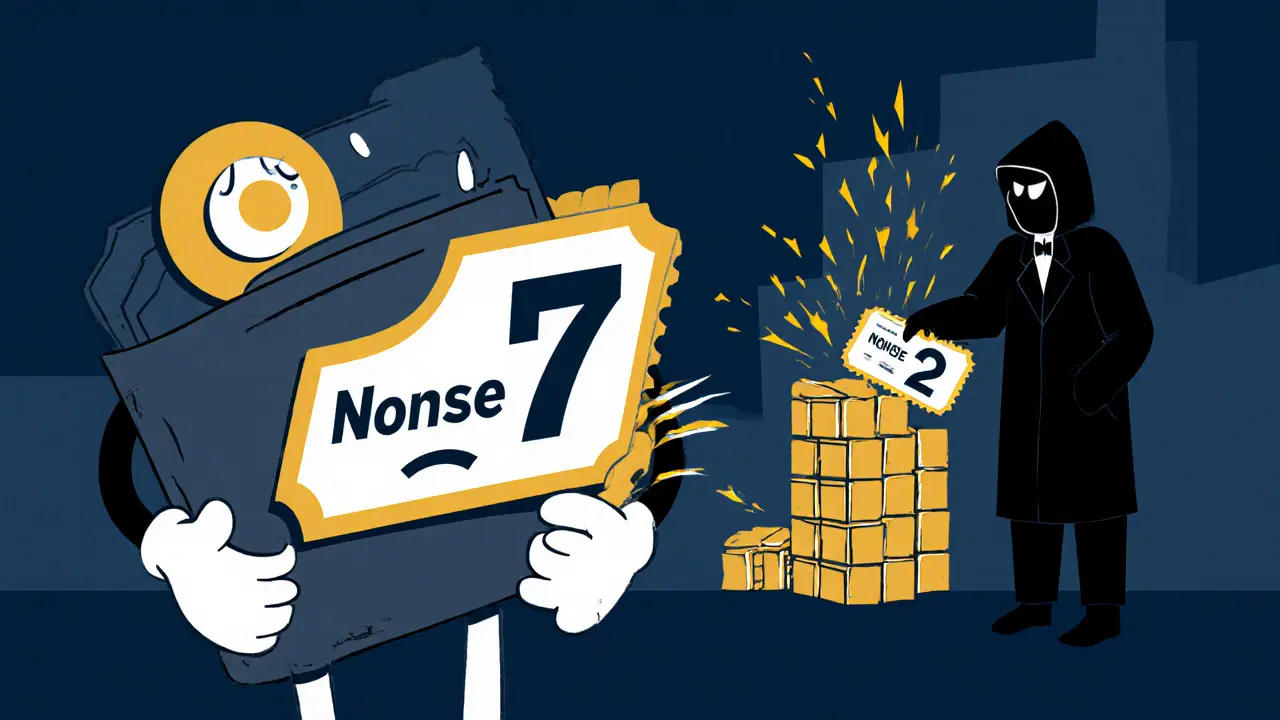
How Nonce Prevents Transaction Replay Attacks in Blockchain
A nonce prevents replay attacks in blockchain by ensuring each transaction is used only once. It's a simple counter that keeps your funds safe from being copied and reused by attackers.