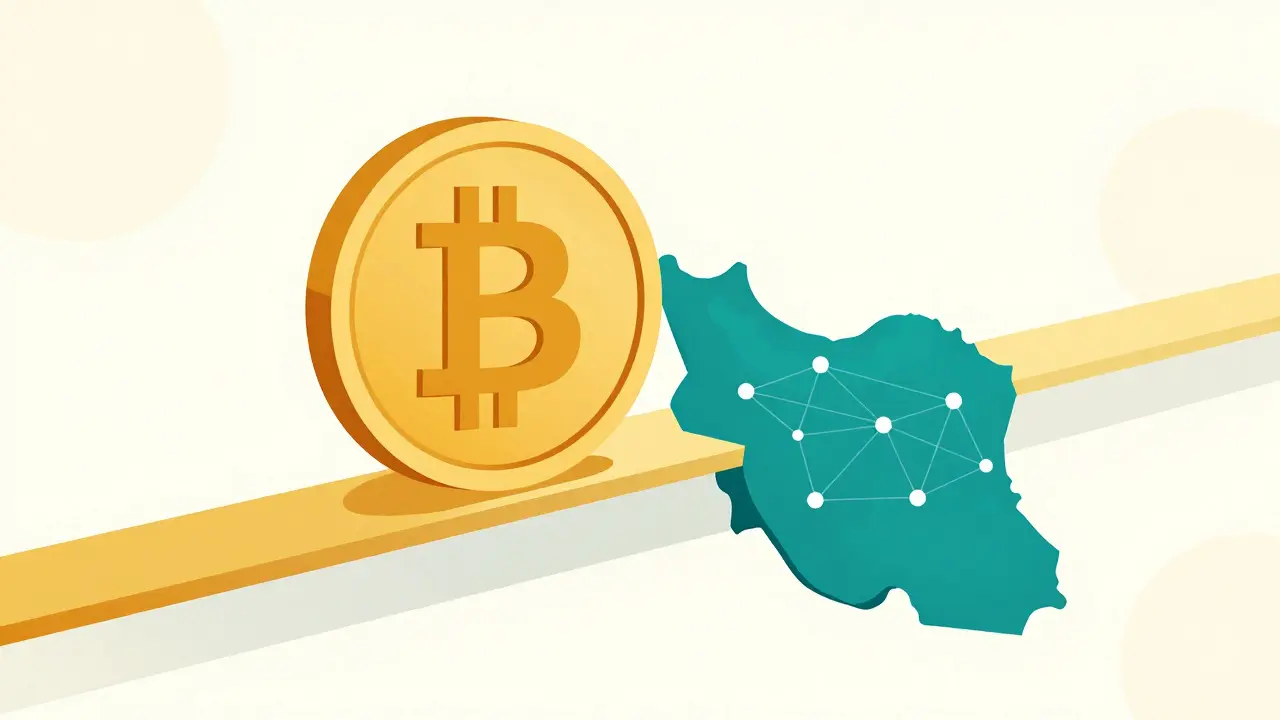
Imagine a world where a government doesn't just regulate a digital gold rush but actually runs the biggest mines. In Iran, this isn't a hypothetical-it's a state-sponsored strategy. While most countries view crypto mining in Iran is the process of using high-powered hardware to validate blockchain transactions to earn digital currency as a private business venture, Tehran has turned it into a tool for national survival. By leveraging some of the cheapest electricity on earth, the Iranian state has built a massive industrial operation designed to bypass global financial blockades.
The Quick Take: State-Backed Mining in Iran
- The Goal: Use Bitcoin and other assets to move money across borders without using the US-dollar-dominated banking system.
- The Players: The Islamic Revolutionary Guard Corps (IRGC) and entities linked to the Supreme Leader are the primary operators.
- The Cost: Massive "crypto cartels" divert power, causing severe blackouts for ordinary citizens.
- The Legal Loophole: While the state mandates licenses for civilians, elite-linked farms often operate with zero oversight and nearly free power.
A Strategy for Sanctions Evasion
For years, Iran has been locked out of the international banking system. When the US tightened sanctions, the Iranian government didn't just look for new trading partners-they looked at the blockchain. In July 2018, the administration of President Hassan Rouhani officially recognized mining as a legal industry. This wasn't about fostering innovation for the public; it was about creating a sovereign way to generate hard currency.
By using Bitcoin and other decentralized assets, the state can convert mined coins into foreign currency without ever touching a traditional bank. This allows them to pay for imports and fund operations globally while remaining invisible to the systems that track SWIFT transactions. To make this work, the Central Bank of Iran (CBI) even explored a national cryptocurrency backed by the rial to further insulate the economy from external pressure.
The Rise of the Crypto Cartel
The real power in Iranian mining doesn't lie with independent entrepreneurs, but with the security apparatus. Between 2019 and 2020, the IRGC and organizations under Supreme Leader Ali Khamenei aggressively entered the market. They didn't start small; they built industrial-scale farms, often in partnership with Chinese investors who were hunting for low-cost energy.
Take the Rafsanjan facility in Kerman province. This massive 175-megawatt farm is a joint venture between IRGC-linked firms and Chinese partners. Why there? Because the electricity tariffs for these elite operations can be as low as 0.004 cents per kWh. To put that in perspective, that is roughly 1/50th of what a commercial miner in North America or Europe would pay. When your power is practically free, your profit margins become astronomical.
These operations aren't always in plain sight. Some are hidden in military bases, while others are buried in urban infrastructure. In one shocking case, a 16-hectare sports complex in Ahvaz was found to have a massive mining operation tucked away in tunnels beneath a cycling track. These facilities operated for over two years, sucking power from the grid while the public remained oblivious.
The Human Cost: Blackouts and Public Outrage
There is a brutal irony in Iran's approach: the state promotes mining to save the economy, but the mining is destroying the power grid. The sheer amount of energy required to run ASIC miners-specialized computers designed solely for hashing-is staggering. By early 2023, national mining capacity was estimated to exceed 1,000 megawatts.
When the summer heat hits 45°C, the grid collapses. While families in Tehran's District 3 suffer through 14-hour blackouts, the state-affiliated mines keep humming. This has led to widespread anger on social media, with hashtags like #IranEnergyCrisis trending as citizens realize that their basic need for electricity is being traded for digital coins that benefit a small circle of power brokers.
| Feature | Legal/Private Miner | State-Affiliated (IRGC/Elite) |
|---|---|---|
| Licensing | Requires Ministry of Industry permit (6-8 weeks) | Often exempt or expedited |
| Electricity Cost | Approx. 7 cents per kWh | As low as 0.004 cents per kWh |
| Hardware | Must use government-approved gear | Latest international ASICs |
| Power Stability | Subject to rationing/cuts | Dedicated, uninterrupted feeds |
The Regulatory Tightrope
Tehran is currently playing a dangerous game of cat and mouse with its own citizens and the international community. On one hand, they want the money from crypto; on the other, they fear capital flight. In late 2024, the Central Bank blocked all cryptocurrency-to-rial payment gateways to stop money from leaving the country. They later partially unblocked them, but with a catch: exchanges had to provide API access giving the government full data on every user.
Now, the state is moving toward taxation. The August 2025 'Law on Taxation of Speculation and Profiteering' finally brought crypto under the tax umbrella, treating it like gold or real estate. This signals a shift: crypto is no longer just a secret tool for sanctions evasion; it's a taxable asset that the state intends to squeeze for every cent.
International Pressure and the Tether Freeze
The world is starting to fight back. Because many Iranian miners and traders rely on stablecoins to avoid the volatile rial, Tether (USDT) has become a primary target. On July 2, 2025, Tether executed its largest-ever freeze of Iranian-linked funds, blocking 42 addresses connected to Nobitex and IRGC wallets.
This move sent shockwaves through the Iranian ecosystem. It forced the government to pivot rapidly, urging users to move their holdings from USDT to DAI via the Polygon network. This adaptation shows that while the state is powerful internally, it is still vulnerable to the controllers of the major stablecoins.
Is cryptocurrency mining legal in Iran?
Yes, it was officially legalized in July 2018. However, to operate legally, miners must obtain a license from the Ministry of Industry, Mine and Trade and adhere to specific electricity tariffs and hardware requirements. Unlicensed mining remains illegal and is subject to crackdowns, although state-affiliated operations often bypass these rules.
Why does the IRGC control crypto mining?
The IRGC uses mining to generate revenue and facilitate cross-border payments that circumvent US and international sanctions. By controlling the infrastructure, they can convert digital assets into foreign currency without using the traditional banking system, which is heavily monitored.
How has crypto mining affected Iran's power grid?
The energy-intensive nature of ASIC mining has contributed to severe grid instability. Massive state-run farms consume huge amounts of electricity, often leading to prolonged power outages in residential areas, especially during peak summer temperatures.
What is the 'Rial Currency' mentioned by the Central Bank?
The Rial Currency is a Central Bank Digital Currency (CBDC) intended to be an electronic version of the traditional Iranian rial. Unlike Bitcoin, it is centralized and controlled by the state, designed to facilitate domestic transactions and potentially international trade under government oversight.
What happened with the Tether freeze in 2025?
In July 2025, Tether froze 42 Iranian-linked addresses associated with Nobitex and IRGC-linked wallets. This was a coordinated effort to stop sanctions evasion, prompting the Iranian government to push users toward more decentralized stablecoins like DAI.
Next Steps for Navigating the Crisis
For those attempting to operate in this environment, the path depends entirely on who you are. If you are a private citizen, the focus is now on compliance and avoiding the "red flags" that lead to fund freezes. Using decentralized alternatives to USDT and keeping an eye on the new capital gains tax is essential for survival.
For observers and policymakers, the situation in Iran serves as a case study in how a state can weaponize blockchain technology. The struggle between the regime's need for sanctions evasion and the public's need for electricity creates a volatile atmosphere where the digital economy is literally stealing power from the real economy.
8 Comments
It's quite fascinating to see how different nations adapt blockchain technology to fit their specific geopolitical needs. While the situation with the power grid is unfortunate, the technical pivot from USDT to DAI shows a remarkable level of resilience and agility in their digital infrastructure.
everyone acts like this is a shock but it's just state corruption as usual the blockchain part is just a fancy wrapper for stealing electricity from poor people lol
The utilization of decentralized finance to mitigate the impact of international sanctions presents a complex ethical dilemma. It is imperative to recognize that while the state benefits, the socio-economic burden falls disproportionately upon the civilian population who suffer from inadequate energy infrastructure.
From a technical standpoint, the shift towards more decentralized stablecoins like DAI is a logical progression. Centralized entities like Tether possess the authority to freeze assets, which inherently contradicts the fundamental premise of censorship resistance that cryptocurrency was designed to provide. This situation highlights the ongoing struggle between the desire for financial autonomy and the reality of centralized control within the current stablecoin ecosystem. Furthermore, the implementation of taxation on these assets indicates a transition from a clandestine operation to a formal state economic strategy, which may lead to more systemic instabilities in the long run. It would be beneficial to explore how other sanctioned nations are employing similar tactics to see if this is becoming a global trend in state-sponsored digital asset acquisition. The intersection of energy policy and digital currency is a critical area of study for future economic stability.
I totally agree that the energy crisis is a huge deal here. It's kind of sad how the elites get the fast lane while everyone else is in the dark.
The point about the sports complex in Ahvaz is wild. It really shows that when the state is involved, the rules just don't apply. I think it's a great lesson in why true decentralization is so hard to achieve when the physical hardware still depends on a state-controlled power grid.
The way they're hiding mines under cycling tracks is just absolutely wild! 🚲✨ Such a chaotic move by the government. Poor people just wanting their AC to work while the elites are mining away in secret tunnels is just a whole other level of unfairness 😱💥
My heart simply breaks for the families in Tehran who must enduure such harrash conditions while the state prioritizes digital coins. It is an utter travesty that basic human needs are being sacrificied for the sake of evadeing sanctions. The sheer dramatics of the situaton are overwhelming and truly disheartenning to read about in this report.
Hopefully, the move toward more decentralized assets helps the average person find some stability!