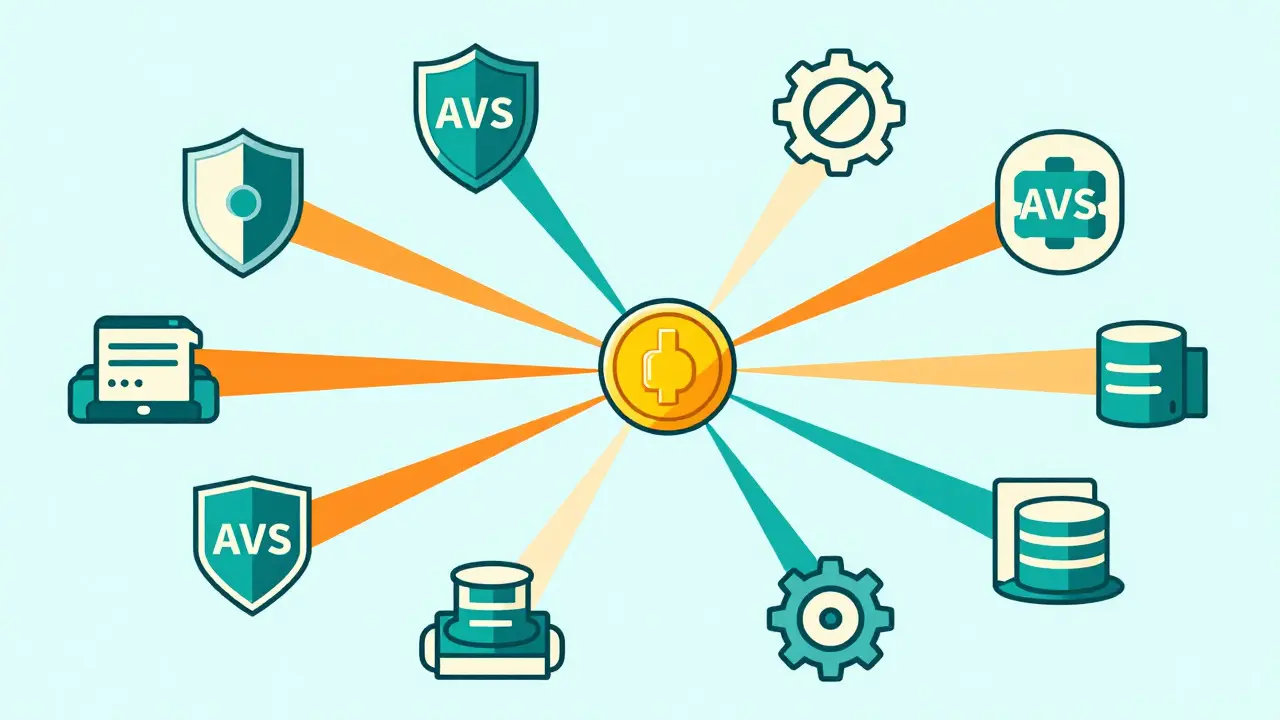
Imagine you have a large sum of money sitting in a savings account. It’s safe, but it’s not doing much for you. Now imagine that same money could secure your house, your car, and your business all at once, earning interest from each without needing to buy three separate insurance policies. That is essentially what restaking is doing for the blockchain world. In 2026, this mechanism has moved beyond experimental hype to become a core pillar of decentralized infrastructure, fundamentally changing how we think about capital efficiency and network security.
For years, staking Ethereum meant locking your assets up to secure one specific network. If you wanted to participate in another protocol, you had to move your funds, risking slippage and complexity. Restaking breaks this silo. It allows validators to extend their existing stake to secure multiple "Actively Validated Services" (AVSs) simultaneously. As of mid-2026, the total value locked in these protocols has surged past previous peaks, signaling that institutional players are no longer just watching-they are participating. The question isn't whether restaking will survive, but how deeply it will integrate into the backbone of global digital finance.
The Core Mechanism: From Idle Capital to Active Security
To understand why this matters, you need to look at the shift in asset utility. Traditional staking locks capital for a single purpose. Restaking enables staked assets to simultaneously secure multiple protocols and services beyond their original blockchain network. This is primarily driven by platforms like EigenLayer, which launched its mainnet in late 2023 and has since become the standard-bearer for this technology. By allowing ETH holders to delegate their stakes to operators who manage various AVSs, the system transforms idle capital into a productive resource.
The technical architecture relies on a sophisticated delegation model. You can either run the validation infrastructure yourself as an operator or trust a third-party operator to handle the technical heavy lifting. In return, you earn supplementary rewards on top of your base staking yield. This dual-income stream is the primary driver for adoption. Users report annual yields 15-25% higher than traditional staking, provided they manage their risk exposure correctly. The key here is that the security is shared; if one service fails, the penalty (slashing) comes from the same pool of staked assets, creating a unified security layer that benefits all connected protocols.
Key Players and the Liquid Restaking Landscape
The ecosystem in 2026 is crowded with innovative solutions, but a few names dominate the conversation. Beyond EigenLayer, protocols like EtherFi, Renzo, and Karak have carved out significant market share by offering different approaches to liquidity and risk management. These platforms issue Liquid Restaking Tokens (LRTs), which allow users to trade their staked positions while still earning yield. This solves the biggest pain point of early restaking: illiquidity.
| Protocol | Primary Focus | Liquidity Model | Risk Profile |
|---|---|---|---|
| EigenLayer | Core AVS Security | Direct Staking / LRT Partners | Medium-High (Complex Slashing) |
| EtherFi | Liquid Yield Optimization | eETH Token | Medium (Smart Contract Risk) |
| Renzo | User-Friendly Access | ezETH Token | Low-Medium (Abstracted Complexity) |
| Karak | Cross-Chain Interoperability | KETH Token | High (Multi-Chain Exposure) |
Each of these entities serves a different job-to-be-done. If you are an experienced DeFi user looking for maximum yield and don't mind managing complex interfaces, direct interaction with EigenLayer might be your path. If you prefer simplicity and want to use your staked assets in other DeFi applications immediately, an LRT like eETH or ezETH is likely a better fit. The choice depends entirely on your risk tolerance and technical comfort level.

Modular Blockchains and the Expansion of Scope
Restaking didn't grow in a vacuum; it evolved alongside the rise of modular blockchain architectures. Networks like Celestia and the restructured framework of Polygon 2.0 introduced the concept of separating data availability from execution. This separation creates new types of services that need securing-specifically, data availability layers and rollup sequencers.
This is where restaking shines. Instead of every new Layer 2 rollup building its own expensive validator set from scratch, they can tap into the massive security pool provided by restaking protocols. For startups, this means launching an execution layer without building a full Layer 1 blockchain. They utilize services like Celestia for data availability while customizing their environment for speed or privacy. The result is a dramatic reduction in infrastructure costs and time-to-market. For end-users, this translates to more robust and cheaper transaction processing across the entire Ethereum ecosystem.
Institutional Adoption and Regulatory Clarity
One of the most significant shifts in 2026 is the entry of institutional capital. Early adopters were mostly retail investors and DeFi natives, but now, enterprise funds and even some traditional financial institutions are exploring restaking as a core strategy. Why? Because the compliance frameworks have matured. Industry surveys indicate that clear crypto regulations have encouraged broader participation, with estimates suggesting that improved regulatory clarity could drive a 20% increase in American engagement with cryptocurrency markets.
Analysts from firms like Three Sigma note that "pooled security" is proving powerful. The introduction of governance models and standardized risk metrics has addressed many of the complexity challenges that previously kept institutions away. We are seeing the emergence of dedicated risk management tools designed specifically for institutional requirements. This isn't just about chasing yield anymore; it's about optimizing balance sheet efficiency. For a fund holding billions in ETH, the ability to generate additional revenue from those assets without increasing directional exposure is a compelling proposition.

Navigating the Risks: Slashing and Complexity
However, it would be irresponsible to discuss the future of restaking without addressing the risks. The primary concern remains slashing. In traditional staking, you only get penalized if the Ethereum network itself fails or if your validator goes offline. In restaking, you are exposed to the failure modes of multiple AVSs. If an oracle network provides bad data, or if a data availability layer fails to commit blocks, your stake can be slashed.
This introduces a layer of complexity that requires active management. The learning curve for restaking typically ranges from two to four weeks for experienced DeFi users, but can take one to three months for those coming from traditional finance. You need to understand operator selection criteria, multi-protocol risk exposure models, and withdrawal timeframes. Common pitfalls include underestimating the impact of gas fees during high volatility periods or failing to monitor operator performance. Effective participation requires an initial investment of 10-15 hours of research, followed by regular monthly monitoring to rebalance your portfolio.
The Road Ahead: Multi-Chain and AI Integration
Looking forward, the next major evolution is multi-chain staking. Currently, most restaking activity is concentrated within the Ethereum ecosystem, but we are seeing early signs of cross-ecosystem capital flows. As more chains adopt shared security and modular consensus models, the potential for cross-chain LRTs and composable yield across rollups becomes a reality. This will allow capital to flow freely between networks, seeking the best risk-adjusted returns.
Another exciting frontier is the intersection of restaking and artificial intelligence. Decentralized AI platforms are emerging, challenging big tech control over compute resources. These platforms require verifiable computation to ensure that AI models are running correctly. Restaking protocols are perfectly positioned to secure these AI-powered solutions through validated computation services. Imagine a future where your staked ETH secures not just blockchains, but also the integrity of decentralized AI agents. This expansion of scope suggests that restaking could become the dominant model for blockchain security by 2030, serving as the foundational infrastructure for a wide array of decentralized applications.
What is the main difference between staking and restaking?
Staking involves locking assets to secure a single blockchain network. Restaking extends that same stake to secure additional services (AVSs) simultaneously, allowing you to earn multiple streams of rewards from one pool of capital.
Are Liquid Restaking Tokens (LRTs) safe?
LRTs add a layer of smart contract risk compared to direct staking. While they offer liquidity and ease of use, you must trust the protocol managing the token. Reputable protocols like EtherFi and Renzo have undergone audits, but due diligence is always required.
How much yield can I expect from restaking in 2026?
Yields vary based on the specific AVSs you expose your stake to. Generally, users report 15-25% higher annual yields compared to base Ethereum staking, though this fluctuates with network demand and reward distributions.
What is slashing in the context of restaking?
Slashing is a penalty where a portion of your staked assets is burned or confiscated if a validator fails to perform correctly. In restaking, you face slashing risks from both the base layer (Ethereum) and any additional AVSs your stake secures.
Do I need to be a technical expert to participate?
Not necessarily. While understanding the mechanics helps with risk management, most users can participate through Liquid Restaking Token protocols that abstract away the technical complexity. However, reading documentation and understanding the risks is crucial for long-term success.
8 Comments
Oh, look at you all, pretending to understand how money actually works in this digital age. It’s just a fancy way for the whales to skim off the top while we small fry worry about slashing penalties that could wipe out our entire savings. I mean, really? Who decided that locking up your assets for multiple 'services' is a good idea instead of just keeping them safe? It feels like they are testing us to see how much risk we will absorb before we complain. The so-called 'efficiency' is just a buzzword for making it harder for regular people to exit their positions without losing a chunk of their principal. I have been following DeFi since the beginning and never once did I see such a convoluted structure designed specifically to confuse the average user. They talk about institutional adoption as if that means something for us, but honestly, it just means the rules are being written by people who don't care about retail investors at all. If one of those AVSs fails, guess who takes the hit? Not the operators, not the institutions, but the people who trusted the system. It is a classic case of privatizing the gains and socializing the losses, but with more code involved. Stop pretending this is about democracy in finance; it is about creating new layers of dependency on centralized validators who act like kings. We should be asking why we need so many layers of abstraction when simple staking used to work fine. The complexity is not a feature, it is a bug that benefits the insiders. :)
the soul of capital is trapped in the digital void waiting for redemption through shared security
this is not just technology it is the evolution of human trust itself
You are ignoring the fact that the liquidity premium provided by LRTs has fundamentally altered the cost of capital for Layer 2 rollups. Without this mechanism, the entry barrier for new execution environments would remain prohibitively high for most startups. The correlation between TVL growth and protocol stability is statistically significant across the EigenLayer ecosystem data from Q1 2026. Furthermore, the reduction in redundant validator sets decreases the total computational overhead required to secure the Ethereum ecosystem by an estimated 15 percent. This efficiency gain is not trivial when considering the energy costs associated with running full nodes globally. The argument that it is merely a scheme for whales ignores the composability benefits that allow smaller protocols to bootstrap their security without raising separate funds. The market has priced in this risk adjustment correctly, as evidenced by the spread between base staking yields and restaking yields. To dismiss it as complex is to ignore the engineering marvel that enables cross-protocol settlement without bridging. The future of decentralized infrastructure depends on these shared security models becoming the standard rather than the exception.
stop crying about the risk you idiots its free money if you know how to play the game
america is leading this charge because we build things that work while europe sits there debating regulation again
look at the numbers the tvl is up 40% in the last quarter thanks to US based teams pushing hard
if you cant handle a little slashing then go buy a bond and sit in a corner
One must observe the inherent fragility of the delegation model described herein. The reliance on third-party operators introduces a non-trivial vector for adversarial attacks, which is often glossed over in such optimistic narratives. The term 'shared security' is somewhat misleading; it is, in reality, a concentration of risk that demands rigorous actuarial analysis. Furthermore, the assumption that institutional participation mitigates retail risk is empirically unsound. History suggests that large players often exit first during systemic shocks, leaving smaller holders exposed to illiquidity. The modular blockchain narrative, while technically sound, suffers from severe coordination problems that have yet to be resolved in practice. Until a robust insurance layer is integrated into the protocol design, the expected value remains negative for the median participant. One should proceed with extreme caution and perhaps consider allocating only a negligible portion of one's portfolio to such speculative instruments. The jargon-heavy marketing obscures the fundamental lack of downside protection for the end-user.
It is quite evident that this entire construct is a mechanism for centralization disguised as decentralization. The operators controlling the AVSs hold disproportionate power over the fate of every staker's assets. One cannot help but wonder if the regulatory clarity mentioned is merely a facade to allow these entities to operate with less oversight. The claim of increased yield is likely a trap to lure in unsuspecting investors who do not understand the true nature of smart contract risk. In the grand scheme of financial history, this resembles the subprime mortgage crisis of 2008, where complex derivatives were sold to the public as safe havens. The separation of data availability from execution is a clever trick to obscure the single points of failure that remain within the sequencer networks. We must ask ourselves who truly benefits when a major AVS fails; surely it is not the retail holder watching their balance evaporate. The integration of AI into this stack adds another layer of opacity that makes auditing nearly impossible for the average citizen. Until transparent governance structures are implemented, this remains a playground for the elite few. The path forward requires a complete overhaul of the incentive mechanisms to align operator interests with those of the delegators. Otherwise, we are building a house of cards on a foundation of speculation and hidden agendas.
How utterly exhausting to read yet another article that treats speculative yield farming as if it were a stable investment strategy.
The notion that 'institutional adoption' validates this mechanism is laughable; institutions adopt what is profitable, not what is sound.
One wonders if the authors have ever actually managed a portfolio that relies on such volatile reward streams.
The comparison to savings accounts is not just inaccurate; it is dangerously misleading to the uninitiated.
We are seeing a repeat of the dot-com bubble, where technical novelty was mistaken for economic substance.
The risk profile table provided is a gross oversimplification of the tail risks involved.
If one values capital preservation above all else, this entire sector should be avoided entirely.
The hype cycle is peaking, and we are all just along for the ride until the music stops.
🤯
Finally someone is talking about the real utility here! 🚀
Forget the boring old staking, this is the future of yield optimization.
The LRTs are a game changer for liquidity, no cap.
I've been sitting on my ETH doing nothing, time to put it to work.
Who else is diving into Karak for that cross-chain exposure? 🌍
The AI angle is wild, securing AI agents with crypto? Mind blown. 🧠
Just gotta watch out for slashing, but the rewards are worth it, right?
This is how we take back control from the banks, baby! 💪
Can't wait to see what 2027 brings for multi-chain staking. 🔥