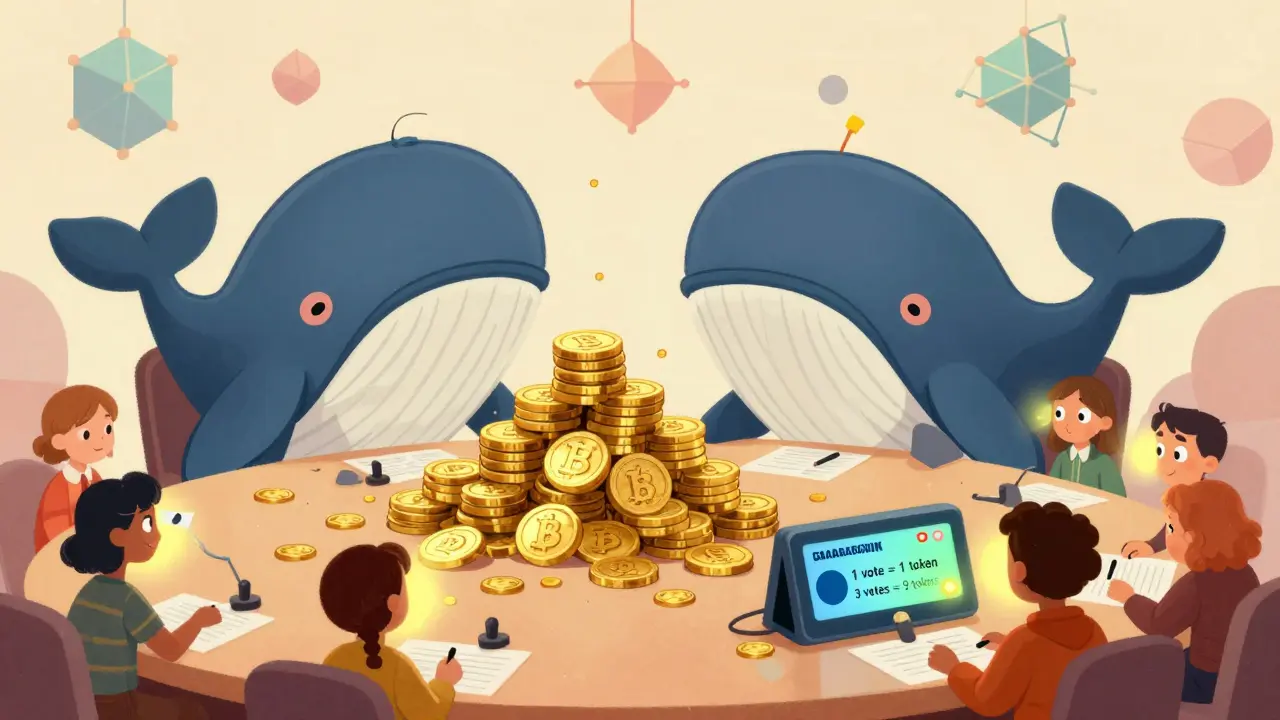
Imagine a DAO where one person holds 10% of all tokens. In a normal vote, they control 10% of the outcome. Now imagine another person holds 50% of the tokens. They control half the vote. That’s token-weighted voting - simple, but deeply unfair. It turns governance into a wealth contest. Quadratic voting changes that. It doesn’t ignore how much you hold - it just makes it harder to crush the rest of the community with it.
How Quadratic Voting Works (Without the Math)
Quadratic voting isn’t about giving everyone one vote. It’s about letting people say how much they care - but at a price. If you want to cast one vote, it costs one token. Two votes? Four tokens. Three votes? Nine tokens. Ten votes? One hundred tokens. The cost goes up by the square of the number of votes. That’s the quadratic part.
Why does this matter? Because it forces people to think. If you’re a whale with 10,000 tokens, you can’t just spend them all on one proposal. You’d burn through your budget fast. But if you’re someone with 10 tokens, you can still make your voice heard - maybe cast 3 votes for a proposal you really believe in, even if you don’t have much to spare. The system doesn’t silence the rich. It just stops them from drowning out everyone else.
Real-world example: A DAO has 100 members. 99 of them have 1 token each. One member has 100 tokens. In a normal vote, the whale wins 100 to 99. In quadratic voting, the whale gets 10 votes (square root of 100). The 99 others together get 99 votes. The community wins. That’s not magic. That’s math designed for fairness.
Why Token-Weighted Voting Fails in DAOs
Most DAOs still use token-weighted voting. It’s easy to code. It’s familiar. But it’s broken. Large holders - whales, venture funds, founders - dominate every decision. Proposals that benefit the few get passed. Proposals that help the many get ignored. Even if 80% of members dislike a proposal, if one whale holds 51% of tokens, it passes.
This isn’t hypothetical. In 2023, a major DeFi DAO passed a proposal to redirect treasury funds to a project owned by its largest investor. The vote passed 52% to 48%. But only 12% of token holders voted. The rest didn’t bother - why would they? Their 0.1% stake meant nothing. The system rewarded apathy and concentrated power.
Quadratic voting fixes this by making participation matter more than balance. It turns governance from a battle of wallets into a conversation of conviction. People who care deeply - even if they hold little - can still swing outcomes. That’s how you get real community-driven decisions.
How Real-World DAOs Are Using It
Some DAOs are already testing quadratic voting - not as a theory, but in practice.
CityDAO used it to decide where to buy land for a decentralized city. Instead of letting big holders pick the location, they let smaller members vote with quadratic credits. The winning site wasn’t the most expensive or the most popular among whales - it was the one with the most passionate support across many small holders.
Codeless Conduct used quadratic voting to rank hackathon submissions. Judges didn’t just pick one winner. They allocated votes across dozens of projects, spending their limited credit pool on what they truly believed in. The result? A more balanced set of winners that reflected diverse skill sets, not just flashy marketing.
Realms, a DAO platform, built a built-in quadratic voting plugin. It’s not just a feature - it’s a governance upgrade. Voters get a fixed budget of voting credits. They can spend them on one proposal or spread them out. The smart contract enforces the square rule automatically. No manual counting. No cheating. No whales gaming the system.
These aren’t experiments. They’re proof that quadratic voting works in real governance - when the tool is set up right.

The Hidden Problems (And How to Solve Them)
Quadratic voting isn’t magic. It has real flaws.
1. Sybil Attacks - What if someone creates 100 fake accounts to vote? Each one gets a small budget. Together, they could flood the system. The fix? Identity verification. Realms uses Civic Pass to tie votes to real people. No ID? No vote. This isn’t perfect, but it’s the best we have right now.
2. Voter Confusion - Most people don’t understand squares and square roots. If you ask someone to spend 9 tokens for 3 votes, they’ll think you’re asking them to pay $9 for 3 apples. The interface has to explain it simply. Good DAOs use visual sliders: drag to 3 votes, and it shows “Cost: 9 credits.” No math needed.
3. Low Participation - Even with better voting, people still don’t vote. A 2024 study from Frontiers in Blockchain found that DAOs using quadratic voting saw participation rise by 27% compared to token-weighted systems - but only if they actively reminded members and made voting easy. Push notifications. Simple dashboards. Weekly voting summaries. These matter.
4. Budget Allocation - How many credits should each voter get? Too few, and people can’t express strong opinions. Too many, and whales can still dominate. Most DAOs start with 100 credits per member. They adjust based on turnout and results. It’s not set in stone - it’s a dial you tweak over time.
When Quadratic Voting Doesn’t Work
It’s not a cure-all. There are times when it’s the wrong tool.
If you’re voting on a simple yes/no decision - like whether to hire a new developer - linear voting is fine. Quadratic voting adds noise. It’s overkill.
If your DAO has fewer than 50 active members, the math doesn’t help much. You’re better off with a simple majority.
If you can’t verify identities, skip it. Without Sybil resistance, quadratic voting becomes a game of fake accounts - and you’re worse off than before.
Quadratic voting shines when you have:
- 100+ active members
- High concentration of tokens in a few hands
- Complex proposals with multiple stakeholder interests
- A community that wants fairness, not just efficiency
If your DAO is growing and you’re starting to see tension between whales and the rest - that’s when you need quadratic voting.

What’s Next for DAO Voting?
DAOs are learning. The early days were about getting any governance working. Now, they’re about getting the right governance working.
In 2024, researchers published new models that combine quadratic voting with reputation systems. Imagine: your voting power isn’t just based on tokens or identity - it’s also based on how long you’ve contributed, how often you’ve voted well, or how many proposals you’ve helped improve. That’s the next step.
Tools are getting better too. New interfaces let you see your vote budget in real time. You can drag sliders, see how much you’re spending, and even simulate outcomes before you vote. No more guesswork.
And the academic work is accelerating. Papers from Stanford, MIT, and Frontiers in Blockchain are now treating quadratic voting not as a niche experiment, but as a core building block of democratic Web3.
DAOs that stick with token-weighted voting will keep losing trust. The whales will win. The rest will leave. The ones that adopt quadratic voting - and do it well - will build communities that last.
Should Your DAO Use It?
Ask yourself these questions:
- Do large holders dominate every vote?
- Do most members feel their voice doesn’t matter?
- Are you seeing low turnout because people think voting is pointless?
- Do you want decisions that reflect the community - not just the richest?
If you answered yes to any of these, you’re ready.
You don’t need to build it from scratch. Use Realms. Use Colony.io. Use a template. Start with 100 credits per member. Enable Civic Pass for identity. Run one vote with quadratic voting. See what happens.
Don’t wait for perfect. Wait for better.
Final Thought
Blockchain promised decentralized power. But without smart governance, it just recreated the same old hierarchy - with crypto wallets instead of boardrooms.
Quadratic voting is one of the first real tools that flips that script. It says: your voice matters, no matter how many tokens you hold. And that’s not just technical. It’s human.
What is quadratic voting in DAOs?
Quadratic voting is a governance system where the cost of casting votes increases with the square of the number of votes. For example, 1 vote costs 1 token, 2 votes cost 4 tokens, and 3 votes cost 9 tokens. This prevents large token holders from dominating decisions by making it expensive to cast many votes, while still allowing smaller holders to express strong preferences.
How is quadratic voting different from token-weighted voting?
In token-weighted voting, each token equals one vote. The more tokens you hold, the more power you have - leading to whale dominance. Quadratic voting gives everyone a budget of voting credits, and each additional vote costs more than the last. This reduces the influence of large holders and gives more weight to passionate minority opinions.
Can whales still manipulate quadratic voting?
Not easily. A whale with 10,000 tokens can only cast 100 votes (the square root of 10,000). In a community of 100 members, if the rest each have 1 token, they can collectively cast 100 votes. The whale doesn’t win by default - the community can. But if the whale spends all their credits on one proposal, they lose influence on others. This forces them to prioritize, not overpower.
Is quadratic voting secure from fake accounts?
Not by itself. Without identity verification, bad actors could create hundreds of fake wallets (Sybil attacks). That’s why successful implementations like Realms use tools like Civic Pass to link votes to real people. Quadratic voting needs Sybil resistance to work - it’s not optional.
Do I need to be a coder to use quadratic voting?
No. Platforms like Realms and Colony.io offer plug-and-play quadratic voting tools. You don’t write code - you turn it on in your DAO’s settings. The hard part is educating members and setting up identity verification. The voting interface itself is designed to be simple: drag a slider, see the cost, vote.
What DAOs are using quadratic voting successfully?
CityDAO used it to choose land for a decentralized city, letting small holders influence the outcome. Codeless Conduct used it to rank hackathon entries fairly. Realms powers dozens of DAOs with its built-in quadratic voting plugin. These aren’t theoretical - they’re live, working examples.
Is quadratic voting the future of DAO governance?
It’s one of the strongest candidates. As DAOs grow and face more complex decisions, simple token-weighted voting becomes dangerous. Quadratic voting balances efficiency with fairness. Academic research and real-world use show it reduces whale dominance and increases participation. It’s not perfect, but it’s the most promising system we have right now.
5 Comments
Quadratic voting is essentially a liquidity constraint on power concentration. The square root function acts as a non-linear tax on whale behavior-forcing capital to internalize the social cost of dominance. It’s not about equality of votes, it’s about equality of *influence*. The math is elegant because it scales convexly with preference intensity, not token hoarding.
lol this is just socialism with crypto jargon 😂
I’ve seen this before. It’s always the same. They say ‘fairness’ but it’s just a way to make the quiet ones feel powerful while the real decision-makers quietly shift the credit allocation behind the scenes. You think they don’t have backdoor vote bundling? They do. They always do.
OMG this is so friggin’ cool 🤯 I was skeptical at first but then I saw how CityDAO picked that land-like, imagine a guy with 3 tokens voting 3 times for a spot in New Mexico because he grew up there and it’s sacred to his family? That’s the shit. The UI is dumb-simple too-just drag a slider and it tells you ‘cost: 9 credits’-no calc needed. And yeah, Sybil attacks are a real headache, but Civic Pass is legit. This isn’t magic, it’s just… *human* design. We’ve been treating governance like a spreadsheet when it’s actually a living conversation. This fixes that. 💪
Let’s not pretend this isn’t a Trojan horse for identity-based governance. Quadratic voting needs KYC, which means centralized identity providers-Civic Pass, Chainlink, etc.-are gatekeepers. Who owns those? Who audits them? And if your vote is tied to your real ID, what happens when governments start blacklisting DAO participants? This isn’t decentralization-it’s compliance theater with a fancy math coat of paint. The whales didn’t disappear. They just got a compliance badge. 🕵️♂️