You’ve probably seen long strings of letters and numbers when sending Bitcoin or Ethereum. You might have heard someone call it a "public key" and another person call it a "wallet address." Are they the same thing? Can you use them interchangeably? The short answer is no. While they are closely related, confusing a public key with a wallet address can lead to confusion about how your crypto is secured.
Understanding this difference isn’t just for computer scientists. It matters because it explains why you can safely share one but must guard the other like gold. Let’s break down exactly what these terms mean, how they work together, and why getting this right keeps your money safe.
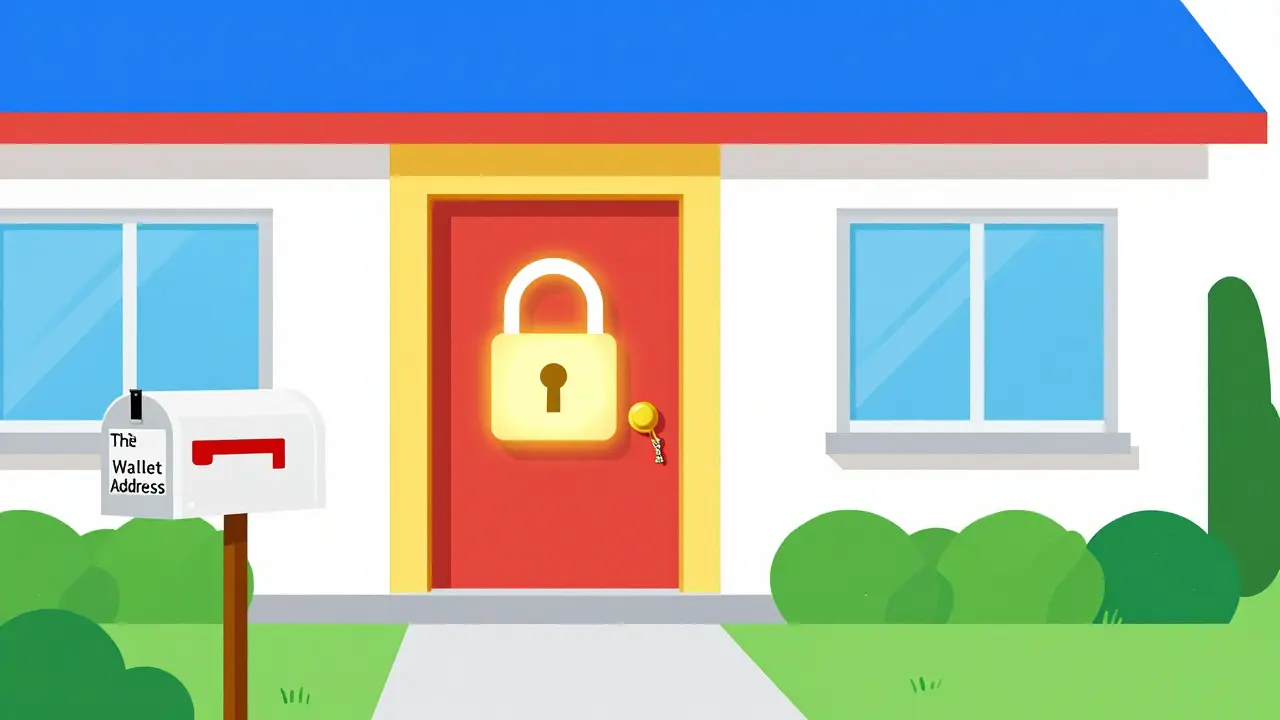
The Simple Analogy: House, Door, and Keys
Before diving into cryptography, let’s use a real-world example. Imagine you own a house.
- Your Home Address: This is what you give to friends so they can visit you. It tells them where to go. In crypto, this is your Wallet Address.
- The Lock on Your Door: This mechanism verifies that anyone trying to enter has the right permission. In crypto, this is your Public Key.
- Your Physical House Key: Only you have this. If you lose it or give it away, anyone can walk in and take everything. In crypto, this is your Private Key.
You wouldn’t hand out copies of your physical house key to everyone who wants to send you a package. Similarly, you shouldn’t confuse your public cryptographic keys with your secret private keys. But here is the twist: you rarely even see your public key directly anymore. Most wallets hide it behind the scenes and just show you the address. That’s why the distinction feels blurry.
What Is a Public Key?
A public key is a long string of alphanumeric characters derived from your private key using one-way mathematics. Think of it as the mathematical proof that you own the funds without actually revealing your secret password.
Here are the facts about public keys:
- Visibility: It is meant to be seen. You can share it publicly without losing access to your funds.
- Function: Its main job is verification. When you sign a transaction with your private key, the network uses your public key to check if that signature is valid.
- Derivation: It is generated from your private key. Because the math is one-way (like grinding coffee beans), you can get the public key from the private key, but you cannot reverse-engineer the private key from the public key.
In early Bitcoin days, users often shared their public keys directly. Today, most networks hash the public key further to create an address. So while the public key still exists in the background, you usually interact with its compressed child: the wallet address.
What Is a Wallet Address?
A wallet address is a shorter, hashed version of your public key used specifically to receive funds. It acts as the destination label for transactions.
If you ask someone to send you crypto, you paste your wallet address. Here is why addresses are preferred over raw public keys:
- Brevity: Public keys are very long (often 64-130 characters). Wallet addresses are shorter (usually 26-35 characters for Bitcoin, 42 for Ethereum), making them easier to copy-paste or scan via QR code.
- Error Checking: Addresses include checksums. If you mistype a character, your wallet will reject it before you send money into the void. Raw public keys lack this safety net in many contexts.
- Privacy: By hashing the public key again to create an address, you add another layer of obfuscation. Even if someone sees your address on the blockchain, they cannot immediately derive your public key unless you spend from that address.
You can generate thousands of unique wallet addresses from a single private key. This is why modern wallets auto-generate a new address for every incoming transaction. It helps keep your financial history fragmented and harder to track by outsiders.
Side-by-Side Comparison
| Feature | Public Key | Wallet Address |
|---|---|---|
| Primary Use | Verifying transaction signatures | Receiving funds (destination ID) |
| Length | Long (e.g., 130 chars in Bitcoin) | Shorter (e.g., 34 chars in Bitcoin) |
| Security Risk if Shared | Low (Safe to publish) | None (Safe to publish) |
| Relationship to Private Key | Directly derived | Indirectly derived (Hashed Public Key) |
| Human Readable? | No (Hexadecimal string) | No (Base58 or Base64 encoded) |
The Critical Role of the Private Key
We can’t talk about public keys and addresses without mentioning the boss of the operation: the Secret Key. While both public keys and addresses are safe to share, the private key is the opposite.
The private key is the only thing that proves ownership. It is a randomly generated number that allows you to authorize spending. If you expose your private key, you do not just lose privacy; you lose control. Anyone with your private key can drain your wallet instantly. There is no customer support to call. No reset button.
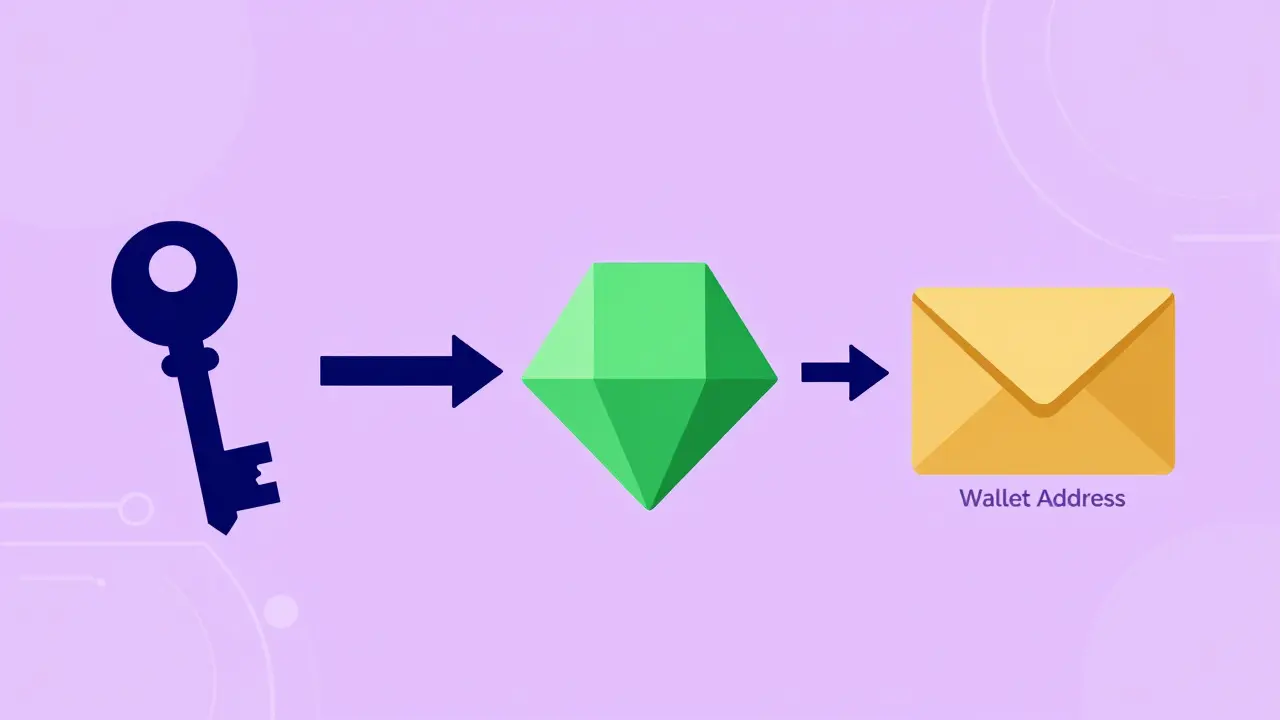
The relationship flows like this:
Private Key → (One-Way Math) → Public Key → (Hashing) → Wallet Address
This hierarchy ensures that even if the whole world knows your wallet address, they cannot guess your public key easily, and they absolutely cannot guess your private key.
Why Does This Distinction Matter for Security?
Most beginners think all these strings are just "IDs." But treating them differently protects you from specific attacks.
1. Phishing Scams
Scammers often try to trick you into pasting your private key into a fake website claiming it will "verify" your wallet. They might say, "Enter your public key to claim airdrop." If you don’t know the difference, you might hand over your private key. Remember: you never need to enter your private key to receive funds. You only ever share your address.
2. Privacy Leakage
If you reuse the same wallet address for every transaction, anyone can link all your activity to one identity. By understanding that addresses are derived from public keys, which come from private keys, you realize you can generate infinite addresses. Using a new address for each payment breaks the chain of visibility for casual observers.
3. Transaction Verification
When you send crypto, your wallet signs the transaction with your private key. The network then checks this signature against your public key. If the math matches, the transaction is valid. If you didn’t understand that the public key is the verifier, you might wonder how the network knows you didn’t forge the request. It’s the public key doing the heavy lifting behind the scenes.

Common Mistakes to Avoid
Even experienced users slip up. Here are three traps to watch out for:
- Mixing Up Networks: A Bitcoin public key/address format differs from Ethereum’s. Sending ETH to a BTC address usually results in lost funds. Always double-check the network protocol, not just the string length.
- Sharing Screenshots of Seed Phrases: Your seed phrase (recovery phrase) generates your private keys. Never screenshot it. It is effectively your master private key. Treat it with more care than your bank PIN.
- Assuming Addresses Are Permanent Identities: Unlike a bank account number, a crypto address doesn’t have to be static. Many wallets rotate addresses automatically. Don’t worry if your "address" changes next time you click "Receive." It’s still your wallet.
How to Check Your Own Keys
Curious to see the difference yourself? Open your hardware or software wallet (like Ledger, Trezor, or MetaMask).
- Navigate to the "Receive" section. Copy the address shown. Note its length and format (often starting with '1', '3', or 'bc1' for Bitcoin; '0x' for Ethereum).
- Look for an option labeled "Show Public Key" or "Export Public Key." This is often buried in advanced settings. Paste it somewhere safe. Compare the length. The public key will look longer and less structured than the address.
- Never look for "Show Private Key" unless you are backing up to a cold storage device. If a website asks for it, close the tab immediately.
By seeing both, you’ll appreciate the compression and hashing that turns a complex mathematical proof into a simple, shareable destination.
Summary
Your wallet address is the doorbell. Your public key is the lock mechanism. Your private key is the key in your pocket. Share the doorbell freely. Trust the lock. Guard the key.
As blockchain technology evolves, layers 2 solutions and smart contracts add complexity, but this core triad remains unchanged. Mastering these basics gives you confidence to move assets securely, verify transactions independently, and protect your digital wealth from avoidable mistakes.
Can I recover my funds if I lose my public key?
Yes. Since the public key is derived from your private key (or seed phrase), you can regenerate it at any time. As long as you have your private key or recovery phrase, you can recreate your public key and all associated addresses.
Is it safe to post my wallet address on social media?
Yes, it is completely safe. Your wallet address is designed to be public. Posting it does not compromise your funds. However, be aware that anyone can view the transaction history associated with that address on the blockchain explorer.
Why do some wallets generate a new address every time?
This is a privacy feature. By using a unique address for each transaction, it becomes harder for third parties to link all your payments to a single identity. All these addresses are controlled by the same private key, so you manage them from one wallet interface.
What happens if I send crypto to the wrong address?
In most cases, the funds are lost forever. Blockchain transactions are irreversible. Some networks have safeguards that detect invalid formats, but if the address is valid but belongs to someone else, there is no way to retrieve the assets.
Do Bitcoin and Ethereum use the same key structure?
They use similar cryptographic principles (ECDSA), but the encoding formats differ. Bitcoin addresses often start with 1, 3, or bc1, while Ethereum addresses always start with 0x and are 42 characters long. Never mix them up.
Can a hacker steal my crypto if they only have my public key?
No. The public key is mathematically one-way. It is computationally impossible to derive the private key from the public key with current technology. Your funds remain secure as long as your private key stays secret.