
The Hard Truth About Crypto Taxes in India
You trade Bitcoin, sell it for a profit, and pay your taxes. Simple enough. But here is the kicker: you also lose money on another trade that month, yet you cannot use that loss to lower your tax bill. This is the reality of the No Loss Offset Rulea regulation prohibiting cryptocurrency losses from reducing taxable gains in India. Introduced under Section 115BBH(2)(b) of the Income Tax Act, this rule treats digital assets differently than almost any other investment. If you are an Indian trader operating through 2025 and into 2026, understanding how this asymmetry works is vital. You could find yourself paying tax even when your wallet is empty.
How Section 115BBH Changes Everything
To understand why so many traders are frustrated, we need to look at how the government defines these assets. In India, cryptocurrencies like Bitcointhe leading cryptocurrency traded globally and Ethereuma blockchain platform enabling smart contracts fall under the category of Virtual Digital Assets (VDAs). Previously, investors in stocks could offset capital losses against capital gains. If you sold one stock for a loss, that loss reduced the tax you owed on a profitable sale. With VDAs, that door is completely closed. The law states that income from virtual digital assets is taxed separately, and losses incurred cannot be set off against income from any other head of income or carried forward.
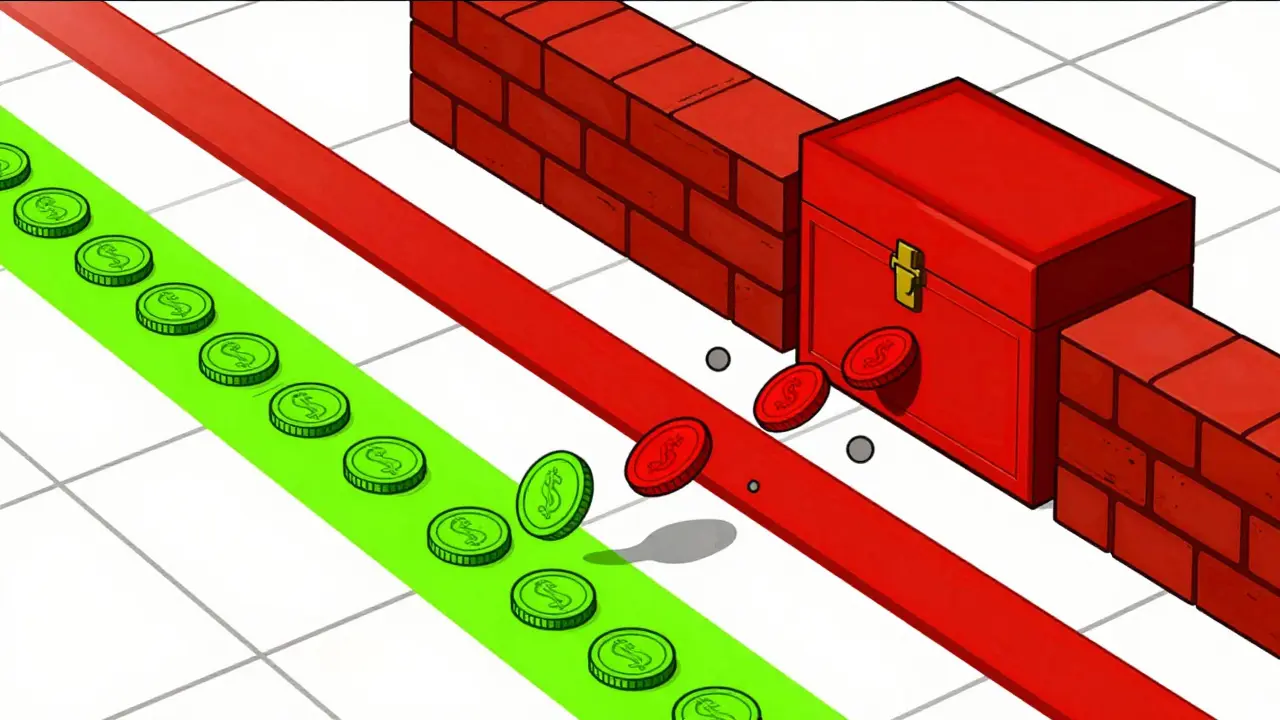
This creates a specific type of financial friction. Imagine you have two trades in a single month. You buy and sell Dogecoin, making a profit of ₹50,000. In the same period, you buy and sell Solana, but the price drops, leaving you with a loss of ₹40,000. In a normal business model, your net position is a profit of ₹10,000, and you would only pay tax on that amount. Under the current regime, however, you are taxed on the full ₹50,000 gain. The ₹40,000 loss simply disappears for tax purposes. You owe 30% tax on the ₹50,000, plus surcharges and cess, regardless of your actual net wealth.
The Math Behind the Asymmetric Burden
Let's break down the numbers because they are often clearer than legal jargon. Consider a trader named Rahul who operates in New Delhi. In the financial year ending March 2025, he executes several transactions. Here is the breakdown of his hypothetical position:
- Total Crypto Gains: ₹2,00,000
- Total Crypto Losses: ₹1,50,000
- Net Economic Gain: ₹50,000
If Rahul were selling real estate or shares, he would report a taxable income of ₹50,000. Because he is trading VDAs, he reports taxable income of ₹2,00,000. His tax liability jumps significantly. At a flat rate of 30%, the tax on ₹2,00,000 is ₹60,000. Even after adding a 4% health and education cess, his payout is substantial. He pays tax on money he does not actually keep. This effectively doubles the cost of failed trades. Many experts argue this creates an environment where risk-taking is penalized disproportionately.
| Feature | Equity Shares | Virtual Digital Assets (Crypto) |
|---|---|---|
| Loss Set-off Allowed | Yes (Same Category) | No |
| Cash Carry Forward | Up to 8 Years | Not Permitted |
| Tax Rate | 10% / 20% (Long/Short Term) | Flat 30% |
| TDS Applicable | Specific Scenarios | 1% on All Transfers |
Beyond the Tax Rate: TDS and Cash Flow
The problem isn't just the year-end tax bill. There is also the monthly grind of complying with Tax Deducted at Source (TDS). Since July 2022, exchanges must deduct 1% TDS on the total value of every crypto transfer exceeding ₹50,000 annually for small traders, or ₹10,000 for others. This means every time you sell crypto for INR, a portion of that value gets locked up in TDS before you even hit the 'withdraw' button. While this is creditable against your final tax liability, it creates an immediate liquidity crunch. You lose cash flow that was meant for reinvesting or managing operational costs. For high-frequency traders, this 1% deduction happens dozens of times a year, creating administrative nightmares.
Furthermore, if you decide to move your operations offshore to avoid this pressure, you face new risks. Using foreign exchanges triggers scrutiny under the Liberalised Remittance Scheme (LRS). If you remit more than ₹7 lakh annually, a 20% Tax Collected at Source (TCS) applies on the excess amount. This stacks with your Indian tax liabilities, potentially resulting in an effective tax rate far higher than 30%. It forces traders to choose between high domestic compliance costs and risky offshore strategies.
2025 Updates and Penalty Structures
We are now looking at the fiscal landscape as of early 2026, reflecting changes made in Budget 2025. The government has not softened its stance; instead, enforcement mechanisms have tightened. Authorities gained powers to tax unreported crypto holdings at a steep rate of 60%. This applies retrospectively from February 1, 2025. If you held significant amounts of USDTa stablecoin pegged to the US dollar or Bitcoin in an unverified wallet, the risk of discovery and retroactive assessment is real. This move signals that the "no loss offset" policy is part of a broader crackdown designed to bring all digital asset activity onto the grid.
Additionally, staking rewards and airdrops are treated as income upon receipt, not capital gains. This means miners and validators also face the same rigid tax framework. If your mining operation has gas fees and electricity costs that exceed revenue for a quarter, those expenses are largely ignored by the tax authority because the income side is taxed flatly without deductions for operational expenditure beyond acquisition costs.

Filing Compliance and Record Keeping
For the average filer, meeting these requirements demands discipline. You cannot file a return using the basic ITR-1 form. Crypto income pushes you into ITR-2 or ITR-3, which require you to disclose details in Schedule VDA. This schedule asks for specific transaction dates, values, and acquisition costs. If you trade frequently, maintaining a ledger for hundreds of transactions manually is impossible. Many platforms offer tools to export transaction history, but the onus remains on you to verify accuracy. Missing a single large loss in your records doesn't help you anyway, but missing a gain leads to prosecution risks.
The complexity extends to peer-to-peer (P2P) trades. If you buy directly from someone else rather than an exchange, the buyer is technically responsible for deducting TDS. Most casual traders ignore this, leaving themselves vulnerable to audits later. Professional accounting firms report a surge in demand for crypto-specific audit services as individuals realize the standard tax prep companies do not understand VDAs.
Why This Matters for Market Growth
Economists suggest that while strict rules aim to prevent tax evasion, the lack of loss offset capabilities might shrink the ecosystem. When traders know their downside is unlimited but their tax relief is capped at zero, they may reduce participation. Data indicates that domestic volumes on major Indian exchanges have seen volatility correlating with regulatory announcements. Instead of driving adoption, the rules create friction that benefits institutional players over retail enthusiasts who operate on smaller margins.
Can I carry forward my crypto losses to next year?
No. Unlike equity investments, losses from Virtual Digital Assets cannot be carried forward to future years. They vanish for tax purposes once the financial year ends.
What happens if I lose crypto due to a hack?
The law offers no tax relief for theft or hacks. You bear the full financial loss without any ability to claim it against your other income or gains.
Does the 1% TDS get refunded if I have no taxable income?
Yes, the 1% TDS is creditable. If your overall liability is low, you can claim a refund during your annual tax filing process.
Which ITR form do I need for crypto gains?
You must use ITR-2 or ITR-3 forms. The simpler ITR-1 does not accommodate the disclosure requirements for Virtual Digital Assets found in Schedule VDA.
Are trading expenses like gas fees deductible?
Generally, no. Only the acquisition cost of the asset itself is considered. Operational costs like network fees or broker charges are typically disallowed.
8 Comments
This whole situation is actually crazy!!! The implications are huge...!! You think you are safe but the tax man sees it differently...!! And the TDS part really locks up funds unnecessarily...!! It creates so much friction for normal traders...!! Honestly this is scary stuff...!
The systemic inefficiencies introduced by section 115BBH are profound and require detailed analysis of the liquidity implications
When a trader executes a transaction involving virtual digital assets the resulting tax liability is calculated without regard for net position
This creates a scenario where operational costs exceed theoretical net income while tax remains constant
The inability to carry forward losses eliminates a standard risk mitigation strategy used in traditional equity markets
Furthermore the one percent deduction at source acts as a forced holding mechanism for capital that belongs to the trader
Such mechanisms distort market pricing because traders cannot deploy their full realized capital efficiently
Institutional frameworks often bypass these restrictions through jurisdictional arbitrage which leaves retail participants exposed
The discrepancy between reported income and actual wealth retention generates significant psychological stress among compliant filers
Record keeping requirements escalate beyond reasonable expectations for casual market participants
Compliance software solutions often fail to account for the nuanced reporting demands of Schedule VDA filings
Retail investors effectively subsidize institutional operations by absorbing higher effective tax rates on failed hedges
The regulatory intent seems focused on extraction rather than ecosystem development or sustainable growth
Liquidity crunches occur frequently when transfer values are withheld during periods of active trading cycles
Without a mechanism to offset losses against gains the risk profile of the entire asset class becomes untenable
Market depth diminishes as sophisticated actors migrate to jurisdictions with coherent fiscal policies
This isolation ultimately harms the broader economy by reducing domestic technological adoption rates
It is amusing that anyone expects coherence from current regulatory bodies
The lack of foresight regarding liquidity dynamics suggests a complete disregard for market realities
Those who complain merely demonstrate an inability to adapt to sovereign mandates
make sure u keep allll ur receipts cause u never know when they come knocking and u gotta show everything right?
they dont care if u lost money they still want the taxs paid on the win part anyway
so just save files for every single trade u do even small ones
i heard some guys getting audited for missing logs so be carful
This is literally unfair and its making people panic for no reason!
We are doing our best but the system is rigged against the little guy completely
I feel like my hard work gets punished when I just try to make a profit
Fiscal asymmetry penalizes genuine market participation without providing tangible benefits to the state budget
Sovereign claims to taxation do not override basic principles of equity management and business continuity
The restriction on loss set-off forces artificial inflation of taxable events regardless of actual economic outcome
This regulatory posture discourages local investment in emerging technologies by design
International standards prioritize flexibility while this regime mandates rigidity
The cumulative effect drives value out of the domestic sphere into offshore entities
Tax authorities gain administrative revenue but sacrifice long term industry viability
Enforcement costs outweigh the marginal gains achieved through retroactive collection
Economic friction becomes the primary cost of doing business in this sector
The result is a hollowed out market with reduced volume and participation
tackling schedule vda requires discipline but its manageable if you stay organized
We will find a way to navigate these challenges together.