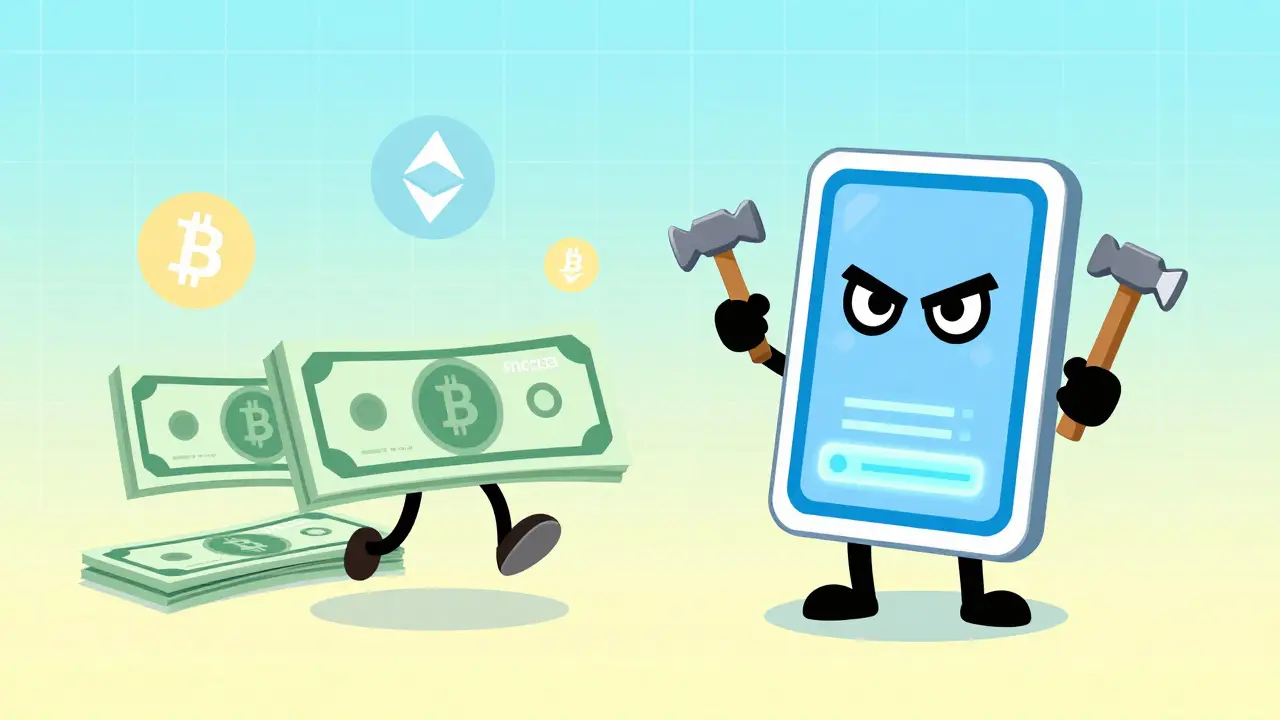
Think of cryptocurrency as digital cash. You can send it, spend it, save it - and one unit is exactly the same as another. A Bitcoin is a Bitcoin. A Ethereum is an Ethereum. They’re interchangeable, like dollar bills. Now picture an NFT. It’s not money. It’s more like a one-of-a-kind trading card - but digital. You can’t split it. You can’t swap it for another one and call it even. That’s the core difference, and everything else flows from it.
What Makes Something Fungible?
Fungibility isn’t a fancy word for techies. It’s a simple idea: if two things can be swapped without losing value, they’re fungible. A $20 bill is fungible. You hand over one, you get another back - no one cares which one. But your grandma’s wedding ring? Not fungible. No other ring has the same history, the same weight, the same meaning.
Cryptocurrencies are built to be fungible. Bitcoin, Ethereum, Solana - every unit is identical. That’s why they work as money. You don’t need to track who owned the last 10 coins. You just care that the amount is correct. This makes them perfect for payments, trading, and storing value across borders.
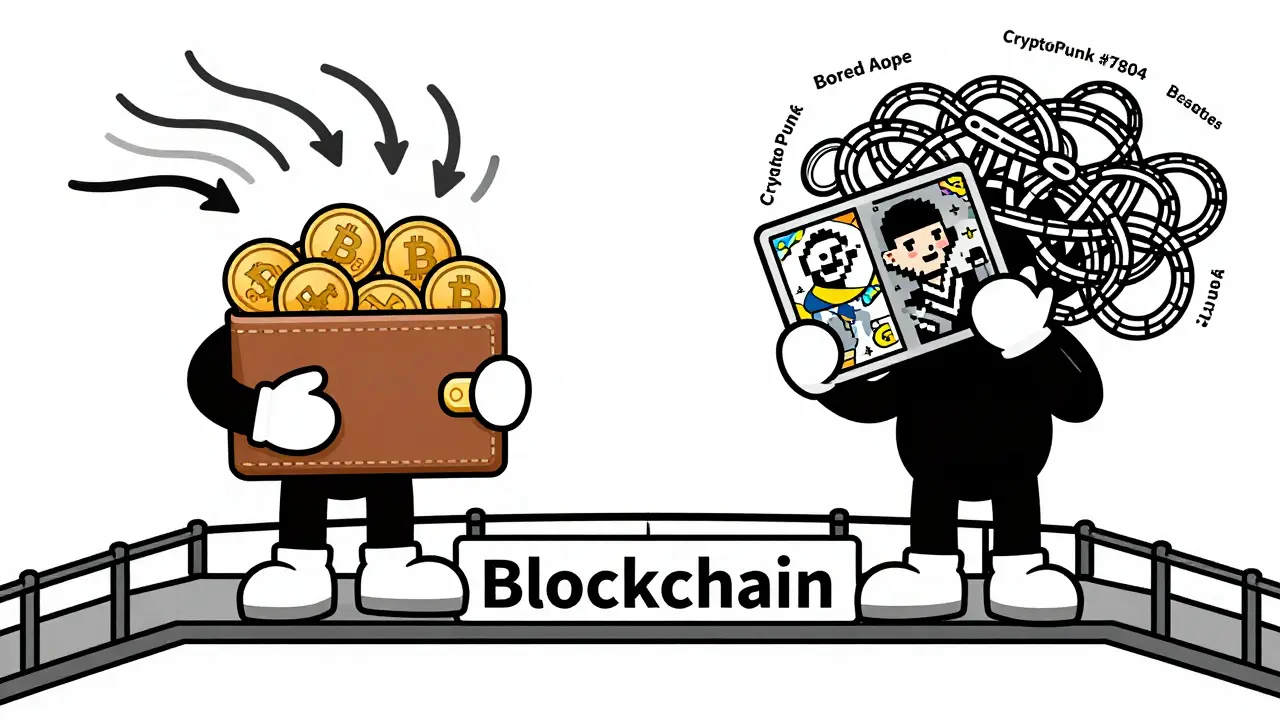
NFTs are the opposite. Each one has a unique ID tied to its blockchain record. That ID links to metadata - a file name, a creator’s signature, a link to a digital image, even a song or a video. No two NFTs are the same. Even if two NFTs show the same image, their underlying tokens are different. That’s why you can’t trade your CryptoPunk #7804 for someone else’s and call it a fair swap. You’re not trading pixels. You’re trading ownership of a specific, verifiable digital item.
How They’re Built - Same Tech, Different Rules
Both NFTs and cryptocurrencies run on blockchain networks. Most use Ethereum, but some run on Solana, Polygon, or Flow. The difference isn’t the blockchain - it’s the token standard.
Cryptocurrencies use standards like ERC-20 is a technical standard for creating fungible tokens on the Ethereum blockchain. Every token made with ERC-20 follows the same rules: same supply, same structure, same behavior. That’s why you can send 0.3 ETH to someone and it works just like sending 1 ETH - the system treats them as equal units.
NFTs use standards like ERC-721 is a blockchain standard for creating unique, non-interchangeable tokens or ERC-1155 is a multi-token standard that supports both fungible and non-fungible tokens. These standards let each token carry custom data. Think of it like a digital deed. The NFT doesn’t just say "I own this" - it says "I own THIS specific version, created by this artist, minted on this date, with this exact file hash." That’s what makes it unique.
And here’s another big difference: you can’t divide an NFT. Bitcoin can be split into satoshis - one hundred millionth of a coin. An NFT? It’s all or nothing. You can’t own half of a Bored Ape. You own the whole token, or you don’t own it at all.
What Are They Used For?
Cryptocurrencies are designed to act like money. People use them to:
- Send money across borders without banks
- Store value, especially in countries with unstable currencies
- Pay for goods and services (越来越多商家接受加密货币支付)
- Trade on exchanges like stocks
NFTs? They’re for proving ownership of unique digital things. Common uses include:
- Digital art - like Beeple’s $69 million collage
- Collectibles - CryptoPunks, Bored Apes, or sports highlights
- Music - artists selling limited-edition albums as NFTs
- Virtual land - in games like Decentraland or The Sandbox
- Event tickets - FIFA sold over 3 million NFT tickets for the 2022 World Cup
- Identity - some projects use NFTs as digital passports or membership cards
Notice something? Cryptocurrencies are about exchange. NFTs are about identity and provenance. One moves value. The other proves who owns what.
Who Owns What?
This is where people get confused. Buying an NFT doesn’t mean you own the copyright to the artwork. It means you own the token that proves you bought it. The artist still holds the rights to the image. You can’t legally print it on T-shirts or sell copies - unless the creator says so.
Compare that to cryptocurrency. When you own Bitcoin, you own the asset. No one else can claim it. There’s no underlying file, no license, no creator’s rights involved. You just have the private key to that balance.
Some NFT projects do grant commercial rights - like Bored Ape Yacht Club members who can use their ape for merchandise. But that’s a separate agreement. It’s not built into the NFT itself. Most NFTs come with zero rights beyond ownership of the token.
How Are They Valued?
Cryptocurrency prices move with supply, demand, news, adoption, and macroeconomic trends. Bitcoin’s price jumped from $17,500 in June 2022 to over $70,000 in early 2024. Why? More institutions bought it. More countries considered it legal tender. More people trusted it.
NFT prices? They’re emotional. They’re based on:
- Scarcity - how many exist?
- Creator reputation - is it from a known artist?
- Community hype - are people talking about it?
- Utility - does it unlock access to something?
That’s why an NFT can sell for $1 million one day and $500 the next. One person loves it. Another doesn’t. There’s no market-wide consensus like there is for Bitcoin. The NFT market saw $24.8 billion in sales in 2021. By 2022, that dropped to $10.5 billion. Demand didn’t vanish - it just got selective. Only the most iconic pieces held value.
Liquidity: Easy to Sell vs Hard to Sell
Cryptocurrencies trade 24/7 on hundreds of exchanges. You can turn Bitcoin into cash in minutes. That’s high liquidity.
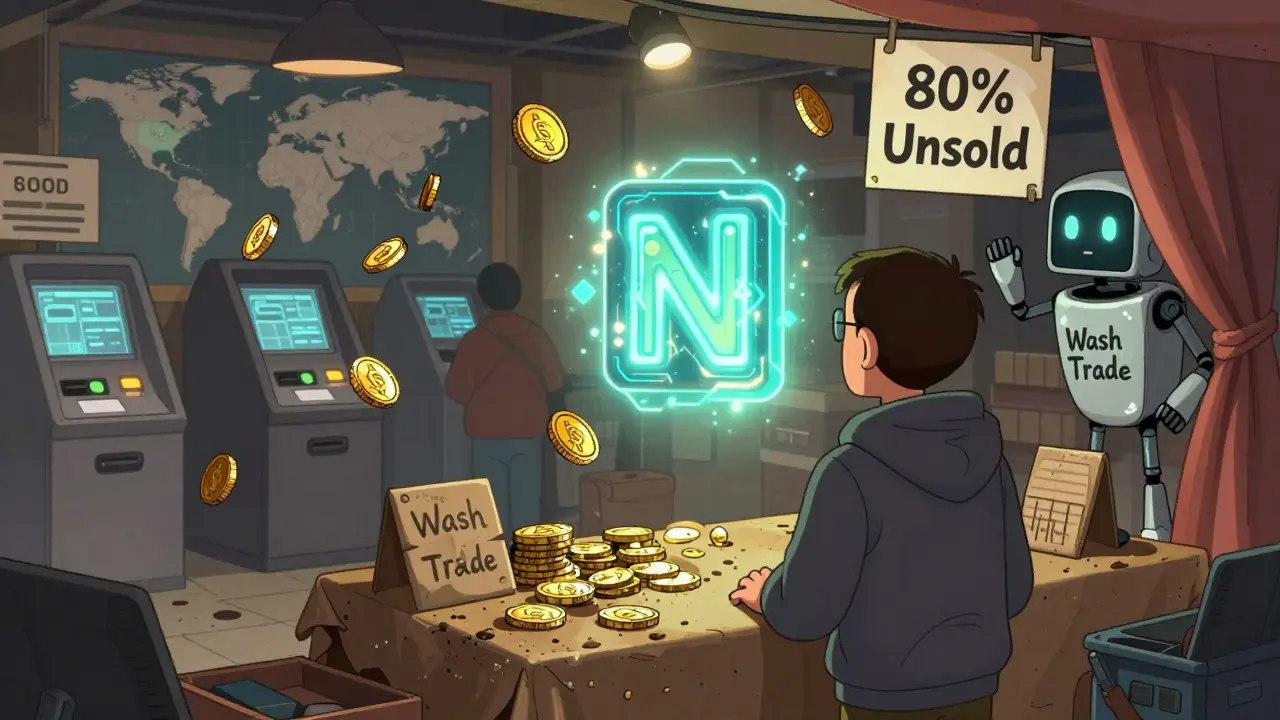
NFTs? You’re stuck on marketplaces like OpenSea, Rarible, or LooksRare. And even there, finding a buyer isn’t guaranteed. Over 80% of NFTs listed on OpenSea never sell. Many sit unsold for months. That’s low liquidity. If you need cash fast, an NFT isn’t reliable.
Wash trading is also common. Chainalysis found that 18% of NFT volume in 2022 was fake - bots buying and selling the same NFT to trick people into thinking it was popular. That doesn’t happen with Bitcoin.
Security and Risks
Cryptocurrency users worry about exchange hacks. Remember when Poly Network lost $600 million in 2021? Or when FTX collapsed? Those are big risks, but they’re rare. Most users keep crypto in private wallets - not on exchanges.
NFT collectors face different dangers:
- Rug pulls - creators vanish after launching a project
- Plagiarism - someone copies an artist’s work and mints it as their own NFT
- Phishing - fake websites trick you into signing away your wallet access
- Gas fees - Ethereum transaction costs can spike from $1 to $200 during rush hours
OpenSea reported that 68% of new NFT buyers spend at least two weeks researching before their first purchase. That’s because the risks aren’t obvious. With Bitcoin, you learn how to send coins. With NFTs, you have to learn how to spot fraud.
Regulation and Adoption
Cryptocurrencies are being treated like financial assets. The EU’s MiCA law (effective 2024) regulates them as digital money. The U.S. SEC treats some tokens as securities. Bitcoin ETFs now manage over $25 billion in assets.
NFTs? They’re in a gray zone. The U.S. SEC only steps in if an NFT acts like an investment - like promising profits from a project. Most NFTs are treated as collectibles, not securities. That’s why they’re not regulated like stocks. But that could change. The Financial Action Task Force (FATF) warned in 2021 that some NFTs could be used for money laundering if they’re combined with fungible tokens.
Adoption shows the split too. Over 128 million Americans own crypto, according to Pew Research. NFTs? Only 10% of crypto owners have ever bought one. They’re niche. Not mainstream.
Future Outlook
Cryptocurrencies are settling into infrastructure. Bitcoin’s Taproot upgrade made transactions cheaper and more private. Ethereum’s Merge cut energy use by 99.95%. These aren’t flashy changes - but they’re lasting.
NFTs are still searching for their purpose. Beyond art and collectibles, they’re being tested for:
- Real estate deeds - Propy sold a $22 million Ukrainian property as an NFT in 2022
- Event access - Coachella and SXSW are testing NFT tickets
- Music royalties - artists now earn 5-10% every time their NFT resells
- Game items - players own weapons, skins, or land in-game
Will these stick? Maybe. But for now, NFTs feel more like a trend than a transformation. Cryptocurrencies? They’re here to stay.
10 Comments
I love how you broke this down. It’s not about which one is better-it’s about what they’re meant to do. Cryptocurrency is the highway. NFTs are the unique street art along the side. You don’t need to stop for every piece, but knowing it’s there changes the whole journey.
Kinda makes me think about how we assign value in general. Not everything that matters can be divided or exchanged. Some things just… are.
NFTs are just crypto with extra steps and a lot of ego. People paying millions for a jpeg? Bro. My phone has better art. You think your bored ape is special? It’s a .png with a blockchain stamp. Meanwhile real artists make money without pretending their work is a currency.
The ERC-20 vs ERC-721 distinction is the real key here. Fungibility isn’t just a technicality-it’s a design philosophy. One is optimized for liquidity and interoperability. The other for uniqueness and provenance. You can’t force one into the other’s lane and expect it to work. The tech is the same. The intent isn’t.
This is so beautifully explained 🥹 I’ve been trying to explain this to my cousin for months and you just nailed it. NFTs aren’t money-they’re digital heirlooms. And honestly? That’s kind of beautiful. Not everyone gets it, but the ones who do? They’re holding onto something that feels real.
I suppose the real tragedy is that the blockchain-this revolutionary ledger of truth-has been co-opted by people who think owning a JPEG makes them culturally significant. The irony is that the technology itself is profoundly egalitarian. But the culture? Oh, it’s a country club with a Discord server.
I’ve been watching this for years. There’s a pattern. First, the tech is misunderstood. Then, it’s exploited. Then, it’s weaponized. NFTs are the next phase of the same game that crashed the housing market. Only this time, the collateral is pixels and the banks are wallets. I’m not saying it’s fake-I’m saying the system is rigged.
So let me get this straight. You’re telling me I can’t own half a Bored Ape… but I can own half a Bitcoin? Interesting. So the crypto world is fine with fractional ownership, but the NFT world is like, ‘Nope, you get the whole thing or you get nothing.’ Sounds like someone’s trying to make scarcity feel like value. Or maybe they just hate math.
The fact that people still think NFTs are ‘just art’ is why this whole thing is doomed. Art doesn’t need a blockchain. Art needs a gallery. A curator. A history. NFTs are just branded digital graffiti with a side of FOMO. And don’t even get me started on the ‘royalties’-those are promises, not contracts. They’re vapor. I’ve seen too many artists get burned.
In many African cultures, ownership is not merely about possession-it is about lineage, memory, and communal recognition. NFTs, despite their digital nature, echo this ancient concept. The uniqueness of the token mirrors the uniqueness of a tribal artifact or a ceremonial object. Perhaps this is not a Western invention but a global reawakening.
NFTs are trash. Crypto is money. That’s it. Stop overthinking it.