What Exactly Is On-Chain Data Mining?
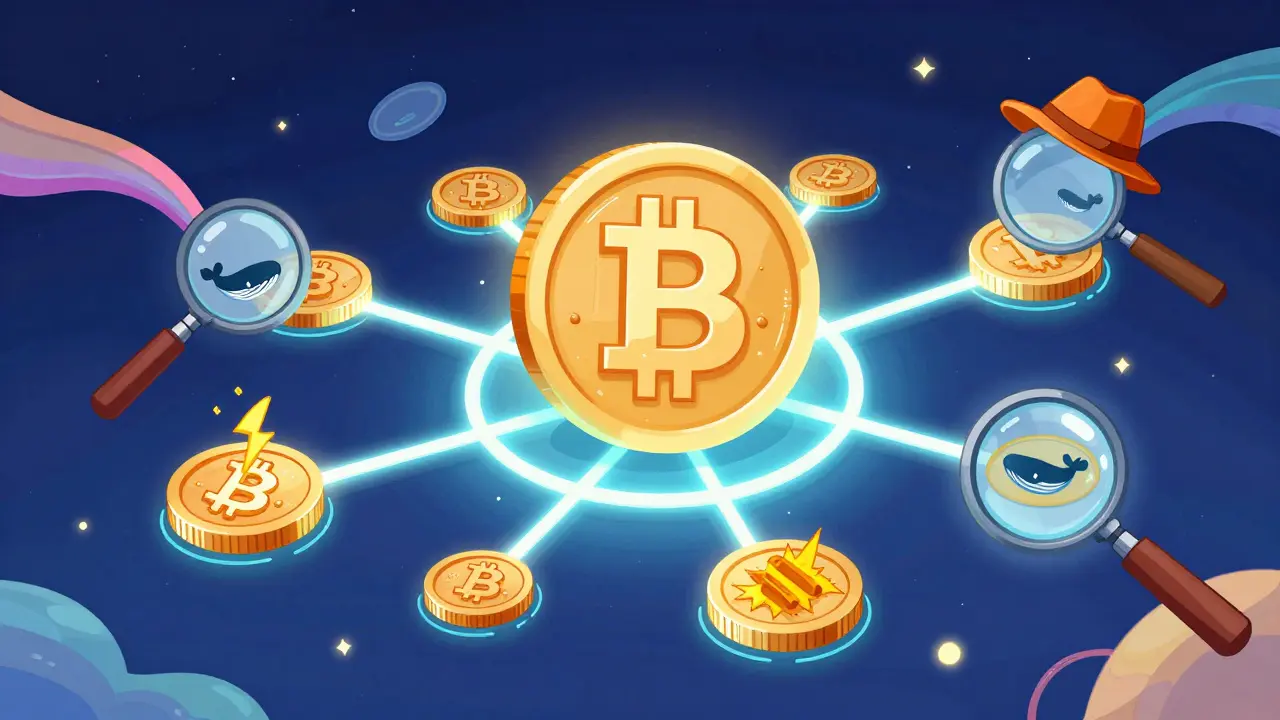
On-chain data mining is the process of pulling raw transaction records directly from public blockchains-like Bitcoin and Ethereum-and turning them into useful insights. Unlike traditional financial data, which lives inside banks or exchanges, this information is out in the open, permanently stored, and verified by thousands of computers worldwide. Every time someone sends ETH, swaps tokens on Uniswap, or stakes their SOL, that action gets written to the blockchain. No middleman. No edits. Just facts.
This isn’t guesswork. It’s forensic accounting on a global scale. You can see exactly how much Bitcoin moved between wallets, when large holders sold, or how often a new DeFi protocol gets used. The data doesn’t lie-but it doesn’t explain itself either. That’s where mining comes in: filtering noise, spotting patterns, and connecting dots others miss.
Why On-Chain Data Beats Off-Chain Guesses
Most people think crypto prices move because of tweets, news, or influencer hype. But the real signals often come from what’s happening on the chain. Take exchange volume. If a coin shows $500 million in trading volume on Binance, that doesn’t mean $500 million changed hands in the real economy. It could be users just moving money between their own Binance accounts. That’s off-chain activity-invisible to the blockchain.
On-chain data cuts through that. If a whale wallet sends 5,000 BTC to a new address, that’s a real movement. Glassnode’s 2023 analysis showed on-chain tracking catches 99.998% of large transfers accurately. Exchange-reported volume? Only 85% reliable. Why? Because exchanges don’t report internal transfers. On-chain does.
Same goes for whale alerts. A $100,000 transaction on-chain might be a hedge fund dumping. Or it might be a crypto exchange moving funds between cold wallets. Without context, you’re shooting in the dark. But with proper mining tools, you can label wallets-like spotting that this address belongs to Coinbase Custody, not a random investor. That’s the difference between noise and signal.
How Bitcoin and Ethereum Handle Data Differently
Not all blockchains are built the same. Bitcoin uses a system called UTXO-Unspent Transaction Output. Think of it like cash: each transaction is a bill you receive, and you spend entire bills, getting change back. This creates a long trail of small, disconnected pieces. Mining Bitcoin data means stitching together these fragments to track who owns what.
Ethereum, on the other hand, uses account-based ledgers. It’s more like a bank statement. Each address has a balance, and every transaction just updates it. That makes it easier to follow money flow, but harder to track individual token movements across thousands of smart contracts.
Performance varies too. Bitcoin handles about 7 transactions per second. Ethereum does 15-30, but gas fees spike during congestion-sometimes hitting $50 per transaction. Solana? 4,000 transactions per second, fees under $0.01. That’s why DeFi apps thrive there. But each chain needs different tools to mine its data effectively. You can’t use the same SQL query for Bitcoin and Ethereum. The structure is different. The tools must adapt.
Who’s Using This Data-and How
Institutional investors rely on on-chain analytics like a radar system. Hedge funds use metrics like MVRV (Market Value to Realized Value) to spot when Bitcoin is overvalued or undervalued. In 2023, 68% of top crypto research reports included MVRV, according to Nic Carter. That’s not a niche indicator anymore-it’s standard.
Companies like Walmart use on-chain ledgers to track supply chains. Instead of paper receipts, they log each shipment as a blockchain transaction. Audit time dropped 76%. No more chasing emails or spreadsheets. Just check the chain.
For retail traders, it’s simpler: follow the smart money. Nansen’s labeled wallet system shows you when known institutional addresses buy or sell. One Reddit user tracked an Ethereum staking surge three days before the price jumped 18%. That wasn’t luck. That was on-chain data revealing behavior before the market reacted.
Even regulators are paying attention. The SEC says on-chain analysis meets AML compliance standards. EU’s MiCA law now requires stablecoin issuers to monitor on-chain flows. This isn’t just for traders-it’s becoming infrastructure.
The Tools: Free vs. Paid, Simple vs. Powerful
You don’t need a $500/month subscription to start. Etherscan and Blockchain.com offer free block explorers. You can see every transaction, check wallet balances, and track token transfers. But free tools don’t label wallets or calculate advanced metrics. You’re looking at raw data-like seeing a spreadsheet with 10 million rows and no column headers.
That’s where paid platforms come in. Glassnode and Nansen turn that chaos into charts. Glassnode’s NUPL (Net Unrealized Profit/Loss) metric tells you whether most holders are in profit or loss. It predicted the 2023 market bottom within 2.3% accuracy on three separate occasions. Nansen’s Smart Alerts use machine learning to reduce false positives by 37%. Instead of getting 20 whale alerts a day, you get 3 that matter.
But pricing is brutal. Glassnode’s basic Ethereum plan starts at $99/month. Nansen’s Pro tier is $99. Enterprise access to Google BigQuery for full Ethereum history? $500/month. For a retail trader, that’s a lot. Many users on Reddit complain they’re paying for alerts that turn out to be exchange internal transfers. That’s the trap: data without context is useless.
Where On-Chain Analysis Fails
It’s not magic. On-chain data mining hits walls. Privacy coins like Monero and Zcash encrypt transaction details. Chainalysis says only 1.7% of Monero’s data is analyzable. You can’t track what you can’t see.
Then there’s the bot problem. In Q1 2023, 43% of Ethereum’s “activity” came from arbitrage bots-not humans. That inflated transaction counts and made it look like the network was booming. But it wasn’t adoption. It was machines playing games. Dr. David Gerard calls this “on-chain fundamentalism”-mistaking volume for value.
And latency? Real. During a flash crash, transactions pile up in the mempool. A wallet might send 10,000 ETH, but the blockchain takes 15 minutes to confirm it. By then, the price has moved. Your alert is late. Your analysis is outdated.
Even worse: fake volume. Tether minted $2 billion in USDT in August 2023. On-chain, that looked like massive demand. But it was just a stablecoin issuer adjusting supply. No real economic activity. If you don’t understand the context, you’ll panic-buy and lose money.

Getting Started: Skills, Time, and Tools
You don’t need to be a coder, but you need to learn. Coinbase’s 2023 survey found most beginners spend 80-120 hours to get comfortable. Start with free tools: Etherscan, Blockchain.com, and CoinGecko’s on-chain tab. Watch how wallets move. Look for patterns: Do certain addresses always send before price spikes? Do miners dump after block rewards?
Then learn SQL. Most on-chain data lives in tables. You’ll need to write queries to filter out miner transactions or exchange wallets. Python helps automate it. GitHub has open-source scripts to track whale movements. Use them. Modify them. Break them. Learn from the errors.
Key metrics to know:
- SOPR (Spent Output Profit Ratio): Are people selling at a profit? Above 1 = bullish. Below 1 = panic selling.
- NUPL (Net Unrealized Profit/Loss): How much profit is unrealized across all wallets? High = bubble risk. Low = accumulation.
- Active Addresses: Is real usage growing? Or just bot spam?
Don’t chase every metric. Pick one. Master it. Then add another. Most traders fail by trying to track everything at once.
The Future: AI, Privacy, and the Next Leap
The next wave isn’t just more data-it’s smarter analysis. Glassnode’s Realized HODL Waves show how long people hold coins over time. Nansen’s AI now classifies wallets as “decentralized exchange user” or “staking provider.” That’s not just tracking money-it’s understanding behavior.
Zero-knowledge proofs are coming. They’ll let you prove a transaction happened without revealing the details. That sounds like a death knell for on-chain analysis. But it’s not. It’s a shift. Instead of seeing every transaction, you’ll see aggregated patterns: “X% of users are staking,” “Y% of tokens moved to Layer 2.” The data becomes statistical, not granular.
Industry consensus? On-chain analytics is becoming table stakes. Galaxy Digital says it’s unavoidable for crypto participation. Even if privacy grows, the core truth remains: blockchain is the only financial system where every transaction is permanently recorded. That’s not going away.
What’s changing is how we interpret it. The future belongs to those who don’t just see transactions-but understand economic behavior behind them.
What You Should Do Today
Stop relying on price charts alone. Open Etherscan. Look up a wallet you know is active-like a well-known DeFi founder’s address. Track their last 10 transactions. What tokens are they swapping? Are they moving to a new protocol? Are they holding or selling?
Then check Glassnode’s NUPL chart for Bitcoin. Is it near the 0.6 mark? That’s historically been a strong accumulation zone. Don’t trade on it yet. Just observe.
Join r/onchainanalysis. Read the top posts. Don’t ask for tips. Ask how they interpret a metric. Learn the language.
On-chain data isn’t a crystal ball. But it’s the most honest ledger we’ve ever had. Use it wisely.
9 Comments
Honestly, this is the most clear breakdown of on-chain analysis I've seen in months. Free tools like Etherscan are great for peeking, but you're right - without wallet labeling, you're just staring at a wall of numbers. I started tracking a few Nansen-labeled wallets last year and noticed they all dumped right before the last dip. Not magic, just pattern recognition. Still, I wish more people understood that volume ≠ adoption.
on chain data my ass its just noise with a fancy dashboard
The blockchain... is the last great cathedral of truth in a world drowning in curated lies! Every transaction, a silent scream of human intent! Every whale move, a cosmic whisper! We are not merely observers-we are digital archaeologists sifting through the ashes of capitalism's last gasp! And yet... they call it 'analytics'! As if we could contain the soul of decentralization in a heatmap! NUPL? SOPR? These are not metrics-they are incantations! We chant them to ward off the demons of FOMO and the specters of centralized exchanges! But who hears us? Who truly sees the trembling of the ledger when a single wallet moves 5,000 BTC?! I weep for the blind!
I saw a guy on Twitter say he made 300k using on-chain data. I went to Etherscan and spent 12 hours trying to find his wallet. Turned out he was just moving money between his own accounts. I cried. Not because I lost money. Because I believed. I believed in the blockchain. I believed in the data. I believed in the truth. And then I realized... it's all just a game. And I'm the fool who keeps playing.
I started learning this last year after losing a lot on meme coins. Took me 90 hours to understand what SOPR even meant. Now I just check it once a week. If it's below 0.8, I wait. If it's above 1.2, I get nervous. No fancy tools. Just patience. And a notebook. You don't need AI to read the market. You just need to stop chasing noise.
On-chain data doesn't predict anything. It just records what already happened.
Your assertion that on-chain data is ‘more reliable’ than off-chain volume is statistically tenuous. Exchange-reported volume is often mischaracterized as ‘fake’ when in reality, it reflects liquidity depth and market participation-two distinct metrics from on-chain transfer volume. Confusing transaction count with economic activity is a fundamental analytical error. Moreover, the assumption that blockchain data is ‘uneditable’ ignores the reality of chain reorganizations, frontrunning, and sandwich attacks-all of which introduce temporal distortion. Precision matters.
You people are delusional. Nansen and Glassnode are just glorified SPAM bots with a $100/month subscription. 80% of their ‘whale alerts’ are exchange internal transfers. I tracked one ‘smart money’ wallet for 6 months. It moved 47 times. 44 of those were Binance cold wallet reorganizations. You’re not trading on data-you’re trading on marketing copy. And don’t even get me started on the ‘MVRV’ cult. It’s a lagging indicator wrapped in pseudoscience. You’re not an analyst. You’re a candlestick worshipper with a spreadsheet.
They’re not tracking wallets. They’re tracking government backdoors. Every labeled address? Controlled. Every ‘whale alert’? A signal to move the market. The SEC’s endorsement isn’t about compliance-it’s about control. They want you to believe the chain is transparent so you’ll keep feeding it. Meanwhile, Monero and Zcash are the only real options. The rest? A surveillance grid disguised as finance. You think you’re free? You’re just another node in their ledger.