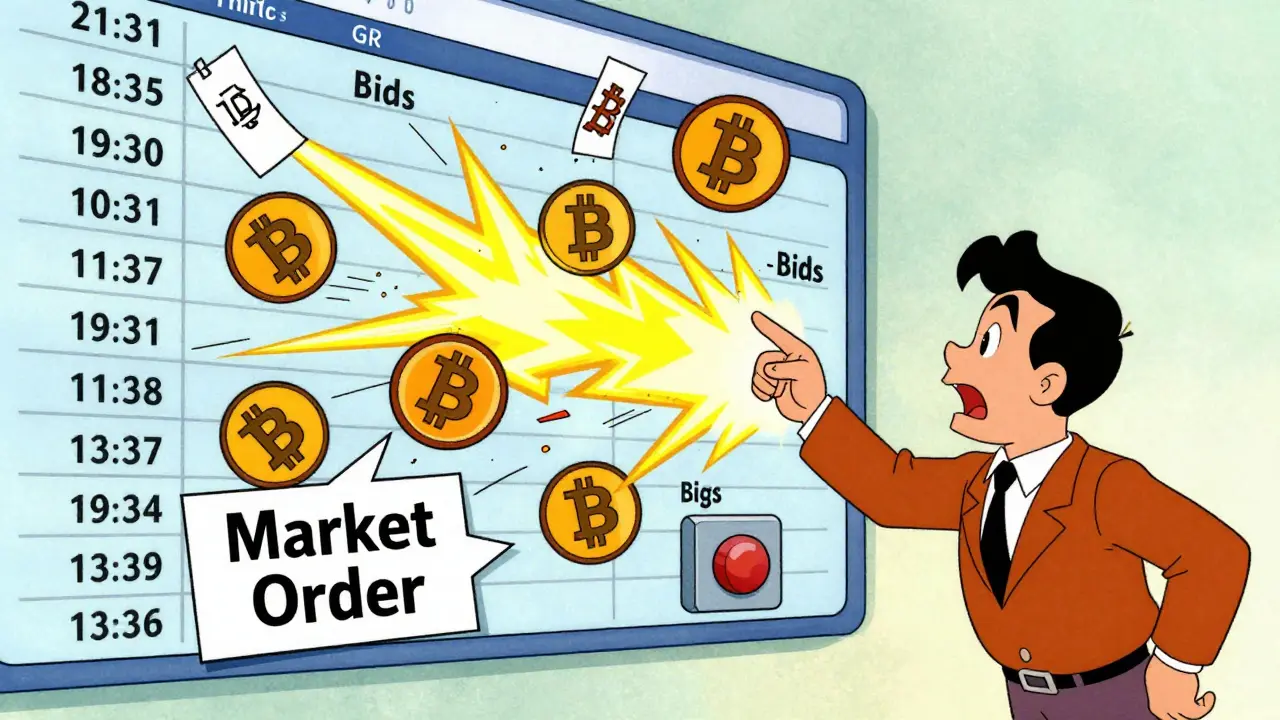
When you hit buy on a crypto exchange, you're not just clicking a button-you're making a decision that can cost you extra or leave you empty-handed. Two order types dominate every trading platform: market orders and limit orders. They work differently, carry different risks, and suit different goals. Knowing which one to use isn't just helpful-it can save you money or stop you from missing a trade entirely.
What Is a Market Order?
A market order is the fastest way to buy or sell. You don’t set a price. You just say, "I want to buy 1 BTC right now," and the exchange fills it at the best available price. That’s it. No waiting. No conditions. If someone is selling BTC at $62,450, your order snaps it up. If they’re selling at $62,460 next, and you’re buying 2 BTC, you might end up paying both prices.This is how market orders work behind the scenes: they take liquidity from the order book. The order book is like a living list of all the buy and sell offers. On one side, people are listing prices they’re willing to sell at (asks). On the other, buyers list prices they’re willing to pay (bids). A market order grabs the lowest ask for a buy, or the highest bid for a sell. It doesn’t care what the price is-it just wants to execute.
Market orders are great when speed matters. If Bitcoin just broke above $63,000 and you’re convinced it’s going higher, a market order gets you in before the momentum fades. Same if you’re panic-selling after a sudden drop. You don’t want to wait-you need out now.
But here’s the catch: slippage. In fast-moving markets, especially with low-volume coins, the price you expect isn’t the price you get. Let’s say you want to buy 500 SOL at $120. The best ask is $120.10 for 100 SOL. The next one is $120.50 for 150 SOL. Then $121.00 for 200 SOL. Your market order eats all three. You end up paying an average of $120.70-not $120. That’s 0.6% slippage. On $60,000, that’s $360 you didn’t plan for.
What Is a Limit Order?
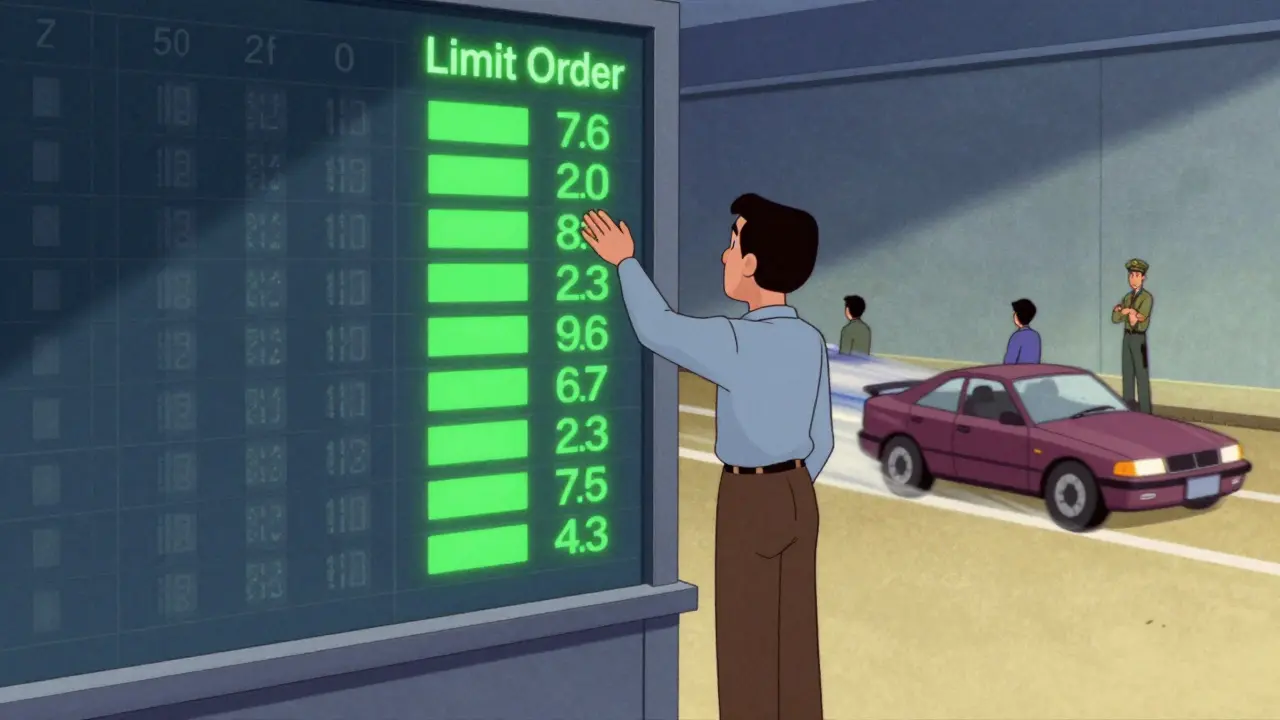
A limit order says: "I’ll buy BTC at $62,000 or lower," or "I’ll sell ETH at $3,100 or higher." You set the price. The trade only happens if the market hits that number. If it doesn’t? Your order sits there, maybe for hours, maybe for days.Unlike market orders, limit orders add liquidity to the order book. You’re not taking from others-you’re offering a price for them to trade against. That’s why many exchanges give you a rebate (a tiny fee discount) for placing limit orders. They reward you for helping the market stay liquid.
Limit orders give you control. If you believe Cardano will dip to $0.45 before rebounding, you can set a buy limit at $0.445. You don’t need to stare at your screen. The trade executes automatically if the price drops there. Same with profit-taking: if you bought Solana at $110 and want to sell at $140, a sell limit at $140 locks in your gain without you lifting a finger.
But there’s a downside: unfilled orders. If the price never reaches your limit, you don’t trade. And if you’re using "good-till-canceled" (GTC) orders, your funds are tied up until the order fills or expires. Some platforms let limit orders expire after 30 or 90 days. Others keep them active indefinitely-until you cancel them. That means your capital is stuck, and you might miss other opportunities.
How Order Books Handle Each Order Type
The order book is where the magic-or chaos-happens. It’s not just a static list. It’s dynamic. Every time someone places a limit order, it adds a new price level. Every time someone places a market order, it removes existing ones.For example, imagine the BTC order book looks like this:
- Bids (buyers): $62,300 (2.1 BTC), $62,250 (1.8 BTC), $62,200 (3.0 BTC)
- Asks (sellers): $62,350 (1.5 BTC), $62,400 (2.2 BTC), $62,450 (1.1 BTC)
If you place a market buy for 3 BTC, it’ll take:
- 1.5 BTC at $62,350
- 2.2 BTC at $62,400 (but you only need 1.5 more to hit 3)
Your average price? Around $62,375. You didn’t choose that price. The market did.
Now, if you place a limit buy at $62,280, you’re adding a new bid. The order book updates. Now someone else might see your offer and decide to sell into it. You’re helping the market. And if the price drops to $62,280 later? Your trade executes.
When to Use Market Orders
Market orders make sense in three situations:- You’re trading high-liquidity assets like Bitcoin or Ethereum. Tight spreads mean slippage is minimal. A $63,000 BTC market buy might only cost you $63,005.
- You need to exit a position fast. Maybe a news drop hit, or your stop-loss triggered. Waiting could mean bigger losses.
- You’re trading during peak hours. Liquidity is highest between 12 PM and 8 PM UTC. That’s when market orders perform best.
But avoid market orders during low-volume periods-like weekends, holidays, or right after major news events. Prices jump around. You could buy at $63,200 when $62,900 was available five minutes ago.
When to Use Limit Orders
Limit orders are your best friend when:- You’re patient. You don’t need to trade now-you’re waiting for a specific price level.
- You’re targeting support or resistance. Historical data shows ETH often bounces at $3,050. Set a buy limit there.
- You’re selling for profit. Lock in gains without monitoring the market 24/7.
- You’re trading low-volume coins. A market order on a coin with 100 daily trades could cost you 5% slippage. A limit order keeps you safe.
Pro tip: Use limit orders to build positions gradually. Instead of buying 1 BTC at once, set five limit orders at $62,000, $61,800, $61,600, $61,400, and $61,200. If the price drops, you buy in chunks. If it doesn’t, you don’t overpay.
Key Risks You Can’t Ignore
Market orders carry slippage risk. In a flash crash, your buy order might fill at 20% below the last price. In a pump, your sell order might fill at 15% below where you expected. Limit orders carry execution risk. Your order might sit there forever. You might miss a 10% rally because your buy limit was set too low. Or you might get filled on a partial order and end up with less than you wanted.Also, limit orders don’t work well with fractional shares. Most crypto exchanges allow fractions, but some older platforms don’t. Always check.
Real-World Example: A Trader’s Choice
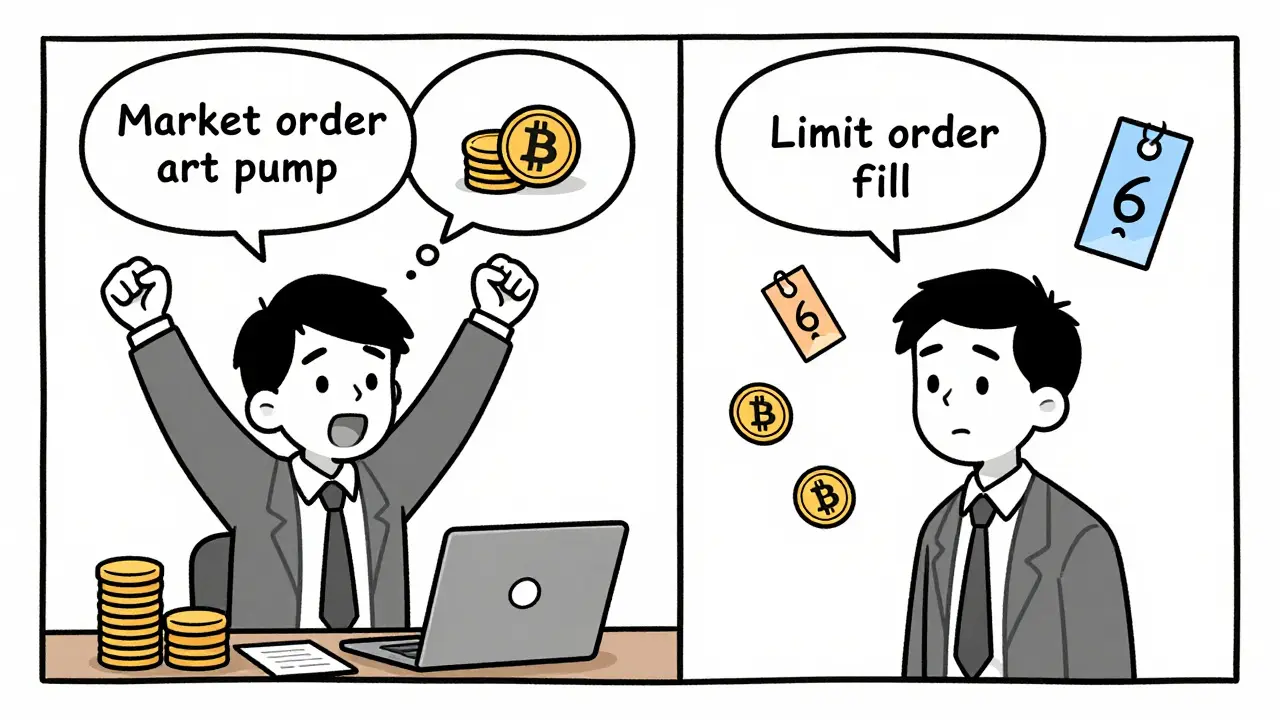
On February 5, 2026, Bitcoin jumped 8% in 90 minutes after a major ETF approval rumor. A trader using a market order bought 0.5 BTC at $63,400. Another trader waited for a pullback and set a limit buy at $62,000. The price never returned. The second trader missed the move.Three days later, Bitcoin dropped 6%. The first trader panicked and sold with a market order at $60,100. Loss: $1,650.
The second trader had a sell limit set at $64,000. It never triggered. But they also had a second limit sell at $61,500. It filled. They kept 0.2 BTC and sold 0.3 BTC at $61,500. Net gain: $450.
Same market. Two outcomes. One used speed. The other used control.
Hybrid Strategies: What Most Pros Do
Most experienced traders don’t pick one. They combine both.Use a market order to get into a position fast when momentum is clear. Then, immediately set a limit order to take profit. That’s a "buy market, sell limit" strategy.
Or, use limit orders to build a position over time, then set a market order to exit if the market suddenly turns.
Some platforms offer "stop-limit" orders too. These trigger a limit order once a price hits a certain level. Useful for avoiding slippage on exits-but still not foolproof.
Final Rule: Know Your Goal
Ask yourself before every trade:- Do I need to be in (or out) right now? → Market order.
- Do I have a specific price in mind? → Limit order.
- Am I trading a high-volume coin? → Market order is safer.
- Am I trading a low-volume altcoin? → Limit order is essential.
There’s no "better" order type. Only the right one for your goal, your asset, and your timing.
Can market orders fail to execute?
Market orders almost always execute during market hours on major exchanges. But if you place one after hours, or on a low-liquidity coin with no sellers, it might not fill. In rare cases, a sudden price gap can cause partial fills or delays. Always check order book depth before using a market order.
Do limit orders expire?
Yes, unless specified otherwise. Most exchanges default to "day order," which expires at the end of the trading day. Some let you set "good-till-canceled" (GTC) orders that last 30 to 90 days. A few crypto platforms allow GTC orders to stay active indefinitely. Always check your exchange’s policy. Unfilled limit orders don’t disappear-they just sit there, tying up your capital.
Why do exchanges give rebates for limit orders?
Limit orders add liquidity to the order book. They create price levels that other traders can use. Market orders remove liquidity by eating into existing bids and asks. Exchanges incentivize liquidity providers (limit order users) with small fee rebates-often 0.01% to 0.05%. This keeps markets deeper and more stable.
Can I use both market and limit orders at the same time?
Yes, and many traders do. For example, you might place a limit order to buy 0.5 BTC at $62,000, and also set a market order to buy 0.1 BTC immediately if the price surges. This way, you cover both scenarios: slow dips and sudden pumps. Just make sure your account has enough balance for both.
Is slippage worse on decentralized exchanges (DEXs)?
Yes, often. DEXs rely on liquidity pools, not traditional order books. Large market orders can cause significant price impact, especially on smaller pools. Slippage of 2-5% is common on DEXs for trades over $5,000. Limit orders are even harder to use on DEXs because they’re not natively supported on most platforms. Always use slippage tolerance settings on DEXs and avoid large market orders.
10 Comments
why overcomplicate this just use limit orders always market orders are for noobs
Oh wow. A *manual* on order types. How quaint. I suppose next you'll tell us water is wet and gravity exists. The real traders? They're not reading this. They're already in their algo bots with conditional triggers, slippage buffers, and dynamic liquidity mapping. You're explaining how to tie shoelaces while the world runs on magnetic levitation.
the liquidity dynamics described here are accurate but i think the emotional weight of unfilled limit orders is underplayed. when you set a gtc buy at $61k and the market never returns... it's not just capital tied up. it's psychological. you start doubting your analysis. you second-guess every support level. it's silent erosion.
This is foundational knowledge every trader must internalize. The order book isn't just data-it's a living pulse of market sentiment. Market orders are adrenaline. Limit orders are discipline. The most successful traders don't choose between them-they choreograph them. I've seen novices lose fortunes because they mistook speed for strategy. Don't be one of them.
limit orders = free money tbh 🤷♂️
i just set my limits and walk away. honestly the less i stare at the chart the better my trades do. sometimes you just gotta trust the process. the market will come to you if it's meant to. no need to chase. peace out 🌿
The notion that market orders are acceptable for high-liquidity assets is dangerously naive. Even BTC experiences micro-liquidity vacuums during macro events. The 2024 Fed announcement triggered a 1.8% slippage on a 5 BTC market buy. This isn't theoretical-it's documented. Your 'tight spreads' are a myth peddled by retail influencers who've never traded a real volume.
you think you're in control with your limit orders but you're just delaying the inevitable. the market doesn't care about your $61,200 buy. it doesn't owe you anything. it's not a vending machine. it's a predator. and if you're not ready to be eaten, you shouldn't be trading. stop pretending you're smart. you're just scared of the noise.
this whole post is a joke. real americans don't sit around calculating slippage percentages. we buy when we see red, sell when we see green, and let the feds deal with the rest. if you're worried about 0.6% slippage on SOL, go work at a bank. we're not here to play chess with crypto. we're here to win.
i use market order when im panic buying and limit when im chill but i always forget to cancel gtc orders and then wonder why my wallet is empty like wth