
Have you seen the buzz about the Kalata airdrop? If you are scrolling through Twitter or Discord right now, you might feel like everyone is getting free tokens except you. It is a frustrating feeling, especially when your wallet sits empty while others celebrate their windfalls. But here is the hard truth about the current situation with Kalata (KALA): there is no official, verified airdrop campaign running at this moment.
This silence is actually more dangerous than noise. In the world of cryptocurrency, absence of information creates a vacuum that scammers rush to fill. Before you connect your wallet to some random website promising free KALA tokens, you need to understand exactly what is happening with the project, how legitimate airdrops work, and why you should be extremely cautious right now.
The Current Status of Kalata (KALA)
Let's look at the facts first. As of mid-2026, Kalata trades as a low-cap cryptocurrency. The token has seen significant volatility, which is typical for smaller projects in the crypto ecosystem. Market data shows KALA trading at microscopic price points, often hovering around fractions of a cent. While the price action is interesting for traders, it tells us very little about distribution events.
Here is what we know from reliable market aggregators:
- Price Volatility: KALA exhibits high volatility, with daily swings that can exceed several percent. This makes it risky but potentially rewarding for active traders.
- Market Sentiment: Indicators like the Relative Strength Index (RSI) have shown neutral to bearish momentum recently. This suggests that hype alone isn't driving massive buying pressure right now.
- Lack of Official Announcement: Major crypto news outlets and airdrop tracking platforms do not list an active Kalata airdrop. No snapshot dates, no eligibility criteria, and no official distribution mechanics have been published by the development team.
If a project wants to distribute tokens fairly, they usually announce it loudly. They publish blog posts, tweet threads, and update their documentation. The fact that Kalata is quiet means one of two things: either they are working on something behind the scenes, or there simply is no airdrop planned yet. Assuming the latter until proven otherwise is the safest strategy for your funds.
How Legitimate Crypto Airdrops Work
To spot a fake, you need to know what a real deal looks like. Major protocols like Arbitrum, Optimism, or Uniswap didn't just give away tokens randomly. They used specific mechanisms to reward early adopters and ensure security.
A standard legitimate airdrop process involves these steps:
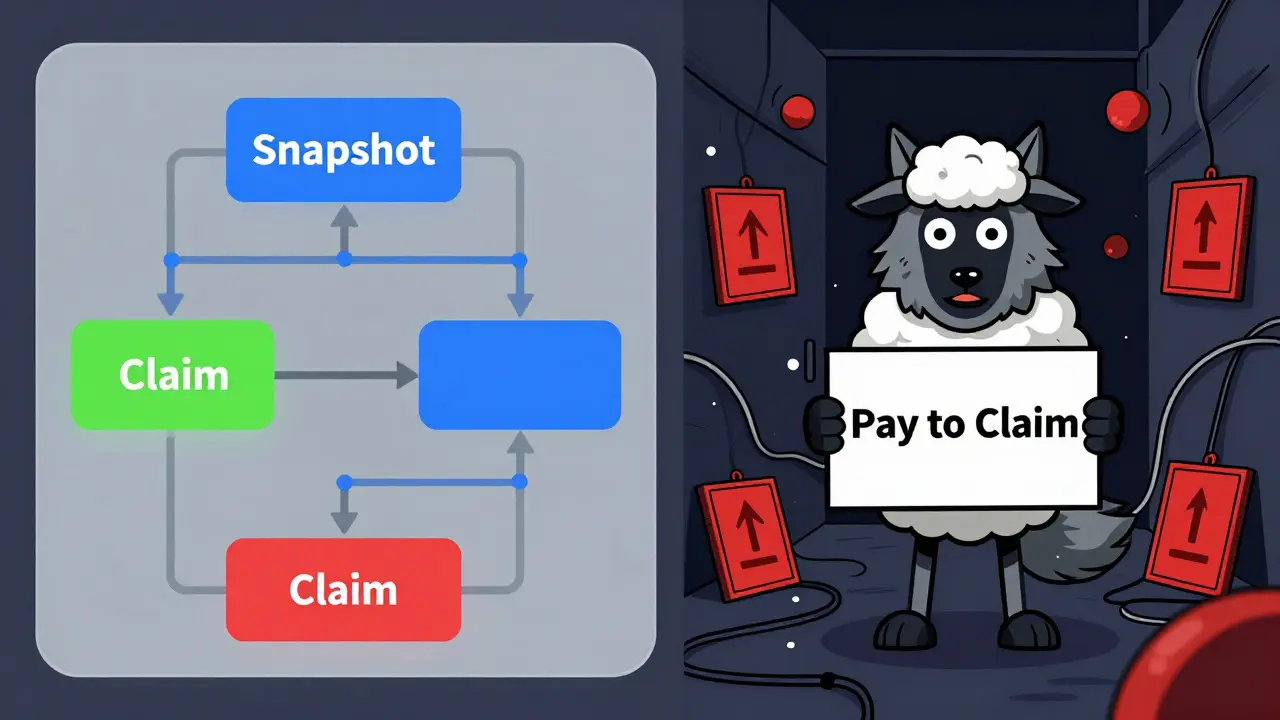
- Snapshot: The project takes a record of all wallets that interacted with their protocol before a certain date. This proves you were an early user.
- Eligibility Criteria: You must meet specific requirements, such as making a minimum number of transactions, holding a certain amount of assets, or participating in governance votes.
- Claim Period: Once eligible wallets are identified, a claim site opens up. You connect your wallet, verify your identity (sometimes), and receive the tokens.
- Vesting Schedules: Often, tokens aren't fully liquid immediately. Some might be locked for months to prevent instant sell-offs that crash the price.
Notice anything missing? There is no step where you send money to get money back. There is no step where you sign a contract giving unlimited access to your entire wallet balance. If a "Kalata airdrop" asks you to pay a gas fee higher than normal or approve a transaction for an unknown smart contract, stop immediately.
Red Flags: Spotting Kalata Airdrop Scams
Scammers are creative. They monitor social media for trending topics and create fake landing pages within hours. Since "Kalata airdrop" is generating search interest, bots are likely already targeting users. Here is how to protect yourself.
1. The "Pay-to-Claim" Trap
You never pay to claim an airdrop. Yes, you pay network gas fees to execute the transaction on the blockchain, but those fees go to miners or validators, not to the project. If a site asks you to send 0.05 ETH or 10 USDT to "verify" your wallet or "unlock" your rewards, it is a scam. The money will vanish into a dead wallet.
2. Phishing Websites
Check the URL carefully. Scammers use domains that look almost identical to the official one. For example, if the real site is `kalata.io`, a scammer might use `kalata-airdrop.com` or `kalata-token-claim.net`. Always bookmark the official website and navigate from there. Never click links sent via direct message on Telegram or Discord.
3. Unlimited Approval Attacks
This is the most technical but most dangerous risk. When you connect your wallet to a dApp, you might be asked to "Approve" a transaction. This grants permission for a smart contract to spend your tokens. Scammers trick you into approving an unlimited allowance for your existing assets (like USDC or ETH). Once approved, they drain your wallet instantly. Always check the exact amount being requested on tools like Revoke.cash before interacting with new sites.
Comparison: Real vs. Fake Airdrop Signals
| Feature | Legitimate Airdrop | Scam Airdrop |
|---|---|---|
| Official Source | Announced on verified Twitter/X account and official blog | Only found via DMs, Reddit ads, or unverified links |
| Cost to Claim | Free (only standard network gas fees) | Requires sending crypto to a "verification" address |
| Wallet Permissions | Requests minimal permissions for specific token interaction | Asks for unlimited approval of other assets in your wallet |
| Urgency | Clear timeline with reasonable deadlines | "Claim in next 1 hour or lose everything!" |
| Community Proof | Verified claims from reputable influencers and users | Fake testimonials using bot accounts |
What Should You Do Now?
Patient capital wins in crypto. Chasing rumors leads to drained wallets. Here is your action plan regarding Kalata and potential future airdrops.
Step 1: Verify Official Channels
Go directly to the official Kalata website and their verified social media handles. Look for pinned tweets or blog posts titled "Airdrop Announcement." If you don't see it there, assume it doesn't exist. Do not trust screenshots forwarded by friends; even well-meaning people can be hacked or misled.
Step 2: Use a Burner Wallet
If you decide to interact with the Kalata testnet or mainnet because you believe in the long-term vision, use a separate hardware wallet or a secondary software wallet with only a small amount of funds. Keep your main savings in a cold storage device that rarely connects to the internet. This limits your exposure if a smart contract vulnerability is discovered.
Step 3: Monitor On-Chain Data
Savvy investors watch the blockchain, not just Twitter. Use block explorers like Etherscan or Solscan to track large transactions related to the Kalata contract. If you see a new contract being deployed that distributes tokens to thousands of addresses simultaneously, that is a strong signal of an actual distribution event. Tools like Nansen or Dune Analytics can also help you visualize whale movements and airdrop farming activities.
Step 4: Engage Authentically (If Interested)
If you genuinely want to support the Kalata project, engage with it naturally. Use their platform if it offers utility. Join their Discord to ask thoughtful questions. Retweet their content because you agree with it, not just to farm points. Projects are increasingly using AI to detect bot behavior. Simple copy-paste comments won't save you from being blacklisted from future rewards.

Understanding Tokenomics and Value
Even if an airdrop happens, receiving tokens doesn't mean you're rich. You need to understand the tokenomics. How many KALA tokens are in circulation? What percentage is allocated to the team, investors, and community? If 50% of the supply is held by venture capitalists who can dump their bags immediately after the airdrop unlocks, the price could crash 90% in minutes.
Look for vesting schedules. Good projects lock team and investor tokens for 12 to 24 months. This aligns incentives and prevents immediate sell pressure. Check if the Kalata whitepaper or documentation mentions these details. If the total supply is infinite or unclear, treat any received tokens with extreme skepticism.
Conclusion: Stay Safe, Stay Sharp
The crypto space moves fast, and FOMO (Fear Of Missing Out) is your biggest enemy. The lack of official news about a Kalata airdrop is not a reason to panic, but it is a reason to pause. Take the time to verify sources, secure your wallets, and educate yourself on how distributions work. When the real opportunity comes-and it might-you'll be ready to claim it safely without losing your principal investment. Remember, in crypto, if it sounds too good to be true, it almost certainly is.
Is there an official Kalata (KALA) airdrop happening right now?
As of mid-2026, there is no official announcement from the Kalata development team regarding an active airdrop. Be wary of unofficial websites or social media posts claiming otherwise, as they are likely scams.
How can I verify if a Kalata airdrop link is safe?
Always navigate to the claim site through the official Kalata website or their verified Twitter/X account. Check the URL for typos, and use tools like Revoke.cash to ensure the site isn't asking for unlimited permissions to your other assets.
Do I need to pay money to claim a crypto airdrop?
No. Legitimate airdrops are free. You may need to pay standard blockchain network fees (gas fees) to execute the claim transaction, but you should never send tokens to a specific address to "unlock" or "verify" your airdrop.
What happens if I connect my wallet to a fake airdrop site?
If you sign a malicious transaction, scammers can drain your wallet of supported tokens. Immediately disconnect your wallet from the site, move remaining funds to a new wallet address, and revoke any approvals granted to the malicious contract.
Will Kalata launch an airdrop in the future?
It is possible, as many projects use airdrops for marketing and decentralization. However, until an official announcement is made, any speculation is just rumor. Follow the project's official channels for updates.