
Imagine trying to buy a specific vintage comic book. You go to the biggest bookstore in town, but they only sell bestsellers. You have to find that tiny, specialized shop downtown just to get what you want. That is exactly where KaiaSwap sits in the cryptocurrency world right now.
If you are looking for a massive platform with thousands of coins, low fees, and instant execution, KaiaSwap might feel like a dead end. But if you are deeply embedded in the Kaia blockchain ecosystem (formerly known as Klaytn) and need to trade specific native tokens, it serves a very narrow purpose. Let’s cut through the noise and look at the hard data from late 2025 and early 2026 to see if this decentralized exchange (DEX) actually works for your portfolio or if it’s just another abandoned project.
The Hard Numbers: Volume and Liquidity Reality Check
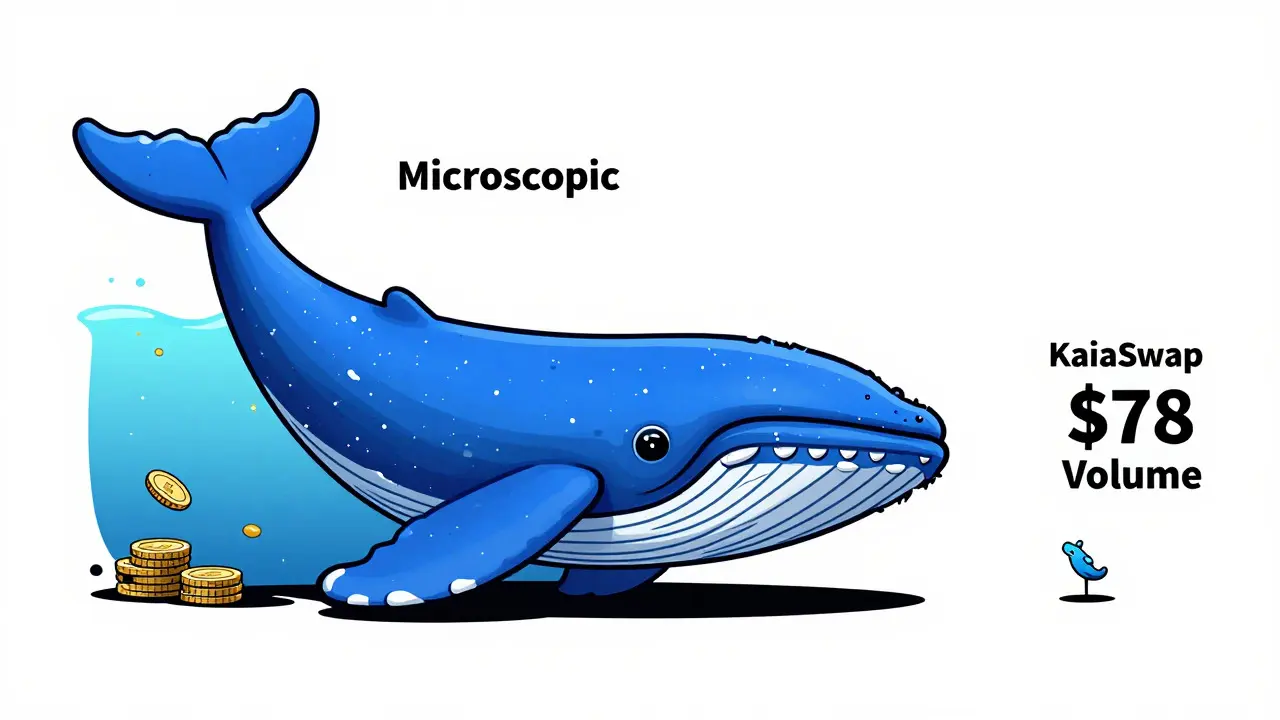
When reviewing any exchange, volume is king. It tells you if people are actually using the place. According to CoinGecko data from December 2025, KaiaSwap reported a 24-hour trading volume of roughly $78.73. Yes, you read that correctly. Less than eighty dollars.
To put that in perspective, industry giants like Uniswap were processing over $1.2 billion in daily volume during the same period. Even smaller competitors like Trader Joe were handling nearly $28 million. KaiaSwap’s volume represents about 0.00024% of the total DEX market. This isn’t just "low"; it’s microscopic.
Why does this matter to you? Low volume means low liquidity. When liquidity is thin, you face two major problems:
- High Slippage: If you try to swap a decent amount of money, your price will change drastically because there aren’t enough orders in the pool to fill your trade at the listed price.
- Wide Spreads: The average bid-ask spread on KaiaSwap is around 0.75%. On major exchanges, spreads often hover near 0.01% or lower. You are effectively paying a hidden tax every time you trade.
The most active pair on the platform is STKAIA/WKLAY (Staked KAIA against Wrapped KLAY), which accounted for $55.49 of that total daily volume. Another pair, PING/WKLAY, showed some activity, but the data inconsistencies suggest reporting errors rather than robust trading interest.
What Can You Actually Trade?
KaiaSwap is not a general-purpose exchange. It is a hyper-specialized tool. As of late 2025, the platform supported only four coins and four trading pairs. Compare this to Uniswap v3, which supports over 15,000 pairs, or even PancakeSwap with around 1,200 pairs.
Your options on KaiaSwap are essentially limited to:
- STKAIA: Staked KAIA, used by users who want yield on their holdings while maintaining tradability.
- PING: A governance or utility token within the Kaia ecosystem.
- WKLAY: Wrapped KLAY, the primary quote currency that allows the native chain token to be used in smart contracts easily.
If you hold Bitcoin, Ethereum, Solana, or even stablecoins like USDT or USDC, KaiaSwap has nothing for you. It does not offer cross-chain functionality out of the box like THORSwap or Synapse. You cannot bridge assets here seamlessly. You must already be inside the Kaia network to use this exchange.
| Feature | KaiaSwap | Uniswap v3 | PancakeSwap |
|---|---|---|---|
| Daily Volume (Dec 2025) | ~$78 | ~$1.24 Billion | ~$487 Million |
| Trading Pairs | 4 | 15,000+ | 1,200+ |
| Average Spread | 0.75% | <0.05% | <0.1% |
| Margin Trading | No | No (Spot Only) | Yes (Futures) |
| Mobile App | No | Web Only | Yes |
| Primary Use Case | Niche Kaia Tokens | Broad DeFi Access | BSC Ecosystem & Yield |
User Experience: Simple but Bare-Bones
Because KaiaSwap is small, its user interface (UI) is incredibly simple. There is no clutter, no complex charts, and no advanced order types like limit orders or stop-losses. It is a basic swap interface. For a seasoned DeFi veteran, this simplicity can be refreshing. For a beginner, it might be confusing because there are no educational tooltips or guides explaining how gas fees work on the Kaia network.
You will need a Web3 wallet compatible with the Kaia blockchain. Kaikas is the native wallet designed for this ecosystem, though MetaMask works if you manually configure the Kaia network settings. Once connected, you select the token you have, the token you want, and click swap. That’s it.
However, the lack of a mobile application is a significant drawback. In 2026, most crypto traders expect to manage positions on their phones. Competitors like PancakeSwap offer dedicated apps. KaiaSwap forces you to use a mobile browser, which can be clunky when dealing with wallet connections and transaction confirmations.
Fees and Hidden Costs
KaiaSwap does not publish explicit fee structures for markets in the traditional sense. Instead, it relies on the standard Automated Market Maker (AMM) model. This means fees are baked into the price you pay due to slippage and the protocol’s share of the swap fee.
While the protocol fee itself might be low (often 0.3% or less on many DEXs), the real cost comes from:
- Gas Fees: While Kaia transactions are generally cheaper than Ethereum mainnet, they are not free. If you are making small trades, gas fees can eat up a large percentage of your capital.
- Slippage Tolerance: Due to low liquidity, you may need to set a high slippage tolerance (e.g., 1% or more) to ensure your transaction doesn’t fail. This results in getting fewer tokens than expected.
There is no margin trading available. If you want leverage, you need to look elsewhere. This makes KaiaSwap unsuitable for active day traders who rely on shorting or borrowing funds.
Safety and Trust: What Do We Know?
In the world of decentralized finance, trust is earned through transparency and audits. KaiaSwap was established in 2024, making it a relatively new player. As of early 2026, detailed public audits of its smart contracts are not prominently featured in major security databases compared to older protocols.
CoinGecko assigns a Trust Score to exchanges, but for KaiaSwap, this score reflects its low activity and limited history. Industry analysts at Messari noted in late 2025 that 78% of new DEX launches on emerging Layer 1 chains fail to reach sustainable volume levels within six months. KaiaSwap fits this profile.
That said, because it is a non-custodial DEX, you retain control of your private keys. Your funds sit in your wallet until the moment of the swap. This reduces the risk of an exchange hack draining your account, unlike centralized exchanges (CEXs). However, the risk shifts to smart contract vulnerabilities. If the underlying code has bugs, your funds could be exploited. Always verify contract addresses yourself before interacting.

Who Should Use KaiaSwap? (And Who Should Avoid It)
Let’s be direct. KaiaSwap is not for everyone. Here is a breakdown of who benefits and who should stay away.
Use KaiaSwap if:
- You hold STKAIA and need to convert it back to WKLAY quickly without leaving the Kaia network.
- You are participating in a specific Kaia-based yield farming strategy that requires swapping PING tokens.
- You want to avoid bridge fees by staying entirely within the Kaia ecosystem.
Avoid KaiaSwap if:
- You are trading large amounts of capital (the slippage will hurt).
- You want to trade major cryptocurrencies like BTC or ETH.
- You need advanced features like limit orders, charting tools, or mobile app support.
- You are new to crypto and need customer support or educational resources.
The Future Outlook: Will It Grow?
The survival of KaiaSwap depends entirely on the growth of the Kaia blockchain itself. The Kaia Foundation has strong corporate ties in South Korea, including partnerships with LG Electronics and Hyundai Motor Company. Daily active addresses on the Kaia network grew by 21.5% from January to November 2025. This is positive, but it hasn’t translated into significant DEX volume yet.
Analysts remain skeptical. Delphi Digital suggested in late 2025 that single-chain DEXs without substantial liquidity mining incentives (minimum $5M allocation) struggle to survive past the initial hype cycle. There is no public evidence of such a massive incentive program for KaiaSwap as of early 2026.
Unless the Kaia Foundation injects significant capital to boost liquidity or integrates KaiaSwap deeply into other popular dApps on the chain, it is likely to remain a niche utility rather than a competitive exchange. For most users, waiting for better infrastructure or using broader aggregators like 1inch (which can route through Kaia if liquidity exists) might be safer.
Is KaiaSwap safe to use?
KaiaSwap is a non-custodial decentralized exchange, meaning you keep control of your private keys. However, safety also depends on the security of its smart contracts. As a newer platform with low volume, comprehensive third-party audit reports are less visible than those of established DEXs. Always start with small amounts to test transactions.
What tokens can I trade on KaiaSwap?
As of early 2026, KaiaSwap primarily supports Kaia-native tokens. The main pairs include STKAIA (Staked KAIA), PING, and WKLAY (Wrapped KLAY). It does not support major cryptocurrencies like Bitcoin or Ethereum directly.
Does KaiaSwap have a mobile app?
No, KaiaSwap does not have a dedicated mobile application on the Apple App Store or Google Play Store. Users must access the platform via a mobile web browser, which requires connecting a Web3 wallet like Kaikas or MetaMask.
How do fees compare to other DEXs?
While the protocol fee may be standard, the effective cost is higher due to wide bid-ask spreads (around 0.75%) and potential slippage caused by low liquidity. Major DEXs like Uniswap typically offer much tighter spreads due to higher trading volumes.
Can I use KaiaSwap for margin trading?
No, KaiaSwap currently operates as a spot-only swap interface. It does not offer margin trading, futures, or leverage products. If you need these features, platforms like GMX or dYdX are better alternatives.
5 Comments
It is fascinating how niche ecosystems like Kaia try to carve out their own space, but the numbers don't lie. The volume is practically non-existent compared to the giants.
You are absolutely correct about the liquidity issues! It is pathetic that anyone would trust a platform with less than $80 in daily volume. Seriously? In 2026? If you are not on Uniswap or PancakeSwap, you are essentially donating your money to slippage fees and inefficient markets. It is an insult to basic financial literacy to even consider this "vintage comic book" analogy when the reality is just a digital ghost town. Wake up!
I mean, I get it, but it’s kind of sad honestly. Like, who is actually using this? It feels so lonely over there. I tried swapping some STKAIA once and my heart dropped because of the spread. It’s like trying to make a friend at a party where everyone else is already talking. Just stick to the big apps, guys. It’s safer and less depressing.
The comparison table is incredibly helpful! It really highlights the disparity in infrastructure between established protocols and newer, smaller chains. While the corporate partnerships with LG and Hyundai sound promising for long-term adoption, the current user experience is undeniably lacking. One must appreciate the effort to maintain sovereignty within the Kaia ecosystem, yet one cannot ignore the practical realities of trading efficiency.
I suppose if you are already deep into the Kaia staking rewards, it makes sense to use it just to avoid bridge fees. But for general trading, yeah, it’s tough.