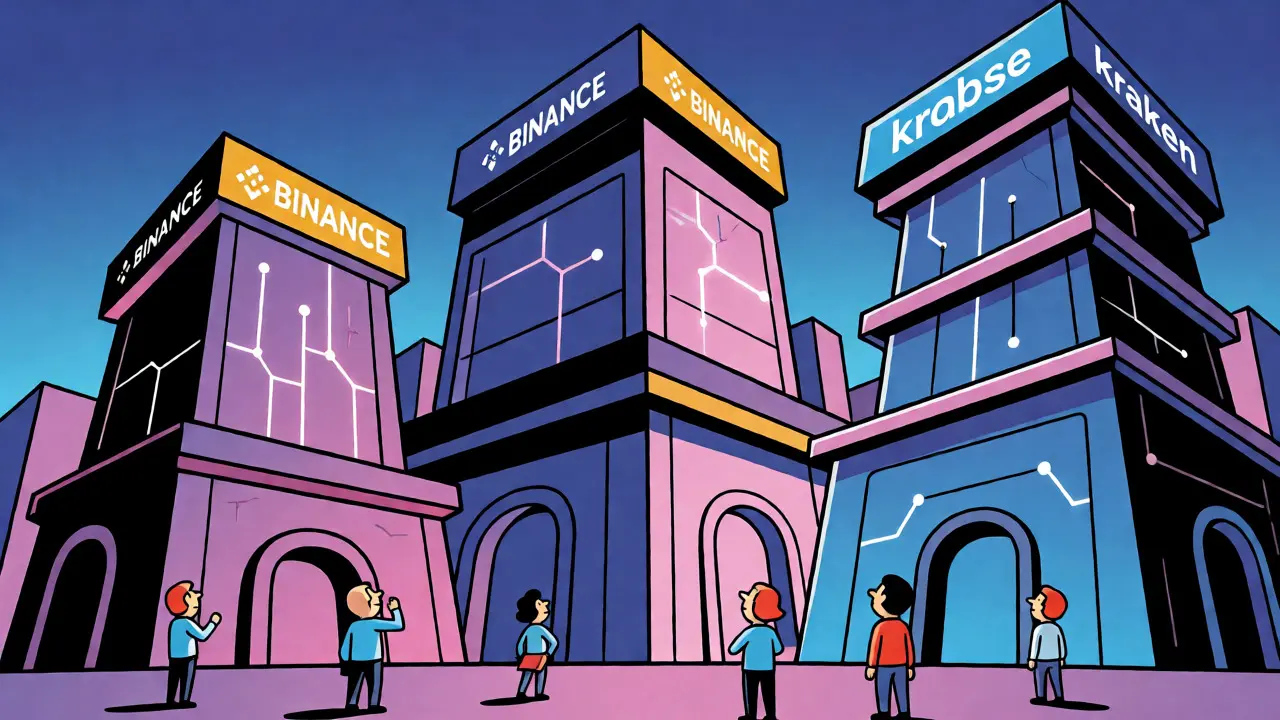
You might think "jumbo" is just a slang term for the biggest names in crypto trading. But if you are looking at platforms like Binance, Coinbase, or Kraken, you aren't just picking a place to buy Bitcoin. You are choosing a fortress. In late 2025, these major exchanges process over $35 billion daily. That is not just money; it is trust. And trust is fragile.
Why does this matter to you? Because when you park your assets on a large platform, you rely on their infrastructure more than your own keys. A small glitch in a jumbo exchange doesn't just lose a few dollars; it can freeze millions of users out of the market during critical volatility spikes. This review breaks down what actually happens behind the scenes at the top-tier exchanges today. We will look at where your money sits, how fast trades execute, and why some platforms sleep better at night than others.
The Scale Game: Why Size Matters
When we talk about a "jumbo" exchange, we are referring to platforms with deep liquidity and massive user bases. As of November 2025, Binance holds roughly 58.7% of the global spot trading market share. Coinbase follows with 12.3%, while Kraken captures about 6.2%. These numbers aren't just bragging rights. They determine whether you get slippage when buying large amounts of ETH or SOL.
High volume means tight spreads. If you try to buy $50,000 worth of Bitcoin on a mid-tier exchange, you might pay 0.5% more due to thin order books. On a jumbo exchange, that spread often drops below 0.05%. For active traders, this difference compounds rapidly. But size brings complexity. Managing billions in assets requires specialized hardware and strict protocols. Smaller exchanges simply cannot match the redundancy systems these giants use.
Security Architecture: Where Your Funds Actually Live
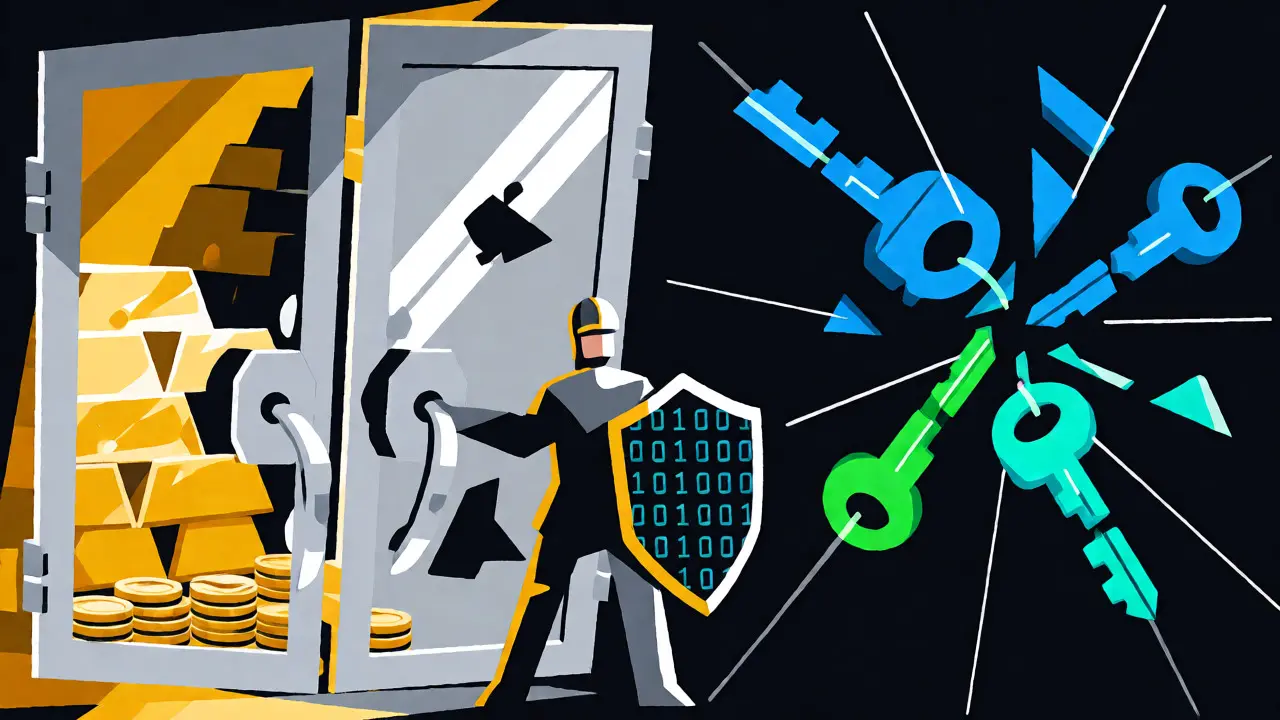
The biggest fear for any crypto holder is a hack. Historically, exchanges were soft targets. Think back to Mt. Gox in 2014 or Bitfinex in 2016. Today, the landscape has shifted dramatically. Leading jumbo exchanges now store between 95% and 98% of user funds in cold storage. This means private keys are kept offline, in physical vaults requiring multi-person authorization to access.
Binance reports storing 95% of assets in geographically dispersed cold wallets. Their system uses military-grade encryption and air-gapped signing computers. These machines never touch the internet directly. When a withdrawal request comes in, data is transferred via encrypted media to an offline machine, signed, and then moved back online. It sounds slow, but it prevents remote hackers from stealing keys.
Kraken takes a different approach with Multi-Party Computation (MPC) wallets. Instead of one key controlling all funds, the key is split into shards. To move more than $1 million, they require a 3-of-5 quorum. This eliminates single points of failure. If one server is compromised, the attacker still cannot sign transactions without accessing multiple isolated devices.
| Feature | Coinbase | Binance | Kraken |
|---|---|---|---|
| Cold Storage % | >95% | ~95% | MPC Wallets |
| Insurance Coverage | $250M Fund | SAFU Fund ($1B+) | Self-Insured |
| Audit Frequency | Quarterly | Monthly Proofs | Quarterly |
| Regulatory Status | US Public Co. | Global Licenses | US Regulated |
Performance Metrics: Speed vs. Safety
Speed matters, especially during market crashes. If you need to exit a position quickly, latency kills profits. Independent testing by CryptoQuant in September 2025 showed that Binance’s matching engine processes trades in 0.8 milliseconds. Coinbase averages 1.2 milliseconds. These differences seem negligible until you consider network congestion.
However, speed comes at a cost. Security verification adds delay. Most jumbo exchanges impose a 200-300 millisecond buffer for fraud checks before executing withdrawals. This isn't lag; it's a filter. During the Hexagate incident in March 2025, real-time monitoring systems blocked $47 million in stolen funds because exchanges integrated Chainalysis tools. Without those delays, the money would have vanished into mixer services within seconds.
Users often complain about withdrawal freezes. If you change your password or enable new 2FA methods, expect a 24-48 hour hold on withdrawals. This is standard practice across all major platforms. It protects against SIM-swap attacks where a hacker resets your credentials and immediately tries to drain your account.
User Experience and Support Quality
Technical specs don't help if you can't log in. User sentiment varies widely among jumbo exchanges. Coinbase maintains a 4.2/5 rating on Trustpilot for security features, though users frequently cite aggressive transaction blocking. One Reddit user noted, "Their mandatory biometric login makes me feel safer, though the 30-minute delay after changing settings is annoying."
Kraken scores higher for support quality, with a 4.4/5 rating specifically for security responsiveness. Their documentation is rated 4.7/5 by CoinDesk readers for clarity. Kraken’s anti-phishing code system allows users to set a unique phrase that appears in all official emails. If that phrase is missing, the email is fake. Simple, effective, and highly praised by beginners.
Binance faces criticism for its support response times. High-priority security cases average 6.2 hours for resolution, compared to Coinbase’s 2-hour target for critical issues. With 1,243 security-related complaints logged in Q3 2025 alone, many users struggle with SMS-based 2FA vulnerabilities. While Binance recommends authenticator apps, many newcomers stick to SMS, leaving them exposed to SIM swaps.
The Cost of Compliance and Regulation
Regulation is no longer optional. In 2025, major exchanges spent $4.2 billion collectively on compliance and security. This cost trickles down to fees. Higher KYC standards mean stricter identity verification. Processing times for KYC average 18 hours, though automated systems have reduced this for verified users.
MiCA regulations in Europe forced exchanges to segregate client funds strictly. This separation ensures that if an exchange goes bankrupt, customer assets remain untouched by creditors. US-based exchanges like Coinbase and Kraken operate under similar state-by-state money transmitter laws. Binance operates globally but faces ongoing scrutiny from the SEC, impacting its ability to offer certain derivatives products in the US.
Institutional adoption drives these changes. Banks and hedge funds won't trade on platforms without SOC 2 Type 2 compliance. Coinbase leads here, having achieved full compliance years ago. This institutional backing stabilizes the platform, reducing the risk of sudden shutdowns due to regulatory crackdowns.
Verdict: Which Jumbo Exchange Fits You?
There is no single "best" exchange. It depends on your priority.
- For maximum security: Choose Coinbase. Its public company status, insurance fund, and strict US regulation provide peace of mind. The interface is simple, and support is robust.
- For advanced trading and low fees: Choose Binance. The liquidity is unmatched, and fee structures reward high-volume traders. Just be prepared for a steeper learning curve and stricter KYC.
- For balanced security and privacy: Choose Kraken. It offers strong MPC wallet technology and excellent customer service. It’s less flashy than Binance but more reliable for long-term holding.
Remember, even jumbo exchanges are custodians. Not your keys, not your coins. Use these platforms for trading and fiat on-ramps. For long-term storage, move significant holdings to a hardware wallet. But if you must keep funds on-exchange, choose the platform with the best track record for handling incidents transparently.
What defines a "jumbo" crypto exchange?
A jumbo crypto exchange refers to a major, high-volume trading platform serving millions of users globally. Examples include Binance, Coinbase, and Kraken. These platforms are characterized by deep liquidity, advanced security infrastructure, and significant daily trading volumes exceeding billions of dollars.
Are jumbo exchanges safe from hacks?
While no system is perfect, jumbo exchanges are significantly safer than smaller ones. They store 95%+ of funds in cold storage, use multi-party computation wallets, and undergo regular third-party audits. Incidents have decreased by 72.7% among top platforms since 2023.
Which jumbo exchange has the best customer support?
Kraken consistently ranks highest for security-focused support, with a 4.4/5 rating for responsiveness. Coinbase also performs well, resolving 89% of critical issues within two hours. Binance tends to have longer wait times for complex security queries.
Do I need KYC for jumbo exchanges?
Yes. All major jumbo exchanges require Know Your Customer (KYC) verification. This involves submitting government ID and proof of address. Verification times average 18 hours but can vary based on document quality and regional regulations.
What is the difference between hot and cold storage?
Hot storage connects to the internet for quick access but is vulnerable to hacks. Cold storage keeps private keys offline in physical vaults. Jumbo exchanges keep most user funds in cold storage, moving only necessary amounts to hot wallets for immediate trading needs.