
Imagine earning money just by leaving a small device on your windowsill that helps build a wireless network for thousands of people. Or getting paid in crypto for driving your car around town, mapping streets that Google Maps doesn’t cover. This isn’t science fiction-it’s happening right now through DePIN projects. Decentralized Physical Infrastructure Networks are turning everyday hardware and unused computing power into income-generating assets, all powered by blockchain. And for investors, this could be one of the most tangible ways to bet on the future of infrastructure.
What Exactly Are DePIN Projects?
DePIN stands for Decentralized Physical Infrastructure Networks. At its core, it’s about replacing old, centralized systems-like cell towers, data storage, or mapping services-with networks built by regular people using blockchain incentives. Instead of a single company owning all the hardware, thousands of individuals contribute their own devices and get rewarded with tokens.
Think of it like Airbnb, but for physical infrastructure. You don’t own the whole network-you just lend a piece of it. In return, you earn tokens that can increase in value as the network grows. Early examples include Helium, which started in 2013 as a way to create a decentralized wireless network, and Filecoin, launched in 2020, which lets you rent out spare hard drive space to store data.
By 2023, over 50 DePIN projects were active, with a combined market cap of more than $3.2 billion. That’s up from just $200 million in early 2022. The growth didn’t come from speculation alone-it came from real usage. Helium had over 1 million hotspots. Hivemapper collected 1.5 billion street images. Render Network processed over a million GPU rendering jobs. These aren’t theoretical numbers. They’re metrics that show real demand.
Two Types of DePIN: Hardware vs. Software
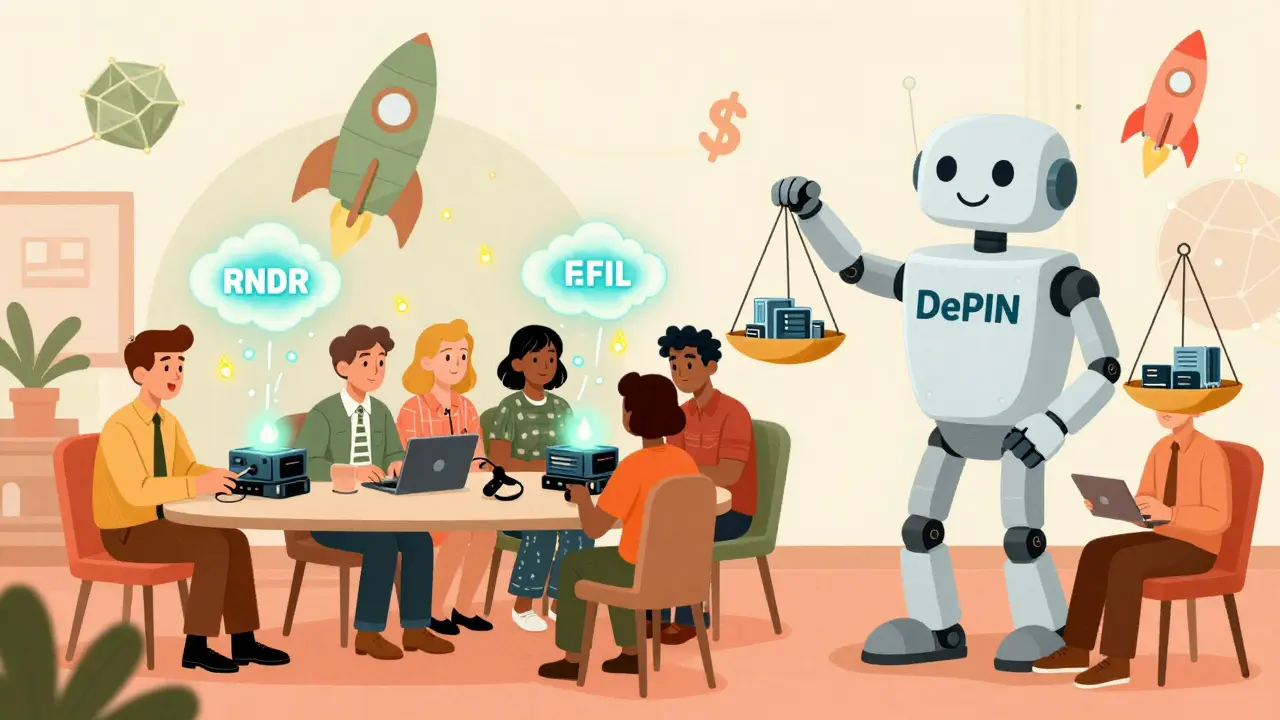
Not all DePIN projects are the same. They fall into two clear buckets: Physical Resource Networks (PRNs) and Digital Resource Networks (DRNs). Understanding the difference is key to making smart investment choices.
PRNs require you to buy and set up physical hardware. Helium’s hotspots, Hivemapper’s camera rigs, and other location-based networks fall here. You might spend $100 to $1,000 upfront on a device. Once it’s running, it earns tokens by providing coverage or data. The catch? Your earnings depend on location, network demand, and how many others are competing in your area. A hotspot in a rural town might earn more than one in a crowded city because there’s less competition for coverage.
DRNs are different. They don’t need you to buy new gear. Instead, you use what you already have-like spare GPU power or unused cloud storage. Render Network lets you rent out your graphics cards for 3D rendering jobs. Filecoin lets you rent out hard drive space. Entry costs are lower, often just the cost of electricity and existing hardware. But competition is fierce. If thousands of people are offering the same service, rewards drop fast.
PRNs have higher barriers but stronger network effects. DRNs are easier to start but more volatile. Investors who put money into both types tend to see better long-term results than those who pick just one.
Why DePIN Beats Traditional Infrastructure
Why would anyone use a decentralized network instead of AT&T or AWS? Because DePIN is cheaper, faster, and more flexible.
According to a16z Crypto, DePIN networks can build infrastructure at 30% to 50% lower cost than traditional providers. How? No corporate overhead. No expensive construction permits. No middlemen. Just people using their own devices and getting paid in tokens.
Helium Mobile, for example, expanded coverage to over 1,800 U.S. cities-including places where Verizon and T-Mobile won’t go-without building a single cell tower. Hivemapper’s street maps are now used by Ford, Uber, and other big companies because they’re cheaper and updated in real time.
And unlike DeFi, where billions are locked up in lending pools with no real-world use, DePIN projects have measurable utility. Helium’s network handles real data traffic. Filecoin stores actual files. Render Network renders real movie frames. That’s why DePIN’s growth outpaced the broader crypto market: 1,500% from 2022 to 2023 versus crypto’s 180%.

How DePIN Tokens Actually Make Money
Token rewards are the engine of DePIN. But not all tokens are created equal. The best ones have three things: clear utility, verifiable usage, and sustainable emissions.
Helium’s HNT token used to pay out $1.50 per day per hotspot in early 2022. By late 2023, that dropped to $0.35. Why? More hotspots joined the network. Supply increased faster than demand. This is common. Messari found that 60% of early DePIN projects changed their reward structures within 18 months.
Successful projects fix this by tying token value to actual service usage. Hivemapper’s MAP token isn’t just earned by driving-it’s spent by companies buying map data. Render’s RNDR token is used to pay for GPU rendering. That creates real demand, not just speculation.
Investors should avoid tokens with high inflation rates. A project giving out 15% new tokens every year is a red flag. The sweet spot is under 5% annual inflation after the initial launch. Projects like Filecoin and Render Network have kept inflation low by burning tokens or locking up rewards.
Real User Earnings and Risks
People are making money with DePIN-but it’s not easy, and it’s not guaranteed.
One Reddit user earned $120 a month from a $400 Helium hotspot after electricity costs. That’s a 30% annual return. Another user made $1,200 in six months driving 500 miles a week for Hivemapper. But others lost money. Early Filecoin miners spent thousands on storage hardware only to see rewards collapse during the 2021 bear market.
Hardware issues are common. About 30% of first-time Helium users struggled with setup. Rewards fluctuate wildly-daily earnings can swing by ±35% in a week. And taxes? In 47 U.S. states, DePIN rewards are treated as taxable income. You’re not just investing in crypto-you’re running a small business.
Don’t treat DePIN like a get-rich-quick scheme. Treat it like a side hustle. Track your electricity costs. Monitor network demand. Diversify across projects. And never invest more than you can afford to lose.
What’s Next for DePIN?
The next few years will decide which DePIN projects survive and which fade away.
Filecoin’s new Virtual Machine (FVM), launched in August 2023, lets developers build smart contracts directly on the network. That’s a game-changer. It turned Filecoin from a storage tool into a full blockchain platform. Developer activity jumped 170%.
Helium is moving from its own blockchain to Solana, cutting transaction fees by 80%. That could make hotspots much more profitable again. Hivemapper’s enterprise API, launching in early 2024, could generate $5-10 million in annual revenue.
But consolidation is coming. Delphi Digital predicts 70% of current DePIN projects will fail or merge by 2025. Only the top 5-10 will survive. That’s why timing matters. Investing in a brand-new, unproven project now is risky. But backing a project with real usage, strong team, and clear roadmap? That’s where the real opportunity lies.
How to Get Started
You don’t need to be a tech expert to get into DePIN. Here’s how to start:
- Start small. Buy a single Helium hotspot or use Render Network with your existing GPU. Test the waters before spending big.
- Track real usage. Don’t just look at token price. Check how many jobs, maps, or connections the network is handling daily. Use their official dashboards.
- Diversify. Put some money into a PRN (like Helium) and some into a DRN (like Filecoin). Balance hardware risk with software volatility.
- Watch the roadmap. Projects with clear upgrades (like Helium’s move to Solana) are more likely to succeed.
- Understand taxes. Keep records of all rewards. Use crypto tax tools like Koinly or CoinTracker.
Most investors spend 20-40 hours learning the basics before making their first move. That’s not much compared to the time it takes to learn how to trade stocks or manage a rental property.
Final Thoughts: Is DePIN Worth It?
DePIN isn’t just another crypto trend. It’s a new way to build infrastructure-faster, cheaper, and owned by the people who use it. The potential is huge: a16z Crypto estimates DePIN could be worth $500 billion to $1 trillion by 2030. Even skeptics like Nic Carter think it could hit $50-100 billion.
The risks are real: regulatory crackdowns, reward drops, hardware failures. But the rewards? Real usage, real income, and real ownership of infrastructure that used to be controlled by giant corporations.
If you believe the future of tech is decentralized, then DePIN isn’t just an investment. It’s a way to help build that future-and get paid for it.
Are DePIN projects a good investment for beginners?
Yes, but only if you start small and focus on learning. Beginners should avoid buying large amounts of hardware upfront. Instead, try token-only investments in established projects like Filecoin or Render Network. These don’t require extra gear and let you understand how the token economy works before risking physical assets. Always start with what you can afford to lose.
How do I know if a DePIN project is legitimate?
Look for three things: verifiable real-world usage (like active hotspots, mapped miles, or rendering jobs), a clear token utility (not just speculation), and a transparent team with public track records. Avoid projects that only talk about token price or future partnerships without showing current data. Check their official dashboards and GitHub activity. If they don’t publish metrics, walk away.
Can I make money without buying hardware?
Absolutely. Digital Resource Networks (DRNs) like Filecoin, Render Network, and Golem let you earn tokens using existing hardware you already own-like a spare GPU or unused cloud storage. You don’t need to buy anything new. Just install the software, allocate resources, and start earning. This is the lowest-risk way to get into DePIN.
What’s the biggest risk with DePIN investments?
The biggest risk is reward decay. As more people join a network, the rewards per participant drop. Helium’s daily earnings fell by over 75% in just two years. Projects that don’t adjust their tokenomics or add new use cases will see their value collapse. Always assume rewards will decrease over time and plan accordingly.
How do taxes work with DePIN earnings?
In most U.S. states, DePIN rewards are treated as ordinary income. If you earn $50 in tokens from a Helium hotspot, that $50 is taxable income on the day you receive it. Later, if you sell those tokens for more, you pay capital gains tax on the profit. Keep detailed records of every reward date, amount, and USD value at receipt. Use crypto tax tools to automate this. Ignoring taxes is a common mistake that can lead to penalties.
Will governments shut down DePIN projects?
Regulation is already happening. The FCC approved Helium’s spectrum use in 2022 but added new rules in 2023 that cut earnings by 20%. Telecom and energy DePIN projects face the highest regulatory risk because they compete with licensed industries. Projects that work with regulators-like Helium partnering with Deutsche Telekom-are more likely to survive. Avoid projects that ignore legal frameworks or operate in gray areas without clear compliance plans.
Which DePIN projects should I watch in 2026?
Focus on projects with proven traction, clear roadmaps, and enterprise adoption. Filecoin (storage), Render Network (GPU computing), and Hivemapper (mapping) are top candidates. Helium’s move to Solana could revive its hotspot model. Look for projects that have integrated with real businesses (like Ford or Uber) and have active developer communities. Avoid new projects without at least 12 months of operational history.
6 Comments
DePIN? More like DE-PIN-ning my wallet dry. I bought a hotspot, spent $600 on electricity, and got paid in HNT that’s now worth less than my coffee habit. Someone call the FTC - this isn’t innovation, it’s a pyramid scheme with Wi-Fi.
Y’all are missing the forest for the trees. 🌳💸 DePIN isn’t about whether your hotspot earns $0.40/day - it’s about decentralizing infrastructure from greedy telcos and cloud monopolies. Filecoin stores 8.5 exabytes of real data. Render Network rendered scenes for Netflix. This isn’t crypto fantasy - it’s infrastructure rebellion. If you’re mad about reward decay, you didn’t read the whitepaper. Tokenomics are designed to *adjust*, not collapse. And yes, taxes suck - but so did filing W-2s for your Etsy shop before you learned to use Koinly. Get smart, don’t get salty.
It is, in fact, a dangerous and ill-conceived experiment in economic abstraction. The notion that an American citizen should be expected to subsidize global infrastructure via their personal electrical grid is not only economically unsound - it is a violation of the social contract. Furthermore, the reliance on blockchain technology, a system with no intrinsic value and no regulatory oversight, is tantamount to gambling with taxpayer-backed utilities. I do not endorse this. I do not support this. I will not participate in this.
I've been running a Render Network node for 14 months now. Initial setup took about 20 minutes. Electricity cost: $12/month. Earnings: averaged $28/month in RNDR. Token value has held steady. No hardware failures. No headaches. I didn't need to buy anything new - just repurposed an old GPU from my gaming rig. It's not a get-rich-quick scheme. It's a quiet, passive income stream that quietly compounds. I've reinvested 60% of earnings into Filecoin storage. It's not flashy. But it's real. And it's mine. No middleman. No landlord. No corporate overlords. Just me, my hardware, and a blockchain. 🤝
Hey newcomers - don’t panic if your Helium hotspot isn’t raking in cash yet. I started with one, lost money for six months, then added a second one in a rural area… and boom - earnings tripled. Location matters more than you think. Also, don’t ignore DRNs. I’m earning from Render + Filecoin without touching hardware. It’s like having a digital side hustle that runs while you sleep. The key? Don’t chase hype. Chase usage. Check the dashboards. See how many jobs are being processed. If the numbers are climbing, the token has legs. And yeah, taxes are a pain - but that’s what accounting software is for. You’re not just investing in crypto - you’re building the future’s backbone. Slow and steady wins this race. 🌐💡
bro honestly if u dont have a spare gpu or 2 lying around ur already behind. filecoin and render are the only legit ones left. heliium? dead. map? decent but u gotta drive like a delivery driver for uber. i made $800 last year just by leaving my 3060 on 24/7.电费? $15/mo. tax? i used cointracker. no regrets. dont buy hardware unless u live in a low-coverage zone. drns are the future. and yeah, rewards drop - but so do cpu prices. it's a game of patience. and crypto. 🤓