
Imagine you are filling a bucket with water. You keep pouring until it is full. If you pour one more drop, what happens? The water spills over the edge. In computer programming, specifically in Solidity, the primary programming language for writing smart contracts on Ethereum and other blockchain platforms, this "spill" is called an integer overflow. It is not just a minor glitch; it is a critical security flaw that has cost projects millions of dollars.
When a number gets too big for its data type to hold, it wraps around to zero or a negative number. This can turn a tiny balance into a massive fortune, allowing attackers to drain funds from decentralized finance (DeFi) protocols. Understanding how these errors work-and how to stop them-is essential for any developer building on the blockchain today.
How Integer Overflow and Underflow Work
To understand the danger, we need to look at how the Ethereum Virtual Machine (EVM), the runtime environment for executing smart contract code on the Ethereum blockchain handles numbers. The EVM uses fixed-size data types. Unlike standard computers that might expand memory dynamically, the EVM allocates specific amounts of space for integers.
Solidity offers unsigned integers (uint) and signed integers (int). The most common type is uint256, which can store values from 0 up to $2^{256} - 1$. That is a huge number-far larger than the number of atoms in the observable universe. However, smaller types like uint8 only hold values from 0 to 255.
Here is where the trap lies. If you have a uint8 variable set to 255 and you add 1 to it, the result cannot be 256 because 256 does not fit in 8 bits. Instead of stopping or throwing an error (in older versions), the value wraps around to 0. This is integer overflow.
Conversely, if you have a uint8 set to 0 and subtract 1, the result cannot be -1 because unsigned integers cannot be negative. So, it wraps around to the maximum value, 255. This is integer underflow.
For signed integers (int), the behavior is similar but accounts for negative numbers. An int8 ranges from -128 to 127. Subtracting 1 from -128 wraps it back to 127. These wrap-around behaviors are mathematically predictable but disastrous for financial logic.
The Historical Context: Pre-Solidity 0.8.0
Before December 2020, when Solidity version 0.8.0 was released, developers had no built-in protection against these issues. The compiler would happily let your code execute even if it caused an overflow. This led to some of the earliest and most famous hacks in cryptocurrency history.
One notorious example involved a token contract where an attacker exploited an underflow in a transfer function. By sending tokens to themselves in a way that triggered an underflow, they turned a small balance into a massive amount of tokens, effectively minting infinite currency. They then sold these tokens, crashing the price and draining liquidity pools.
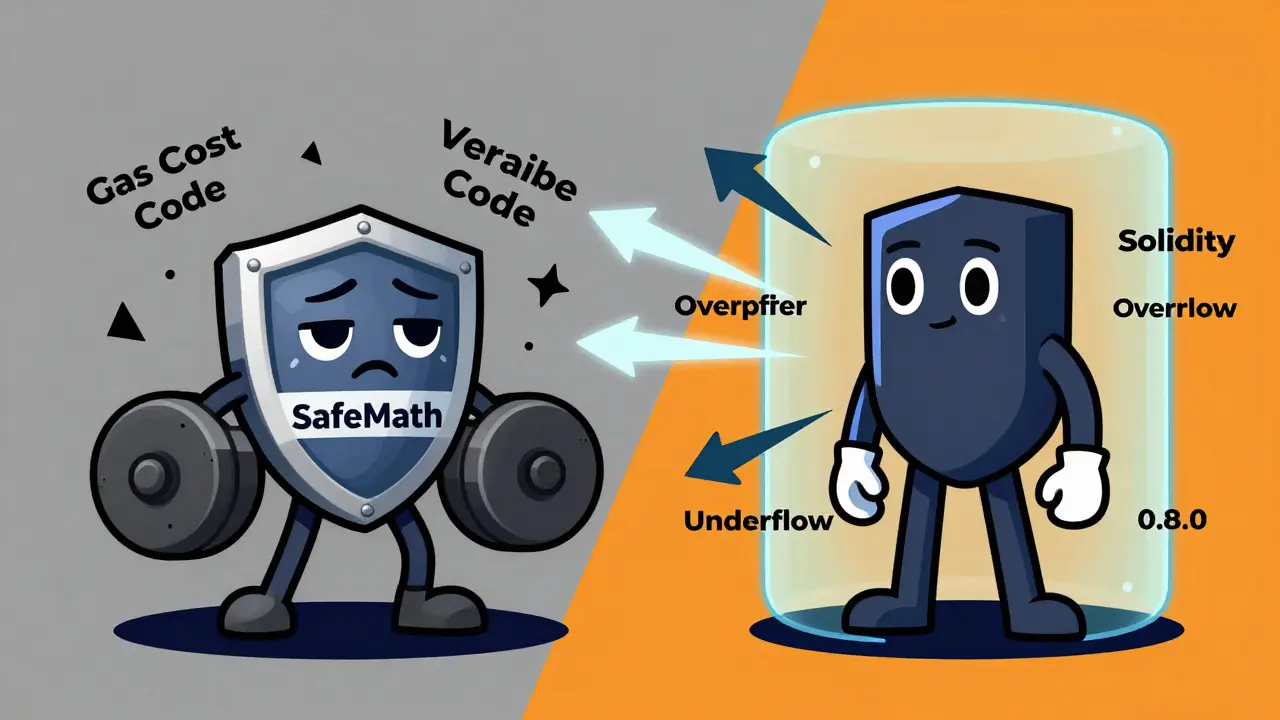
To combat this, the community created the SafeMath library, a widely used open-source library developed by OpenZeppelin to prevent integer overflow and underflow in Solidity versions prior to 0.8.0. Created by OpenZeppelin, a leading provider of secure smart contract libraries, tools, and auditing services for the Ethereum ecosystem, SafeMath provided functions like safeAdd(), safeSub(), and safeMul(). These functions checked if an operation would cause an overflow before executing it. If it would, the transaction would revert, preventing the state corruption.
While effective, SafeMath had downsides. It increased gas costs because every arithmetic operation required extra checks. It also made code verbose and harder to read. Developers had to import the library and use special functions instead of standard operators like + or -.
The Solution: Solidity 0.8.0 and Automatic Checks
The release of Solidity 0.8.0 marked a turning point. The core team decided that protecting developers from such basic errors should be the default behavior. Starting with this version, the compiler automatically inserts overflow and underflow checks for all arithmetic operations.
If you write a + b in Solidity 0.8.0+, and the result exceeds the maximum value of the data type, the transaction reverts immediately. No external library is needed. This change simplified code significantly. You can now use standard operators safely:
pragma solidity ^0.8.0;

contract SafeArithmetic {
    uint256 public balance;

    function addToBalance(uint256 amount) public {
        // If balance + amount overflows, this line reverts automatically
        balance = balance + amount;
    }
}
This automatic protection covers addition, subtraction, multiplication, division, and exponentiation. It applies to both signed and unsigned integers. For most new projects, using Solidity 0.8.0 or later is the single most important step you can take to prevent these vulnerabilities.
When Protection Fails: Unchecked Blocks and Assembly
Even with Solidity 0.8.0, vulnerabilities still exist. Why? Because sometimes developers intentionally disable the safety checks. This is done using the unchecked block.
Why would anyone want to disable safety checks? Gas optimization. Each automatic check costs a small amount of gas. In high-frequency trading bots or complex DeFi protocols where thousands of transactions occur, saving even a few units of gas per operation adds up. Developers might wrap known-safe operations in unchecked blocks to save costs.
function riskyOperation(uint256 a, uint256 b) public {
    unchecked {
        // Safety checks are disabled here!
        // If a + b overflows, it will wrap around silently.
        uint256 result = a + b;
    }
}
The danger arises when developers assume an operation is safe but are wrong. Perhaps a user input changes, or a formula interacts with another contract in an unexpected way. Once inside an unchecked block, there is no safety net. The code behaves exactly like pre-0.8.0 Solidity.
Another risk area is inline assembly (assembly). Low-level Yul or Inline ASM allows direct manipulation of the EVM stack. These operations bypass Solidity’s high-level safety features entirely. While powerful, they require extreme caution. Any arithmetic performed in assembly must be manually verified for overflow conditions.
Best Practices for Secure Arithmetic
Writing secure smart contracts requires more than just relying on the compiler. Here are practical steps to ensure your arithmetic is robust:
- Use Solidity 0.8.0+: Always start new projects with the latest stable version of Solidity. This gives you free protection against basic overflows.
- Avoid
uncheckedunless necessary: Only useuncheckedblocks when you have proven through rigorous testing that an overflow is impossible. Document why it is safe. - Validate User Inputs: Never trust user inputs blindly. If a function accepts a large number, check that it fits within expected bounds before performing calculations.
- Use Libraries for Complex Math: For advanced mathematical operations, consider using well-audited libraries like PrbMath, a popular library for fixed-point decimal arithmetic in Solidity, designed to handle precise calculations without overflow risks or OpenZeppelin’s Math utilities. These handle edge cases better than custom implementations.
- Test Edge Cases: Your test suite should include scenarios where variables are at their maximum and minimum values. Try adding 1 to
type(uint256).maxto ensure it reverts as expected. - Static Analysis Tools: Use tools like Slither, an open-source static analysis framework written in Python for finding bugs in Solidity smart contracts or Mythril during development. These tools can scan your code for potential overflow patterns, even in newer Solidity versions where
uncheckedblocks are used.

Comparison: SafeMath vs. Solidity 0.8.0 Native Checks
| Feature | SafeMath Library (Pre-0.8.0) | Solidity 0.8.0+ Native | Unchecked Block |
|---|---|---|---|
| Protection Level | High (Manual) | High (Automatic) | None |
| Gas Cost | Higher (extra function calls) | Moderate (inline checks) | Lowest |
| Code Readability | Lower (verbose syntax) | High (standard operators) | High (but risky) |
| Implementation Effort | Medium (import library) | Low (default behavior) | Low (explicit opt-out) |
| Recommended Use | Legacy contracts only | All new projects | Only for proven safe ops |
Real-World Implications and Auditing
Despite improvements, integer overflow remains a top concern. The OWASP Foundation, a non-profit organization that works to improve the security of software through community-led open source software projects lists integer overflow and underflow as SC02 in their Smart Contract Top 10 security risks. This highlights that the threat is still very real.
Professional auditors from firms like ConsenSys Diligence and Trail of Bits often find subtle overflow vulnerabilities in complex DeFi protocols. These usually occur in interactions between multiple contracts or in yield farming formulas where numbers grow exponentially. Automated tools catch many obvious cases, but manual review is still crucial for complex logic.
For developers, the key takeaway is vigilance. Just because the compiler protects you doesn’t mean you can ignore math. Always ask: "Can this number get too big? Can it go negative? What happens if it does?" By treating arithmetic with respect, you protect your users’ funds and your project’s reputation.
What is the difference between integer overflow and underflow?
Overflow occurs when a calculation results in a number larger than the maximum value the data type can hold, causing it to wrap around to zero or a small positive number. Underflow happens when a result is smaller than the minimum value (e.g., going below zero for unsigned integers), causing it to wrap around to the maximum possible value.
Do I still need SafeMath if I am using Solidity 0.8.0?
No, you do not need SafeMath for basic arithmetic operations in Solidity 0.8.0 and later. The compiler includes automatic overflow and underflow checks. However, if you use unchecked blocks to optimize gas, you lose this protection and must manually verify safety.
How can I detect integer overflow vulnerabilities in my code?
You can use static analysis tools like Slither or Mythril to scan for potential issues. Additionally, writing comprehensive unit tests that include edge cases (maximum and minimum values) is essential. Manual code reviews focusing on arithmetic operations involving user inputs are also highly recommended.
Why would a developer use an unchecked block?
Developers use unchecked blocks to reduce gas costs. Since automatic overflow checks consume gas, disabling them for operations that are mathematically guaranteed not to overflow can save money on transaction fees, especially in high-volume applications.
Is integer overflow a problem in other programming languages?
Yes, integer overflow is a common issue in low-level languages like C and C++. However, higher-level languages like Python handle arbitrarily large integers automatically, avoiding this specific type of error. Solidity’s fixed-size types make it similar to C in this regard, requiring careful management.