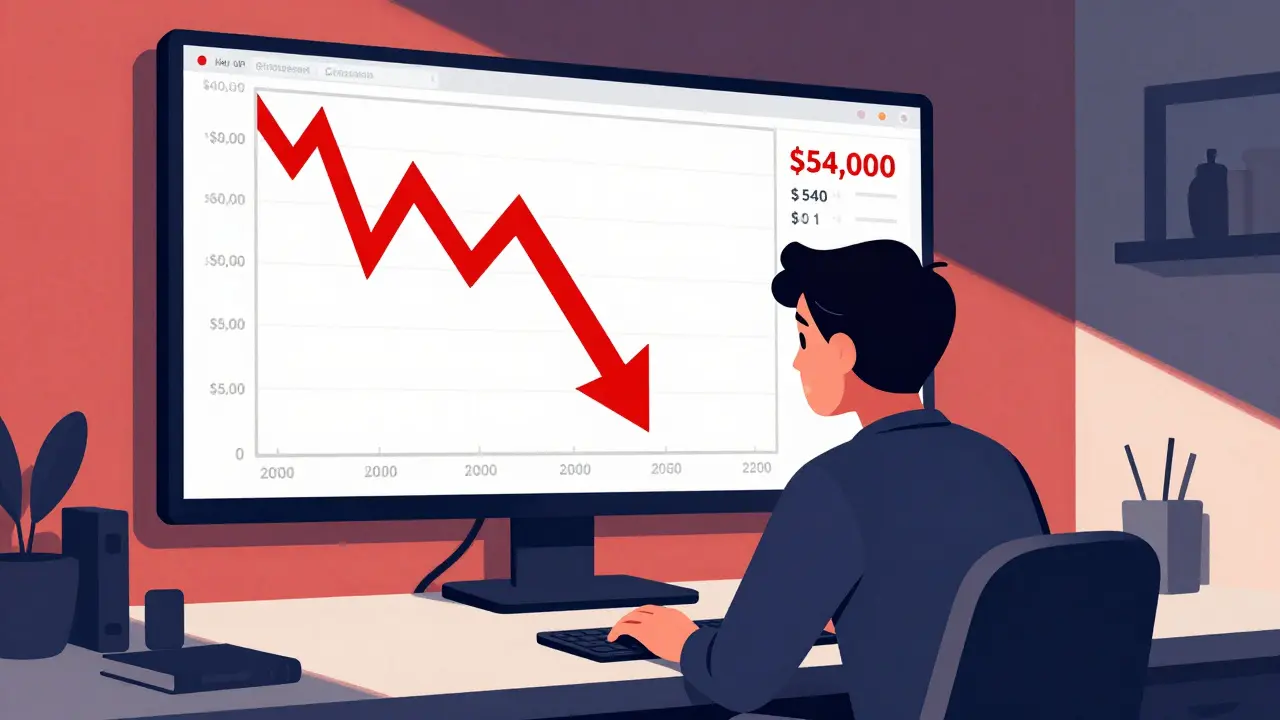
Imagine buying Bitcoin at $60,000. You’re confident it will go up. Then, overnight, a regulatory headline hits, and the price crashes to $54,000 before you even wake up. Without a safety net, you watch your portfolio shrink in real-time, paralyzed by the fear of selling too early or holding on too long. This is exactly why stop-loss orders are non-negotiable tools for any serious cryptocurrency trader. They automate your exit strategy, removing emotion from the equation and protecting your capital when the market turns against you.
Setting a stop-loss isn’t just about picking a random number below your buy price. It’s a strategic calculation that balances risk tolerance, market volatility, and technical analysis. In this guide, we’ll break down how to set effective stop-losses for Bitcoin, avoiding common pitfalls like premature exits and slippage, so you can trade with confidence rather than anxiety.
Understanding How Bitcoin Stop-Loss Orders Work
A stop-loss order is an instruction to your exchange to sell your Bitcoin automatically if the price drops to a specific level. Think of it as a tripwire. You don’t need to stare at charts all day; the system watches for you. When the price hits your trigger point, the order activates.
There are two main types you’ll encounter on platforms like Binance, Coinbase, or Kraken:
- Stop-Market Order: When the price hits your stop level, it immediately becomes a market order. This guarantees execution but not the price. In fast-moving markets, you might sell slightly lower than expected due to slippage.
- Stop-Limit Order: When the price hits your stop level, it becomes a limit order at a price you specify. This gives you more control over the sale price, but there’s a risk: if the price crashes past your limit, the order won’t fill, and you’ll be left holding the bag.
For most traders, especially beginners, the stop-market order is safer because it ensures you get out of the position. The slight loss from slippage is usually better than being stuck in a plummeting asset.
The Golden Rule: Position Sizing Before Stop Placement
Before you even think about where to place your stop-loss, you need to know how much Bitcoin you’re buying. This is called position sizing, and it’s the foundation of professional trading. Many new traders make the mistake of setting their stop-loss first and then figuring out their position size later. This is backward.
Here’s the correct workflow:
- Determine your maximum acceptable loss per trade. Most professionals risk no more than 1-2% of their total account balance on a single trade.
- Identify your technical stop-loss level based on chart patterns (we’ll cover this next).
- Calculate your position size so that if the stop-loss triggers, you only lose that 1-2%.
Let’s say you have a $10,000 account. You decide to risk 1% ($100) on this trade. If your technical analysis suggests placing a stop-loss 5% below your entry price, you can calculate your position size like this:
Position Size = Risk Amount / Stop-Loss Percentage
$100 / 0.05 = $2,000
You would buy $2,000 worth of Bitcoin. If the price drops 5% and your stop triggers, you lose exactly $100. If you had bought $10,000 worth instead, that same 5% drop would wipe out $500-half your allowed risk. Position sizing keeps you in the game even after a string of losses.
Where to Place Your Stop-Loss: Technical Analysis Strategies
Picking a stop-loss level arbitrarily, like “I’ll sell if it drops 10%,” is dangerous. Markets respect psychological levels and technical structures. Your goal is to place your stop just beyond the point where your original thesis for buying is invalidated.
Here are three proven methods for determining that level:
1. Support Levels
Support is a price floor where buying pressure historically exceeds selling pressure. Look at a daily or weekly chart. Identify recent lows where the price bounced back up. Place your stop-loss slightly below this level. For example, if Bitcoin has bounced off $58,000 three times in the last month, setting your stop at $57,500 accounts for minor noise while protecting you if the support breaks.
2. Moving Averages
Dynamic support often forms around moving averages. The 50-day Simple Moving Average (SMA) or the 200-day SMA are widely watched by institutional investors. If Bitcoin is trending above the 50-day SMA, placing your stop just below this line can help you stay in the trend while exiting if momentum shifts.
3. Average True Range (ATR)
Bitcoin is volatile. A static percentage stop might get shaken out during normal fluctuations. The Average True Range (ATR) indicator measures average volatility over a set period. Professional traders often place stops 1.5 to 2 times the ATR value below their entry price. This adapts your stop to current market conditions-wider during high volatility, tighter during calm periods.
| Method | Best For | Pros | Cons |
|---|---|---|---|
| Support Levels | Swing Traders | Based on historical price action; logical invalidation point | Can be subjective; requires chart reading skills |
| Moving Averages | Trend Followers | Dynamic; adjusts with price; widely respected | Lagging indicator; may give late signals in choppy markets |
| ATR-Based | Volatile Markets | Adapts to volatility; reduces false exits | Requires calculation; may result in wider stops |

Trailing Stop-Losses: Locking in Profits
A standard stop-loss protects against downside, but it doesn’t help you capture upside. That’s where a trailing stop-loss shines. Instead of a fixed price, a trailing stop follows the price of Bitcoin upward by a specified percentage or dollar amount.
Imagine you buy Bitcoin at $60,000 and set a 10% trailing stop. The initial stop is at $54,000. If Bitcoin rises to $70,000, your stop automatically moves up to $63,000 (10% below $70,000). If it then drops to $63,000, you sell, locking in a significant profit. If it continues to $80,000, your stop moves to $72,000.
This strategy is powerful for bull runs. It lets profits run while protecting gains if the trend reverses. Just remember: once the price starts falling, the trailing stop stays put. It never moves down. This prevents you from being stopped out by normal pullbacks within an uptrend.
Navigating Slippage and Market Gaps
No matter how well you plan, you can’t control the market’s speed. Slippage occurs when your order executes at a different price than expected. This is common in Bitcoin trading due to its 24/7 nature and occasional liquidity gaps.
During major news events-like Federal Reserve announcements or ETF approvals-prices can gap down instantly. If you set a stop-market order at $59,000, but the price jumps from $59,500 to $58,000 in seconds, your order will execute at $58,000 or worse. There’s no way to avoid this completely with market orders.
To mitigate slippage:
- Use Limit Orders During High Volatility: Consider using a stop-limit order with a tight limit range if you’re concerned about extreme slippage, but accept the risk of non-execution.
- Trade During Liquid Hours: Bitcoin liquidity is highest during overlapping US and European trading hours. Stops are less likely to slip significantly during these times.
- Avoid Overleveraging: High leverage amplifies slippage impact. Stick to spot trading or low leverage (2x or less) if you’re new to stop-losses.

Common Mistakes to Avoid
Even experienced traders mess up stop-loss placement. Here are the most frequent errors:
- Placing Stops Too Tight: Setting a stop 1-2% below entry in a volatile asset like Bitcoin invites noise. You’ll get stopped out repeatedly by normal fluctuations, eroding your capital through fees and small losses.
- Ignoring Psychology: Don’t place your stop at obvious round numbers like $60,000 or $50,000. These are magnets for liquidity, meaning many other traders have stops there. Large players often push prices briefly below these levels to trigger those stops before reversing. Place your stop slightly below these zones.
- Moving Stops Against the Trend: Never move your stop-loss further away to avoid being triggered. This violates risk management principles and can turn a small loss into a catastrophic one. Only move stops in the direction of profit (upwards for longs).
- Forgetting Exchange Fees: Ensure your potential profit covers both the entry and exit fees. A tight stop might result in a net loss after fees are deducted.
Practical Steps to Set Your First Stop-Loss
Ready to implement? Here’s a step-by-step checklist for your next Bitcoin trade:
- Analyze the Chart: Identify key support levels, moving averages, or use ATR to determine a logical stop price.
- Calculate Risk: Decide what percentage of your account you’re willing to lose (e.g., 1%).
- Determine Position Size: Use the formula: Risk Amount / Stop-Loss Distance = Position Size.
- Execute Entry: Buy your calculated amount of Bitcoin.
- Set the Stop-Loss: Immediately after buying, place your stop-market or stop-limit order on your exchange. Do not wait.
- Monitor and Adjust: If the price moves in your favor, consider converting to a trailing stop or manually raising your stop to lock in profits.
Remember, a stop-loss is not a prediction of where the price will go. It’s a definition of when you were wrong. By accepting small, controlled losses, you preserve capital for future opportunities where your analysis is correct.
Should I use a stop-market or stop-limit order for Bitcoin?
For most traders, a stop-market order is safer because it guarantees execution. While you might experience slight slippage, a stop-limit order risks leaving you holding a depreciating asset if the price crashes past your limit. Use stop-limit only if you prioritize exact price over guaranteed exit.
How far below my entry price should I set my stop-loss?
There is no fixed percentage. It depends on volatility and technical structure. A common rule is to place it below the nearest significant support level or 1.5-2 times the Average True Range (ATR). For Bitcoin, this often means 5-10% below entry, depending on market conditions.
What is slippage in Bitcoin trading?
Slippage is the difference between the expected price of a trade and the actual executed price. It happens when there isn’t enough liquidity at your desired price level, causing your order to fill at a worse price. This is common during rapid price movements or low-volume periods.
Can I change my stop-loss order after placing it?
Yes, you can modify or cancel stop-loss orders on most exchanges. However, you should only move your stop-loss in the direction of profit (higher for long positions) to lock in gains. Never move it further away to avoid being stopped out, as this increases your risk exposure.
Do stop-loss orders work during weekends?
Yes, Bitcoin trades 24/7, including weekends. Stop-loss orders remain active regardless of the time. However, liquidity can be lower on weekends, potentially increasing the risk of slippage if a large move occurs.
9 Comments
man i really wish i had read this before my first crash, saved me a lot of stress knowing about the trailing stops now
Glad you found it useful! 🌟 The trailing stop is like having a safety net that grows with you. It’s wild how much anxiety disappears when you automate the exit strategy. You don’t have to stare at the charts every five minutes anymore. Just set it and let the market do its thing. 💪📈
This entire guide is patronizing drivel for the uninitiated masses who think they can outsmart the market with simple technical indicators. Real wealth isn't made by following retail herd mentality strategies like 'support levels' or 'moving averages'. Those are lagging indicators designed to keep the little people in check while the whales manipulate liquidity pools. If you need a tutorial on basic risk management, perhaps cryptocurrency trading is not the sophisticated arena for your capital. One should either understand macroeconomic flows or stay away entirely.
You're missing the point completely. This isn't about getting rich quick; it's about survival. Most retail traders blow up their accounts because they don't use stop-losses. Ignoring position sizing is suicide. Your elitist attitude doesn't change the fact that without these tools, you're just gambling. Read the section on ATR again, it actually adapts to volatility unlike your static worldview.
The epistemological framework underlying this discourse fails to account for the inherent systemic vulnerabilities within decentralized ledger technologies. Furthermore, the reliance on heuristic models such as the Average True Range ignores the stochastic nature of algorithmic high-frequency trading bots that dominate the order books. We must interrogate the very premise of 'risk management' in an environment where regulatory arbitrage and geopolitical instability create non-linear shockwaves. To suggest that a static percentage stop-loss provides adequate protection is to engage in a dangerous reductionism of complex financial dynamics. The user must recognize that true sovereignty over one's assets requires a deeper philosophical engagement with the ontology of digital scarcity rather than mere tactical execution on centralized exchanges which remain susceptible to counterparty risk and existential failure modes.
I totally agree with the part about position sizing being the most critical step because if you don't get that right then everything else falls apart and you end up losing more money than you thought you could afford to lose which is super stressful and not fun at all so I always make sure to calculate my risk before I even look at the chart because that way I know exactly what I'm dealing with and I can sleep better at night knowing that even if the market crashes I won't be ruined financially which is a huge relief and allows me to stay in the game for the long haul instead of getting wiped out in a single bad trade which happens to so many people who rush into things without a plan.
That makes total sense, taking the time to calculate risk first really does take the pressure off. I've been trying to implement the ATR method mentioned here since it seems less rigid than fixed percentages. Has anyone else noticed how much smoother their trades feel when they aren't constantly checking if they should move their stop? It feels like a big weight off my shoulders.
It is interesting to consider the psychological aspect of letting go. When we control the exit, we often cling to hope. Automating it forces us to accept reality.
In my experience navigating various global markets, including those in Asia and Europe, the concept of slippage becomes particularly pronounced during times of low liquidity, which often coincide with weekends or major holidays in different regions. It is fascinating to observe how cultural attitudes towards risk vary, yet the mathematical necessity of position sizing remains a universal truth that transcends borders. I have seen many traders from diverse backgrounds struggle with the emotional toll of holding positions without defined exits, leading to significant financial distress. By adopting a disciplined approach to stop-loss placement, one not only protects their capital but also maintains mental clarity, allowing for a more balanced integration of trading activities into daily life. The use of trailing stops, in particular, offers a dynamic solution that respects the organic movement of price action while safeguarding accumulated gains, thereby fostering a sustainable trading practice that can endure through various market cycles.