
Crypto Tax Calculator
Calculate Your Crypto Transaction Tax
Enter purchase and sale prices to see your capital gain or loss calculation
Every time you buy, sell, trade, or even spend cryptocurrency, the IRS sees a taxable event. Not because they’re watching your wallet - but because crypto is property, not cash. That’s been the rule since 2014, and as of 2025, the IRS is finally making it impossible to ignore.
Why Crypto Taxes Are Different from Stocks
If you’ve ever sold a stock, you got a Form 1099-B from your broker. It told you exactly what you bought, what you sold it for, and your profit. Crypto used to be the Wild West. No reports. No help. Just you, your exchange history, and a prayer. That changed on January 1, 2025. Now, exchanges like Coinbase, Kraken, and Binance.US must send you Form 1099-DA. But here’s the catch: it only shows the gross proceeds - the total dollars you got when you sold. It doesn’t tell you what you paid for it. That’s on you. Think of it like this: you sold 0.5 BTC for $18,000. The 1099-DA says $18,000. But if you bought that same 0.5 BTC for $10,000 two years ago, your taxable gain is $8,000. If you bought it for $16,000? Only $2,000 gain. The IRS doesn’t know which one it is. You have to figure it out.What Counts as a Taxable Event
You don’t just owe taxes when you cash out. Every move can trigger a tax bill:- Selling crypto for USD - obvious gain or loss
- Trading one crypto for another - like BTC for ETH - treated as a sale of the first
- Spending crypto - buying coffee, a laptop, or a NFT with Bitcoin? That’s a sale
- Earning crypto - from staking, mining, airdrops, or as payment for work - taxed as ordinary income
- Receiving crypto as a gift - not taxed when received, but you inherit the giver’s cost basis
- Donating crypto - no tax if you hold over a year; you can deduct fair market value
Where to Report Crypto on Your Tax Return
You’ll need three forms:- Form 1040 - The main tax form. Answer “Yes” to the digital asset question. If you say “No” and you had any activity, you’re lying under penalty of perjury.
- Form 8949 - Lists every single crypto sale, trade, or disposal. You need the date you bought it, date you sold it, cost basis, proceeds, and gain/loss.
- Form Schedule D - Summarizes your capital gains and losses from Form 8949. This goes on your 1040.
Cost Basis Is Your Most Important Number
Cost basis = what you paid for the crypto, plus fees. That’s the anchor for your gains. Before 2025, you could average your cost basis across all your holdings. Now? The IRS says: wallet-by-wallet. You can’t mix your Coinbase coins with your Ledger coins. Each purchase in each wallet must be tracked separately. Example: You bought 1 ETH on Coinbase for $1,500 with a $5 fee. Cost basis = $1,550. Later, you bought another 1 ETH on Kraken for $1,600 with a $3 fee. Cost basis = $1,603. If you sell the first ETH, you can’t use the $1,603. You have to use $1,550. This makes manual tracking a nightmare. If you transferred crypto between wallets without noting the cost basis, you’ve lost it forever. The IRS doesn’t care about your memory.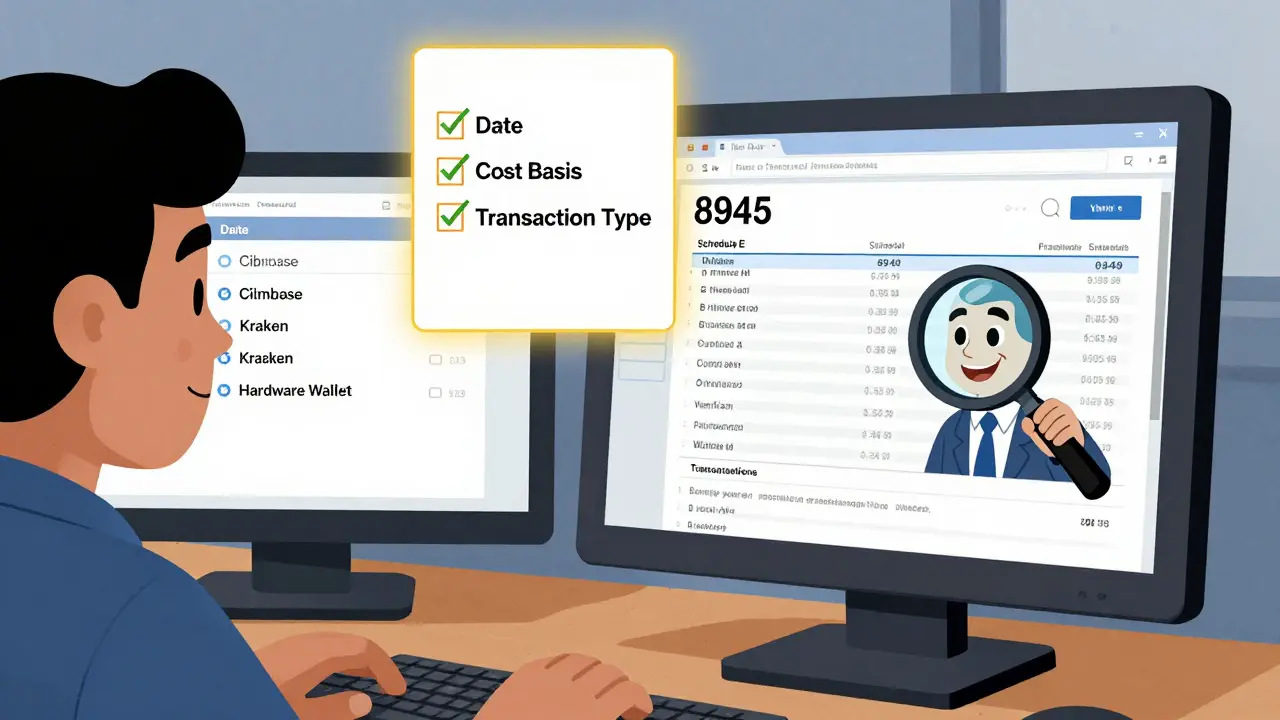
What Exchanges Will (and Won’t) Report
Only centralized exchanges that hold your keys - like Coinbase, Kraken, Binance.US - must file Form 1099-DA. They report gross proceeds starting in 2025. Cost basis reporting starts in 2026. Decentralized exchanges? Like Uniswap, SushiSwap, or PancakeSwap? They don’t report. Ever. And they won’t, thanks to the DeFi Broker Rule repeal signed in April 2025. Same with peer-to-peer trades, wallet-to-wallet transfers, and crypto paid directly by a client. That doesn’t mean you don’t owe taxes. It just means you’re on your own. The IRS can still trace those transactions using blockchain analysis tools. They’ve been doing it since 2023. And they’re getting better.What You Must Track for Every Transaction
You need these five pieces of data for every crypto move:- Date - When the transaction was confirmed on the blockchain
- Amount - How much crypto you bought, sold, or traded
- Value in USD - Fair market value at the exact time of the transaction (use a reputable price source like CoinMarketCap or CoinGecko)
- Transaction type - Purchase, sale, trade, staking reward, airdrop, payment, etc.
- Counterparty - Exchange name, wallet address, or person you traded with
How to Use Crypto Tax Software
Most people who report crypto taxes in 2025 use software. TurboTax, Koinly, CoinTracker, and TokenTax all connect to over 300 exchanges and wallets. They auto-import your transactions, calculate gains, and generate Form 8949 and Schedule D. Here’s what they do for you:- Auto-match buys and sells across multiple wallets
- Apply FIFO, LIFO, or specific identification methods (you choose)
- Calculate staking rewards as income
- Flag airdrops and hard forks
- Export directly to TurboTax or TaxAct
Common Mistakes That Trigger Audits
The IRS has flagged these five errors as top audit triggers in 2025:- Not reporting airdrops - If you got free tokens from a fork or promo, they’re taxable income at fair market value on the day you received them. 32% of audits start here.
- Misclassifying staking rewards - Are they income? Capital gain? The IRS says income. But many people treat them like dividends and wait to tax them on sale. That’s wrong.
- Forgetting to report small trades - Even if you only made $50 profit on a trade, you still have to report it. The IRS doesn’t have a minimum.
- Using average cost basis - That method is gone. If you used it in 2024 and carried it into 2025, you’re at risk.
- Saying “No” to the digital asset question - The IRS cross-checks 1099-DA data with your return. If they see you traded and you said “No,” you’re flagged.
What to Do If You Didn’t Report Crypto Before
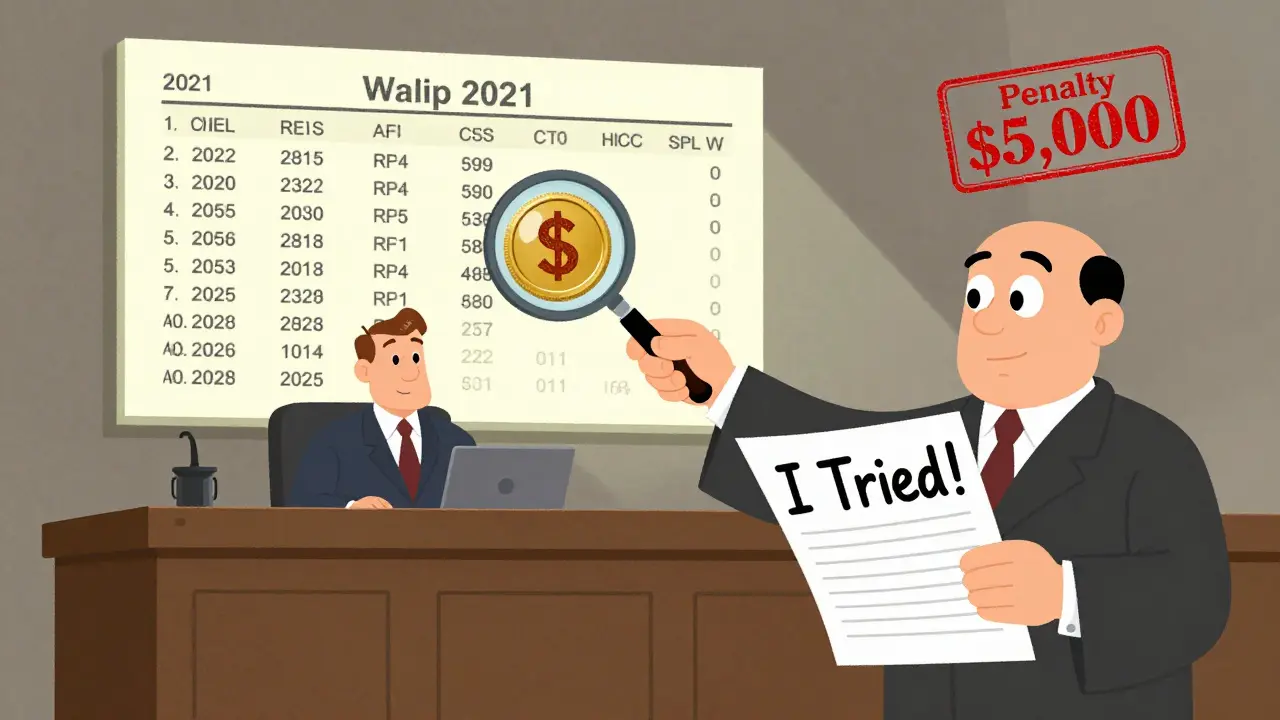
If you’ve been ignoring crypto taxes for years, don’t panic. But don’t wait either. The IRS has a Voluntary Disclosure Program. You can file amended returns for past years (2021-2024) and pay what you owe with reduced penalties. You’ll need to reconstruct your transaction history - which is hard, but doable with software. Most tax pros recommend starting with 2023 and working backward. If you had under $10,000 in total crypto activity across all years, you might qualify for a streamlined filing. If you had more? Talk to a CPA who specializes in crypto.What’s Coming in 2026 and Beyond
In 2026, exchanges will start reporting cost basis on Form 1099-DA. That’s a huge win - but only if you use one of the big exchanges. If you trade on DeFi or use multiple wallets, you’re still on your own. The IRS is also working on new rules for NFTs and staking. They’ve already updated Form 8949 instructions to include NFT sales. And they’re reviewing the Southerland v. IRS case - which could change how staking rewards are taxed. Meanwhile, Congress is still debating new crypto reporting rules. Senator Lummis’s Digital Asset Market Structure Bill could bring back some DeFi reporting by late 2026. Bottom line: The rules are changing fast. But the core principle won’t: every crypto move has tax consequences.Next Steps: Your 5-Minute Action Plan
If you’re reading this in December 2025, here’s what to do right now:- Collect all your wallet addresses - including hardware wallets, mobile wallets, and exchange accounts.
- Export transaction history from every platform you used since 2021.
- Use crypto tax software - pick one (Koinly or CoinTracker are popular) and import your data.
- Review your 2025 gains - make sure you didn’t miss any trades, airdrops, or staking rewards.
- Answer “Yes” to the digital asset question on Form 1040 - and file your return before April 15.
Do I have to report crypto if I didn’t sell it?
Yes - if you traded it for another crypto, spent it on goods or services, or received it as income (like staking rewards or airdrops). Just holding crypto isn’t taxable. But every time you move it, you trigger a tax event.
What if I lost money on crypto? Do I still report it?
Yes. You report all sales and trades, whether you made a profit or a loss. Capital losses can offset capital gains - and up to $3,000 of ordinary income per year. Any extra losses roll over to future years.
Can I use FIFO, LIFO, or specific ID for crypto?
Yes. FIFO (first-in, first-out) is the default method. But you can choose LIFO or specific identification - as long as you’re consistent and document your choice. Tax software makes this easy. The IRS accepts all three methods.
Do I need to report crypto from international exchanges?
Yes. U.S. tax law applies to all your worldwide income and assets. If you used Binance (non-U.S.), Kraken, or any foreign exchange, you still owe taxes on gains. Those exchanges won’t send you a 1099-DA, so you must track it yourself.
What happens if I don’t report crypto?
You risk an audit, penalties, and interest. The IRS can match your 1099-DA data with your return. If you say “No” to the digital asset question but they see a 1099-DA in your name, you’re flagged. Penalties start at $5,000 for willful noncompliance. For simple mistakes, expect $1,850 per error.
Are airdrops really taxable?
Yes. If you received free tokens from a fork, promotion, or airdrop, the IRS treats them as ordinary income at their fair market value on the day you gained control. Many people miss this - and it’s one of the top reasons the IRS audits crypto holders.
7 Comments
Okay but let’s be real - if you’re still manually tracking crypto trades in 2025, you’re doing it wrong. I used to do this with spreadsheets until I lost 3 weeks of my life trying to match a wallet transfer from 2022 that didn’t even have a timestamp. Koinly saved me. I now just drag and drop my CSVs and it auto-finds every airdrop I forgot I even got. Seriously, if you’re not using software, you’re gambling with your tax return. And no, your memory isn’t a valid IRS defense. 💥
IRS wants cost basis from every wallet? LMAO. You think Americans care about tracking 5000 transactions? They just want to steal more. DeFi is freedom. Let them trace the blockchain. We’ll still move coins. Tax is theft. End of story.
Hi! Just wanted to say thank you for this guide - it’s the clearest one I’ve seen. I’m a beginner and I was terrified of messing up my taxes. I used CoinTracker and it literally flagged a $120 staking reward I didn’t even realize I’d earned. Also - YES to answering YES on Form 1040. I saw someone say ‘no’ on a forum and my heart stopped. Don’t do that. You’re not hiding from the IRS, you’re just setting yourself up for stress. You got this 💪
Let’s not pretend this is about tax compliance. This is a stealth wealth transfer. The IRS didn’t suddenly become ‘tech-savvy’ - they were handed blockchain surveillance tools by private contractors with ties to Wall Street. They’re not auditing you for fairness. They’re auditing you because crypto threatens their control over monetary policy. And now they’ve weaponized tax law to crush decentralized finance. This isn’t regulation. It’s digital suppression. And you’re being lied to if you think this ends with crypto.
What about NFTs? Do I report if I bought one with ETH and sold it for more ETH?
Let’s break this down statistically because most people don’t understand the real risk profile here. According to the 2024 IRS Crypto Enforcement Report, 68% of audits triggered by 1099-DA mismatches involved underreported capital gains under $5,000. That’s not a billionaire issue - it’s a college student who traded Dogecoin for a pizza in 2023. The IRS doesn’t care if you’re poor. They care if you didn’t report. And here’s the kicker: 92% of people who used average cost basis in 2024 and carried it into 2025 got flagged by automated matching algorithms. The system doesn’t care if you ‘forgot’ - it just knows your math doesn’t add up. So yes, even if you think you’re small fry, you’re still on the radar. And no, ‘I didn’t know’ is not a defense. The IRS has been sending educational emails since 2021. You had your chance. Now you’re just a data point in a compliance heatmap.
they say 'you must track every wallet' but what if you used 10 wallets across 4 years and one of them got hacked in 2023 and the exchange shut down? you think the irs gives a f***? no. they just want you to panic and pay some 'crypto tax expert' $300 to 'fix' your records. meanwhile, the real criminals? the ones who got rich off stablecoin scams and didn't report? they're on a yacht in the bahamas. you? you're stressing over a $70 gain from a trade you made while high in 2021. this whole thing is rigged. and if you think the government cares about fairness, you've never seen a 1099-DA form. they don't want you to pay taxes - they want you to fear them. 🤡