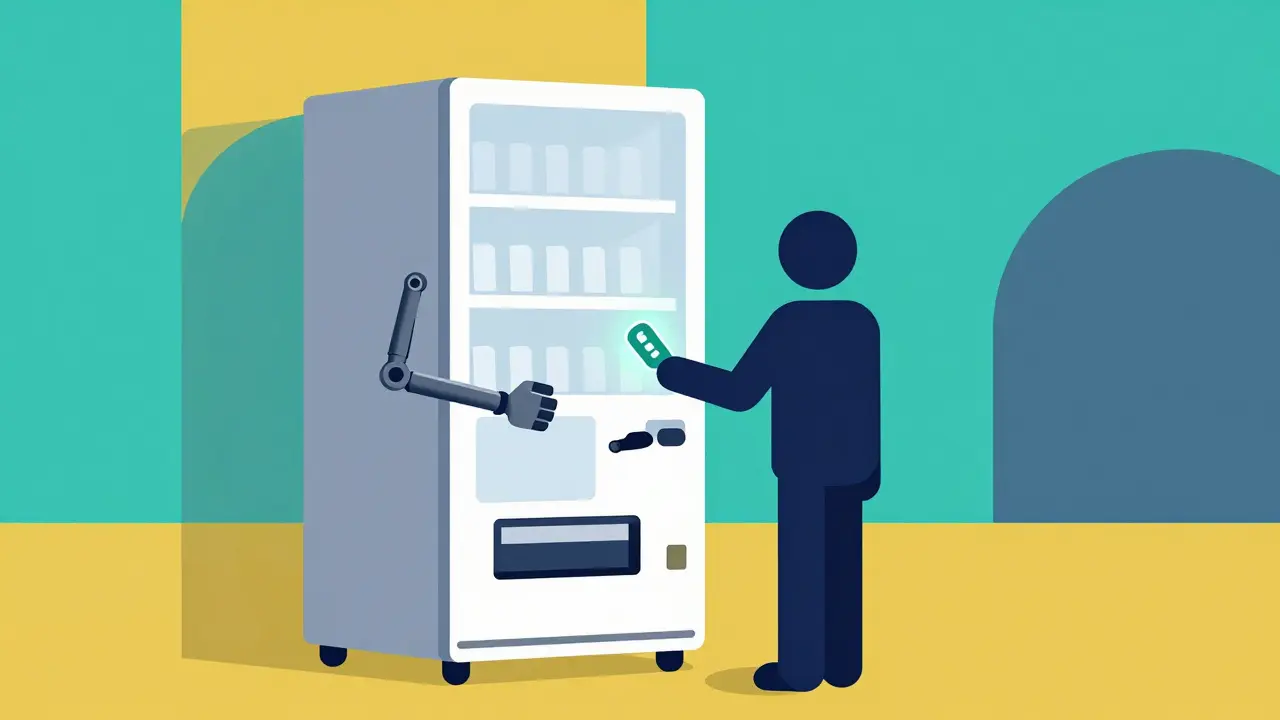
Imagine a vending machine that doesn't need a cashier. You put in the exact amount of money, press the button for your snack, and the machine mechanically drops it. No one has to trust the machine to give you the right item; the mechanism simply guarantees it. That is exactly how Smart Contracts are self-executing code stored on a blockchain that automatically enforces terms when conditions are met work on Ethereum is a decentralized blockchain platform supporting smart contract execution via the EVM. They remove the middleman, cut out the delay, and make agreements between strangers as reliable as physics.
If you’ve heard about crypto but never looked under the hood, this might sound like magic. It isn’t. It’s just code running on a global computer network. In this guide, we’ll break down exactly what these programs are, how they run on the Ethereum Virtual Machine (EVM), and why they matter for everything from digital art to banking.
The Core Mechanism: If/Then Logic on a Global Scale
At its heart, a smart contract is a set of instructions written in code. Think of it as a series of "if/when... then..." statements. If Alice sends 5 ETH to the contract address, then the contract releases a digital token to her wallet. When the condition is met, the action happens automatically.
These programs don’t live on a single server owned by a company. They reside at a specific address on the Ethereum Blockchain is a distributed ledger recording all transactions and smart contract states across thousands of nodes. This means the code and its data (state) are copied across thousands of computers worldwide. Because everyone sees the same version of the truth, no one can cheat or alter the history once it’s recorded. This immutability is what gives smart contracts their power.
- Automation: Tasks execute without human intervention.
- Transparency: The code is public and verifiable by anyone.
- Immutability: Once deployed, the rules cannot be changed arbitrarily.
This structure eliminates the need for intermediaries like lawyers or banks to enforce simple agreements. You’re not trusting a person; you’re trusting math.
The Engine Room: The Ethereum Virtual Machine (EVM)
You might wonder how different computers around the world agree on what the code does. The answer lies in the Ethereum Virtual Machine (EVM) is the runtime environment that executes smart contract bytecode on the Ethereum network. The EVM is a sandboxed environment that isolates smart contracts during execution. It ensures that even if a contract contains an error, it won’t crash the entire network.
When you write code for Ethereum, you aren’t writing directly in binary. Developers use high-level languages like Solidity is the most popular programming language for writing Ethereum smart contracts or Vyper is a Pythonic alternative to Solidity designed for security and simplicity. These languages are compiled into bytecode-a low-level instruction set that the EVM understands.
The EVM processes these instructions step-by-step. Every operation costs "gas," a unit that measures computational effort. Gas fees prevent spam attacks and ensure that users pay for the resources they consume. If a contract runs into an infinite loop, it will eventually run out of gas and stop, protecting the network from freezing.
Anatomy of a Smart Contract
A typical smart contract consists of two main parts: state variables and functions. State variables store information permanently on the blockchain, like a balance sheet. Functions are actions that can change that state or read it.
For example, a simple storage contract might look like this:
uint256 private count = 0;

function increment() public {
    require(msg.sender == owner, "Not authorized");
    count++;
}
In this snippet, `count` is a state variable. The `increment()` function only allows the owner (`msg.sender`) to increase the number. The `require()` statement acts as a gatekeeper, halting execution if the condition isn’t met. This kind of logic is foundational to security in smart contracts.
Contracts also have access to special global variables like `block.number` or `tx.origin`, which provide context about the current transaction and block. This allows contracts to react to time-sensitive events or verify user identities.
Deployment and Gas Costs
Creating a smart contract isn’t free. Deploying a contract is technically a transaction on the Ethereum network, meaning you must pay gas fees. These costs can be significantly higher than sending plain ETH because deploying involves storing new code on the blockchain.
Developers usually test their contracts on testnets like Sepolia is an Ethereum testnet used for testing smart contracts before mainnet deployment using tools like Remix IDE is a browser-based integrated development environment for Ethereum smart contract coding, Hardhat, or Foundry. Once tested, they connect wallets like MetaMask, compile the code, and approve the deployment transaction.
After deployment, the contract receives a permanent address. Anyone can interact with it by sending transactions to that address. There’s no central authority managing access-permissionless innovation is a core feature of Ethereum.
| Tool | Type | Best For | Learning Curve |
|---|---|---|---|
| Remix IDE | Browser-based | Beginners, quick prototyping | Low |
| Hardhat | Node.js framework | Professional development, testing | Medium |
| Foundry | Rust-based toolkit | Advanced developers, speed | High |
Token Standards: ERC-20 and ERC-721
Smart contracts aren’t just for agreements; they’re the backbone of digital assets. Two standards dominate the space: ERC-20 is the standard interface for fungible tokens on Ethereum and ERC-721 is the standard for non-fungible tokens (NFTs) representing unique assets.
ERC-20 tokens are interchangeable, like dollars or Bitcoin. One USDC is identical to another USDC. ERC-721 tokens are unique, like deeds to land or original artworks. Each NFT has distinct metadata and ownership history.
These standards define a common set of functions that all compliant contracts must implement. This interoperability allows wallets, exchanges, and dApps to recognize and handle any token that follows the rules, creating a seamless ecosystem.

Limitations and Real-World Data
Smart contracts are powerful, but they aren’t omniscient. They cannot access real-world data directly. If a contract needs to know the price of gold or the outcome of a sports game, it can’t just look it up. This limitation preserves consensus integrity-if every node could fetch different external data, the network would disagree.
To solve this, developers use Oracles are services that bring off-chain data onto the blockchain for smart contracts to use. Oracles act as bridges, fetching verified data from APIs and feeding it into the contract. Services like Chainlink are widely used for this purpose.
Another constraint is size. Smart contracts on Ethereum have a maximum size of 24KB. Larger contracts fail during deployment due to gas limits. Developers work around this using patterns like The Diamond Pattern, which splits logic across multiple smaller contracts.
Composability: Money Legos
One of Ethereum’s greatest strengths is composability. Smart contracts are open APIs. Any contract can call another, creating complex systems from simple building blocks. This is often called “Money Legos.”
For instance, a lending protocol might use a price oracle to value collateral, an ERC-20 contract to issue loans, and a governance contract to manage parameters. All these pieces work together seamlessly because they speak the same language.
This modularity accelerates innovation. Developers don’t need to rebuild basic functionality-they can plug into existing infrastructure. It’s why DeFi exploded so quickly: teams built on top of each other’s work rather than starting from scratch.
What is the difference between a regular contract and a smart contract?
A regular contract relies on legal enforcement and human interpretation, while a smart contract is self-executing code that enforces terms automatically when predefined conditions are met. Smart contracts run on a blockchain, making them immutable and transparent.
Can smart contracts be hacked?
Yes, if the code contains vulnerabilities. Unlike traditional software, bugs in smart contracts can lead to irreversible loss of funds since transactions cannot be undone. Security audits and rigorous testing are critical before deployment.
Why do I need to pay gas fees to deploy a smart contract?
Gas fees compensate validators for the computational resources used to process and store your contract on the blockchain. Deployment requires more computation than simple transfers, hence higher costs.
What is the role of the EVM in smart contracts?
The Ethereum Virtual Machine (EVM) is the runtime environment that executes smart contract bytecode. It ensures consistent behavior across all nodes in the network and isolates contracts to prevent crashes.
How do smart contracts get real-world data?
Smart contracts cannot access external data directly. They rely on oracles, which are trusted services that fetch off-chain information and deliver it to the blockchain in a verifiable way.
10 Comments
another guide pretending smart contracts arent just glorified if-statements that cost more than my rent to run lol
Hey Mike, I get the frustration with gas fees, but the immutability is actually pretty cool once you wrap your head around it 🚀 It’s like having a digital vault that no one can break into, not even the bank. The EVM sandboxing is what keeps everything safe from crashing the whole network.
It is quite amusing to see such elementary explanations being presented as groundbreaking insights. One would think that by now, the concept of decentralized execution would be common knowledge among those who bother to read beyond the headlines. However, for the layperson, perhaps this simplified view is sufficient to prevent them from attempting to deploy code without understanding the underlying architecture.
i mean sure its code but isnt it crazy how we trust math over people now? used to be u needed a lawyer to sign papers now u just send eth and hope the contract doesnt have a bug in it which happens all the time so maybe trusting code isnt so great afterall
i really love how this breaks down the vending machine analogy because it makes so much sense when you think about it like that and i was always confused about why we need intermediaries when the code can just do it automatically and its kind of scary but also exciting to think that anyone can build these things without asking permission from a big corporation or government agency which feels like true freedom to me
boring stuff. everyone knows this already. stop wasting my time with basic tutorials for beginners who should just stick to buying coins instead of trying to write code they dont understand
I totally agree with the breakdown here! The part about composability is huge, honestly. Being able to stack protocols like legos changes the game entirely. It’s wild to think how fast DeFi grew just because devs could plug into existing infrastructure instead of rebuilding wheels every single time. Great read!
The oracle problem is still the biggest hurdle for real-world adoption though. If the data feeding the contract is wrong, the contract executes correctly but based on false premises. Chainlink helps, but it’s still a centralized point of failure compared to the pure decentralization of the blockchain itself.
thanks for sharing this info it really helps clear up some confusion i had about how the evm works and why gas fees exist im glad there are tools like remix ide for beginners to try out without needing to set up complex environments first
Why are we relying on foreign tech stacks when American innovation could lead this space properly? The security risks of open-source global codebases are unacceptable for our national financial infrastructure. We need domestic solutions that prioritize our citizens' safety over this chaotic decentralized mess.