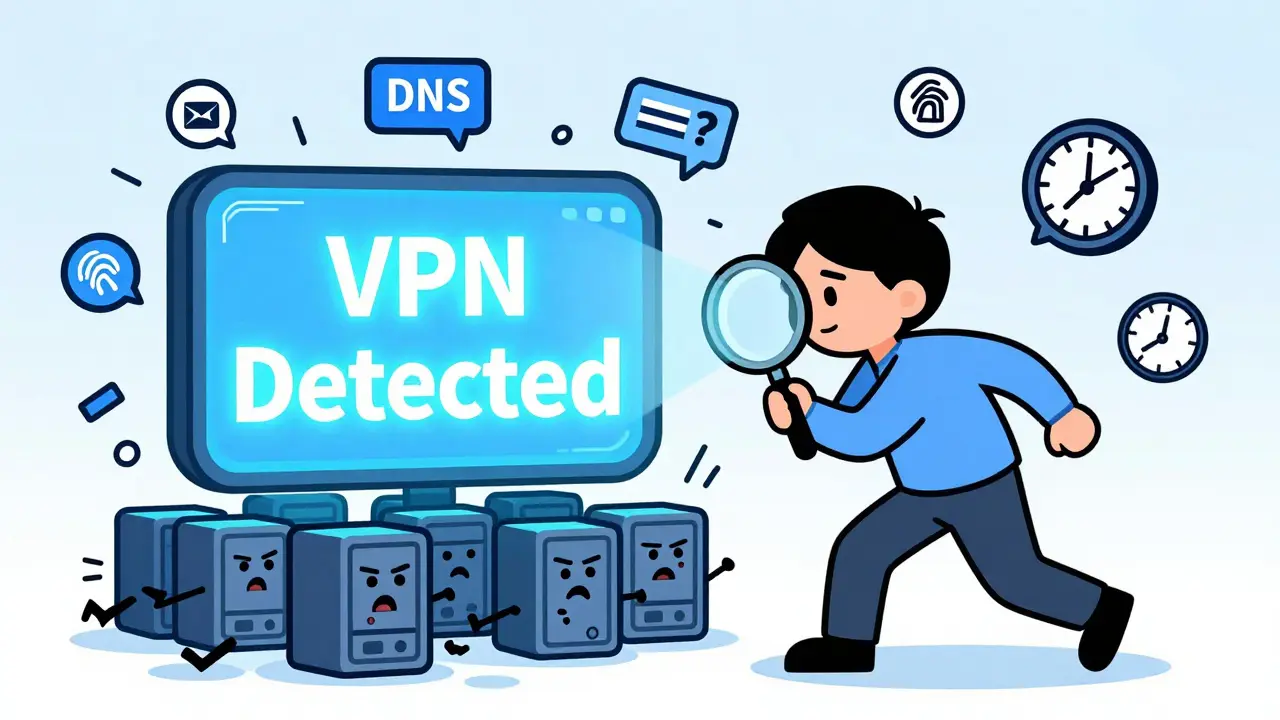
When you try to access a crypto exchange like Binance or Coinbase from a country where trading is restricted, you might think using a VPN is enough to slip through. But modern exchanges don’t just check your IP address anymore. They’ve built multi-layered VPN detection systems that can spot you even if you’re using a premium service like NordVPN or ExpressVPN. It’s not just about hiding your location-it’s about outsmarting a system designed to catch you at every turn.
How Exchanges Know You’re Using a VPN
It starts with your IP address. Every time you connect to a crypto exchange, the platform checks where your traffic is coming from. They don’t just look at one IP-they maintain massive, constantly updated databases of known VPN server IPs. These lists come from public sources, user reports, and automated scans. If your connection matches any of these IPs, your session gets flagged immediately. But that’s just the first layer. Many users switch to obfuscated servers or try to mask their traffic. That’s where Deep Packet Inspection (DPI) kicks in. DPI doesn’t care what your data says-it watches how it moves. VPN traffic has patterns: consistent packet sizes, timing delays, and encrypted headers that look different from normal web traffic. Even if you’re using a service that claims to hide its signature, exchanges have trained algorithms to spot those subtle fingerprints. Then there’s DNS. If your device is set to use a DNS server in London but your IP claims you’re in Singapore, that mismatch gets logged. Exchanges monitor which DNS resolver you’re using, and if it doesn’t match your claimed location, it’s a red flag. Same with time zones. If you’re logging in at 3 a.m. local time but your trading activity spikes during U.S. market hours, the system starts asking questions.Beyond the Network: Browser Fingerprinting and Behavior
Your device gives away more than you think. Exchanges use browser fingerprinting to collect details like screen resolution, installed fonts, GPU model, and even how your mouse moves across the screen. If your browser says you’re using a Mac with a 1440p display but your VPN claims you’re in a region where most users have older PCs, the system flags it as inconsistent. This isn’t just about tech-it’s about behavior. If your account has never traded before but suddenly starts making large ETH transfers at 2 a.m. local time, and your KYC documents show you live in Russia, the system connects the dots. Even if your IP and DNS look clean, unusual trading patterns trigger manual reviews or account restrictions. Users on Reddit’s r/cryptocurrency report being asked to re-verify their ID or lock their accounts after switching to a new VPN server, even when no technical violation occurred.Not All VPNs Are Created Equal
Some VPNs are easy to block. Free services like Hotspot Shield or ProtonVPN’s free tier? Nearly 100% detectable. Their IP ranges are small, well-known, and often shared by thousands of users. Exchanges can shut them down with a single update. Premium services like NordVPN and ExpressVPN are harder-but not impossible-to bypass. NordVPN has over 7,000 servers across 113 countries, and many are optimized for crypto access. Still, exchanges have learned to target their most popular server clusters. Users report success with NordVPN’s “Obfuscated Servers” feature, which disguises traffic as regular HTTPS. But even those can get flagged if too many users from the same server start trading at once. The real challenge comes from decentralized options. Services like NymVPN route traffic through hundreds of volunteer-run nodes using a Noise Mixnet. There’s no central server list to block. Traffic looks like random noise, not a VPN stream. Exchanges can’t build a database for something that doesn’t have fixed endpoints. That’s why privacy advocates see Nym and similar projects as the future of bypassing geo-restrictions-not because they’re faster, but because they’re fundamentally unblockable.
What Happens When You Get Caught
Getting detected doesn’t always mean instant ban. Many exchanges first send a warning: “We’ve noticed unusual login activity. Please verify your identity.” If you don’t respond, your account may be frozen. Some users report being locked out for weeks while waiting for manual review. Others get permanently restricted from trading or withdrawing funds, even if they never broke any rules. Binance and Coinbase have both publicly stated they comply with local regulations. In countries like Turkey or Russia, where crypto trading is heavily restricted, exchanges have no choice but to enforce geoblocking. But enforcement isn’t always consistent. Some users in Iran or Nigeria report being able to trade with a VPN for months before being flagged. Others get blocked within minutes. It depends on how aggressively the exchange is being monitored by local regulators.The Arms Race Is Getting Worse
Exchanges aren’t just using static rules anymore. They’re deploying machine learning models that learn from millions of sessions. These models track typing speed, click patterns, and even how long you wait between trades. If your behavior looks automated-or different from your past activity-the system assumes you’re using a proxy or VPN. Newer systems are even linking wallet addresses to location. If your MetaMask wallet has always been used from Brazil but suddenly starts receiving funds from a Binance account flagged for VPN use, that connection gets flagged too. Some platforms now require mobile verification-matching your phone’s GPS location with your login IP. If your phone says you’re in New York but your VPN says you’re in Tokyo, you’re out.
What’s Next? Decentralized Exchanges and Regulatory Pressure
The biggest threat to multi-layered VPN detection might not be better VPNs-it’s the rise of decentralized exchanges (DEXs). Platforms like Uniswap or dYdX don’t require KYC, don’t store user data, and don’t control your funds. You can trade from anywhere, using any connection. There’s no central server to block, no IP to blacklist. But regulators are catching on. The EU’s MiCA regulation and proposed U.S. rules are starting to target DeFi protocols and wallet providers. If you’re using a wallet linked to a banned jurisdiction, future laws might require those services to block you-even if you’re not on a centralized exchange. For now, the system is still imperfect. Some users slip through. Others get caught. But the trend is clear: exchanges are investing millions into detection because the financial stakes are huge. The global crypto exchange market is projected to hit $57.3 billion by 2030. For exchanges, losing access to even a small market like Turkey or Nigeria means losing millions. So they’ll keep upgrading-until the only way to trade freely is to stop using centralized platforms altogether.What Can You Do?
If you need to access crypto exchanges from a restricted region:- Avoid free VPNs-they’re dead on arrival.
- Try premium services with obfuscation features (NordVPN’s Obfuscated Servers, ExpressVPN’s Lightway protocol).
- Use different servers for different sessions-don’t stick to one.
- Don’t mix VPN usage with KYC documents that show your real location.
- Consider decentralized wallets and DEXs if you need true freedom.
10 Comments
Interesting breakdown. I’ve been using NordVPN’s obfuscated servers for months now and still get flagged every 3-4 weeks. It’s not the IP-it’s the behavioral fingerprint. My mouse movements, the way I scroll before clicking trade, even how long I hover over the confirm button-they’re all logged. I didn’t even know my browser was that loud.
Switched to a dedicated residential proxy last month. No more warnings. But now I pay $40/month just to trade. Worth it? Maybe. But it feels like paying rent on a digital cage.
As someone who’s worked in fintech compliance for 12 years, I can tell you this: exchanges aren’t being ‘overzealous.’ They’re being legally required to block users from sanctioned regions. The real issue? The system is blunt. A 70-year-old grandmother in Nigeria using her nephew’s VPN to buy small amounts of BTC for remittances gets flagged the same way as a hedge fund arbitraging across borders.
There’s no nuance. No human review. Just automated flags. And once your account is frozen, good luck getting it back. I’ve seen people wait 11 months.
Decentralized exchanges aren’t the answer-they’re the only answer.
Let’s be clear: if you’re using a VPN to bypass geoblocking, you’re violating the Terms of Service. End of story. No one is forcing you to use Binance. There are 200+ regulated exchanges worldwide. If you’re in a country where crypto is restricted, that’s a policy decision made by your government-not some corporate conspiracy.
And yes, DPI, DNS leaks, and browser fingerprinting are all legitimate security tools. If you think you’re outsmarting a billion-dollar platform with a $5/month VPN, you’re not clever-you’re delusional.
Also, NymVPN? It’s a vaporware project with 12 active nodes. Don’t confuse obscurity with security.
They’re watching everything. Your heartbeat through your webcam mic. The way your phone vibrates when you tap the screen. The thermal signature of your laptop when you trade. The NSA feeds this data to Coinbase. They’re building a global financial surveillance grid. You think you’re just buying ETH? You’re feeding a neural net that will one day predict your political views based on your trading history.
They already know you’re not from India. They know you’re in Delhi but pretending to be in London. They know you bought Dogecoin in 2021 because your ex posted about it. They know everything.
Wake up.
And yes I’ve been banned three times. I don’t care. I’m not afraid of them. I’m afraid of what they’re becoming.
Try using a mobile hotspot with a local SIM card instead of a VPN. No DNS leaks, no fingerprinting issues. Just your real phone’s IP. Works like a charm if you’re in a country with decent mobile coverage. I’ve been doing this in Brazil for 8 months. No flags. No warnings.
Also, if you’re using a Mac, disable WebRTC and use Firefox with uBlock Origin + Privacy Badger. That alone cuts 70% of fingerprinting vectors.
And yeah, DEXs are the future. Uniswap doesn’t care where you are. Just make sure you’re not holding your keys in a wallet linked to a banned IP.
There’s a philosophical dimension here that’s being overlooked. The architecture of trust in centralized exchanges is predicated on identity verification. When you use a VPN, you’re not just hiding your location-you’re rejecting the social contract that underpins the system. You want freedom, but you’re still using their platform. That’s the paradox.
It’s like demanding the right to drive on a highway while refusing to show your license. The highway isn’t the problem. The expectation of accountability is.
Perhaps the real question isn’t how to bypass detection-but whether you should be trying to.
AMERICA DOESN’T NEED YOUR VPN TRICKS! You think you’re some hacker genius hiding behind NordVPN? You’re a liability! You’re giving our financial system a bad name! You’re the reason regulators are cracking down on ALL crypto! If you can’t follow the rules, don’t play the game! You’re not a freedom fighter-you’re a fraudster in a hoodie!
And Nym? That’s Russian spyware disguised as privacy. I’ve seen the whitepaper. It’s just obfuscation with a fancy name. You’re not safe-you’re just stupid.
VPN? Lmao. Just use Tor. Or better yet-don’t trade at all. If you need to bypass geo-blocking, you probably shouldn’t be trading anyway. Go play with your NFTs in the metaverse. Or better yet-get a real job.
Thank you for writing this with such care. I think it’s important to remember that behind every flagged account is a person trying to survive-maybe they’re in a country with hyperinflation, or they’re sending money to family. The system isn’t evil, but it’s not compassionate either.
Maybe the answer isn’t better tech-but better policy. Exchanges could offer tiered access: limited trading for users in restricted regions, with manual review instead of automatic bans.
Let’s not make financial access a privilege for the tech-savvy few.
lol who even cares anymore. just use binance us and call it a day. also nym is just a cult. and yes i know i spelled 'nvm' wrong. sue me.