
Once data is written to a blockchain, it’s nearly impossible to change. Not because it’s locked behind passwords or firewalls, but because of how it’s built-step by step, block by block, using math that makes tampering not just hard, but practically impossible. This is blockchain immutability, and it’s what separates blockchain from every other kind of digital database. You can’t edit a transaction in Bitcoin or Ethereum after it’s confirmed. You can’t delete a land title recorded on a blockchain. You can’t alter a supply chain log. Why? Because the system was designed to make that failure, not just unlikely, but computationally and economically unfeasible.
Cryptographic Hashing: The Digital Fingerprint System
Every block in a blockchain contains a list of transactions, a timestamp, and something called a hash. That hash is a unique string of letters and numbers-like a digital fingerprint-generated from all the data inside the block. It’s created using a cryptographic hash function, most commonly SHA-256. Even a tiny change, like flipping a single digit in a transaction amount, completely changes the hash. It’s like shaking a snow globe: no two snowflake arrangements ever look the same. But here’s the key: each block also includes the hash of the block that came before it. So Block 3 doesn’t just contain its own data-it contains the hash of Block 2. Block 2 contains the hash of Block 1. This creates a chain. If someone tries to change a transaction in Block 5, the hash of Block 5 changes. That means Block 6’s stored hash (which points to Block 5) no longer matches. So Block 6 becomes invalid. To fix that, you’d have to recalculate the hash of Block 6, which changes its own hash, breaking Block 7. And so on-all the way to the most recent block. This isn’t theoretical. In Bitcoin, changing one transaction would require recalculating over 700,000 blocks (as of 2025). That’s not just time-consuming-it’s physically impossible with current technology.The Chain Structure: Why You Can’t Just Rewrite History
Think of the blockchain like a row of sealed envelopes. Each envelope contains a transaction record and the sealed fingerprint of the envelope before it. Once you seal the last one, you can’t open any earlier envelope without breaking the seal-and once you break it, the next envelope’s fingerprint no longer matches. The whole chain becomes invalid. This structure makes the blockchain not just a list of records, but a living, self-verifying timeline. Every new block reinforces the integrity of every block before it. The longer the chain, the stronger the protection. That’s why older transactions are considered more secure. A transaction confirmed 10 blocks ago is far more tamper-resistant than one confirmed 2 blocks ago. This isn’t magic. It’s math. And it’s why blockchain ledgers are used by banks, governments, and hospitals to store records that must never be altered-like medical histories, property deeds, or audit logs.Consensus Mechanisms: The Network That Enforces the Rules
Hashing alone isn’t enough. What stops someone from creating a fake version of the blockchain and convincing the network to accept it? That’s where consensus mechanisms come in. In Bitcoin, the system uses Proof of Work. Miners compete to solve a complex math puzzle. The first one to solve it gets to add the next block. But here’s the catch: every other node on the network checks that block. They verify the transactions, check the hash, and confirm it links correctly to the previous block. Only if over 50% of the network agrees is the block accepted. If you want to change an old block, you’d need to redo all the work for that block and every block after it. Then you’d need to outpace the entire network-mining faster than all honest miners combined. In Bitcoin, that means controlling more than half of the global mining power. That’s called a 51% attack. It’s been attempted. It’s never succeeded on Bitcoin. The cost to pull it off? Estimated at over $5 billion in 2025 hardware and electricity alone. Other blockchains, like Ethereum, use Proof of Stake. Instead of miners solving puzzles, validators are chosen based on how much cryptocurrency they “stake” as collateral. If a validator tries to cheat-say, by approving a fake transaction-they lose their staked coins. The economic penalty is higher than any potential gain. So honesty becomes the default. Either way, immutability isn’t just about math. It’s about economics. It’s about making fraud more expensive than compliance.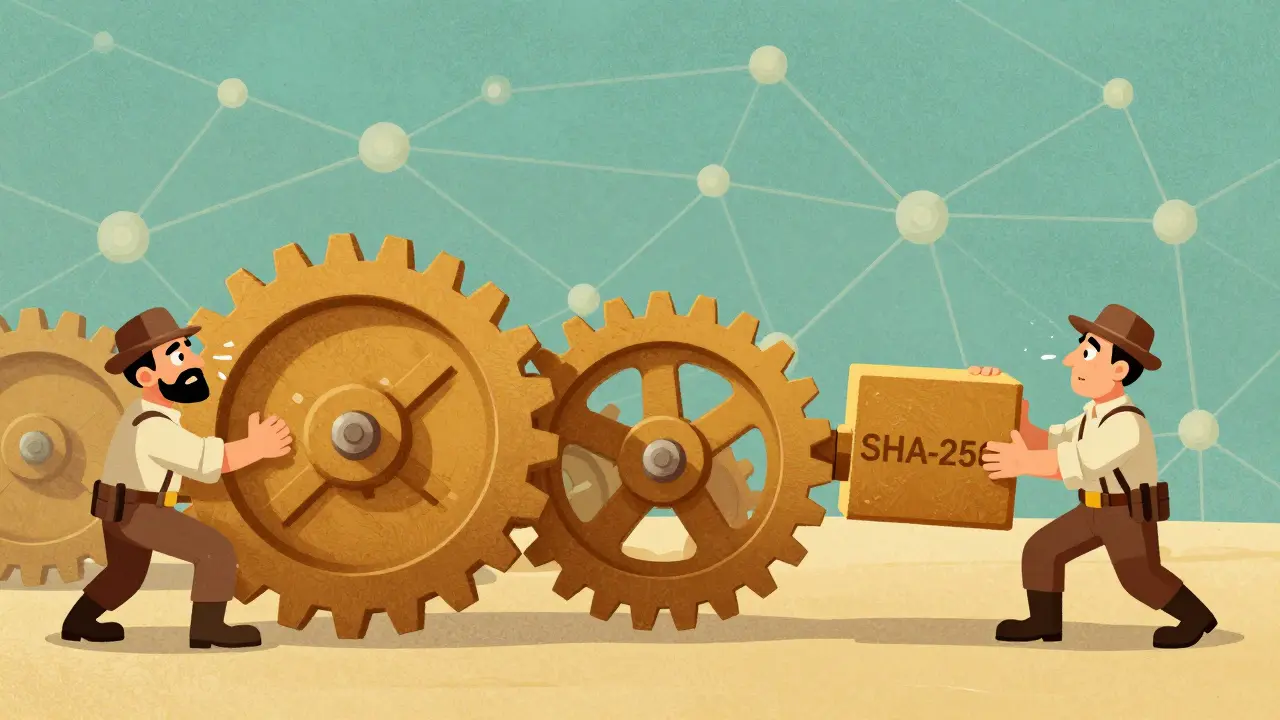
Timestamps and Decentralization: No Single Point of Failure
Each block includes a timestamp, recorded by the network nodes when the block is added. This creates a verifiable sequence of events. If someone claims a transaction happened on January 10, but the blockchain shows it was added on January 15, the discrepancy is obvious. And because the blockchain isn’t stored on one server-it’s copied across thousands of computers around the world-there’s no central place to hack. You’d need to take over a majority of nodes simultaneously. In Bitcoin, that’s over 10,000 active nodes. In Ethereum, it’s more than 20,000. You’d need to physically access and compromise them all at once. That’s not a cyberattack-it’s a military operation. This decentralization is why blockchain records survive wars, outages, and corruption. Even if every bank in a country shuts down, the blockchain keeps running. Even if a government tries to erase a record, it still exists on computers in Japan, Brazil, and Canada.Where Immutability Matters Most
Immutability isn’t just a technical curiosity. It solves real problems. In supply chains, companies like Walmart use blockchain to track food from farm to shelf. If spinach is contaminated, they can trace it back to the exact farm in minutes-not weeks. And because the records can’t be changed, suppliers can’t hide mistakes. In healthcare, patients’ medical histories are stored on blockchain in pilot programs across the U.S. and EU. Doctors access a complete, unaltered record. No more lost files, no more falsified prescriptions. In voting systems, blockchain-based ballots ensure each vote is counted once-and only once. No tampering. No deletion. No double-counting. Even art and music are moving to blockchain. Digital artists mint NFTs as proof of ownership. The record of who created it, who bought it, and when-it’s permanent.
The Trade-Offs: What Immutability Costs
But immutability isn’t free. There are real downsides. First, it’s slow. Bitcoin can only process about 7 transactions per second. Ethereum does around 30. Compare that to Visa, which handles 65,000 per second. The security comes at a speed cost. Second, it’s expensive. Proof of Work blockchains like Bitcoin use more electricity than some countries. That’s why Ethereum switched to Proof of Stake in 2022-cutting its energy use by 99.95%. Third, mistakes are permanent. If you send crypto to the wrong address? There’s no customer service line. No “undo.” The funds are gone forever. That’s the price of trustless systems. And you can’t easily update the rules. If a security flaw is found in a smart contract, you can’t just patch it. You have to fork the chain-create a new version-and convince everyone to switch. That’s messy. That’s divisive. That’s why some blockchains now allow limited, controlled edits through governance votes-but that’s a compromise. True immutability means no edits at all.Is Immutability Absolute?
No. But it’s close enough for practical purposes. There are theoretical ways to break it: quantum computing, massive centralization, or a global collapse of network participation. But none of these are realistic today. Quantum computers powerful enough to crack SHA-256 don’t exist yet-and even if they did, blockchains could upgrade their hashing algorithms. What’s more important: immutability isn’t about being perfect. It’s about being reliable. It’s about giving you confidence that the record you’re seeing today is the same record that was created five years ago. That’s the power. That’s why governments, banks, and corporations are betting billions on it.What Comes Next?
The future of blockchain immutability isn’t about making it stronger-it’s about making it lighter. New consensus methods like Proof of History, Proof of Space, and verifiable delay functions are being tested to reduce energy use without sacrificing security. Hybrid systems are emerging too. Some enterprise blockchains combine blockchain-style hashing with traditional databases for speed, but still keep critical records on-chain for auditability. One thing won’t change: the core idea. Data that can’t be altered is data you can trust. And in a world full of deepfakes, hacked records, and erased history, that’s worth more than gold.Can blockchain data ever be deleted?
No, not in the traditional sense. Once a transaction is confirmed and added to a blockchain, it becomes part of a permanent, cryptographically linked chain. You can’t delete it. But some blockchains allow data to be marked as "invalid" or "retracted" through new transactions-like a correction note attached to the original. The original record still exists, but the network recognizes a later update. This is how privacy-focused blockchains handle things like revoked credentials, without breaking immutability.
Does immutability mean blockchain is hack-proof?
Not entirely. The blockchain itself is extremely hard to alter, but the software around it isn’t. Smart contracts can have bugs. Wallets can be stolen. Exchanges can be hacked. Immutability protects the ledger, not the user. If you send crypto to a scammer, the transaction can’t be reversed-but the problem wasn’t the blockchain. It was the human error. That’s why security practices still matter.
Why can’t we just change the hash of a block if we want to edit it?
Because every block after it stores the previous block’s hash. If you change Block 100, its hash changes. That breaks Block 101, which expects the old hash. To fix Block 101, you’d have to change its hash too, which breaks Block 102-and so on. You’d need to rewrite every block after the one you changed, and then get the entire network to accept your new version. That requires more computing power than the entire network combined. In Bitcoin, that’s over 1,000 exahashes per second. It’s not possible with today’s technology.
How does Proof of Stake achieve immutability without mining?
Validators in Proof of Stake are chosen to create new blocks based on how much cryptocurrency they lock up (stake). If they try to approve a fraudulent transaction, they lose their stake. The financial risk is greater than any reward from cheating. The network also checks every block. If a validator acts dishonestly, the system detects it and removes them. Immutability comes from the fact that rewriting history would require controlling 51% of all staked coins-which would cost billions and destroy the value of the very asset you’re trying to manipulate.
Is blockchain immutability useful outside of cryptocurrency?
Absolutely. It’s used in supply chains to track food safety, in healthcare to secure patient records, in voting systems to prevent fraud, and in legal systems to timestamp contracts. Any system that needs a tamper-proof audit trail benefits. For example, the U.S. Department of Veterans Affairs tested blockchain to securely store veterans’ medical records. The goal? To ensure no one-no hacker, no bureaucrat, no insider-can alter treatment history after the fact.
10 Comments
Okay but let’s be real-this whole 'immutability' thing is just crypto bros pretending their ledger is sacred scripture. 🙄 I’ve seen blockchain projects where they just hard-forked the chain like it was a Minecraft save file. If you can rewrite history by convincing enough people to switch chains, is it really immutable? Or just... politically inconvenient to change? I’m not buying the 'math is magic' narrative anymore. It’s all just consensus with extra steps.
Oh wow. Another glowing ode to blockchain like it’s the second coming of Christ. 🤡 Let me guess-you also think your NFT ape is a masterpiece and that Bitcoin is digital gold? Newsflash: if you can’t delete data, you’re not building a database-you’re building a digital graveyard. GDPR doesn’t care about your 'math.' Your blockchain is a regulatory nightmare waiting to explode.
Honestly? This post nails it. The hash chaining is such an elegant solution-it’s like a domino effect where every piece holds the next one accountable. I worked on a supply chain project using Hyperledger, and the moment we saw how easily auditors could trace a shipment back to the farm without any back-and-forth emails? Mind blown. It’s not magic. It’s just really good engineering. And yeah, the energy use is a problem-but that’s why PoS exists now. We’re evolving.
There’s something deeply human about the idea of permanence. We carve names into stone, write letters to the future, burn records in protest. Blockchain is just the latest iteration of that urge-to make something last. But permanence without context is just noise. What good is an unchangeable record if no one understands why it was made? Immutability doesn’t guarantee truth. It just guarantees persistence. And that’s... a quiet kind of tragedy.
I love how this explains things simply. I’m not techy at all, but I get it now: it’s like a chain of locked boxes, each one holding the key to the next. So if someone tries to sneak in and change one, the whole thing falls apart. That’s so cool. And it makes sense why hospitals and governments are trying it out. Safety matters.
I just want to say THANK YOU for writing this!! 🙌 I’ve been trying to explain blockchain to my mom for months and she kept saying, 'But what if I make a mistake?' And now I can send her this!! The part about 'mistakes are permanent' hit me right in the soul-no undo button, no customer service, just you and your keys. It’s scary… but also kinda beautiful?? Like digital responsibility. 💪❤️
I appreciate the breakdown. But I wonder-how many people actually understand this when they use apps that say 'powered by blockchain'? Most just click 'confirm.' The system works, but the awareness doesn’t. That’s the real gap.
I’ve been working with a blockchain-based land registry in rural India, and honestly, it’s changed everything. Before, land disputes took years because records were handwritten, lost, or altered by local officials. Now, farmers can show a QR code on their phone and prove ownership in seconds. No bribes, no fake documents. The immutability isn’t about tech-it’s about justice. I’ve seen elderly women cry because for the first time, their inheritance couldn’t be stolen. That’s the real power here. Not the hashes. Not the mining. The trust.
You guys are missing the big picture. Immutability isn’t just about preventing fraud-it’s about creating a new kind of social contract. When you know the record can’t be erased, you start acting differently. Companies stop lying. Politicians stop rewriting history. People stop cheating because they know it’ll live forever. That’s not just technology. That’s cultural evolution. And yeah, it’s slow. And yeah, it’s expensive. But so was the printing press. And look where that got us. This? This is the next Gutenberg moment. Don’t sleep on it.
Let’s cut through the crypto-washing. This 'immutability' is just a marketing gimmick designed to make dumb investors think they’re buying 'digital gold.' Meanwhile, the U.S. government is quietly using private, permissioned blockchains where admins can edit records anytime. And you think that’s real immutability? Please. It’s a facade. Real decentralization? Doesn’t exist. This is just corporate control with a fancy name. And the energy waste? Unforgivable. We need real solutions-not blockchain theater.