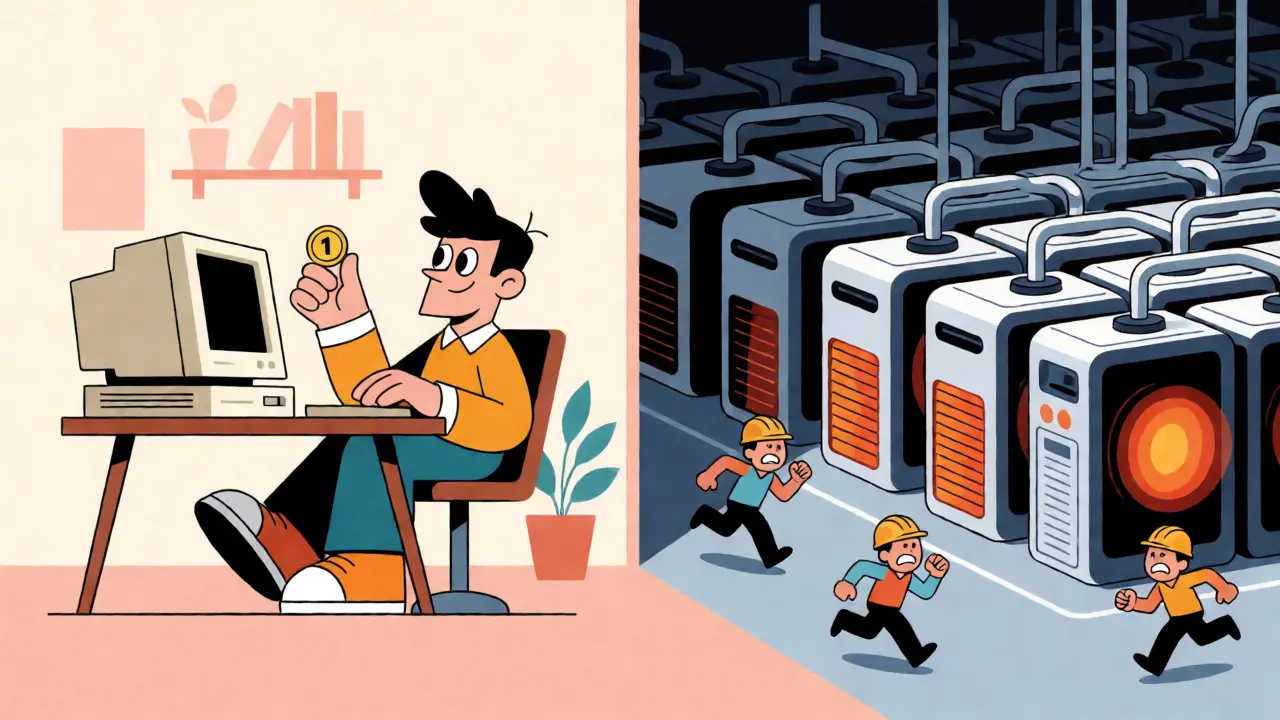
Imagine trying to guess a specific number between 1 and 10. Easy, right? Now imagine guessing a number between 1 and 100 trillion. That is essentially what Bitcoin mining difficulty represents today. It’s not just a technical stat; it’s the heartbeat of the network’s security and the primary driver of miner profitability. If you’ve ever wondered why your home mining rig stopped making sense years ago, or why industrial farms in Texas are fighting over electricity contracts, the answer lies in the historical trajectory of this single metric.
What Is Mining Difficulty Really Measuring?
At its core, mining difficulty is a dimensionless index that tells you how hard it is to find a valid block hash. Think of it as a throttle on the network. Bitcoin was designed to produce a new block every ten minutes, no matter how many computers join the race. To keep that timing tight, the protocol automatically adjusts the difficulty target. If miners solve blocks too fast, the puzzle gets harder. If they slow down, it gets easier.
The formula is deceptively simple: Difficulty = Difficulty Target / Current Target. In practical terms, Newhedge defines current difficulty as the approximate number of hashes required to mine a single block. When we say difficulty is 124 trillion, we mean that, on average, miners must perform roughly 124 trillion computational attempts to find one valid solution. This isn’t about hardware speed alone; it’s about statistical probability. As more powerful machines come online, the network raises the bar to ensure the 10-minute cadence remains intact.
The Explosive Growth Curve: 2009 to 2026
To understand where we are, look at where we started. In January 2009, when Satoshi Nakamoto mined the Genesis Block, the difficulty was exactly 1. You could mine Bitcoin on a standard laptop CPU. Fast forward to mid-2026, and YCharts reports the average daily difficulty sitting at approximately 124.93 trillion (T).
This isn’t linear growth; it’s exponential. Hashrate Index calculates that from inception to recent highs, difficulty compounded at an average rate of 20.64% per month. That means if you had invested in hash power in 2015, your equipment would have become obsolete within months as the difficulty skyrocketed past your machine’s capabilities. The jump from single digits to trillions reflects the shift from hobbyist mining to a multi-billion dollar industrial sector.
| Period | Approximate Difficulty | Primary Hardware Era | Network Context |
|---|---|---|---|
| 2009-2010 | 1 - 1,000 | CPU / GPU | Hobbyist phase; negligible energy cost. |
| 2011-2013 | Millions - Billions | FPGA / Early ASICs | Specialized hardware emerges; competition intensifies. |
| 2014-2017 | Trillions | Dominant ASICs | Industrial farms begin consolidation; difficulty stabilizes at higher baselines. |
| 2018-2021 | Tens of Trillions | Advanced ASICs (e.g., Antminer S19) | Global distribution; renewable energy focus begins. |
| 2022-2026 | 100+ Trillions | Next-Gen ASICs & Immersion Cooling | Institutional scale; difficulty plateaus then rises with price cycles. |
How the Protocol Adjusts Every Two Weeks
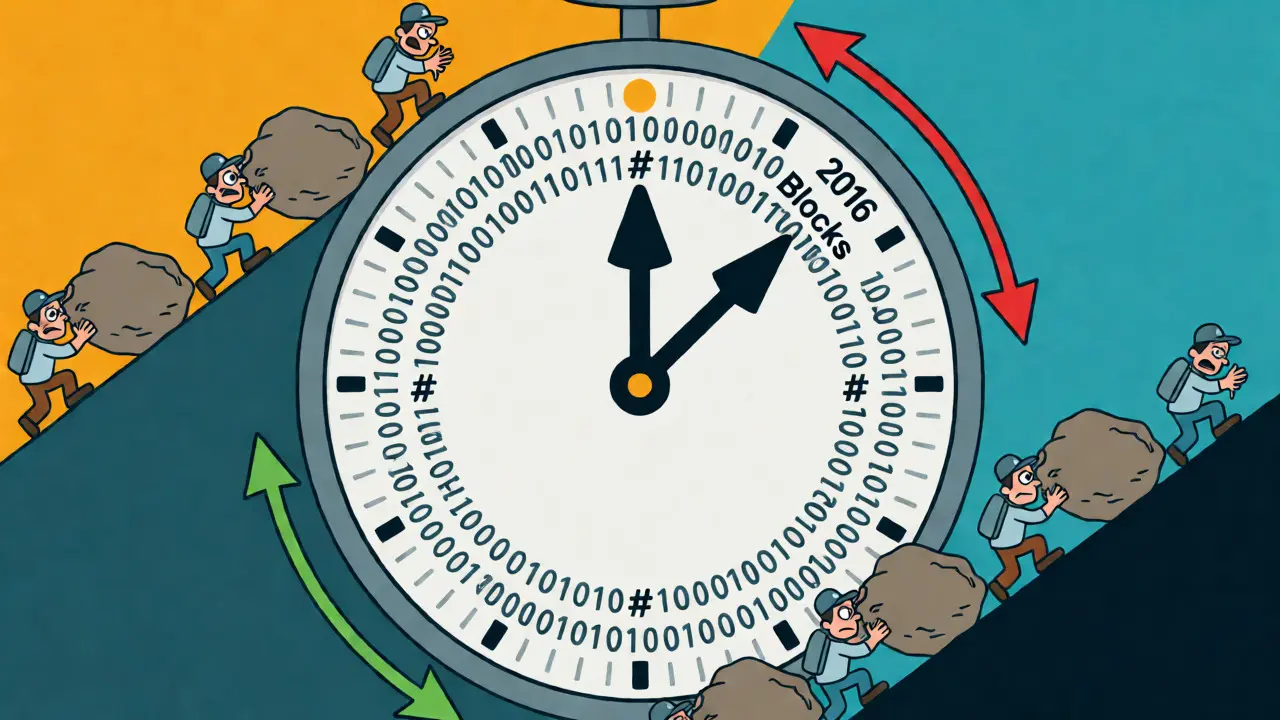
You might think difficulty changes constantly, like stock prices. It doesn’t. The Bitcoin protocol locks in difficulty for exactly 2,016 blocks. Since the target block time is 10 minutes, this adjustment happens roughly every two weeks. During those 2,016 blocks, the difficulty stays static, regardless of whether thousands of miners plug in or unplug their rigs overnight.
This lag creates interesting market dynamics. If a major mining farm goes offline due to a heatwave in Texas, the network doesn’t immediately lower difficulty. Instead, block times stretch out slightly beyond 10 minutes until the next adjustment window opens. Then, the algorithm looks back at the previous epoch’s actual block times. If they averaged 11 minutes, difficulty drops. If they averaged 9 minutes, difficulty rises. This self-correcting mechanism ensures that while short-term volatility exists, the long-term rhythm of the blockchain remains steady.
Why Difficulty Drops: The Miner Capitulation Events
We often talk about difficulty going up, but it also falls. These downward adjustments are critical signals for investors and analysts. A drop in difficulty usually indicates "miner capitulation"-a scenario where less efficient miners shut down because the cost of electricity exceeds the value of the Bitcoin they earn.
For example, in early 2022, following China’s ban on mining operations, the global hash rate plummeted. Difficulty didn’t crash instantly, but over several adjustment periods, it decreased significantly as the network recalibrated to the sudden loss of computational power. Similarly, during bear markets, when Bitcoin’s price falls below production costs, older hardware becomes unprofitable. Miners turn off these machines, reducing total hash rate, which eventually triggers a difficulty reduction. This cycle makes mining more profitable for survivors, attracting new capital and pushing difficulty back up.
The Economic Impact on Miners and Investors
For anyone involved in crypto, understanding historical difficulty trends is non-negotiable. For miners, it dictates hardware lifecycle management. Buying an Application-Specific Integrated Circuit (ASIC) today is a bet that difficulty won’t rise so fast that your return on investment vanishes before the machine dies. Historically, high efficiency gains in hardware (like moving from 7nm to 3nm chips) allow newer machines to stay profitable longer, even as difficulty climbs.
For investors, difficulty serves as a proxy for network security and sentiment. Rising difficulty suggests miners are optimistic about future prices, willing to spend cash on electricity now for coins they’ll sell later. Falling difficulty can signal caution or operational stress. Data providers like Bitbo and Blockchain.com track these metrics closely because they correlate with supply-side pressure. When difficulty drops, it often precedes a period where fewer new coins enter circulation, potentially supporting price floors.
Current Trends and Future Outlook
As of September 2026, we are seeing a nuanced picture. While the long-term trend is undeniably upward, recent data shows periods of stagnation or slight decline. YCharts noted a year-over-year change of -1.17% around mid-2026, hovering near 124.93 T. Why the pause? Several factors are at play:
- Hardware Efficiency: Newer ASICs are exponentially more efficient, allowing miners to maintain profitability without needing to add as much raw hash rate as in previous eras.
- Energy Constraints: Grid limitations in key mining hubs force operators to optimize rather than just expand.
- Post-Halving Dynamics: Following the most recent halving, block rewards were cut. Miners had to adjust their models, leading to temporary capacity exits before stabilization.
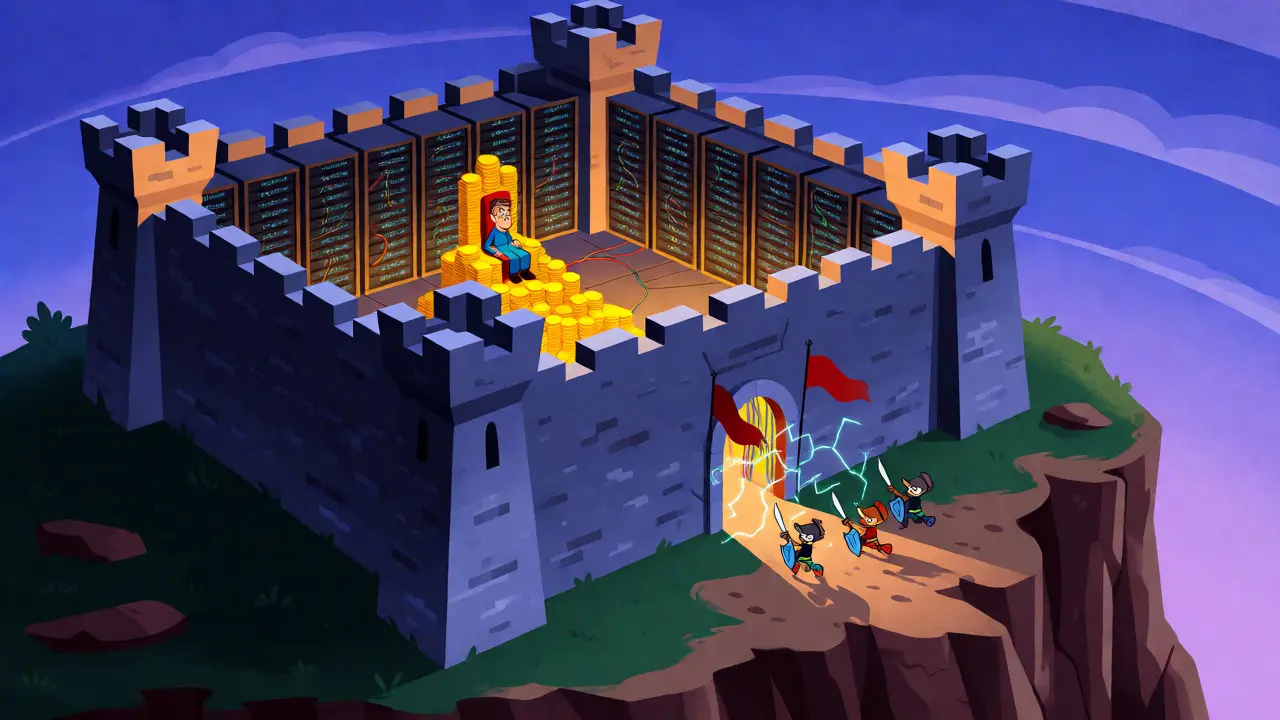
Looking ahead, expect difficulty to remain volatile but structurally high. The days of easy mining are gone forever. The barrier to entry is now measured in megawatts of power and millions of dollars in infrastructure. However, this high difficulty is a feature, not a bug. It makes attacking the Bitcoin network prohibitively expensive, securing the billions of dollars stored on-chain.
Practical Tools for Monitoring Difficulty
If you want to track these trends yourself, don’t rely on outdated blogs. Use real-time dashboards. Sites like BitInfoCharts, Blockchain.com, and YCharts provide granular data. Look for three key indicators:
- Current Difficulty: The absolute number (e.g., 124.93 T).
- Hash Rate: The total computational power securing the network (measured in Exahashes per second).
- Estimated Adjustment: Predictors like Newhedge show what the next difficulty change will likely be based on current block times.
By correlating these numbers with Bitcoin’s price, you can gauge whether mining is currently profitable. If difficulty is rising while price is flat, margins are squeezing. If difficulty is falling while price holds, margins are expanding. This simple heuristic helps you understand the health of the mining ecosystem without needing a degree in cryptography.
Why does Bitcoin mining difficulty increase over time?
Difficulty increases primarily because more computational power (hash rate) joins the network. The Bitcoin protocol is designed to keep block discovery at a constant 10-minute interval. As more miners compete, the protocol automatically raises the difficulty level to ensure blocks aren't found too quickly. This reflects growing interest and investment in Bitcoin mining infrastructure.
How often does Bitcoin difficulty adjust?
Bitcoin difficulty adjusts every 2,016 blocks. Given the target block time of 10 minutes, this adjustment occurs approximately every two weeks. The algorithm compares the actual time taken to mine the last 2,016 blocks against the expected time (20,160 minutes). If blocks were mined faster than expected, difficulty increases; if slower, it decreases.
Can mining difficulty decrease?
Yes, mining difficulty can and does decrease. This typically happens when significant amounts of hash rate leave the network, often due to economic pressures like low Bitcoin prices or high electricity costs. When miners shut down inefficient rigs, the total network hash rate drops, causing the protocol to lower difficulty in subsequent adjustments to maintain the 10-minute block time.
What is the relationship between difficulty and hash rate?
Hash rate is the measure of total computational power working to secure the network, while difficulty is the protocol's response to that power. They are inversely related in terms of impact on block time: high hash rate tends to push difficulty up to slow down block production, while low hash rate pushes difficulty down to speed it up. Together, they determine the competitive landscape for miners.
Is high mining difficulty good or bad for Bitcoin?
Generally, high difficulty is seen as positive for Bitcoin's security because it indicates a massive amount of energy and resources are dedicated to protecting the ledger, making attacks extremely costly. However, for individual miners, high difficulty reduces profitability unless offset by higher Bitcoin prices or more efficient hardware. It signals a mature, highly competitive network.