
Bitcoin doesn’t just go up-it explodes. And every time it does, it follows a pattern you can trace back to the very beginning. Since its launch in 2009, Bitcoin has had four major bull runs, each bigger than the last, each driven by different forces, and each leaving behind a trail of lessons for anyone who wants to understand where it might go next. If you’ve ever wondered why Bitcoin surges every few years, or why people keep saying "this time is different"-only for history to repeat itself-you’re not alone. Let’s break down what actually happened during each bull run, what made them tick, and what’s different this time around.
The 2013 Bull Run: The First Real Surge
Before Bitcoin was a household name, before ETFs or institutional wallets, it was a niche experiment. The first real bull run started in early 2013. Bitcoin was trading around $145 in May. By December, it hit $1,200. That’s a 730% gain in just seven months. What caused it? A mix of panic and curiosity. The Cyprus banking crisis made people question traditional banks. Suddenly, a decentralized digital currency looked like a safe haven. Media coverage exploded. Forums like Reddit’s r/Bitcoin went from quiet corners to packed chat rooms. But this run was messy. Most of the trading happened on Mt. Gox, which handled 70% of all Bitcoin transactions at the time. Then, in early 2014, Mt. Gox collapsed. Bitcoin crashed to under $300. People lost everything. But the crash didn’t kill Bitcoin-it proved it could survive a major shock. The lesson? Early cycles were fragile, built on weak infrastructure. The market wasn’t ready for mass adoption… yet.
The 2017 Bull Run: ICO Mania and Retail Frenzy
By 2017, Bitcoin had a second life. It started the year at $1,000. By December, it hit $20,000. That’s a 1,900% jump. But this time, something new happened: altcoins. Ethereum, Ripple, Litecoin-they all surged. The ICO boom turned crypto into a gold rush. Anyone with a whitepaper could raise millions. Retail investors flooded in. Coinbase, the biggest U.S. exchange, saw its user base explode. Trustpilot reviews from Q4 2017 show users raving about the platform… and complaining about constant outages. Trading volume doubled. Social media chatter hit new levels. But the bubble was obvious. The Fear & Greed Index flashed "Extreme Greed". People bought Bitcoin because their friend bought it. They sold because they were scared. When the crash came, Bitcoin dropped 80% from its peak, falling below $200 by 2018. The lesson? When retail investors dominate, volatility spikes. And when the hype fades, the market resets hard.
The 2020-2021 Bull Run: Institutions Walk In
The third bull run changed everything. It started quietly in March 2020, right after the pandemic hit. Bitcoin dipped to $3,800. But within a year, it soared to $69,000. What shifted? Institutions. Tesla bought $1.5 billion in Bitcoin. MicroStrategy turned into a Bitcoin hedge fund. Grayscale’s Bitcoin Trust held 3% of all circulating supply by 2021. This wasn’t just speculation-it was portfolio diversification. The total crypto market cap jumped from $180 billion in 2020 to over $3 trillion in 2021. Bitcoin’s dominance rose from 40% back to 55%, as investors moved out of risky altcoins and back into the original. Daily active addresses hit 1.8 million. But again, the top was followed by a brutal correction. By November 2022, Bitcoin fell to $15,476-a 77.7% drop. The lesson? When big money enters, the market gets more stable… but also more expensive to ride. Retail traders still got burned, but now they were competing against hedge funds with billions.

The 2024 Cycle: The Institutional Era
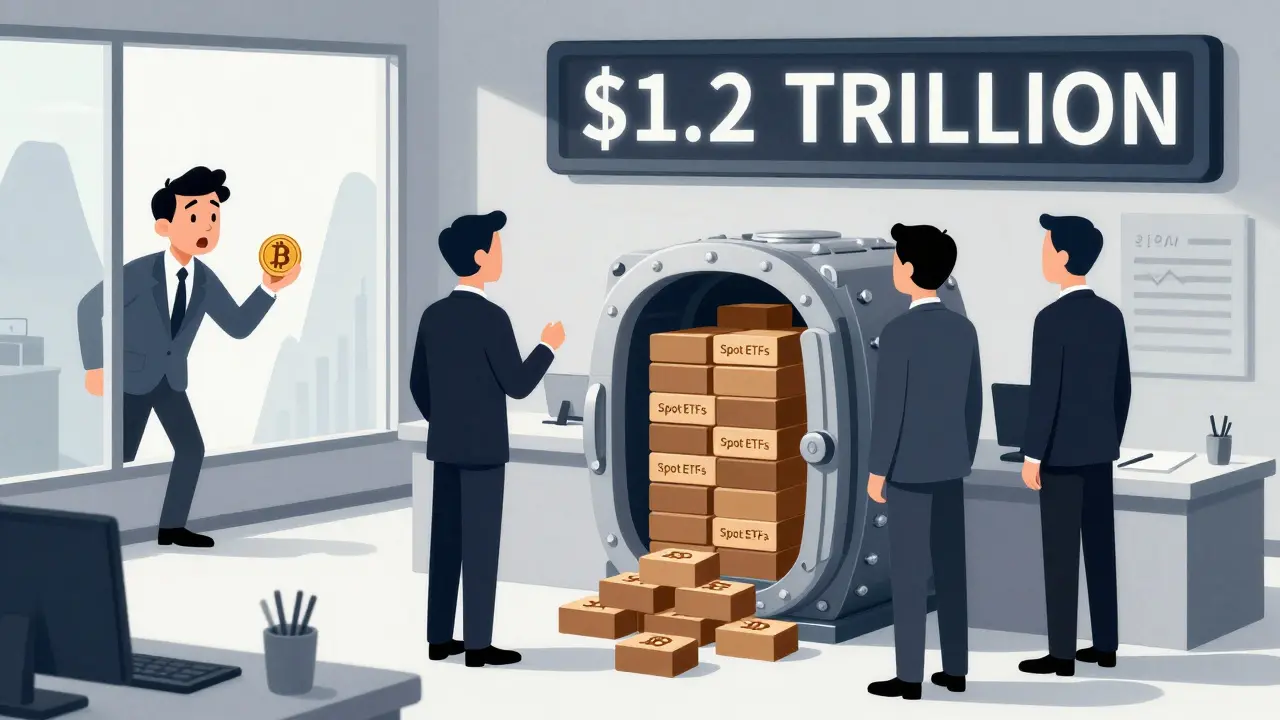
The latest cycle began with the April 20, 2024 halving-the fourth in Bitcoin’s history. This time, the game changed completely. Spot Bitcoin ETFs launched in the U.S. in January 2024. By November 2024, these ETFs had accumulated over 850,000 BTC, worth roughly $50 billion. That’s more Bitcoin in institutional hands than ever before. The market cap of Bitcoin alone crossed $1.2 trillion. Bitcoin dominance hit 58%, meaning capital is flowing back into Bitcoin, not altcoins. Unlike 2017, there’s no ICO mania. Unlike 2021, there’s no FOMO-driven retail explosion. This is a slow, steady, institutional buildup. Analysts at Standard Chartered predict a peak between $180,000 and $200,000 by late 2025 or early 2026. ARK Invest is more cautious, estimating $150,000 by 2030. But one thing is clear: this cycle is built on infrastructure. Regulated custody. Institutional trading platforms. Clearer rules under MiCA in Europe. The market isn’t just bigger-it’s deeper.
The Four Phases of Every Bitcoin Bull Run
Every cycle follows the same four stages, no matter the year. Understanding them helps you avoid panic selling or buying at the top.
- Phase 1: Accumulation - Prices hover near the bottom. Volume is low. Sentiment is negative. This is when smart money buys quietly. It can last 6-12 months after a halving.
- Phase 2: Growth - Prices start climbing steadily. Halving supply shocks reduce new coins. Exchange reserves shrink. Bitcoin dominance rises. This is the sweet spot for long-term holders.
- Phase 3: Bubble - Prices explode. Media headlines scream "Bitcoin will hit $1 million!" The Fear & Greed Index hits "Extreme Greed." Social volume peaks. This is when retail traders rush in-and get crushed later.
- Phase 4: Crash - The top is followed by a 75-80% drop. It takes months, sometimes over a year, to stabilize. This is when panic sells happen. But it’s also when the cycle resets.
Calen and Brown’s model, backed by data from every cycle, shows this pattern holds. The 2021 crash followed it exactly: $69,000 to $15,476. The 2017 crash? $20,000 down to under $200. The same math. The same emotions.
What to Watch Right Now
As of November 2024, we’re in the Growth phase. Bitcoin dominance is rising. Hash rate is at all-time highs. Exchange reserves are falling. These are classic signs of accumulation turning into real momentum. Here’s what to monitor:
- Bitcoin Dominance - If it climbs above 60%, expect more capital to flow into Bitcoin, not altcoins.
- Exchange Reserves - When wallets on exchanges drop, it means people are moving Bitcoin to private wallets-signaling long-term holding.
- ETF Inflows - If daily inflows into spot Bitcoin ETFs stay above $100 million, the institutional demand is strong.
- Hash Rate - A rising hash rate means miners are confident. It’s a sign of network health.
Tools like Bitbo Charts and the Bitcoin Bull Run Index (CBBI) help track these metrics. CBBI uses nine real-time indicators-from transaction volume to miner revenue-to tell you which phase the market is in. You don’t need to guess. You can measure.
Why This Time Is Different (And Why It’s Not)
People say "this time is different" every cycle. And every time, they’re half-right. This time, we have ETFs. We have institutional custody. We have regulated markets. That makes the market more stable. But the human behavior? Still the same. FOMO. Panic. Greed. Fear. The 2013 trader who sold too early, the 2017 trader who bought at $19,000, the 2021 trader who watched Bitcoin hit $69,000 and then sold at $30,000-these are all the same person. You. Me. Anyone who lets emotion drive decisions.
The real difference? Infrastructure. In 2013, you needed a technical setup to buy Bitcoin. In 2024, you can buy it in your Roth IRA. The barrier to entry is lower. The trust is higher. The risks? Still there. Regulatory crackdowns. Macro shocks. Black swans. But now, the market can absorb them better.
What History Suggests for 2025-2026
If history repeats, we’re still early in this cycle. The 2013 run peaked 18 months after the halving. 2017? 16 months. 2021? 18 months. The 2024 halving happened in April. That puts the likely peak between late 2025 and early 2026. If Bitcoin follows the percentage gain of the 2017 cycle, it could hit $260,000. If it matches the 2013 cycle’s growth? $850,000. That’s speculative. But even the most conservative estimates-$150,000 to $200,000-are far above today’s price.
The key isn’t predicting the exact number. It’s understanding the phase you’re in. If you’re holding Bitcoin now, you’re not betting on a miracle. You’re betting on a pattern that’s held for 15 years. And so far, it’s never failed.
What caused Bitcoin’s first bull run in 2013?
The 2013 bull run was triggered by the Cyprus banking crisis, where depositors lost access to their savings. This sparked global interest in decentralized alternatives. Media coverage surged, and Bitcoin prices jumped from around $145 to $1,200 in seven months. However, the market was fragile, relying heavily on the Mt. Gox exchange, which collapsed shortly after the peak, causing a sharp correction.
How did the 2017 bull run differ from 2013?
The 2017 bull run was fueled by the ICO boom and widespread retail participation. Ethereum and other altcoins surged alongside Bitcoin, pushing total crypto market cap to $560 billion. Trading volumes were much higher, and platforms like Coinbase struggled with demand. Unlike 2013, this cycle had real media attention, but also more volatility and a larger crash afterward, with Bitcoin dropping below $200 by 2018.
Why was the 2020-2021 bull run considered a turning point?
The 2020-2021 bull run marked the shift from retail-driven speculation to institutional adoption. Companies like Tesla and MicroStrategy bought billions in Bitcoin. Grayscale’s Bitcoin Trust held 3% of all supply. The market cap reached $3 trillion, and Bitcoin dominance rose to 55%. This cycle proved Bitcoin could be a legitimate asset class, not just a speculative token.
What’s different about the 2024 bull run?
The 2024 cycle is defined by spot Bitcoin ETFs in the U.S., which have accumulated over 850,000 BTC since January 2024. Institutional custody, regulated markets, and mature derivatives markets make this cycle more stable. Bitcoin dominance is rising again, and retail FOMO is muted. Analysts expect the peak to occur in late 2025 or early 2026, with price targets between $150,000 and $200,000.
How can I tell which phase of the cycle we’re in right now?
Look at three key indicators: Bitcoin dominance (rising = institutional accumulation), exchange reserves (falling = people moving Bitcoin off exchanges), and hash rate (increasing = miner confidence). As of late 2024, Bitcoin dominance is at 58%, exchange reserves are declining, and hash rate is at record highs-signs we’re in the Growth phase, not the Bubble yet.
Should I buy Bitcoin now based on historical patterns?
History shows Bitcoin tends to peak 16-18 months after a halving, which puts the next peak around late 2025. But buying based on history alone is risky. The market is more mature now, with institutional demand acting as a floor. The best approach is dollar-cost averaging-buying small amounts over time-to reduce timing risk. Never invest more than you can afford to lose.
Bitcoin’s history isn’t just a list of price charts. It’s a story of human behavior, technological evolution, and institutional adoption. Every bull run teaches the same lesson: patience beats panic. The next peak may be $150,000. Or $200,000. Or even higher. But whether it’s 2025 or 2026, one thing’s certain-the cycle isn’t over. It’s just getting started.
8 Comments
Oh, another "history repeats" lecture? How poetic. The same human greed, the same panic, the same "this time is different"-except now we have ETFs and a blockchain that runs on solar-powered miners in Texas. I mean, really? We’re still here, debating whether Bitcoin will hit $200K while the planet burns? The only pattern I see? Humans. Always. The. Same.
🚨 ALERT 🚨 This is all a CIA-backed scheme to replace the dollar with Bitcoin so they can track EVERY transaction. You think ETFs are "regulated"? Nah. They’re just the new SWIFT. They’re already tagging your wallet with your social security number. I’ve seen the leaked memos. They’re calling it "Project Silent Ledger." Buy gold. Or better yet-move to a bunker. 🏴☠️💣
While your historical analysis is, technically, accurate-it is fundamentally flawed in its assumption that market behavior is predictable. The notion that "phases" exist as discrete, repeatable entities ignores the emergent complexity of decentralized systems. Furthermore, to suggest that institutional adoption equates to stability is to misunderstand the nature of financialization. Hedge funds do not stabilize-they extract. And when the next macro shock occurs-perhaps triggered by a sovereign debt crisis in Japan-the entire edifice will tremble. The market is not deeper. It is merely more leveraged. And more fragile.
I just bought my first Bitcoin last month. I didn’t even know what a halving was. But I read this post and thought-hey, maybe this is the one. I’m not trying to get rich. I just want to feel like I’m part of something that lasts. If it goes up? Cool. If it goes down? I’ll still be proud I tried.
There’s something almost spiritual about watching Bitcoin evolve. It’s like watching a forest grow-not in a straight line, but in rings, each layer built from fire, drought, rain, and time. The 2013 crash? That was the lightning strike. 2017? The wildfire. 2021? The slow, creeping sap rising through the roots. And now? The roots are deep. The soil is richer. The trees are taller. And yes, another storm is coming. But this time, the forest knows how to bend. It doesn’t just survive-it remembers. And that’s the quiet magic no chart can capture.
It is imperative to recognize that the structural underpinnings of the current Bitcoin cycle are unprecedented in both scale and sophistication. The emergence of regulated, SEC-approved spot Bitcoin ETFs represents not merely a product innovation, but a systemic reallocation of global capital. The institutional infrastructure-custody solutions, compliance frameworks, and liquidity pools-now exists at a level that renders prior cycles obsolete in terms of resilience. Furthermore, the decline in exchange reserves, coupled with sustained hash rate growth, indicates a paradigm shift from speculative trading to long-term sovereignty. To dismiss this as merely another cycle is to overlook the qualitative evolution of the asset class. We are not witnessing a bull run. We are witnessing the institutionalization of digital scarcity.
Every cycle feels like a mirror… and every time I look, I see myself buying at the top, selling at the bottom, and then pretending I "knew it all along." But here’s the truth-I’m not here to time the market. I’m here to learn how to stop being scared. Bitcoin doesn’t care if I’m rich or poor. It just keeps going. And maybe… that’s the lesson. Not the price. The patience.
Halving → Growth → Peak → Crash. Rinse. Repeat. 🔄 But hey, I’m still here. Still holding. Still believing. 🙌