
Sidechain Cost & Security Calculator
Input Transaction Details
Security & Cost Comparison
Based on Q3 2023 data from article
Sidechains aren’t just a buzzword anymore-they’re the quiet backbone of most blockchain activity you don’t see on the mainnet. While everyone talks about Ethereum’s Layer 2s and Bitcoin’s Taproot upgrades, millions of transactions are quietly flowing through sidechains every day, at a fraction of the cost and speed. But what happens next? As we move deeper into 2025, sidechain technology is no longer about just scaling Ethereum or Bitcoin. It’s becoming a toolkit for specialization, security trade-offs, and real-world enterprise use. And the future isn’t one path-it’s many.
What Sidechains Actually Do (And Why They Matter)
A sidechain is its own blockchain, connected to a main chain-like Ethereum or Bitcoin-through a two-way peg. This lets you move assets back and forth, but the sidechain runs its own rules. It can have faster blocks, lower fees, different consensus, even its own tokens. Think of it like a private highway connected to a busy freeway. You get the same destination, but you avoid the traffic.
Take Polygon’s PoS sidechain. In Q2 2023, it processed transactions in 2.1 seconds with fees averaging $0.0002. Compare that to Ethereum’s 15-second blocks and $1.20 average fees during the same period. That’s not a small improvement-it’s a game-changer for NFT minting, gaming, and DeFi apps that need cheap, fast interactions. Users on Reddit reported NFT minting costs dropping from $85 to just $0.17. That’s the kind of difference that turns theoretical use cases into real behavior.
But here’s the catch: sidechains don’t inherit the security of the main chain. Most use their own validator sets-78% of them, according to Messari’s 2023 report. That means if those validators are compromised, your assets on the sidechain are at risk. The $600 million Nomad bridge hack in 2022 wasn’t a flaw in Ethereum. It was a flaw in how the sidechain communicated with it. That’s the core tension: flexibility vs. safety.
Sidechains vs. Rollups: The Real Battle for Scaling
It’s easy to confuse sidechains with Layer 2s like Optimism or Arbitrum. But they’re not the same. Rollups bundle transactions and post proofs back to Ethereum, inheriting its security. Sidechains operate independently. That’s why Vitalik Buterin says rollups offer 95%+ of Ethereum’s security, while sidechains deliver only 30-40%.
So why use sidechains at all? Because rollups can’t do everything. They’re great for simple transfers and DeFi. But if you need a blockchain that runs on 100ms blocks-like Rootstock on Bitcoin-you need a sidechain. If you want to build a gaming chain that handles 1,000 transactions per second, like Immutable X, you need a sidechain. Rollups are optimized for security. Sidechains are optimized for control.
And that’s where the market is splitting. Polygon, with 7-day transaction volumes over $12.4 billion in Q3 2023, isn’t trying to replace Ethereum. It’s becoming a hub for apps that need speed and low cost, not Bitcoin-level security. Meanwhile, Bitcoin’s Liquid Network, handling 5,000 daily transactions, serves institutions that need private, fast settlements without touching the main chain.
The Security Problem: Bridges Are the Weakest Link
If you want to know where sidechains are most vulnerable, look at the bridges. These are the smart contracts that lock assets on the main chain and mint equivalent tokens on the sidechain-and vice versa. Chainalysis found that 72% of all bridge hacks target sidechain-mainnet connections, even though sidechains only handle 35% of cross-chain volume.
Why? Because bridges are complex. They need to verify transactions across two different blockchains, often with different consensus rules. A single bug can let attackers drain funds. And users don’t always understand the risk. A Reddit poll of 12,450 people showed 68% had experienced failed cross-chain transfers. Over 40% said the 7-12 hour wait times were “unacceptable for daily use.”
Enterprise users are even more cautious. Deloitte’s 2023 report found that 67% of companies implementing sidechains delayed deployment because of security audit complexity. The average implementation takes 8-12 weeks, not because the tech is hard to build, but because the risk is too high to get wrong.
What’s Changing in 2025: The Rise of Hybrid Models
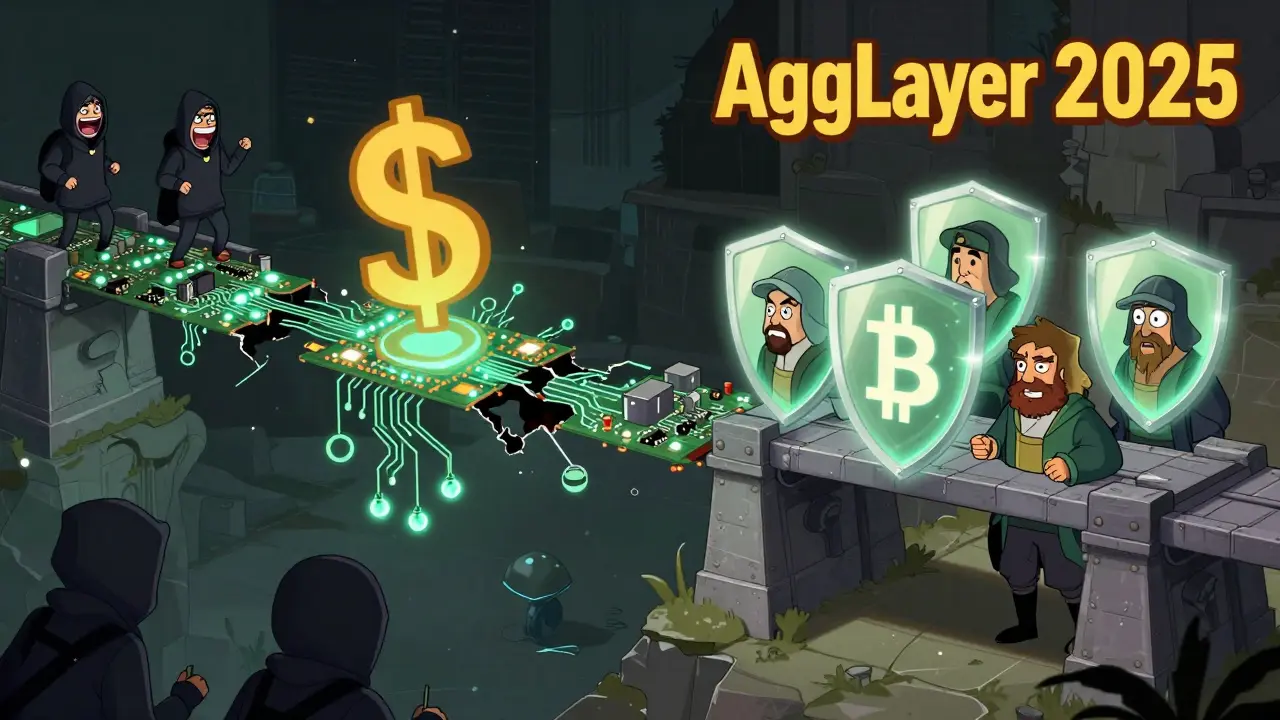
The future of sidechains isn’t about choosing between security and speed. It’s about combining both. Polygon’s AggLayer, announced in September 2023, is a clear signal: they’re building a network of sidechains that share security through a unified validator set. It’s not a rollup. It’s not a traditional sidechain. It’s something new.
Academic research from UC Berkeley predicts 65% of new sidechains will include fraud proofs by 2025. That means they’ll still run independently, but if someone tries to cheat, users can challenge the outcome using data from the main chain. It’s a middle ground-more secure than today’s sidechains, but more flexible than rollups.
Even Bitcoin is catching up. BIP-300, currently in draft, proposes letting Bitcoin miners validate sidechain blocks. That would mean Bitcoin’s immense hash power helps secure sidechains, not just the main chain. If it launches, it could make Bitcoin sidechains viable for serious DeFi, not just institutional settlements.
Enterprise Adoption: Sidechains Are Quietly Becoming Corporate Tools
You won’t hear about this on Twitter, but 43 of the Fortune 100 companies are using sidechains right now. Why? Because they need privacy. They need control. They don’t want every transaction visible on Ethereum.
Supply chain tracking, identity verification, internal payment systems-these are perfect for private sidechains. Companies like ConsenSys Quorum and IBM’s Hyperledger Fabric are already offering enterprise-grade sidechain solutions. The SEC’s September 2023 guidance added another layer: sidechain tokens might be considered securities if they’re sold as investments. That means companies can’t just launch a token and hope for the best. They need legal structure, compliance, and audits.
That’s why the sidechain market is projected to grow from $1.2 billion in 2023 to $8.7 billion by 2027. This isn’t speculation-it’s enterprise contracts being signed. The users aren’t retail traders. They’re procurement officers, compliance teams, and CFOs.
Specialization Over Generalization: The Death of the All-in-One Sidechain
Remember when everyone thought one sidechain would dominate? Polygon, Arbitrum, Optimism-each was supposed to be the “one to rule them all.” That’s over. The future belongs to specialized chains.
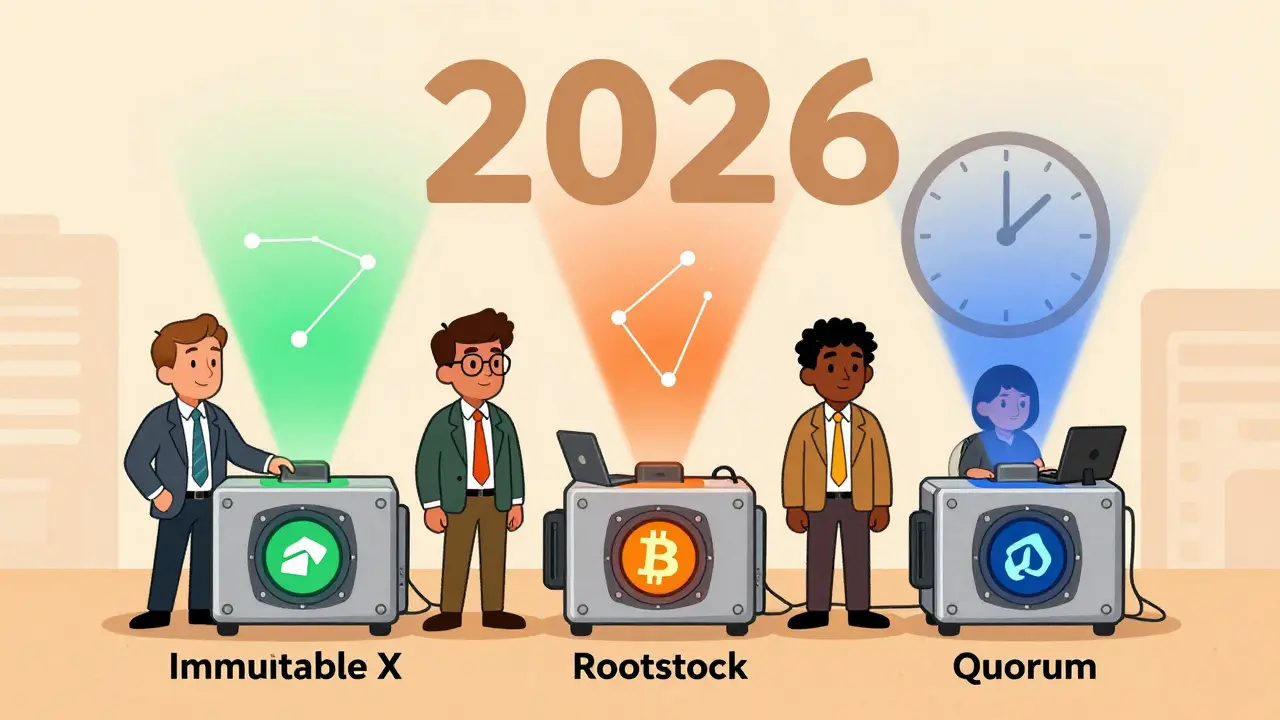
Rootstock: optimized for Bitcoin-based DeFi with 100ms blocks.
Immutable X: built for NFT gaming with zero gas fees for users.
ConsenSys Quorum: designed for enterprise privacy and permissioned access.
Forrester predicts general-purpose sidechains will decline by 60% by 2026. Why? Because they can’t compete. A gaming chain doesn’t need the same security as a bank settlement layer. A supply chain tracker doesn’t need to support DeFi protocols. The best sidechains will be the ones built for one thing-and built well.
Developer Reality: It’s Still Hard to Build On
Even with all the progress, building on sidechains isn’t easy. Consensys’ 2023 survey found developers spend an average of 178 hours migrating smart contracts from Ethereum to a sidechain. That’s over four weeks of full-time work. Documentation varies wildly-Polygon scores 4.5/5 on developer satisfaction, but Bitcoin sidechains average 3.2/5 because of complex cryptographic requirements.
And the talent gap is real. Sidechain specialists now earn an average of $145,000 a year, according to Glassdoor. Companies aren’t just hiring devs-they’re hiring cryptographers, bridge auditors, and validator economists. The barrier to entry is high, and that’s filtering out the hobbyists. Only serious teams are staying in the game.
What to Expect in the Next Two Years
By 2026, the sidechain landscape will look very different:
- Most new sidechains will be application-specific, not general-purpose.
- Hybrid security models (like fraud proofs or merged consensus) will be standard, not optional.
- Bridge failures will drop as standardized security protocols emerge.
- Enterprise use cases will outnumber retail ones.
- Sidechains will handle over 30% of all blockchain transactions, up from 24% in late 2023.
The sidechain isn’t dead. It’s evolving. It’s no longer the flashy alternative to Ethereum. It’s the quiet engine behind the apps you use every day-gaming, finance, logistics, identity. And in 2025, that’s where the real value is.
Are sidechains safer than Layer 2 solutions like rollups?
No, sidechains are generally less secure. Rollups inherit the security of Ethereum’s mainnet, meaning they’re protected by its 800,000+ validators. Sidechains typically use their own smaller validator sets-sometimes fewer than 100 nodes-making them more vulnerable to attacks. While sidechains offer more flexibility and lower costs, they sacrifice security. For high-value transactions, rollups are still the safer choice.
Why do sidechains have slower cross-chain transfers than expected?
Sidechain transfers require a waiting period to ensure security. On Bitcoin sidechains, this can take 4-12 hours because they need 100-200 block confirmations to prevent double-spending. Ethereum-compatible sidechains are faster, usually 7-15 minutes, but still slower than direct transfers on the mainnet. This delay is intentional-it’s a trade-off for interoperability without compromising safety. Users often find it frustrating, but it’s a necessary safeguard.
Can I use sidechains for DeFi on Bitcoin?
Yes, but only through specialized sidechains like Rootstock. Bitcoin’s main chain doesn’t support smart contracts, so DeFi apps can’t run directly on it. Rootstock is a Bitcoin sidechain that adds EVM compatibility, allowing users to run DeFi protocols like lending and trading using Bitcoin as collateral. It’s not as liquid or popular as Ethereum DeFi, but it’s the only viable way to bring DeFi to Bitcoin without changing Bitcoin itself.
What’s the difference between Polygon and a regular sidechain?
Polygon started as a standard Ethereum sidechain but has evolved into a multi-chain ecosystem. Its PoS chain is still a sidechain, but its newer AggLayer aims to connect hundreds of sidechains with shared security. This makes Polygon less like a single sidechain and more like a security layer for many chains. Other sidechains, like Liquid Network or Immutable X, are standalone and focused on one use case. Polygon is becoming a platform for sidechains, not just one sidechain itself.
Are sidechains regulated by the SEC?
The SEC hasn’t created specific rules for sidechains, but it has said sidechain tokens may be considered securities depending on their economic function. If a token is sold as an investment with the expectation of profit from others’ efforts, it’s likely a security-even if it’s issued on a sidechain. This means projects using sidechains for fundraising must comply with securities laws, just like on Ethereum. Many companies are now delaying sidechain launches until legal clarity improves.
Will sidechains still be relevant if Ethereum fully adopts rollups?
Yes, but their role will change. Ethereum’s rollup-centric future won’t replace sidechains-it will redefine them. Sidechains won’t be the main scaling solution anymore, but they’ll become specialized application chains for gaming, enterprise systems, or Bitcoin DeFi. Vitalik Buterin calls them “complementary components,” not replacements. If you need a blockchain that runs differently from Ethereum, you’ll still need a sidechain. Rollups handle scaling. Sidechains handle specialization.
Final Thoughts: Sidechains Are the Quiet Workhorses of Web3
Sidechains aren’t flashy. They don’t trend on Twitter. But they’re where the real work happens. They let developers build without being blocked by Ethereum’s fees. They let companies transact privately. They let Bitcoin users access DeFi. They’re the unsung heroes of blockchain’s expansion.
The future isn’t about one chain to rule them all. It’s about many chains, each built for a purpose. Sidechains are the tool that makes that possible. And in 2025, they’re more important than ever.
7 Comments
Sidechains are just the internet’s back alleys where the real stuff happens nobody’s watching
It’s fascinating how we’ve built an entire parallel economy on the assumption that people will trade security for convenience-like choosing a fast lane on a highway that doesn’t have guardrails-and then acting surprised when the accidents happen. The real question isn’t whether sidechains are scalable, it’s whether we’ve collectively decided that speed and cost should outweigh systemic trust. We’re not just engineering blockchains anymore; we’re engineering human behavior. And the data shows we’re willing to gamble our assets on validator sets smaller than a Reddit moderation team. That’s not innovation-it’s a philosophical surrender to the myth of efficiency. The moment we stopped treating blockchain as a trust machine and started treating it as a transaction processor, we lost the soul of the thing. Maybe that’s progress. Or maybe it’s just the quiet death of decentralization dressed up in gas fees of $0.0002.
I think the hybrid models are where it’s really at-fraud proofs on sidechains feel like the best of both worlds. You get the flexibility to design for gaming or supply chains without sacrificing the ability to challenge bad state transitions. It’s not perfect, but it’s the first time I’ve seen sidechain devs actually listening to the security concerns instead of just ignoring them. The fact that Berkeley’s predicting 65% adoption by 2025 tells me this isn’t hype-it’s evolution. We’re not replacing rollups. We’re outgrowing the binary of ‘secure vs fast’ and building something that can hold both truths at once.
I’ve been working with enterprise sidechains for a year now, and honestly, the biggest barrier isn’t tech-it’s paperwork. Every single client wants to use a sidechain for internal payments, but then they spend six weeks in legal meetings just to confirm the token isn’t a security. And don’t get me started on the audit costs-some firms charge more to review a sidechain bridge than they do to build the whole thing. But here’s the thing: once you get past all that, the efficiency is insane. A Fortune 500 logistics company I worked with cut their reconciliation time from 72 hours to 90 minutes. That’s not a minor win. That’s life-changing for their ops team. Sidechains aren’t for crypto bros anymore. They’re for the people who actually run the world-and they’re quietly changing how business gets done.
Can we just take a second to appreciate how UNBELIEVABLE it is that we’re now using blockchains to track pallets of coffee beans??!! And it works??!! I mean, like, a decade ago, this would’ve sounded like sci-fi fanfiction… and now? Companies are signing contracts, auditors are nodding, and CFOs are smiling… and it’s all because of sidechains… which, by the way, are not even the flashy part… they’re just… quietly… doing the work… and nobody’s even noticing… except… us… right here… right now…
For anyone new to this-sidechains aren’t magic. They’re tools. Like a hammer. You wouldn’t use a hammer to drill a hole, and you shouldn’t use a sidechain when you need Bitcoin-level security. But if you’re building a game where players mint 10,000 NFTs an hour? Perfect tool. If you’re a bank moving money between branches? Perfect tool. The key is matching the tool to the job. No need to compare them to rollups like they’re rivals. They’re just different parts of the same workshop.
I read the part about bridge hacks and 72% of attacks targeting them… and I just… paused. It’s not the tech that’s broken. It’s the assumption that users understand risk. Most people don’t know what a bridge is. They just see ‘transfer ETH to Polygon’ and click. We’ve built this entire ecosystem on layers of abstraction that hide danger behind simple buttons. And now we’re surprised when things go wrong? Maybe the real innovation isn’t in the consensus mechanism… but in the UI. We need warning labels on bridges. Like cigarette packs. ‘Using this bridge may result in total loss of funds.’