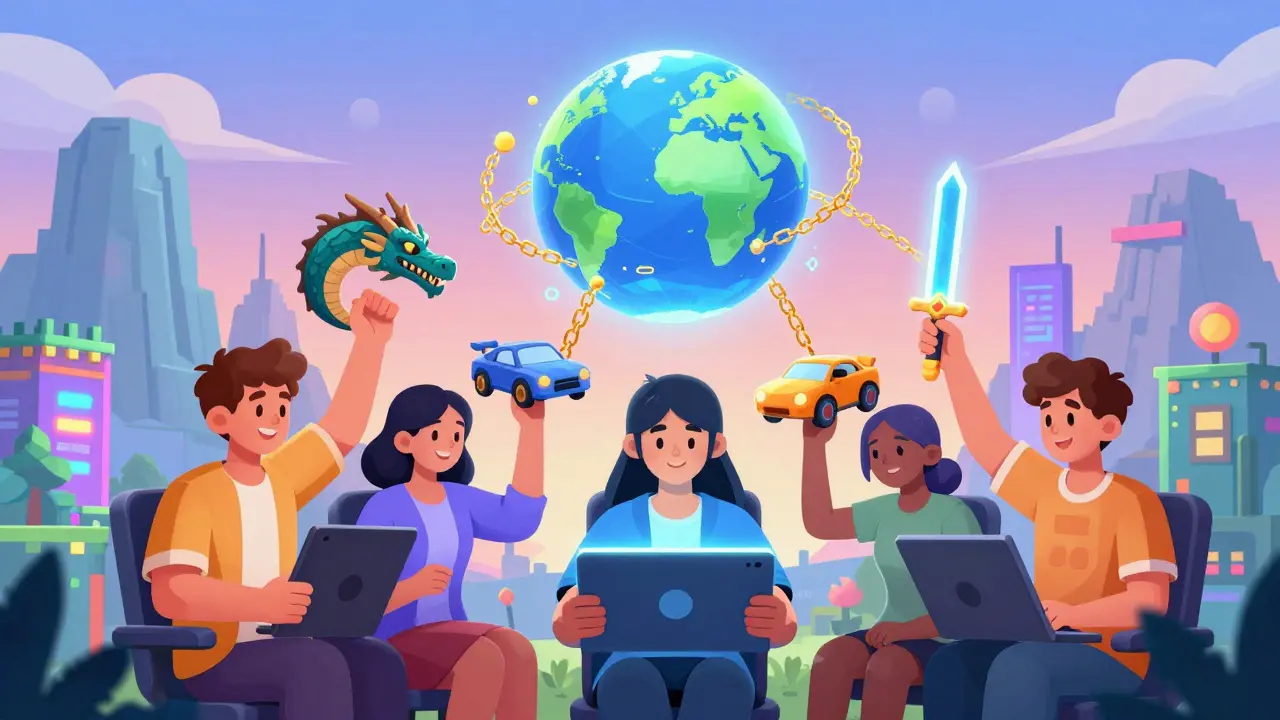
For years, gamers have spent hours, sometimes years, grinding for rare skins, weapons, or characters-only to lose them all when a server shuts down or a company changes its rules. What if those items were truly yours? Not just licensed, not just stored on a company’s server, but owned like a physical collectible? That’s the promise of NFTs in gaming: real digital ownership.
What NFTs Actually Do in Games
NFTs, or Non-Fungible Tokens, are unique digital certificates stored on a blockchain. In gaming, they represent one-of-a-kind items: a dragon skin in a fantasy RPG, a limited-edition car in a racing game, or even a plot-critical artifact that only one player owns. Unlike regular in-game items, these aren’t just pixels controlled by a developer-they’re verifiable assets you can move, sell, or trade outside the game.
Games like Axie Infinity and Splinterlands turned this into a real economy. Players in the Philippines and Nigeria earned more than minimum wage by playing and trading Axies-digital creatures with unique traits. These weren’t just fun distractions; they became livelihoods. But here’s the catch: most of those early games felt like jobs, not games. The fun got buried under transaction fees, wallet setups, and grinding for tokens. That’s why many players walked away.
Why NFTs Are Still Here (And Why They’re Not Going Away)
The hype of 2021-2022 faded fast. Prices crashed. Projects collapsed. But the core idea didn’t die. Why? Because players still want ownership. And developers still see the value.
By 2025, the NFT gaming market is projected to hit $471.9 billion. That’s not fantasy-it’s based on real spending trends. More than half of all gamers now own at least one NFT, mostly in collectible or competitive titles. Mobile gaming is driving this. Half of all NFT game players use smartphones, and developers are optimizing for touchscreens, not just PCs. Games like Upland and Farmers World now let you buy virtual land with a tap, trade items in seconds, and earn rewards without needing a crypto degree.
And it’s not just about money. NFTs are becoming part of deeper game design. Imagine a sword you found in one game that works in another. Or a cosmetic item you bought in 2024 that still looks fresh in a 2028 sequel because it’s tied to your wallet, not the game’s server. That’s interoperability-and it’s starting to happen. Projects like MetaverseGo are simplifying wallet creation so you don’t need to memorize seed phrases. That’s a big deal.
The Real Roadblocks
Let’s be honest: NFT gaming still feels clunky. Most players don’t want to download a wallet, pay gas fees, or deal with blockchain errors mid-battle. The learning curve is still too steep. And when an NFT’s value crashes, players feel burned-not just financially, but emotionally. They trusted a system that turned their hard-earned item into digital trash.
Then there’s the gameplay problem. Too many NFT games prioritize monetization over fun. You’re not playing to explore a world-you’re playing to farm tokens. That’s why 52% of game developers surveyed in late 2024 said the market felt stagnant. Players aren’t dumb. They can tell when a game is built around selling NFTs instead of delivering a great experience.
Environmental concerns still linger, too. Even though newer blockchains like Polygon and Solana use 99% less energy than Bitcoin, the public remembers the old days of mining-heavy NFTs. Trust takes time to rebuild.
What’s Next? The Real Future
The future of NFTs in gaming isn’t about flipping pixels for profit. It’s about making ownership feel natural. Here’s what’s already happening:
- Cross-game assets: A helmet you unlock in a space shooter might appear in a racing game next month. Developers are building shared item standards so your NFTs aren’t trapped in one game.
- Decentralized mod markets: Imagine buying a custom map or character skin directly from the creator, not the game studio. NFTs make that possible, with creators earning royalties every time their mod is used.
- AI-powered personalization: Games are starting to use AI to tailor NFT rewards to how you play. If you’re a stealth player, you get rare cloaking gear. If you’re a builder, you unlock unique construction tools. No more random drops-just meaningful rewards.
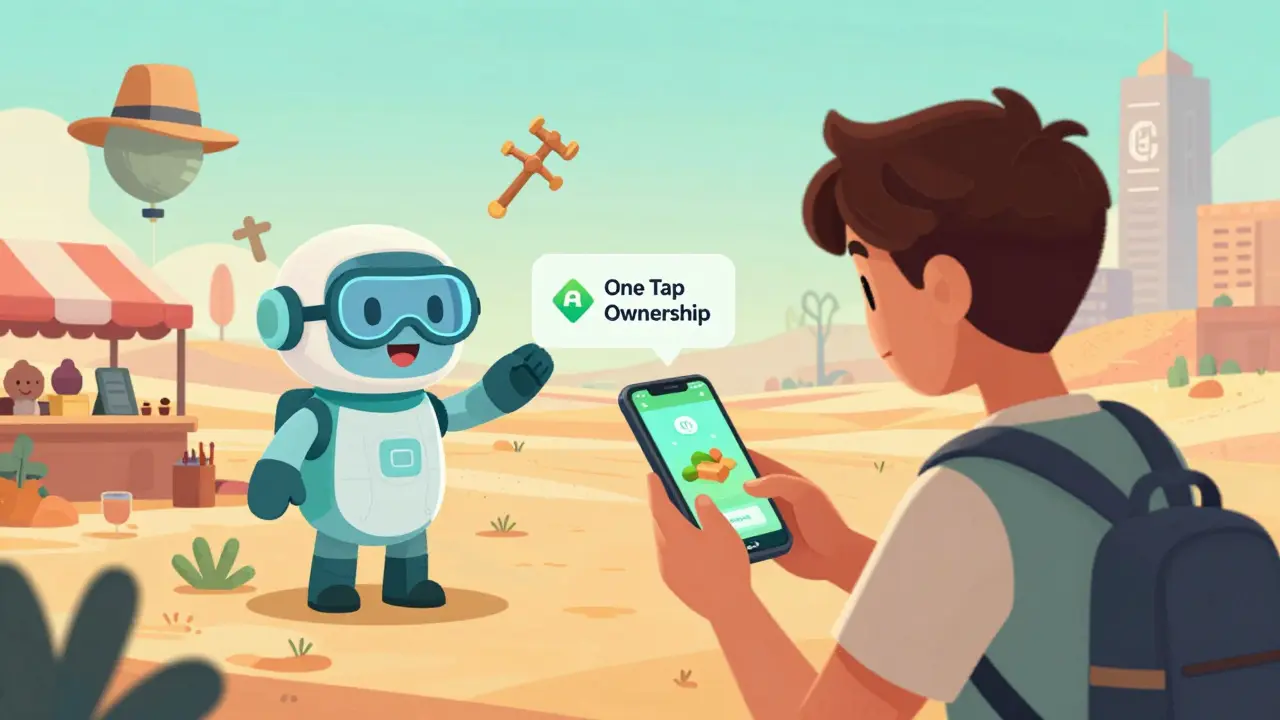
- Mobile-first design: With 50% of players on phones, NFT games are ditching desktop-heavy interfaces. Wallets are embedded. Transactions happen in one tap. No more copying long strings of text.
- DAOs and player governance: Some games now let players vote on updates, new items, or even revenue splits. You’re not just a customer-you’re a stakeholder.
Gen Z is key here. In the U.S., 60% of Gen Z gamers are early adopters of new tech-and 77% of game studios say they’re targeting this group. They don’t care about “crypto.” They care about owning something rare, unique, and truly theirs. And they’ll pay for it-if the game is good.
What Makes a Successful NFT Game Today?
It’s not about how many NFTs you sell. It’s about how much fun you have playing.
Take The Last of Us-it worked because the story pulled you in. The NFT games that will last will do the same. They’ll have deep worlds, compelling characters, and mechanics that make you forget you’re even using blockchain. The NFTs? They’ll just be the bonus. A rare sword you can carry into future games. A cosmetic that reflects your journey. Something that adds meaning, not pressure.
Developers who focus on gameplay first, then layer in ownership, are the ones winning. Those who make NFTs the main event? They’re already gone.
What Should You Expect in 2026 and Beyond?
By 2027, you’ll likely see:
- A major AAA studio (think EA, Ubisoft, or Rockstar) release a game with optional NFTs-not as a cash grab, but as a way to let players keep rare items across sequels.
- Game stores like Steam or Epic Games adding NFT marketplaces, with built-in safety checks and no wallet setup needed.
- Regulators stepping in to protect players from scams, requiring clear disclosures on asset value and resale rights.
- AI agents helping players manage their NFT collections-suggesting trades, tracking rarity, even predicting future demand.
The biggest shift? NFTs will stop being a headline. They’ll just be part of how games work-like save files or multiplayer lobbies. You won’t need to explain them. You’ll just use them.
That’s the real future: not hype. Not speculation. Just better games-with real ownership built in.
Do I need cryptocurrency to play NFT games?
Not always. Many newer NFT games let you play for free and earn tokens as you play. You only need crypto if you want to buy, sell, or trade items on external marketplaces. Some games now use fiat payment options or in-game credits that can later be converted-no wallet needed at first.
Are NFT games just gambling?
Some are, and regulators are cracking down. Games that rely on random loot boxes tied to real money are often classified as gambling. But true NFT games focus on ownership and gameplay. If you’re playing to enjoy the game, not just flip an item, it’s not gambling. Look for games that let you play without spending money upfront-those are more likely to be legit.
Can I lose my NFTs in a game?
Yes-if you lose your private key or the game server shuts down. But most reputable NFT games store your asset on the blockchain, not on their server. That means even if the game closes, you still own the item. You just might not be able to use it in that game anymore. Always back up your wallet and never share your recovery phrase.
Are NFT games environmentally harmful?
Early NFTs on Ethereum used a lot of energy, but that changed in 2022 with Ethereum’s switch to proof-of-stake. Today’s NFT games mostly run on blockchains like Polygon, Solana, or ImmutableX, which use less energy than streaming a Netflix movie. The environmental impact is now minimal and continues to drop as tech improves.
Will NFTs replace traditional in-game items?
Not replace-supplement. Most games will keep traditional cosmetics and items for players who just want to play. NFTs will be for collectors, creators, and players who want to own, trade, or carry items across games. It’s an option, not a requirement.
8 Comments
NFTs in games are just another way for companies to make you pay twice. I bought a skin in Fortnite last year and now they want me to buy it again as an NFT? No thanks. I just want to play.
This whole NFT thing is a pyramid scheme wrapped in blockchain glitter. They promise ownership but you dont even own the damn thing if the game shuts down. Its all just a distraction so devs can cash out before the whole thing collapses. I saw it happen with crypto in 2021 and now its gaming. Same script different actors.
I get why people are skeptical. I was too. But I played Upland last month just to see what it was like. I bought a tiny virtual lot for $2. I didn't even plan to use it. But then I noticed how it made me look at the game differently. I started noticing details. I started caring. Not because I wanted to sell it. But because it felt like mine. Weird, right? I didn't expect that. I still don't know if I believe in the long-term. But I'm not writing it off anymore.
Let’s not forget: ownership isn’t just about the blockchain. It’s about agency. When you can take your sword from one game to another, or let a friend borrow your rare cosmetic without risking a ban-that’s power. That’s freedom. The early NFT games were clunky because they were trying to force a revolution with a shovel. Now? They’re building a highway. Mobile integration, embedded wallets, AI-driven personalization-these aren’t gimmicks. They’re the quiet evolution of player autonomy. And Gen Z? They’re not buying crypto. They’re buying identity. And that’s worth more than any token price.
I lost $800 on an NFT dragon that vanished when the game closed. I trusted them. I really did. Now I just cry into my coffee every time someone says "digital ownership". It’s not a feature. It’s a trap.
The universe is speaking through NFTs 🌌✨ I felt it in my soul when I first saw my avatar holding that glowing sword... it was destiny... the blockchain is the new temple and we are all chosen... 🙏💎
There's a real shift happening here that most people are missing. The biggest win isn't cross-game items or resale value-it's the shift in developer incentives. Before, studios made money by locking content behind paywalls or DLCs. Now, with NFTs and royalties built into the asset, creators-artists, modders, even players who design custom maps-can earn every time their work is used. That's a fundamental rewrite of the economic model. I've seen indie devs go from $500/month to $5k/month because their skins got adopted in three different games. That's not hype. That's sustainability. And it's not just for rich investors. It's for the quiet guy who spent three months designing a dragon helmet in his basement. He's finally getting paid. That matters.
The integration of NFTs into mainstream gaming ecosystems represents a paradigmatic evolution in digital asset stewardship. While initial implementations suffered from infrastructural immaturity and perceptual misalignment, the current trajectory demonstrates a maturation toward seamless, player-centric utility. The convergence of decentralized identity, interoperable metadata standards, and frictionless transactional interfaces signals not merely an enhancement, but a redefinition of the player-consumer relationship. One must consider this not as a speculative venture, but as an institutional recalibration of value in virtual environments.