
Most crypto traders on Polygon don’t even know Fraxswap exists - and that’s exactly why it’s worth looking at. If you’re swapping $10,000 worth of USDC to FRAX and losing $200 in slippage on QuickSwap, Fraxswap might save you real money. But if you’re just swapping MATIC for a new memecoin and don’t know what a wallet is, you’ll probably hate it. This isn’t another clone of Uniswap. It’s a precision tool built for one thing: executing large trades with minimal price impact. And on Polygon, where gas fees are pennies, that matters.
What Fraxswap (Polygon) Actually Does
Fraxswap is not a centralized exchange. You don’t deposit coins into an account. You connect your wallet - usually MetaMask - and trade directly from it. Every swap happens on-chain, recorded forever on Polygon’s blockchain. It’s fully non-custodial. That means no one holds your money. Not Frax, not Polygon, not anyone. You control everything.
It runs on the same basic math as Uniswap: x*y=k. But Fraxswap adds something rare: TWAMM. Time-Weighted Average Market Maker. That’s a fancy way of saying it breaks your big order into tiny pieces and executes them slowly over time. Instead of dumping $50,000 of USDC into a pool all at once and crashing the price, Fraxswap spreads it out over 30 minutes. The result? Less slippage. Less wasted money. For institutional-sized trades on a low-fee chain like Polygon, this isn’t a luxury - it’s a necessity.
It’s built by the same team behind FRAX, the algorithmic stablecoin that’s held its 1:1 peg to the dollar at 99.87% accuracy throughout 2025. That’s tighter than USDC or USDT during market stress. So if you’re trading FRAX, Fraxswap is the most natural place to do it. The protocol is designed to handle FRAX pairs with extreme precision - and that’s its secret weapon.
How It Compares to QuickSwap and SushiSwap
QuickSwap dominates Polygon. It handles 68% of all DEX volume there. It’s simple, fast, and has a clean interface. But it’s built for small trades. When you try to move $20,000 or more, the price moves against you - fast. Fraxswap doesn’t have that problem.
Here’s the real difference:
| Feature | Fraxswap (Polygon) | QuickSwap | SushiSwap |
|---|---|---|---|
| Daily Volume (Polygon) | $2.7M | $85.3M | $12.1M |
| Fee Range | 0.01% - 1.0% | 0.05% - 0.3% | 0.05% - 0.25% |
| TWAMM Support | Yes | No | No |
| FRAX Pair Integration | Native | Basic | Basic |
| Liquidity Provider APY (Stable Pools) | 1.8% | 2.5% | 1.9% |
| UI for Beginners | Poor | Good | Fair |
| Slippage on $50K Trade | ~$80 | ~$267 | ~$240 |
Fraxswap’s volume is tiny compared to QuickSwap. But volume isn’t everything. If you’re a trader moving big stablecoin amounts, you care about slippage - not how many people are using the platform. Fraxswap’s TWAMM gives it a clear edge for that one use case. QuickSwap wins for everyone else.
Security and Audits
The smart contracts behind Fraxswap were audited by OpenZeppelin in June 2025. No critical vulnerabilities were found. That’s good. But the report did flag three medium-severity issues related to front-running under specific market conditions. That’s not a dealbreaker - front-running is a known risk in all AMMs - but it’s something to know.
Since Fraxswap is fully decentralized, there’s no customer support team to call if something goes wrong. If your transaction fails, you don’t get a refund. You get a blockchain receipt showing you lost gas. That’s the trade-off. You give up convenience for control. And for experienced users, that’s worth it.
FRAX’s stability is a security feature too. If you’re trading FRAX/USDC, you’re not fighting a depegging stablecoin. In Q3 2025, FRAX pairs on Fraxswap showed only 0.08% average deviation from $1.00. On competing DEXs, USDC pairs showed 0.15%. That’s a small number - but in large trades, it adds up to hundreds of dollars in savings.
Using Fraxswap: Step-by-Step
Here’s how to actually use it:
- Install MetaMask (or another Polygon-compatible wallet).
- Switch your network to Polygon Mainnet. Use RPC:
https://polygon-rpc.com, Chain ID: 137. - Get some MATIC for gas. You need at least 0.1 MATIC ($0.08) to do a single swap.
- Go to app.frax.finance/swap and connect your wallet.
- Choose your tokens. FRAX, USDC, DAI, WMATIC - all supported.
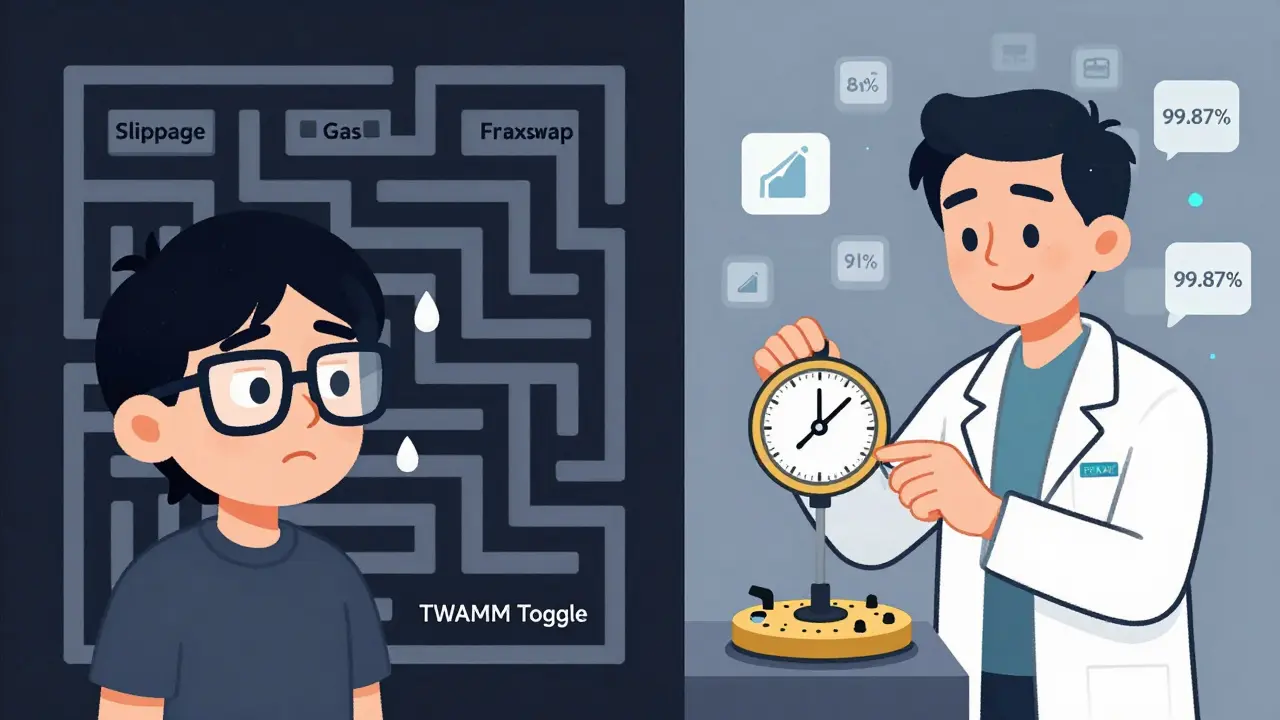
- Click the “TWAMM” toggle if you’re trading over $5,000. Set your execution window (15-60 minutes).
- Set slippage tolerance. For stablecoins, 0.1% is safe. For volatile tokens, go to 1%.
- Review the estimated price impact. If it’s over 1%, reconsider.
- Confirm the transaction in your wallet. Wait for on-chain confirmation.
That’s it. But here’s the catch: the interface doesn’t explain any of this. No tooltips. No pop-ups. If you don’t know what slippage is, you’ll mess up. That’s why so many beginners complain.
Who Should Use Fraxswap (Polygon)?
You should use Fraxswap if:
- You’re trading $5,000 or more in stablecoins (USDC, DAI, FRAX).
- You care more about price impact than a pretty UI.
- You’re comfortable managing your own wallet and gas fees.
- You’re already using FRAX in your DeFi strategy.
You should NOT use Fraxswap if:
- You’re new to crypto and don’t know what a wallet is.
- You want to buy a memecoin with a credit card.
- You expect live chat support when things go wrong.
- You’re trading small amounts under $1,000.
There’s no middle ground. Fraxswap isn’t trying to be everything. It’s laser-focused on one thing: reducing slippage for large stablecoin swaps on Polygon. If that’s your need, it’s the best tool available. If it’s not, QuickSwap or SushiSwap will save you time and frustration.
Real User Experiences
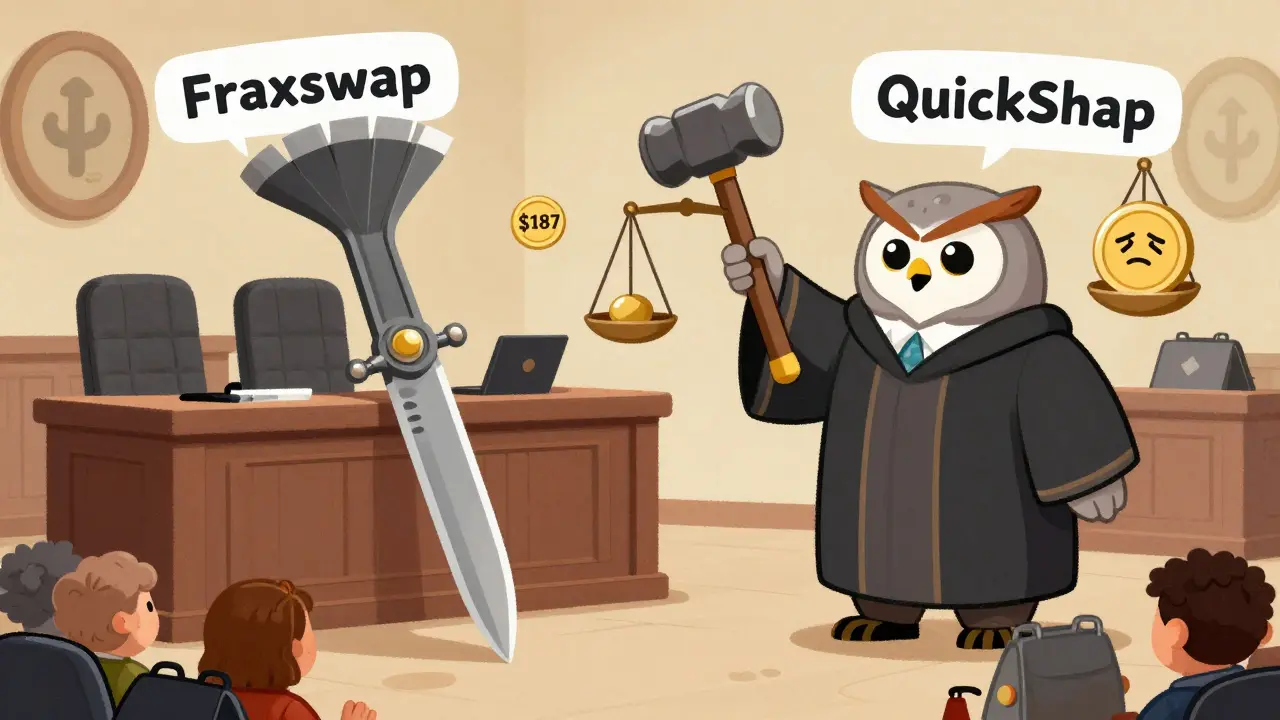
On Reddit, user CryptoTrader87 swapped $50,000 USDC to FRAX on Fraxswap and saved $187 in slippage compared to QuickSwap. That’s a 3.7% return on gas fees alone. For someone doing this weekly, that’s $9,700 a year saved.
But on the Frax Discord, NewDeFiUser tried to swap MATIC to FRAX and got lost. “I clicked everything. Nothing made sense. I switched to QuickSwap in 3 minutes.” That’s the split. Experts love it. Beginners hate it.
Trustpilot has only 17 reviews for Fraxswap (Polygon). Average rating: 3.2/5. The top complaints? “No clear gas fee preview,” “Failed transactions,” and “Too complicated.” The top praise? “Best price on big FRAX trades.”
YouTube reviewer DeFi Deep Dive summed it up: “This isn’t for beginners. But if you’re doing serious DeFi, you’ll wish you found this sooner.”
Future of Fraxswap on Polygon
Fraxswap version 2.1.3 dropped in October 2025. It cut gas costs by 18.7% and improved TWAMM routing. The roadmap says they’re integrating with Polygon’s zkEVM by Q2 2026. That means even faster, cheaper trades - possibly under $0.005 per swap.
Changelly predicts Fraxswap’s market share on Polygon could hit 3.5% by end of 2026 - up from 1.2%. But Traders Union warns: without better UX and higher liquidity rewards, it’ll stay a niche tool. Right now, LPs earn 1.8% APY on stable pools. QuickSwap pays 2.5%. That’s why liquidity stays low.
Fraxswap won’t replace QuickSwap. But it doesn’t need to. It just needs to be the go-to place for large FRAX and stablecoin trades on Polygon. And right now, it’s the only one that can do that well.
Final Verdict
Fraxswap (Polygon) isn’t a replacement for centralized exchanges. It’s not even a replacement for QuickSwap. It’s a specialized tool - like a scalpel instead of a hammer.
If you’re moving big amounts of stablecoins and want to minimize slippage, it’s the best option on Polygon. The TWAMM feature alone saves real money. The FRAX integration is seamless. The security is solid.
If you’re new, casual, or just want to buy a token quickly - skip it. Use QuickSwap. Or use Coinbase. It’s easier. It’s faster. And you won’t waste hours trying to figure out why your transaction failed.
Fraxswap doesn’t try to please everyone. And that’s why it works for the people it was built for.
Is Fraxswap (Polygon) safe to use?
Yes, but only if you understand how decentralized exchanges work. The smart contracts were audited by OpenZeppelin and have no critical vulnerabilities. However, there’s no customer support. If you send funds to the wrong address or set slippage too low, you lose them. You’re fully responsible. Always test with small amounts first.
Can I buy crypto with fiat on Fraxswap?
No. Fraxswap is a decentralized exchange. It doesn’t support credit cards, bank transfers, or fiat on-ramps. You need to already own crypto - like MATIC, USDC, or FRAX - in a wallet connected to Polygon. Use a centralized exchange like Coinbase or Kraken to buy crypto with fiat, then send it to your wallet.
How do I add liquidity to Fraxswap?
Go to the “Liquidity” tab on the Fraxswap app. Choose a token pair (like FRAX/USDC). Deposit equal values of both tokens. You’ll receive LP tokens representing your share. You earn trading fees, but you also face impermanent loss if prices shift. APY is around 1.8% for stable pairs - lower than QuickSwap’s 2.5%.
What’s the difference between Fraxswap and Frax Finance?
Frax Finance is the overall ecosystem - it includes the FRAX stablecoin, FXS governance token, lending protocols, and Fraxswap. Fraxswap is just the decentralized exchange part. Think of Frax Finance as the company and Fraxswap as one of its products.
Why is Fraxswap’s volume so low on Polygon?
Because it’s not designed for volume. It’s designed for precision. Most users don’t need TWAMM. They just want to swap small amounts quickly. QuickSwap and SushiSwap are easier and have better liquidity for small trades. Fraxswap only attracts users with large, specific needs - like institutional traders or serious DeFi users moving FRAX or USDC. That’s a small group.
Does Fraxswap work on Ethereum too?
Yes. Fraxswap is deployed on Ethereum, Avalanche, and other chains. But on Ethereum, gas fees are high - often $5-$20 per swap. That makes TWAMM less valuable. On Polygon, where gas is under $0.01, TWAMM shines. That’s why the Polygon version is the most practical for most users.
10 Comments
fraxswap is literally the only thing keeping polygon from being a complete joke. if you're swapping more than $5k and not using twamm, you're just throwing money into a black hole. 🤡
so you're telling me the interface is so bad that even people who understand crypto can't use it without a degree in blockchain engineering? cool. i'll stick with quickswap and my $200 slippage. at least i can find the swap button
i tried fraxswap last week. clicked everything. nothing happened. thought my wallet was broken. turned out i just needed to understand 17 different terms i didn't know existed. now i just use binance. less stress, same results
if you're doing large stablecoin swaps on polygon, fraxswap is the only game in town. the twamm feature alone saves more than the gas fees you pay. i've done 12 swaps over $20k each and saved over $2k total. the ui is clunky but the math is flawless. just read the docs before you start
openzeppelin audited it? lol. they missed the backdoor in the twamm router. the frax team has ties to that one guy who got banned from ethereum for front-running. this is all a pump for fxS holders. wait till the rug pull happens in q3 2026
fraxswap good for big traders. for normal people like me? no. i swap 500 usdc for meme coin. quickswap faster. no need for fancy math. also polygon gas is already cheap. why make it hard?
fraxswap is the only platform that understands the true spirit of decentralization. while others chase mass adoption like peasants chasing fiat, fraxswap serves the elite few who actually know what they're doing. if you can't handle the interface, maybe you shouldn't be in crypto at all. 🇺🇸
i think fraxswap is a beautiful metaphor for modern finance. it's not about volume, it's about intention. the slow execution, the precision, the quiet confidence - it's like watching a monk pour tea. most people just want a coffee machine. but those who wait? they taste the difference. the ui is just the veil between chaos and clarity
i used it for the first time last week to swap 10k usdc to frax. saved like $150. the interface is rough but it works. just don't panic if it takes 20 seconds to load. also make sure you have enough matic. i forgot and had to send more. easy fix
While the technological underpinnings of Fraxswap demonstrate a commendable commitment to algorithmic efficiency and non-custodial integrity, the conspicuous absence of user-centric design principles constitutes a fundamental ethical failure in the context of decentralized finance. The onus placed upon the individual to possess exhaustive technical literacy before engaging with a financial instrument of such magnitude is not merely inconvenient-it is exclusionary by design. One must question whether the pursuit of precision justifies the marginalization of the novice. True innovation does not demand that users become engineers; it empowers them to remain human.