
When you hear "FraxSwap on Optimism," you might picture a fast, cheap, and powerful decentralized exchange. But here’s the reality: as of March 2026, FraxSwap V1 on Optimism has a 24-hour trading volume of just $3,510.13. That’s less than what some individual traders move in a single day on bigger platforms. It ranks 370th among all crypto exchanges worldwide. If you’re looking for a go-to DEX on Optimism, FraxSwap isn’t the one most people are using.
What Is FraxSwap (Optimism)?
FraxSwap V1 is a decentralized exchange (DEX) built on the Optimism Layer 2 network. Unlike centralized exchanges like Binance or Coinbase, it doesn’t hold your funds. You trade directly from your wallet-no KYC, no paperwork. It’s part of the broader DeFi ecosystem that lets you swap tokens without intermediaries.
But here’s the catch: FraxSwap isn’t a standalone project. It’s tied to the Frax Finance ecosystem, which focuses on algorithmic stablecoins like FRAX and FXS. FraxSwap was designed to help users trade these tokens efficiently. But it never grew beyond that niche. Most traders don’t need FraxSwap to swap FRAX or FXS-Uniswap or Velodrome do it better, with deeper liquidity and lower slippage.
Why Optimism? The Layer 2 Advantage
Optimism isn’t just another blockchain. It’s a Layer 2 rollup that sits on top of Ethereum. That means it inherits Ethereum’s security while cutting costs and speeding up transactions. Gas fees on Optimism are over 90% cheaper than on Ethereum mainnet. A swap that costs $5 on Ethereum might cost $0.05 here.
That’s why DeFi projects like Uniswap V3 and Velodrome Finance V2 moved to Optimism. They needed scale without drowning in fees. But not every DEX that moved there stuck around. FraxSwap did, but it never attracted enough users to make liquidity stick. You can’t have a good exchange without deep pools of trading pairs-and FraxSwap’s pools are thin.
How FraxSwap Compares to Top Optimism DEXs
Let’s look at the real players on Optimism right now:
| DEX | 24-Hour Volume | Trading Pairs | Liquidity Depth | Key Features |
|---|---|---|---|---|
| Uniswap V3 (Optimism) A leading decentralized exchange on Optimism offering concentrated liquidity and TWAP price oracles | $7,107,585 | 181 | Very High | Concentrated liquidity, multiple fee tiers, built-in TWAP oracles, 64 supported tokens |
| Velodrome Finance V2 (Optimism) A high-liquidity DEX with a ve-token model that rewards long-term liquidity providers and voters | $668,487 | 142 | High | veVELO token system, strong governance, high APR for LPs, optimized for stablecoin pairs |
| FraxSwap V1 (Optimism) A niche DEX focused on FRAX and FXS token swaps with minimal liquidity and trading activity | $3,510.13 | 12 | Very Low | Only supports FRAX, FXS, and a few other Frax-related tokens; no advanced features |
Uniswap V3 handles over 2,000 times more volume than FraxSwap. Velodrome is over 190 times bigger. FraxSwap’s 12 trading pairs are mostly just FRAX/ETH, FRAX/USDC, and FXS/ETH. If you’re not specifically trading Frax tokens, you won’t find what you need here.
Why FraxSwap Struggles
There are three big reasons FraxSwap isn’t growing:
- Lack of incentives: Velodrome rewards liquidity providers with veVELO tokens that boost rewards and voting power. Uniswap lets you choose fee tiers to match your risk. FraxSwap offers nothing extra-no token rewards, no governance hooks, no unique features.
- Minimal user base: Most traders who use Optimism already have wallets connected to Uniswap or Velodrome. There’s no reason to switch to FraxSwap unless you’re forced to.
- Weak marketing: FraxSwap doesn’t run campaigns, partner with wallets, or list on DeFi dashboards like DeFiLlama. It’s invisible to most users.
It’s not broken-it’s just ignored.
Who Should Use FraxSwap (Optimism)?
Only one group might find it useful: people who hold large amounts of FRAX or FXS and want to trade them without leaving the Frax ecosystem. If you’re a core Frax Finance user, maybe you trust FraxSwap more than a random DEX. But even then, you’re trading on a platform with almost no liquidity. Slippage could be brutal on larger trades.
For everyone else? Skip it. If you’re new to Optimism, start with Uniswap V3. It’s the default. If you want rewards, try Velodrome. If you’re trading stablecoins, both handle them better than FraxSwap ever could.
The Bigger Picture: Optimism in 2026
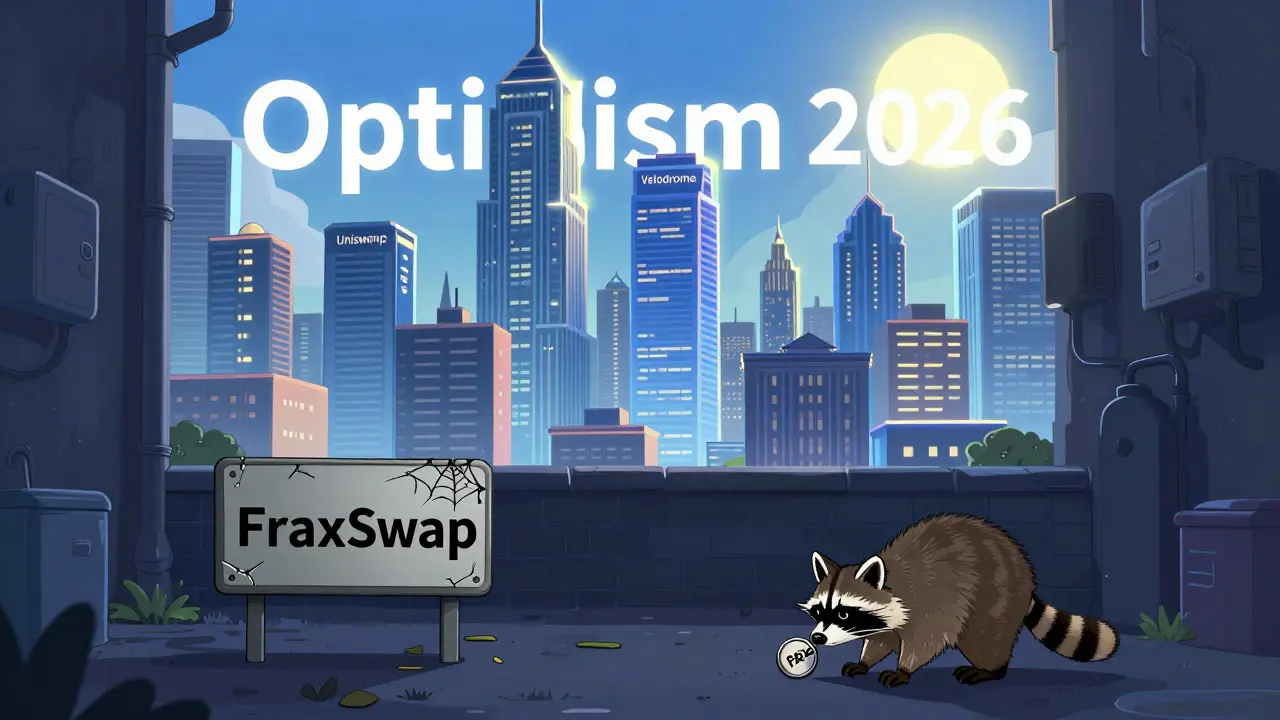
Optimism as a network is alive. Uniswap is testing futarchy-a governance model where proposals are voted on using financial bets. The OP token is trading at $0.12, and the Fear & Greed Index is at 13 (Extreme Fear). That means most people are sitting tight, not trading aggressively.
But even in this bear market, the top DEXs on Optimism are still moving millions daily. FraxSwap isn’t part of that story. It’s a footnote.
Should You Use FraxSwap?
Here’s the bottom line:
- Don’t use it if you’re trading anything other than FRAX or FXS.
- Avoid large trades-liquidity is too thin. You’ll get ripped by slippage.
- Don’t lock up funds expecting rewards. There are none.
- Use Uniswap V3 or Velodrome instead. They’re faster, cheaper, and safer.
If you’re curious, try swapping $10 of FRAX to FXS. See how it feels. But don’t expect miracles. FraxSwap isn’t a hidden gem. It’s a quiet, barely-used tool in a crowded room.
5 Comments
I tested FraxSwap last week with $500 worth of FRAX and FXS. Slippage was insane-like 8% on a simple swap. I switched to Velodrome and did the same trade in half the time with 0.3% slippage. No contest. FraxSwap isn’t broken, it’s just irrelevant now. Why would anyone use it when Uniswap V3 and Velodrome are free, faster, and way deeper?
The data here is spot on. FraxSwap’s 12 trading pairs are basically a shrine to its own ecosystem. If you’re not deep in the Frax rabbit hole, you don’t need this. Uniswap V3 on Optimism has over 180 pairs and 2000x the volume. It’s not even close. People keep asking why FraxSwap exists-this is why: because someone built it and never bothered to ask if anyone actually wanted it.
There’s something almost poetic about FraxSwap-a digital ghost in the machine. It’s not malicious, not broken, not even poorly coded. It’s just… there. Like a forgotten shrine in a bustling city where no one prays anymore. It exists because someone believed in it, and now it lingers as a monument to ambition without audience. We don’t need more tools. We need more reason to use them. FraxSwap has none. And that’s sadder than any failure.
You say ‘skip it’ like it’s obvious. But what about the devs? The builders? The ones who coded this thing hoping it’d matter? This isn’t just about volume-it’s about ethos. FraxSwap is the last holdout of pure DeFi ideology: no incentives, no gimmicks, just raw trust in the token. Maybe that’s why it’s dying. The world doesn’t want purity anymore. It wants rewards. And that’s the real tragedy.
I must express my profound disappointment with the superficiality of this analysis. While the quantitative metrics are… technically accurate, they utterly fail to capture the nuanced philosophical underpinnings of FraxSwap’s existential position within the broader DeFi landscape. One must consider not merely liquidity depth, but the ontological weight of algorithmic stability. To dismiss it as a ‘footnote’ is not merely reductive-it is epistemologically negligent. Furthermore, the author’s casual use of ‘$3,510.13’ as a metric of failure is… aesthetically crude.