
If you run a cryptocurrency exchange in the U.S., you’re not just running a tech business-you’re running a financial institution under federal law. Since 2013, FinCEN has made it clear: any company that moves crypto for others must register as a Money Services Business (MSB). This isn’t optional. It’s the law. And if you skip it, you’re risking fines, criminal charges, or worse-being shut down by federal regulators.
What Exactly Triggers FinCEN Registration?
You don’t need to be a giant exchange like Coinbase to fall under FinCEN’s rules. If your platform does any of these things, you’re already covered:- Buying or selling crypto for fiat currency (USD, EUR, etc.)
- Exchanging one cryptocurrency for another (BTC for ETH, for example)
- Holding user funds as a custodian (even if you don’t trade them)
- Processing payments using crypto as a merchant service
- Operating a wallet that stores crypto on behalf of users
It doesn’t matter if you’re small, new, or think you’re just a "software company." If you’re transmitting value that acts like money, FinCEN sees you as a money transmitter. And under the Bank Secrecy Act (BSA), that means registration is mandatory.
FinCEN Doesn’t Give Licenses-But It Demands Compliance
Here’s the twist: FinCEN doesn’t issue licenses. It doesn’t hand out certificates. Instead, it requires you to register and then keep complying forever. That means:- Submitting Form 103 (Registration of Money Services Business)
- Creating a written Anti-Money Laundering (AML) program
- Training staff on suspicious activity detection
- Keeping records of all transactions for at least five years
- Filing Suspicious Activity Reports (SARs) when something looks off
There’s no one-time approval. Your compliance isn’t checked once a year-it’s monitored continuously. FinCEN can audit you anytime. And if they find gaps? Penalties can hit $500,000 per violation. For a small exchange, that’s bankruptcy.
State Licenses Are Just as Important (and Way More Complicated)
FinCEN is federal. But here’s the catch: every state has its own rules. If you want to operate in New York, you need a BitLicense. In California, you need a Money Transmitter License (MTL). In Texas, it’s a different form, different fee, different process. And if you serve customers in all 50 states? You need 50 licenses.Most small exchanges don’t do this. Instead, they partner with licensed entities-like a bank or a licensed money transmitter-that handles compliance on their behalf. This is called "piggybacking" or using a third-party processor. It’s legal, common, and often cheaper than applying for licenses everywhere. But it means you lose control over your customer data and payment flows. You’re not really running your own exchange-you’re renting someone else’s compliance.

What Happens If You Don’t Register?
The short answer: you’re breaking federal law.In 2023, the U.S. government shut down a crypto exchange based in Florida because it had never registered with FinCEN. The owners were charged with operating an unlicensed money transmitting business. One got 36 months in prison. The other got 24. The company’s assets? Frozen. Their customers? Left with no access to their funds.
FinCEN doesn’t warn you first. They don’t send a polite email saying, "Hey, you forgot to register." They start an investigation. They subpoena bank records. They track your IP addresses. And if they find you’ve been moving crypto without registration? That’s a criminal offense under 18 U.S.C. § 1960.
It’s Not Just FinCEN-You’re Also in the Crosshairs of the SEC and CFTC
If you’re running a crypto exchange, you’re not just dealing with FinCEN. You’re also in the line of fire from other agencies:- SEC: If you list tokens they classify as securities (like many tokens that promise future profits), you’re violating securities law. You need to register as an exchange or broker-dealer.
- CFTC: If you offer derivatives or futures trading on crypto (like Bitcoin options), you need CFTC approval.
- OCC: If your exchange uses a bank for fiat on-ramps, that bank has to report your activity to the OCC.
One company in 2024 got hit with $12 million in fines from FinCEN, SEC, and CFTC-all in the same year-because they didn’t realize they needed approval from all three. You can’t pick and choose which regulator to follow. You have to follow them all.
Compliance Costs Are Higher Than You Think
People think registration is just a form you fill out. It’s not. Here’s what it actually costs:- FinCEN registration fee: $2,500 (one-time)
- State MTLs: $500-$5,000 per state (plus bonds, audits, and legal fees)
- AML software: $10,000-$50,000/year for transaction monitoring tools
- KYC provider: $0.50-$2 per user verification (think ID scans, facial recognition)
- Legal counsel: $200-$500/hour for ongoing compliance advice
- Staff training: Minimum 10-20 hours/year per employee
For a small exchange handling 5,000 users a month? Total annual compliance costs can hit $150,000-$300,000. That’s before marketing, servers, or payroll. Most startups don’t survive long enough to reach this point-because they didn’t budget for it.
What’s Changing in 2026?
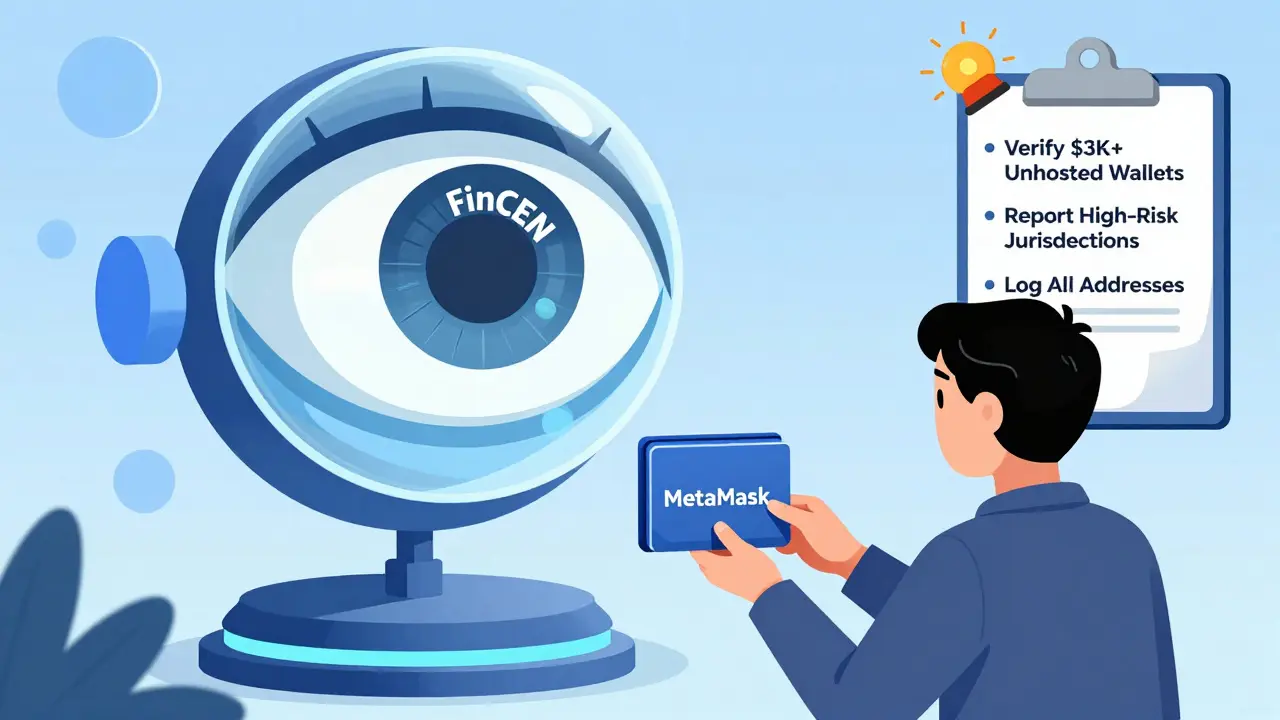
In late 2024, FinCEN proposed a new rule that would expand its reach even further. If it passes, you’ll need to:- Verify identities for any transaction over $3,000 involving unhosted wallets (like MetaMask or Ledger)
- Report transfers to wallets in "high-risk jurisdictions" (like certain countries with weak AML laws)
- Keep logs of all blockchain addresses used in transactions
This isn’t theoretical. It’s coming. And it’s aimed at stopping mixers, privacy coins, and cross-border laundering. If you’re using decentralized wallets to move crypto for users, you’ll need to collect and store wallet addresses-even if you don’t control them.
What Should You Do Right Now?
If you’re running a crypto exchange in the U.S., here’s your checklist:- Confirm if your business model triggers MSB status (if you move crypto for others, you do).
- Register with FinCEN using Form 103. It takes 4-8 weeks to process.
- Build a written AML program with policies, training, and audit trails.
- Choose a KYC/AML provider (like Jumio, Onfido, or Sumsub) and integrate it.
- Apply for state MTLs in every state where you have users-or partner with a licensed entity.
- Set up transaction monitoring software to flag unusual patterns (e.g., rapid transfers, high-volume small deposits).
- Train your team on SAR filing. Know what looks suspicious: rapid deposits followed by withdrawals, fake IDs, or transactions from sanctioned countries.
There’s no shortcut. No loophole. No "we’re just a tech startup" excuse. FinCEN has been clear for over a decade. If you’re moving crypto for others, you’re a financial institution. Act like it.
Do I need to register with FinCEN if I only trade crypto for crypto?
Yes. Even if you don’t touch fiat currency, exchanging one cryptocurrency for another still counts as money transmission under FinCEN’s 2019 guidance. If you’re facilitating trades between users, you’re a Money Services Business and must register.
Can I operate without a state license if I only serve customers in one state?
No. FinCEN registration is federal, but state money transmitter laws still apply. Even if you only serve customers in one state, you still need that state’s Money Transmitter License (MTL). Some states, like New York, require additional licenses like the BitLicense. There are no exceptions.
What if I use a third-party payment processor to handle crypto-to-fiat conversions?
You still need FinCEN registration. Using a third party doesn’t transfer your legal responsibility. You’re still providing money transmission services. The processor may handle the state licensing, but you must register as an MSB and maintain your own AML program. FinCEN holds you accountable, not the processor.
How often do I need to renew my FinCEN registration?
FinCEN registration doesn’t expire, but you must renew your MSB status every two years. Failure to renew means your registration becomes inactive, and you lose legal protection. You also need to update your AML program annually and file SARs whenever suspicious activity is detected.
Are decentralized exchanges (DEXs) required to register with FinCEN?
Currently, fully decentralized exchanges (where no entity controls the code or holds user funds) are not required to register. But if your DEX has any centralized components-like a team that manages fees, customer support, or wallet keys-you may be classified as a money transmitter. FinCEN is actively investigating hybrid DEXs, and enforcement actions are expected in 2026.
8 Comments
Let me get this straight - the government wants us to register like some corporate bank just because we let people swap BTC for ETH? 🤡
They’ve been chasing crypto for 10 years and still can’t tell the difference between a wallet and a bank.
And now they want to track every single unhosted wallet address? Like, my grandma’s Ledger Nano S is suddenly a federal liability?
This isn’t regulation - it’s digital surveillance wrapped in legalese.
They’ll bankrupt every indie dev who just wanted to build something open.
Meanwhile, the big exchanges? They’ve got lawyers on retainer and lobbyists in D.C.
Small operators? We’re the ones getting crushed under paperwork while the real criminals - the hedge funds, the Wall Street crypto shills - laugh all the way to the Fed.
And don’t even get me started on the state licenses. You need 50 different permits just to let someone buy Dogecoin?
It’s not about security. It’s about control.
And if you think this is going to stop money laundering, you’re delusional.
Every time they make a rule, the bad actors just move to Monero or Zcash.
They’re not fighting crime - they’re fighting innovation.
And they’re doing it with taxpayer money.
I’m not anti-regulation. I’m anti-corruption.
And right now, the system is rigged to protect the rich, not protect us.
So yeah, I’ll register - but I’ll do it while screaming into the void.
Okay but like… have y’all even READ the BSA?? 😅
FinCEN isn’t ‘being mean’ - they’re enforcing the law that’s been on the books since 1970.
You can’t just ‘be a tech startup’ and move value like it’s a game of Magic: The Gathering.
AML programs aren’t optional because you’re ‘small’ - they’re mandatory because criminals use crypto to fund terror, drugs, and ransomware.
And yes, if you’re facilitating BTC/ETH swaps, you’re a money transmitter. Period.
Stop pretending this is about ‘freedom’ - it’s about accountability.
Also - third-party processors? Please.
You’re not ‘piggybacking,’ you’re outsourcing liability.
And guess who gets audited when things go sideways? YOU.
Stop being lazy. Register. Train your team. Use KYC.
Or get out. There’s no ‘gray area’ here. It’s black and white.
And if you can’t handle compliance? Then you shouldn’t be in finance. Period. 💅
Regulatory compliance is not a burden - it is the foundational pillar upon which legitimate financial innovation must be built.
Any entity that facilitates the transfer of value, regardless of form or medium, is obligated under U.S. federal law to adhere to the Bank Secrecy Act.
Failure to comply is not an oversight - it is a breach of fiduciary and legal duty.
The costs associated with AML software, KYC integration, and legal counsel are not punitive - they are proportional to the risk profile of the service rendered.
Furthermore, the assertion that small operators are being unfairly targeted is empirically false - enforcement actions are proportionate to activity, not scale.
It is not the intention of FinCEN to stifle innovation - it is to ensure that innovation does not operate outside the rule of law.
Those who choose to operate without registration are not entrepreneurs - they are unlicensed financial actors.
And in a nation that upholds the sanctity of contract and commerce, such actors will be held to account.
There is no moral high ground in noncompliance.
There is only the law - and those who choose to ignore it do so at their own peril.
Register. Comply. Educate. Evolve.
Or step aside.
bro i just wanted to let my friends trade ETH for SOL without turning into a bank
but now i gotta hire a lawyer, buy fancy software, and file forms in 50 states??
what even is this anymore 😭
i’m not a money launderer, i’m just a dude with a website and a coffee habit
and now the feds want my IP logs??
my grandma’s crypto wallet is now a federal case??
can we just… not?
like… i get it, bad actors exist
but we’re not them
we’re just trying to make crypto feel human again
not turn it into a corporate nightmare with 300-page compliance manuals
pls let us be weird.
we’re not the problem.
the problem is the system.
and now i have to pay $150k just to exist.
bye, crypto.
i loved you while it lasted 💔
ok but like… i just wanna say 🙏🙏🙏
FINCEN ISN’T THE ENEMY 😭
THEY’RE JUST DOING THEIR JOB
and if you’re running a platform that moves money - even crypto - you HAVE to follow the rules
it’s not about ‘big gov’
it’s about not letting criminals turn your app into a drug cartel’s ATM
yes, it’s expensive
yes, it’s annoying
but imagine if you DIDN’T have KYC and someone sent you $2M in stolen Bitcoin…
you’d be the one in jail 😳
so yeah, register
get the software
train your team
it’s not a ‘tax’
it’s insurance
for your freedom
and your future
and your bank account
and your kids’ college fund
so stop complaining
and do the work 💪❤️
ugh. i read half of this. too long. just tell me if i need to do something or not. 🥱
Anyone who thinks this is ‘overregulation’ hasn’t studied how money laundering actually works.
It’s not ‘big banks’ - it’s decentralized, unregulated platforms that become the backbone of global crime.
And you? You’re not a ‘small innovator.’
You’re a vector.
Every unregistered exchange is a backdoor for ransomware gangs.
Every ‘just swapping crypto’ platform is a pipeline for North Korean hackers.
Stop romanticizing your ignorance.
Compliance isn’t a cost - it’s a moral obligation.
If you can’t meet it, you don’t deserve to operate.
And if you whine about it? You’re part of the problem.
Not the solution.
Grow up.
The regulatory framework governing cryptocurrency transactions in the United States is neither arbitrary nor capricious; it is an extension of centuries-old financial jurisprudence adapted to digital mediums.
One cannot invoke the principles of decentralization while simultaneously engaging in value transmission - for the latter is inherently centralized in its operational mechanics.
FinCEN’s mandate is not to stifle innovation, but to ensure that innovation does not operate in a vacuum beyond the reach of accountability.
The requirement to register as an MSB is not a burden - it is a recognition of responsibility.
Those who claim exemption due to size misunderstand the nature of systemic risk.
A single unregulated node can compromise the integrity of an entire financial ecosystem.
Therefore, compliance is not optional - it is existential.
One may lament the cost, but one must not lament the necessity.
For in the absence of regulation, there is not freedom - there is chaos.
And chaos, in financial systems, is the first precursor to collapse.