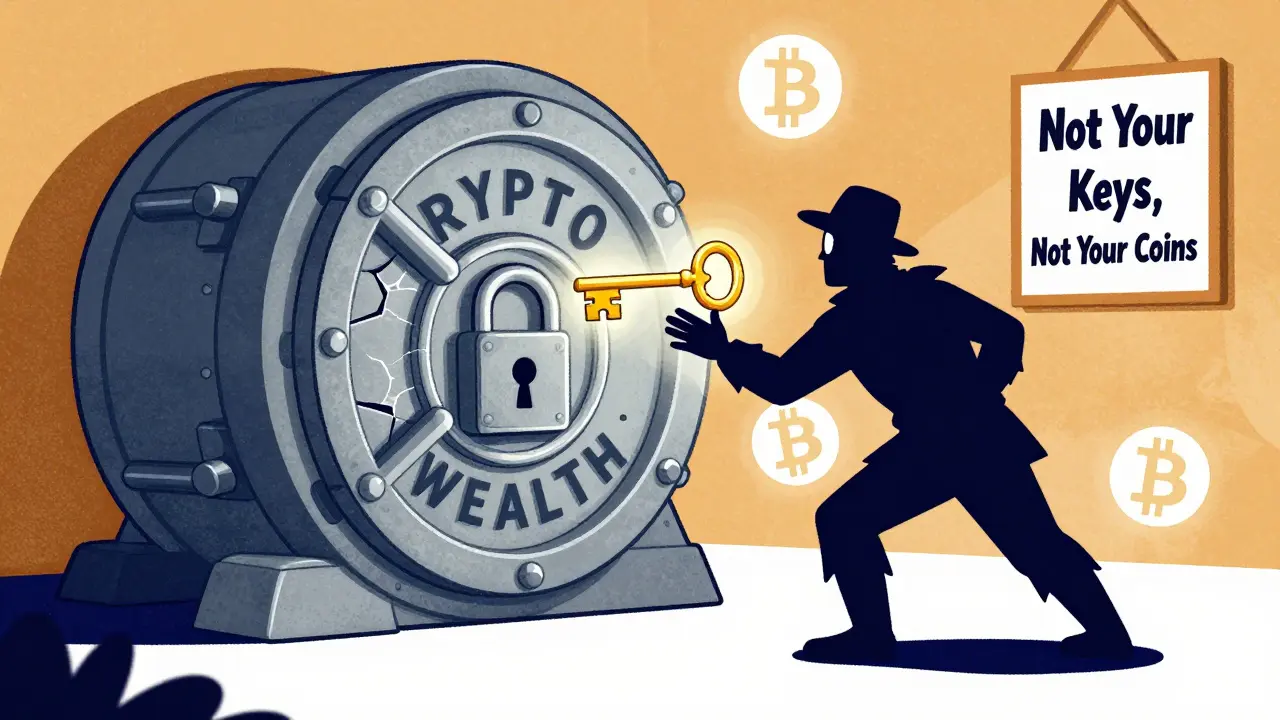
When you own cryptocurrency, you don’t just own a number on a screen-you own a private key. That key is the only thing standing between your coins and anyone else who wants them. If you lose it, your money is gone forever. If someone steals it, your money is gone forever. There’s no customer service line, no password reset, no bank to call. This is why encryption key management isn’t just a technical detail-it’s the foundation of everything in crypto.
What Exactly Is a Private Key?
A private key is a long, random string of letters and numbers-usually 256 bits long-that proves you own a specific cryptocurrency address. It’s mathematically linked to a public key, which you can share safely. Together, they let you sign transactions without ever revealing your private key. Think of it like a physical key to a safe deposit box. The public key is the box number everyone can see. The private key is the only thing that opens it.
Bitcoin’s original design in 2009 didn’t assume users would manage their own keys. But by 2013, the community realized the truth: Not your keys, not your coins. That phrase became a mantra because of events like Mt. Gox’s collapse in 2014, where 850,000 BTC vanished because the exchange held users’ private keys. Since then, key management has evolved from an afterthought into a full industry.
The Key Lifecycle: Seven Stages You Can’t Ignore
Managing keys isn’t a one-time setup. It’s a cycle with seven critical stages:
- Generation: Keys must be created using a truly random source. Poor randomness caused the 2019 MyEtherWallet breach, where hackers guessed keys because they were generated from weak entropy. Modern hardware wallets use certified random number generators compliant with NIST SP 800-90A.
- Storage: Where you keep your key matters more than you think. Software wallets on phones are vulnerable to malware. Paper backups can burn or fade. Hardware wallets like Ledger Nano X or Trezor Model T store keys offline, shielded from remote attacks.
- Access: Who can use the key? Single-signature wallets let one person spend. Multi-signature (multisig) requires 2 or more people to approve a transaction. This is standard for institutions-Kraken’s multisig system has protected $19.3 billion since 2016 without a single breach.
- Usage: Every time you send crypto, you sign with your private key. If that signing process is intercepted or compromised, your funds are gone. Enterprise systems like Thales CipherTrust use hardware security modules (HSMs) that never expose the key-even to the computer it’s running on.
- Rotation: Keys shouldn’t sit forever. Institutions rotate keys every 90 to 180 days. But most individuals never do. That’s a risk. A key compromised in 2021 could still be used in 2026 if it’s never changed.
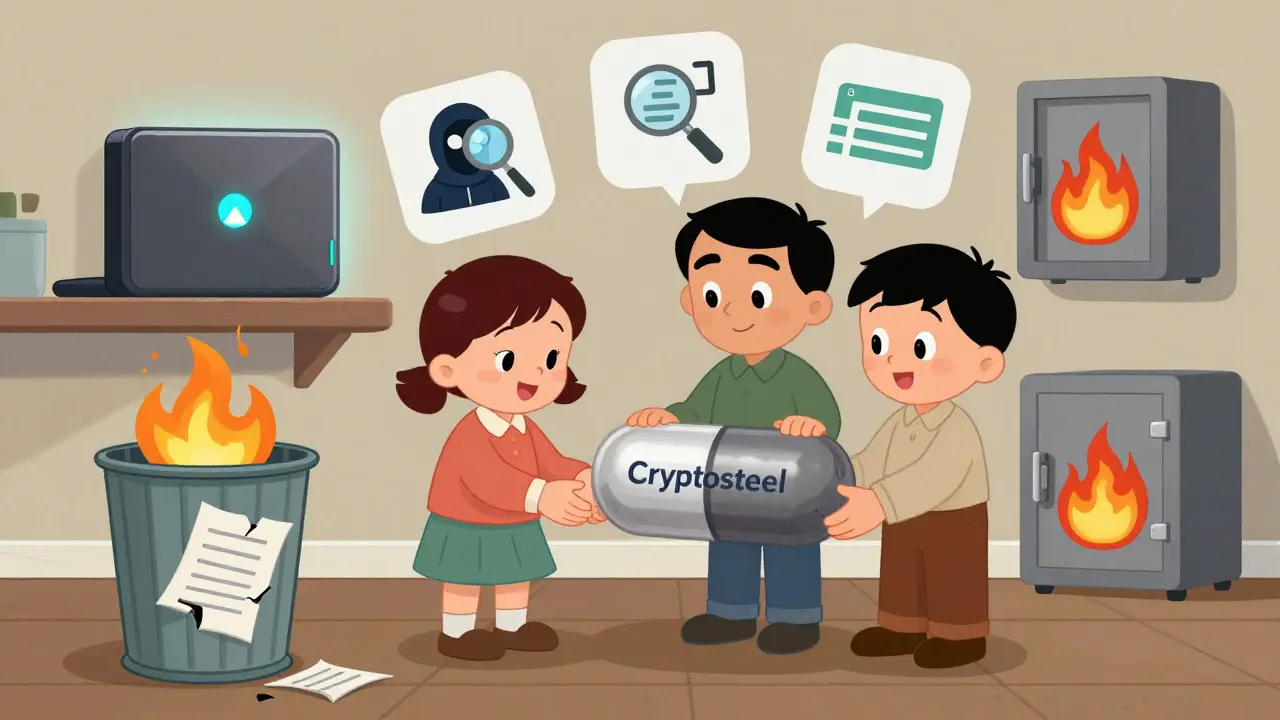
- Backup: Your seed phrase (a 12- or 24-word recovery phrase) is your backup. But 42% of users lose access because they misplace, miswrite, or misunderstand their seed. Metal backups like Cryptosteel survive fire, water, and time. Plastic paper? Not so much.
- Deletion: When a key is no longer needed, it must be destroyed securely. Software keys can be overwritten. Hardware keys should be physically destroyed. Leaving old keys lying around is like keeping a spare house key under the mat.
Three Main Approaches-And Why Most People Are Doing It Wrong
There are three ways people manage keys today. Each has trade-offs.
1. Custodial Services (Exchanges Like Coinbase or Binance)
These platforms hold your keys for you. It’s convenient-you log in, buy, sell, trade. But you’re trusting someone else with your money. In 2022, FTX collapsed and $8 billion in customer funds vanished because the exchange mixed user funds with its own and used them for risky bets. Today, 87% of Bitcoin is held by exchanges or other custodians. That’s a massive single point of failure.
2. Self-Custody (Hardware Wallets Like Ledger or Trezor)
This is the gold standard for individuals. Your private key lives on a device you control, disconnected from the internet. Ledger and Trezor together hold 65% of the hardware wallet market. But here’s the catch: 38% of Ledger users reported at least one recovery incident in the past year. Why? They didn’t test their seed phrase backup. They wrote it on sticky notes. They forgot their passphrase. They trusted a cloud backup that got hacked.
3. Institutional Key Management (Fireblocks, Copper, Thales)
These are for hedge funds, exchanges, and banks. They use Multi-Party Computation (MPC), which splits a key into parts and requires multiple parties to sign a transaction-no single key exists in one place. Fireblocks serves over 1,200 institutions. Their system eliminates the need for cold storage vaults, reduces human error, and prevents insider threats. But it costs $185,000 per year on average. Not for beginners.
The Human Factor: Why Most Losses Are Not Hacks
Here’s the uncomfortable truth: 20% of all cryptocurrency losses between 2022 and 2023 came from poor key management-not hacking, not bugs, not scams. Just people making mistakes.
- Lost seed phrases: 42% of users
- Forgotten passphrases: 29%
- Device failure without backup: 23%
A user on Reddit recovered $250,000 after their Ledger broke-because they’d practiced restoring their wallet on a new device months before. Another user lost $18,000 because they didn’t know the difference between a seed phrase and a passphrase. These aren’t edge cases. They’re routine.
Institutions face different problems. A hedge fund lost $3.2 million when an employee quit without handing over key access. No rotation. No documentation. No process. CISPA’s 2023 study found employee turnover is one of the biggest risks for institutional key management.
What You Need to Do Right Now
If you hold crypto, here’s what you must do:
- Use a hardware wallet if you have more than $1,000. Ledger Nano X or Trezor Model T are reliable. Avoid software wallets for long-term storage.
- Write your seed phrase on metal. Use a Cryptosteel capsule or similar. Store it in a fireproof safe. Never take a photo. Never store it digitally.
- Test your backup. Do this once a year. Buy a $50 replacement wallet. Restore from your seed. Make sure it works. If it doesn’t, you’re already at risk.
- Enable a passphrase (also called a 25th or 26th word). It adds a layer of security. Even if someone steals your seed, they can’t access your funds without the passphrase.
- Never reuse keys. Don’t use the same wallet for trading, staking, and long-term holding. Separate them.
- Learn multisig if you’re managing funds for others. It’s not hard. Wallets like Sparrow and Coldcard support it. Start with a 2-of-3 setup.
If you’re running a business or managing institutional funds:
- Adopt MPC technology. It’s the future.
- Require CISSP or CISM certification for your key managers.
- Implement mandatory key rotation every 90 days.
- Use FIPS 140-2 Level 3 validated HSMs.
- Document every process. Train everyone. Audit quarterly.

What’s Next? Quantum, Regulation, and the Future
By 2026, Gartner predicts 75% of institutional crypto holdings will use MPC-based key management. That’s up from 28% today. The shift is happening fast.
Regulation is catching up too. The EU’s MiCA law, effective January 2024, requires all licensed crypto service providers to prove they have secure key management systems. No more guessing. No more homegrown tools. 70% of exchanges still use them-and 83% of those have known vulnerabilities, according to Securosis.
Long-term, quantum computing threatens current elliptic curve cryptography. Experts warn that by 2035, today’s keys could be broken. The solution? Cryptographic agility-systems that can switch algorithms on the fly. By 2025, this will be a standard requirement. Your wallet today might not be secure in 10 years.
Final Thought
Cryptocurrency gives you control. But control means responsibility. You don’t need to be a cryptographer. You just need to be careful. Your private key isn’t a password. It’s your identity, your wealth, your legacy. Treat it like something you’d lock in a bank vault. Because in crypto, that’s exactly what it is.
What happens if I lose my private key?
If you lose your private key and don’t have a backup seed phrase, your cryptocurrency is permanently inaccessible. Blockchain transactions are irreversible, and no company can recover them for you. This is why seed phrase backup is non-negotiable. If you have a seed phrase, you can restore access using any compatible wallet.
Is a hardware wallet completely hack-proof?
No wallet is 100% hack-proof, but hardware wallets are the most secure option for individuals. They keep private keys offline and require physical interaction to sign transactions. However, if you enter your seed phrase into a compromised computer or write it down poorly, you’re still vulnerable. The device itself is secure-but the human using it isn’t always.
What’s the difference between a seed phrase and a passphrase?
Your seed phrase (usually 12 or 24 words) is the master backup for your wallet. A passphrase is an optional extra word or phrase you add when setting up your wallet. It changes the wallet’s internal address, creating a hidden wallet. Without the passphrase, even someone with your seed phrase can’t access funds stored in the hidden wallet. Think of it as a second lock.
Why do institutions use multi-signature or MPC instead of single keys?
Single keys create a single point of failure. If one person gets hacked or quits, the entire fund is at risk. Multi-signature requires multiple people to approve a transaction (e.g., 3 out of 5). MPC splits the key into encrypted shares-no single share can sign a transaction. Both methods eliminate the risk of insider theft or loss due to one person’s mistake.
Can I store my seed phrase in a password manager?
Technically, yes-but it’s not recommended. Password managers are digital, and if your device is compromised, your seed phrase is exposed. The whole point of a seed phrase is to be offline. If you must use a digital backup, encrypt it with a strong password and store it on an air-gapped device (one never connected to the internet). But metal backups are still the safest option.
How often should I rotate my cryptocurrency keys?
For individuals: rarely, if ever-unless you suspect compromise. For institutions: every 90 to 180 days. Key rotation is a core part of enterprise security. It limits the damage if a key is stolen or leaked. Many institutional systems automate this process using HSMs and KMIP-compliant platforms.
Are software wallets ever safe for long-term storage?
Only if you’re actively using them for small amounts and have a secure, offline backup. Software wallets on phones or computers are always connected to the internet, making them vulnerable to malware, phishing, and remote exploits. They’re fine for trading or small daily spends, but never for holding significant value. Always pair them with a hardware wallet backup.
8 Comments
I love how this post breaks down key management like a step-by-step guide. Seriously, most people treat crypto like a lottery ticket-buy it, forget it, hope for the best. But this? This is how you actually survive in this space. Hardware wallet, metal backup, test your restore… it’s not sexy, but it’s life-saving. I’ve seen too many people lose everything because they thought ‘I’ll remember it’ or ‘it’s just a little bit.’ No. It’s everything.
I just want to say… I lost $47,000 because I trusted a cloud backup. I thought, ‘Oh, Google Drive is safe.’ WRONG. My phone got hacked. My backup got wiped. I cried for three days. This article? It’s not just advice-it’s a warning scream. If you’re not using metal, you’re playing Russian roulette with your future. And don’t even get me started on passphrases. I didn’t know they existed until it was too late. 😭
Look, let’s cut through the crypto marketing fluff. Hardware wallets aren’t magic. They’re just expensive USB sticks with a screen. The real issue? People don’t understand entropy, randomness, or cryptographic integrity. They think ‘Ledger’ means ‘unhackable.’ It doesn’t. The 2019 MyEtherWallet breach? That was because of predictable entropy. The 2022 Trezor firmware flaw? That was because they outsourced security to a third-party contractor. And now we’re supposed to trust a $100 device with our life savings? Meanwhile, institutions are moving to MPC because they know single points of failure are just… lazy. This whole ‘just use a hardware wallet’ narrative is a scam designed to sell more devices. The real solution? Decentralized key shards. Zero-trust architecture. Not a plastic box with a button.
You know what’s really happening here? This isn’t about keys. It’s about control. The system wants you to believe you’re safe if you buy a Ledger. But who owns Ledger? Who owns Trezor? Who controls the firmware updates? The same banks that run the traditional system. They’re just repackaging control as ‘security.’ And don’t get me started on MiCA. Regulation is coming. They’re not protecting you-they’re preparing to freeze, seize, or tax your assets. Your ‘secure’ wallet? It’s just a digital leash. Quantum computing is a distraction. The real threat? A government mandate that forces wallet manufacturers to backdoor every device. You think you’re safe? You’re already owned.
I’m not a techie, but I held crypto for 5 years and lost nothing. Here’s what I did: got a Trezor, wrote my seed on metal, stored it in a safe, and tested the restore once a year. No cloud. No photos. No fancy terms. Just simple. If you’re overcomplicating it, you’re probably making a mistake. Also, passphrase? YES. Use it. It’s like a second lock on your front door. Nobody’s asking you to be a cryptographer. Just be consistent. And stop trusting your phone.
As someone from India, I’ve seen so many friends lose everything because they trusted WhatsApp groups or ‘crypto gurus’ who told them to ‘send your seed to verify your wallet.’ I cried for them. But now? I teach my cousins how to use metal backups. We even made a little group-3 of us-each with a copy of our seed in different cities. It’s not about paranoia. It’s about community. And yes, I use a passphrase. It’s like a secret handshake with your future self. 🙏✨
Quantum computing? 😂 LMAO. They’ve been saying that since 2015. Meanwhile, 99% of users still write their seed on a napkin. The real threat isn’t quantum-it’s your dumbass cousin who screenshots your seed and posts it on TikTok. Also, MPC? That’s just a fancy way of saying ‘I don’t trust myself.’ If you need 5 people to sign one transaction, you’re not managing crypto-you’re managing a corporate board meeting. Use a hardware wallet. Write it on metal. Done. Stop overengineering. 🤡🔐
The assertion that self-custody is the 'gold standard' is empirically unsubstantiated. The data on recovery incidents among Ledger users is anecdotal and self-reported. Furthermore, institutional adoption of MPC is not a validation of individual best practices-it reflects regulatory compliance and fiduciary duty, not superior security architecture. One cannot extrapolate enterprise risk models to retail users without committing a category error. The recommendation to 'test your backup annually' is prudent, yet the conflation of seed phrase with passphrase, and the omission of key derivation path standards, renders the guidance incomplete. A more rigorous analysis is warranted.