Stablecoin Swap Fee Calculator
Calculate Your Savings
Compare costs between DFX Finance and traditional services for your stablecoin swap
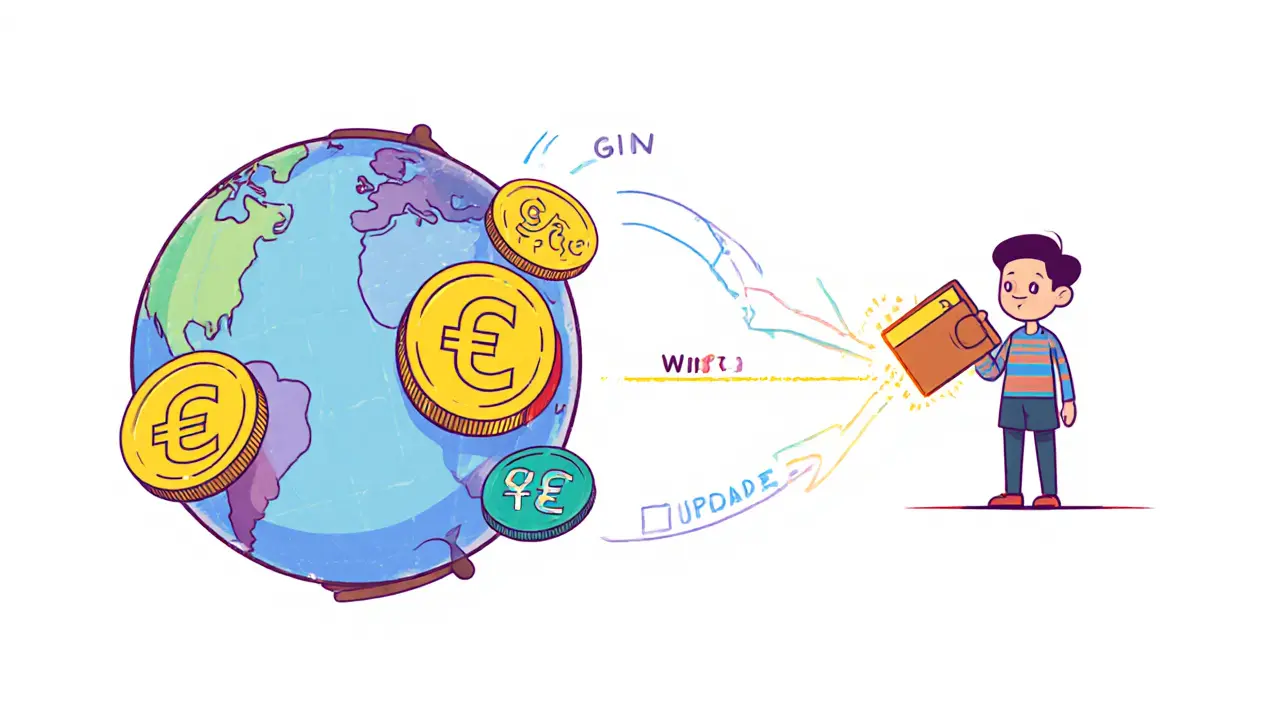
Most crypto exchanges let you trade Bitcoin for Ethereum, or Solana for USDT. But what if you want to swap EUR-backed stablecoins for JPY-backed stablecoins without touching USD? That’s where DFX Finance comes in. It’s not another Uniswap clone. It’s a specialized decentralized exchange built on Polygon that only handles fiat-backed stablecoins - and nothing else. If you’re someone who deals with international payments, remittances, or currency hedging outside the U.S., this might be the tool you’ve been waiting for. But here’s the catch: it’s not for everyone.
What Exactly Is DFX Finance?
DFX Finance is a decentralized foreign exchange (FX) protocol launched in 2021. Unlike general-purpose DEXs, it doesn’t trade BTC, ETH, or meme coins. It only swaps stablecoins pegged to real-world currencies like EUR, GBP, CAD, JPY, and others. The idea is simple: cut out the middleman. Instead of converting EUR to USD, then USD to JPY, you go directly from EUR stablecoin to JPY stablecoin - faster, cheaper, and without the extra fees.
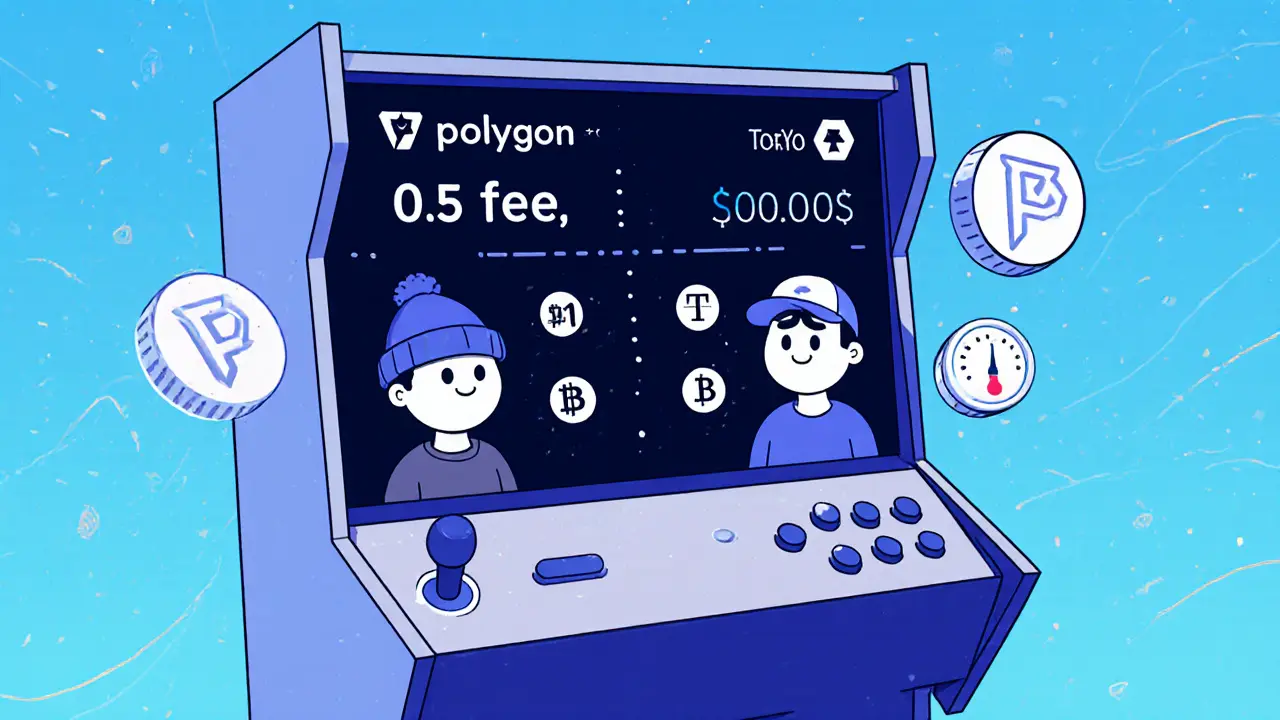
The whole system runs on Polygon, which means transaction costs are a fraction of what you’d pay on Ethereum. Gas fees? Usually under $0.10. Settlement time? Under 3 seconds. That’s critical when you’re moving money across borders and need speed.
At its core, DFX uses a custom-built Automated Market Maker (AMM) designed for ultra-low volatility trading. Most AMMs, like Uniswap’s, are built for wild price swings. DFX’s AMM is tuned for stability. It minimizes slippage even when trading large amounts of stablecoins. That’s rare. Most DEXs get messy when you try to swap $10,000 worth of EUR stablecoins. DFX handles it smoothly.
How It Works - No Fluff, Just Steps
You don’t need a brokerage account. You don’t need to verify your ID. You just need a Web3 wallet and some MATIC for gas.
- Get a wallet like MetaMask or Rabby, and switch the network to Polygon.
- Buy a little MATIC (around $5 worth) to cover transaction fees.
- Get a fiat-backed stablecoin - like EURT (Euro Tether), GBPT (GBP Tether), or JPYC (Japanese Yen Coin). You can get these on exchanges like MEXC, Bitrue, or directly through on-ramps like MoonPay or Ramp.
- Go to app.dfx.finance and connect your wallet.
- Choose your source stablecoin and target stablecoin. Swap. Done.
There are no order books. No spreads marked up by a middleman. The price comes from the AMM pool, which is fed by liquidity providers. And because the assets are all stablecoins, the price doesn’t jump around. You get near-1:1 pricing, even on larger trades.
The DFX Token - What’s It For?
DFX is the native token of the protocol. It’s not used for trading. It’s used for governance and liquidity mining.
As of November 2025:
- Circulating supply: 43.6 million DFX
- Max supply: 100 million DFX
- Price: ~$0.0077
- Market cap: ~$335,000
- 24-hour volume: ~$1,835
That volume is tiny. For comparison, Uniswap trades over $1 billion daily. DFX’s daily volume is less than what some meme coins trade in an hour. The token isn’t listed on Coinbase, Kraken, or Binance. You can only buy it on smaller DEXs like QuickSwap or on Polygon-based platforms.
That’s a red flag for most retail traders. But here’s the twist: DFX isn’t trying to be a speculative asset. It’s designed as a utility token for protocol users who want to earn rewards by providing liquidity to stablecoin pairs. If you’re a liquidity provider, you get DFX rewards. If you’re just holding it hoping for a 10x, you’re probably going to be disappointed.
Who Is This For? And Who Should Avoid It?
DFX Finance isn’t a general crypto exchange. It’s a niche tool. Here’s who benefits:
- Freelancers in Europe or Asia getting paid in EUR or JPY and needing to pay vendors in CAD or GBP.
- Small businesses doing cross-border trade who want to avoid USD conversion fees.
- DeFi users who want to hedge against USD exposure without selling crypto.
- Developers building apps that need multi-currency stablecoin support.
Here’s who should skip it:
- People who want to trade Bitcoin or altcoins. DFX doesn’t support them.
- Beginners in crypto. You need to understand wallets, gas, and Polygon. This isn’t a Coinbase app.
- Those looking for quick profits. DFX token volume is too low for reliable trading.
- Users who need customer support. There’s no phone line, no live chat. It’s fully decentralized.
Why It’s Not Mainstream - And Why That Matters
DFX Finance has a website Alexa rank of over 1.5 million. That’s lower than most small blogs. Its trading volume is minuscule. It’s not listed on major exchanges. Why?
Because the market for non-USD stablecoins is still small. Most DeFi users use USDT or USDC. Even in Europe, people often convert to USD first. That’s the inertia DFX is fighting.
Also, regulatory uncertainty plays a role. Stablecoins tied to EUR, JPY, or GBP are less standardized than USDT or USDC. Fewer issuers mean less liquidity. Fewer issuers mean fewer users. It’s a chicken-and-egg problem.
But here’s the opportunity: central bank digital currencies (CBDCs) are rolling out globally. The European Central Bank is testing a digital euro. Japan is piloting a digital yen. When those launch, DFX’s infrastructure could become the backbone for exchanging them - without banks.

Real-World Use Case: A Freelancer in Berlin
Sarah, a freelance designer in Berlin, gets paid in EUR by clients in Canada and Japan. She used to convert EUR to USD on PayPal, then USD to CAD or JPY on Wise - paying 3-5% in fees each time.
Now, she:
- Receives EURT (Euro Tether) directly into her MetaMask.
- Swaps EURT for CADT (Canadian Dollar Tether) on DFX Finance.
- Uses CADT to pay her Canadian contractor.
- Does the same for JPYC when needed.
Total fees? Under $0.50 per swap. Time? Under 10 seconds. No bank delays. No paperwork. No currency risk.
This isn’t theory. This is happening. Just not at scale yet.
Pros and Cons - Straight Up
| Feature | DFX Finance | Uniswap | Wise (Traditional) |
|---|---|---|---|
| Supported Assets | Fiat-backed stablecoins only | Most crypto tokens | Real fiat currencies |
| Transaction Speed | Under 3 seconds | 15-60 seconds | 1-5 business days |
| Fees | $0.05-$0.20 per trade | 0.3% swap fee | 1-5% FX fee |
| Slippage | Extremely low for stablecoins | High for low-volume pairs | N/A - fixed rate |
| Accessibility | Web3 wallet required | Web3 wallet required | Bank account, ID verification |
| Regulatory Risk | High - unregulated stablecoins | High | Low - licensed |
DFX wins on speed and cost for stablecoin swaps. It loses on accessibility and trust. You’re trading on a protocol with no customer service, no insurance, and no guarantee it’ll still be around in 2 years.
Future Outlook - Will It Survive?
DFX Finance is a bet on a future where money isn’t dominated by the U.S. dollar. It’s a bet that non-USD stablecoins will grow. That’s not a wild idea. The EU, Japan, and China are all pushing their own digital currencies. If those gain traction, DFX’s architecture could be the missing link.
But right now? It’s a prototype. A quiet experiment. The token price is low. The volume is tiny. The user base is invisible. There’s no marketing. No influencers. No press.
If you’re a developer, a cross-border business owner, or a DeFi power user who hates USD-centric systems - try it. Swap a few dollars. See how it feels.
If you’re looking to make money off the DFX token? Don’t. It’s not designed for that. And if you want a safe, regulated way to move money? Use Wise or Revolut.
DFX Finance doesn’t need to be the next Binance. It just needs to work for the few who need it. So far, it does.
Is DFX Finance safe to use?
DFX Finance is a decentralized protocol, so it doesn’t hold your funds. You control your wallet. That means no hacks of a central exchange - but also no recovery if you lose your private key. The smart contracts have been audited by reputable firms like CertiK, but DeFi always carries risk. Only use what you can afford to lose.
Can I buy DFX on Coinbase or Binance?
No. DFX is not listed on any major centralized exchanges like Coinbase, Binance, or Kraken. You can only buy it on smaller decentralized exchanges on Polygon, like QuickSwap or SushiSwap. That limits liquidity and makes price swings more volatile.
Do I need to know how to use crypto wallets?
Yes. You need a Web3 wallet (like MetaMask), you need to switch it to the Polygon network, and you need MATIC tokens to pay for gas. If you’ve never used a DEX before, start with a small amount. There’s no customer support if something goes wrong.
What stablecoins does DFX support?
DFX supports fiat-backed stablecoins like EURT (Tether Euro), GBPT (Tether GBP), CADT (Tether CAD), JPYC (Japanese Yen Coin), and others. It does not support USDT or USDC as primary pairs - though some liquidity pools may include them. Always check the token symbol before trading.
Is DFX Finance better than Wise for international payments?
It depends. If you’re sending money from a bank account to another bank account, Wise is easier and more regulated. But if you already hold stablecoins and need to swap between EUR, JPY, or CAD instantly, DFX is faster and cheaper. DFX is for crypto-native users. Wise is for everyone else.
Why is DFX’s trading volume so low?
Because most people still use USD-based stablecoins. Non-USD stablecoins are harder to get, less known, and not widely supported by wallets or on-ramps. DFX’s market is small by design - it’s targeting a niche that hasn’t scaled yet. That could change if CBDCs grow.
9 Comments
Been using DFX for my freelance payments between Germany and Japan-no more PayPal fees eating my lunch. Under $0.10 per swap and instant. It’s not flashy, but it just works.
Wish more people knew about this.
Oh sweet merciful blockchain, another ‘decentralized FX’ project masquerading as innovation. The liquidity is a ghost town, the token market cap is less than my monthly coffee budget, and you’re seriously suggesting this replaces Wise?
Let me guess-your wallet’s full of DFX and you’re just hoping for a pump. Cute.
Used this last month to send INR equivalent to a client in Canada. Got JPYC to CADT swap done in 7 seconds. No KYC, no delays. I don’t care if it’s not on Binance-this is what DeFi should be.
Simple. Efficient. No noise.
What if money isn’t a national construct at all?
What if the dollar’s dominance is just a historical accident?
DFX isn’t a tool-it’s a whisper of a new system. Quiet. Unnoticed. But real.
It doesn’t need to go viral to matter.
It just needs to work for the ones who need it.
And it does.
Y’all are overthinking this. If you’re already in crypto and need to move EUR to JPY? Try it with $5. No harm, no foul. If it saves you $10 in fees? Win.
And if it doesn’t? You’re out $0.20 in gas. Big deal.
Just give it a shot. 😊
Alan’s comment made me smile. This is the exact kind of quiet innovation that changes lives without headlines.
Imagine a freelancer in Nairobi using CADT to pay a designer in Poland. No bank. No waiting. No middlemen.
That’s the future. And it’s already here.
Don’t wait for it to be popular. Just use it if it fits your life.
Ann, you’re right about the token being useless for speculation-but you’re missing the point.
This isn’t a pump-and-dump. It’s infrastructure.
Like TCP/IP in the 90s. No one cared about the protocol. But when you needed to send data? It just worked.
DFX is the same. Ignore the token. Watch the swaps.
Why should I care about some American crypto bro’s pet stablecoin project when India has UPI and China has digital yuan?
This is just another Western tech fantasy.
Real money moves through state-backed systems. Not some unregulated Polygon sidechain.
And you call this innovation? Pathetic.
Just swapped 500 EURT to JPYC for my daughter’s online art class in Tokyo. Took 4 seconds. Fees: $0.08.
She got paid in her local currency. I didn’t have to explain crypto to her teacher.
Thank you, DFX. You’re quietly changing the world.
❤️