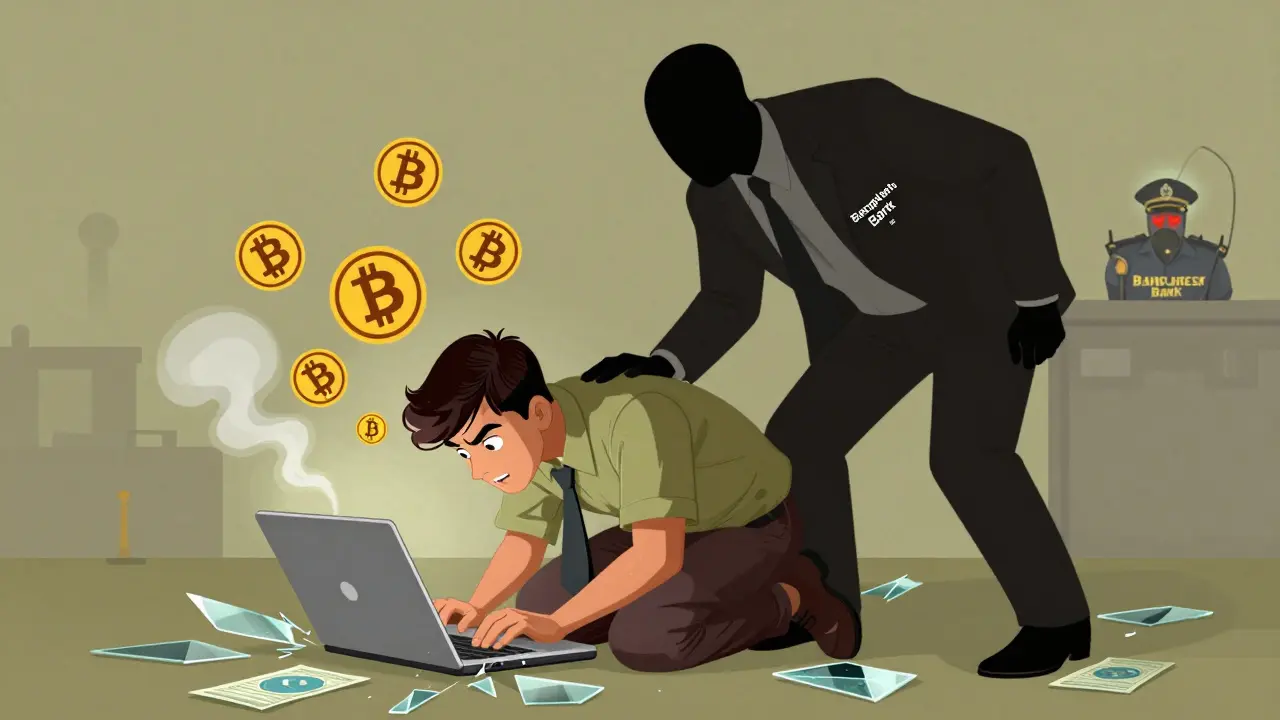
Buying or selling Bitcoin in Bangladesh isn't just risky-it’s legally dangerous. Even though you won’t find a law that says, "Owning cryptocurrency is a crime," the moment you trade it, you step into a legal gray zone where authorities can throw you in jail or seize your assets. This isn’t speculation. It’s happening right now.
What the Ban Actually Means
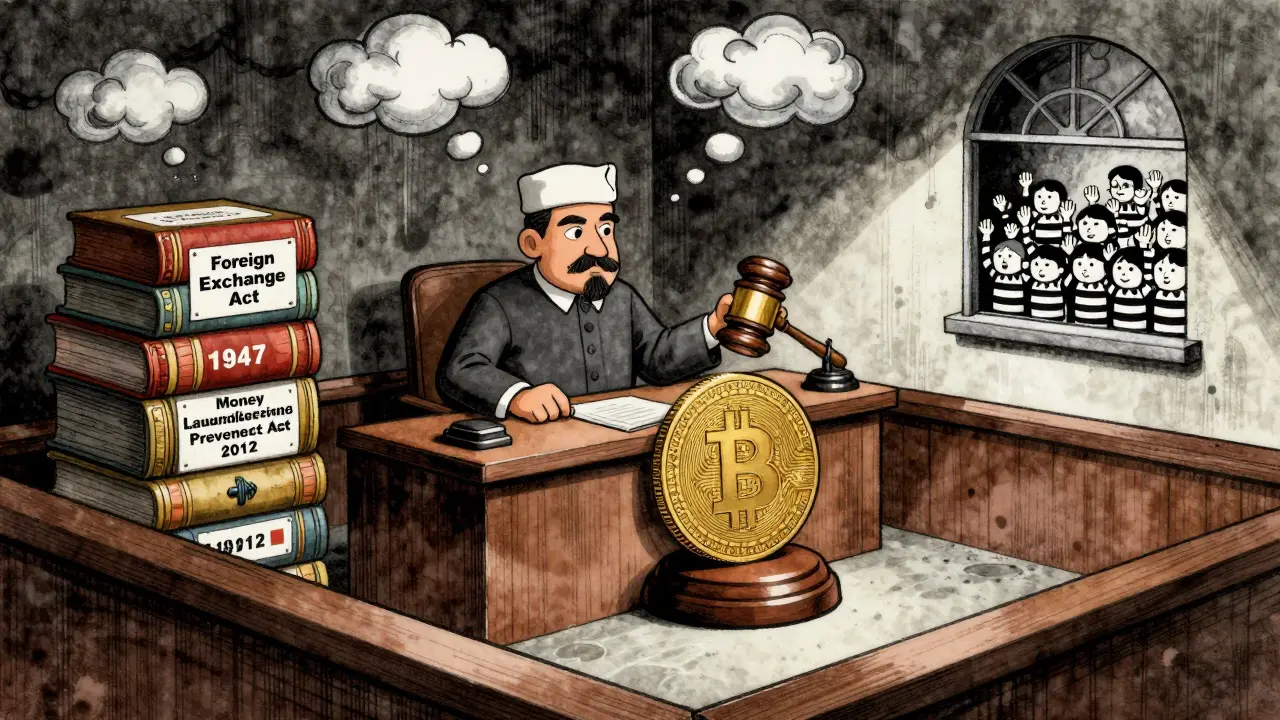
The Bangladesh Bank issued its first warning about Bitcoin in 2014. By 2017, it was clear: digital currencies like Bitcoin are not legal tender. That means you can’t use them to pay for goods, services, or even remittances. But here’s the twist: the bank never passed a law that makes owning Bitcoin illegal. Instead, they use existing laws to punish trading. The real hammer comes from two laws: the Foreign Exchange Regulation Act of 1947 and the Money Laundering Prevention Act of 2012. If you buy Bitcoin using Bangladeshi Taka, you’re technically moving money outside the country without approval. That’s a violation of foreign exchange rules. If you sell Bitcoin and convert it back to Taka through a local agent, authorities can argue you’re laundering money-especially if the source isn’t documented. This creates a trap. You can hold Bitcoin in your wallet. But if you trade it, you’re likely breaking the law.Who Gets Caught-and How
Enforcement isn’t random. Authorities have clear methods to track users.- Bank transactions: The Bangladesh Automated Clearing House (BACH) monitors international card payments. In Q4 2024 alone, 127 transactions linked to crypto exchanges were flagged.
- Mobile money: Services like bKash and Nagad blocked over 2,800 accounts in 2024 for suspicious activity tied to crypto payments.
- Local agents: Many traders use middlemen to convert USDT to Taka. These agents are prime targets. In June 2024, a man named Sohel Rana vanished after collecting over $350,000 from traders-leaving them with nothing and no legal recourse.
- Peer-to-peer platforms: Even though apps like Binance and KuCoin are still on Google Play in Bangladesh, the government tracks IP addresses and device IDs. In 2023, police seized 127 Bitcoin (worth $12.1 million) from a trader in Dhaka after tracing his wallet activity.
Why the Confusion?
Here’s where it gets messy. In November 2021, the Bangladesh Bank sent a private note to the CID saying: "Trading or owning cryptocurrency is not illegal by itself." That note, documented in CID Case No. 1147/2021, contradicts everything the bank says publicly. Legal experts call it a "dangerous limbo." You might think you’re safe if you just hold Bitcoin. But if you trade-even once-authorities can still charge you under foreign exchange or money laundering laws. And since there’s no clear definition of what constitutes "trading," every transaction becomes a gamble. Barrister Rokibul Hasan put it bluntly: "The law doesn’t protect you. It just gives them more ways to punish you."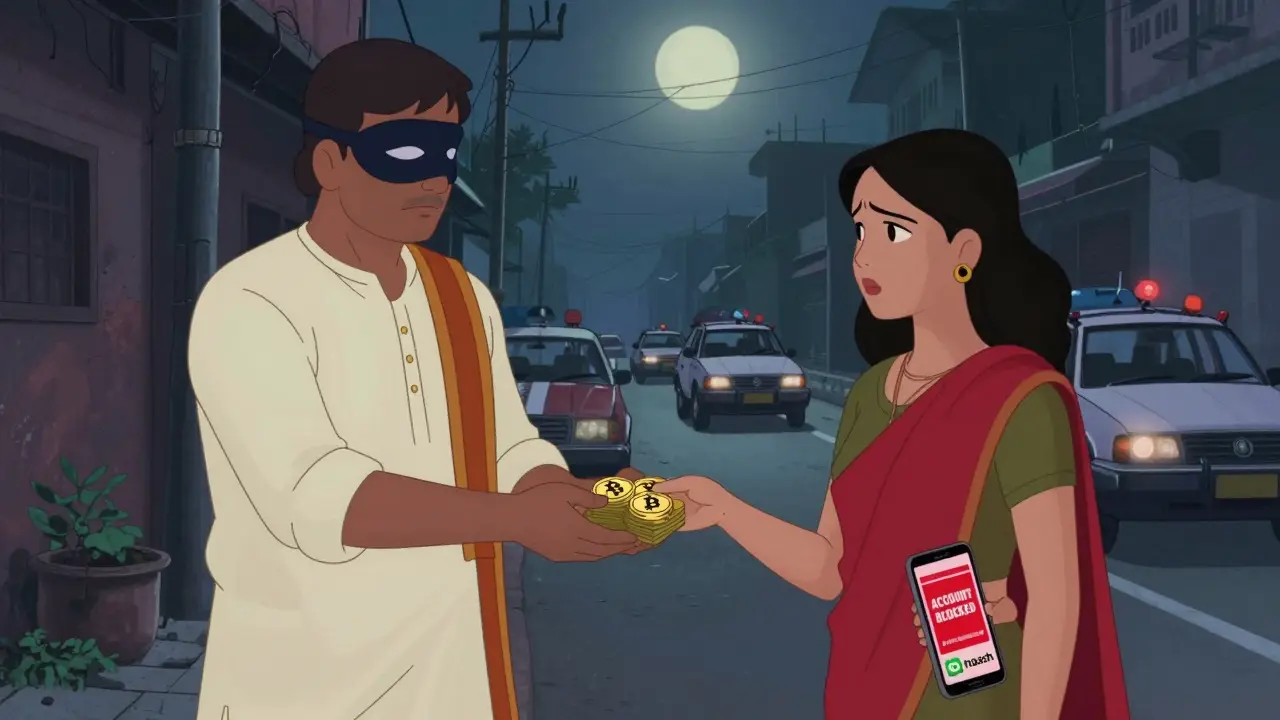
Who’s Trading Anyway?
Despite the risks, an estimated 500,000 to 700,000 Bangladeshis are still trading crypto. Most are young, tech-savvy, and frustrated by the country’s strict capital controls. Remittances from abroad make up 6.1% of Bangladesh’s GDP-over $21 billion in 2024. Many see crypto as a faster, cheaper way to receive money from family overseas. A 2025 survey by a Dhaka-based fintech researcher found that 68% of crypto users had at least one bank account frozen because of suspected crypto activity. One man, a 29-year-old software developer in Sylhet, told me his savings account was locked for six months after he used USDT to pay for a freelance job. He had no proof the money came from abroad. The bank didn’t ask questions-they just froze everything. Facebook groups like "Bangladeshi Crypto Traders" have over 28,000 members. Reddit’s r/CryptoBd has nearly 12,500. These aren’t just hobbyists. They’re people trying to navigate a system that punishes them for trying to work around broken financial infrastructure.Taxes? There Are None-But There Could Be
The National Board of Revenue (NBR) has never issued a single rule about taxing cryptocurrency. But they don’t need to. Under the Income Tax Ordinance of 1984, any profit you make from selling Bitcoin can be classified as "other income." That means you could owe up to 30% in personal income tax. In February 2025, NBR Commissioner Md. Moniruzzaman confirmed in a press briefing: "There are no specific crypto tax regulations." But he didn’t say crypto profits are tax-free. He said nothing. That silence is intentional. It leaves room for auditors to come after traders later. No one has been fined for crypto taxes yet. But if you’re ever audited, and you’ve made a profit from Bitcoin, the NBR can-and likely will-come after you.How Bangladesh Compares to Its Neighbors
While Bangladesh bans crypto outright, neighboring countries are taking different paths:- India: Allows trading. Imposes a 30% tax on gains. Over 15 million users in 2025.
- Pakistan: Started exploring Bitcoin reserves in early 2025. No ban.
- Sri Lanka: Drafted a regulatory framework in late 2024.
What Happens If You Get Caught?
If you’re investigated:- Your bank accounts will be frozen.
- Your phone and laptop may be seized.
- You’ll be questioned by the CID or BFIU.
- You could be charged under the Money Laundering Prevention Act.
- Potential penalties: 1 to 10 years in prison + fines up to 1,000,000 BDT ($8,300 USD).
Is There Any Way Out?
No. Not legally. The government has made it clear. In March 2025, Finance Minister Abul Hassan Mahmood Ali told Parliament: "There are no plans to reconsider the cryptocurrency ban." The central bank’s Innovation Hub launched a blockchain sandbox in January 2025-but it excludes all crypto-related projects. That tells you everything: they want the tech, not the money. If you’re trading Bitcoin in Bangladesh, you’re doing it at your own risk. There’s no legal shield. No insurance. No protection. Just the silent threat of an investigation, a frozen account, or a prison cell.Final Reality
This isn’t about morality. It’s about power. The Bangladesh Bank doesn’t want competition. It doesn’t want people bypassing its control over money. So it uses fear, ambiguity, and old laws to keep people in line. You can still trade Bitcoin. Thousands do. But every click, every transfer, every payment you make could be the one that gets you arrested. The law doesn’t say "don’t own Bitcoin." But it says enough to make you pay for it.Is it illegal to just own Bitcoin in Bangladesh?
Owning Bitcoin isn’t explicitly illegal under Bangladeshi law. But the Bangladesh Bank’s 2017 ban declares it "not legal tender," and authorities use other laws-like the Money Laundering Prevention Act and Foreign Exchange Regulation Act-to punish any activity involving trading, transferring, or converting Bitcoin into Taka. So while possession isn’t banned, using it almost always is.
Can I get arrested for trading Bitcoin in Bangladesh?
Yes. There have been multiple arrests. In 2022, 14 people were jailed for running a crypto exchange. In 2023, a trader was arrested after police seized 127 Bitcoin worth over $12 million. Under Section 6 of the Money Laundering Prevention Act, you can face 1 to 10 years in prison and fines up to 1,000,000 BDT for crypto-related transactions.
Are banks blocking crypto transactions?
Yes. Banks and mobile financial services like bKash and Nagad actively block accounts linked to crypto activity. In 2024, over 2,800 accounts were frozen. If you send or receive money from a crypto exchange-even if it’s from a friend-you risk having your account locked without warning.
Do I have to pay taxes on Bitcoin profits in Bangladesh?
There is no specific crypto tax law. But under the Income Tax Ordinance of 1984, profits from Bitcoin sales can be classified as "other income," making them subject to personal income tax (up to 30%) or corporate tax (25%). While no one has been taxed yet, the National Board of Revenue has not ruled it out and can audit you at any time.
Why does Bangladesh ban Bitcoin but allow blockchain?
The government sees blockchain as a tool for public systems-like land records and supply chain tracking-but views Bitcoin as a threat to its control over money. The 2020 National Blockchain Strategy supports tech innovation while explicitly excluding cryptocurrencies. The central bank’s 2025 blockchain sandbox only accepts non-crypto projects. This shows a deliberate effort to separate the technology from decentralized money.
How many people in Bangladesh still trade crypto?
An estimated 500,000 to 700,000 people trade cryptocurrency in Bangladesh, according to the Blockchain Association of Bangladesh’s 2024 report. Apps like Binance and KuCoin still have 150,000-200,000 monthly active users in the country, despite the ban. Most use peer-to-peer networks and local agents to convert USDT into Bangladeshi Taka.
What happens if a local crypto agent disappears with my money?
You have no legal protection. Local agents who convert USDT to Taka operate outside the law. If they vanish-like Sohel Rana did in June 2024, after taking $350,000 from traders-you can’t file a police report for fraud because the transaction itself is illegal. You lose your money and can’t seek justice.
Is using a VPN to access Binance or KuCoin safe?
No. Using a VPN doesn’t protect you. Authorities track mobile data usage, device IDs, and transaction patterns. Even if you access crypto apps through a VPN, your bank or mobile wallet provider may still flag your activity. The Bangladesh Bank monitors international card transactions and MFS logs-your digital footprint is still traceable.
Could Bangladesh lift the crypto ban in the future?
As of March 2026, there is no indication the ban will be lifted. Finance Minister Abul Hassan Mahmood Ali confirmed in March 2025 that there are "no plans to reconsider" the ban. While neighboring countries are regulating crypto, Bangladesh remains committed to its strict prohibition, despite growing pressure from citizens and economists.
Why is the ban so strict compared to other countries?
Bangladesh’s central bank fears crypto could undermine its control over remittances, which make up 6.1% of GDP. It also worries about capital flight and loss of monetary policy control. Unlike India or Sri Lanka, Bangladesh has not developed a regulatory framework to manage risk. Instead, it chose total prohibition to avoid any potential instability-even if that means stifling innovation and pushing users into dangerous underground markets.
8 Comments
The Bangladesh Bank's regulatory posture isn't merely reactionary-it's structurally incoherent. By weaponizing the Foreign Exchange Regulation Act of 1947 against decentralized digital assets, they're applying a colonial-era monetary control paradigm to a post-blockchain reality. This is regulatory anachronism masquerading as sovereignty. The legal framework is predicated on the assumption that capital flows must be channeled through state-monopolized intermediaries, which is fundamentally incompatible with permissionless, peer-to-peer value transfer systems. The result? A black market in financial innovation, where citizens are forced into dangerous intermediation networks just to access global capital flows. This isn't financial stability-it's financial repression dressed in bureaucratic legalese.
While I recognize the complexity of the situation, I must emphasize the importance of adhering to established legal frameworks, regardless of their perceived antiquity. The rule of law, even when imperfect, provides the only stable foundation for societal order. To undermine it in the name of innovation is to invite chaos. The Bangladesh Bank's position, however rigid it may seem, serves as a necessary bulwark against systemic financial risk. It is not the role of individuals to circumvent regulatory authority, even when the rationale appears opaque. The consequences of noncompliance-asset seizure, imprisonment-are not arbitrary; they are the logical outcome of violating statutory norms.
lol so basically if u hold btc u r fine… until u try to spend it? so its like owning a gun but ur not allowed to fire it? 🤡
the fact that people are still trading despite this is wild. imagine having to use some sketchy dude named sohel rana to turn ur usdt into cash 😭 i mean… at least they got hustle. but also… why???
also why does the government want blockchain but not crypto? like… its the same damn thing. its like saying u can have a car but not wheels. 🤦♀️
There is a quiet tragedy here, not in the laws, but in the people. Five hundred thousand souls, trying to send love across borders, to feed their families, to build something beyond the reach of bureaucracy. They are not criminals-they are caregivers, students, workers, dreamers. The state sees a threat to its control, but it forgets that money is not power-it is connection. When a son in Dubai sends money to his mother in Sylhet, and the bank freezes her account because she used USDT, who is the real violator? The son? Or the system that refuses to see him? The ban does not protect the economy-it protects the illusion of order. And illusions, when they crack, leave behind only broken hearts and silent phones.
Wow, so you're telling me people are risking jail time because they're too lazy to use a bank? I mean, come on. If you want to send money abroad, there are LEGAL channels. SWIFT, Western Union, remittance services-there's a whole ecosystem built for this. But no, people want to cut corners, use shady middlemen, and act like they're in some crypto dystopia movie. And now they're surprised when they get caught? This isn't oppression-it's consequences. You don't get to break laws because you think they're inconvenient. The fact that 68% of users have had accounts frozen is a warning sign, not a call for reform. It's called personal responsibility. Learn it.
I just want to say-I see you, Bangladeshis. I see how hard you're trying to build something better in a system that doesn't want you to. You're not reckless. You're resourceful. You're not breaking the law because you're criminals-you're doing it because the law doesn't serve you. And honestly? That’s not rebellion. That’s resilience. I hope one day the government realizes that blockchain and crypto aren’t enemies-they’re tools. And tools don’t need to be banned. They need to be guided. Maybe instead of jail, we need mentors. Instead of fear, we need inclusion. You’re not alone in this. The world is watching-and it’s starting to listen.
It’s fascinating how this situation reflects a broader global tension between centralized monetary authority and decentralized technological autonomy. The Bangladesh Bank’s stance is not unique-it mirrors the hesitancy of central banks worldwide, from the ECB to the Fed, to fully embrace crypto. Yet Bangladesh’s approach is uniquely draconian, precisely because it lacks even the veneer of regulatory clarity. In India, for example, taxation provides a framework for accountability; in Sri Lanka, regulatory sandboxes allow for iterative development. Bangladesh, however, has chosen opacity as policy. This creates a paradox: the state simultaneously acknowledges blockchain’s utility in public infrastructure while demonizing the very currency that enables its decentralized ethos. The contradiction is not accidental-it is ideological. The central bank fears not the technology, but the erosion of its monopoly over financial narrative. And so it clings to the 1947 Act like a life raft, even as the ship sinks. The real cost isn’t the 127 Bitcoin seized or the 2,800 frozen accounts-it’s the stifling of an entire generation’s economic imagination. And that’s a loss no law can ever recover.