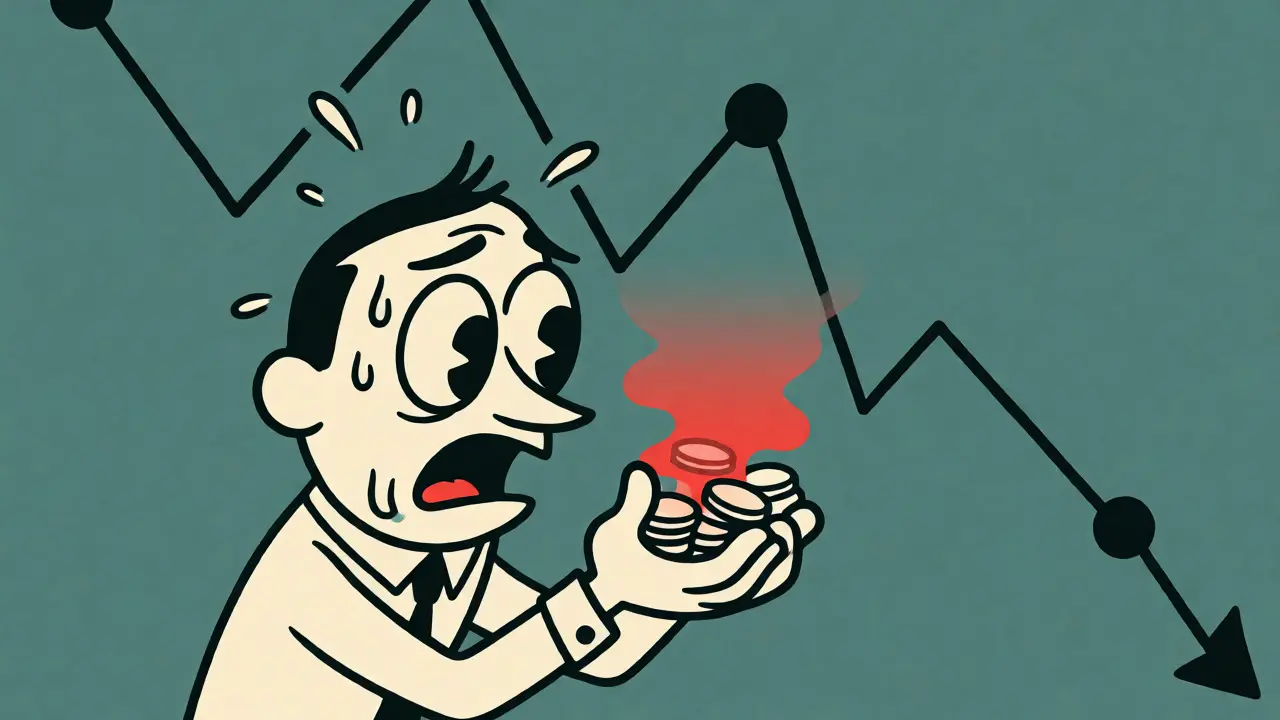
You set up a recurring buy for Bitcoin every Friday. You think you've cracked the code on stress-free investing. Then the market drops 40%, your portfolio bleeds red, and you panic-sell half your stack. Sound familiar? Dollar Cost Averaging (DCA) is supposed to be the antidote to market timing anxiety, yet most retail investors treat it like a magic wand that works regardless of how they wield it. The strategy itself-buying fixed amounts at regular intervals-is mathematically sound for volatile assets. But the execution is where things go wrong. If you're losing money despite consistent buying, you aren't failing because of the market; you're failing because of common behavioral and structural errors.
Key Takeaways
- Diversify beyond one asset: Concentrating DCA into a single altcoin increases risk rather than mitigating it.
- Control fees: Frequent small trades can erode returns if platform fees are ignored.
- Set allocation limits: Keep crypto exposure between 4-7.5% of total net worth to avoid liquidity crises.
- Automate execution: Manual buying invites emotional interference; automation enforces discipline.
- Plan your exit: DCA solves entry, not exit. Define sell criteria before you start buying.
The Myth of "Set It and Forget It" Without Research
Many people assume that because Dollar Cost Averaging removes the need to time the market, it also removes the need to research the asset. This is a dangerous misconception. DCA lowers your average entry price over time, but it cannot save an investment in a project with poor fundamentals. Imagine consistently buying shares in a company that goes bankrupt. Your average price might look great, but your equity is worthless.
This mistake often stems from following social media hype rather than reading whitepapers or understanding tokenomics. Investors frequently pour monthly funds into trending meme coins without checking if the team has locked liquidity or if the supply schedule creates massive dilution. While Bitcoin and Ethereum have established network effects, smaller altcoins require rigorous due diligence. If you don't understand why a coin has value, you likely won't hold it through a 90% drawdown.
Concentration Risk: Putting All Eggs in One Basket
A classic error is applying DCA strictly to a single cryptocurrency. If you only buy Solana, your entire crypto performance depends on Solana's ecosystem health. What happens if a competitor chain steals its developer mindshare? Or if a regulatory crackdown targets proof-of-stake chains specifically? By concentrating your systematic purchases into one asset, you negate the primary benefit of DCA: risk mitigation through time diversification.
Smart DCA practitioners spread their capital across different sectors. Consider splitting your monthly budget among Layer 1 blockchains, DeFi protocols, and perhaps a stablecoin yield strategy. This doesn't mean buying ten obscure tokens. It means avoiding single-point failure. A balanced approach might look like 60% Bitcoin/Ethereum, 30% mid-cap infrastructure projects, and 10% speculative plays. This structure ensures that if one sector underperforms, others may compensate.
Ignoring the Impact of Trading Fees
DCA involves frequent transactions. If you buy $100 of crypto every week, that’s 52 transactions a year. On some exchanges, each trade incurs a flat fee or a percentage-based commission. Let's do the math. If your exchange charges a 0.5% maker/taker fee, plus withdrawal fees when moving to cold storage, those costs add up. For small amounts, fees can eat 2-5% of your principal annually. Over five years, this drag significantly reduces compounding potential.
To fix this, choose platforms with low-cost structures for recurring buys. Some brokers offer zero-fee recurring investments for major pairs. Others provide tiered fee discounts based on volume. Always calculate the "break-even" point for your trade size. Buying $50 at once with a $5 fee is a 10% loss instantly. Buying $500 with a $5 fee is only 1%. Adjust your frequency to match your budget size to minimize fee impact.
| Strategy | Annual Transactions | Estimated Fee Drag (0.5%) | Suitability |
|---|---|---|---|
| Weekly DCA ($100) | 52 | ~$26 | High friction for small budgets |
| Monthly DCA ($400) | 12 | ~$24 | Better efficiency |
| Quarterly Lump Sum ($1,200) | 4 | ~$24 | Lowest operational overhead |

Emotional Interference and FOMO
The whole point of DCA is to remove emotion from the equation. Yet, many investors override their automated plans during extreme market conditions. In a bull run, seeing friends brag about 10x gains triggers Fear Of Missing Out (FOMO). They pause their standard $200 weekly buy and dump $2,000 into the market at peak prices. Conversely, during a bear market crash, fear strikes. They stop buying because they think, "I'll wait for it to drop further." Both actions defeat the purpose of averaging.
Research from CoinShares indicates that emotional deviation is the top reason retail investors underperform simple index strategies. When you manually intervene, you’re essentially trying to time the market again, just with extra steps. Stick to the script. If the algorithm says buy, buy. If the news screams "crash," keep buying. That’s when you accumulate the most units per dollar.
Overallocation: Betting the Rent Money
Crypto is volatile. Assets can swing 20% in a day. A critical mistake is allocating too much of your total net worth to digital assets. Financial planners generally recommend keeping speculative assets like crypto between 4% and 7.5% of your investable portfolio. Why? Because if your crypto holdings drop by 80%, you shouldn't lose sleep or ability to pay rent.
If you allocate 50% of your savings to altcoins via DCA, a prolonged winter could wipe out half your net worth. This forces you to either liquidate at lows or suffer severe psychological distress. Start small. Ensure your emergency fund is fully stocked in fiat currency first. Only then should you begin systematic crypto accumulation. Remember, DCA protects against volatility timing, not against catastrophic portfolio imbalance.
Lack of an Exit Strategy
DCA is an entry method, not a complete investment lifecycle. Many investors never define when or how they will sell. They buy endlessly, watching their stack grow, until a black swan event wipes out gains. Without a predefined exit plan, greed takes over. You might ride a wave up 500%, refusing to take profits because you expect 1000%, only to watch it retrace to breakeven.
Implement a rebalancing rule. For example, if Bitcoin becomes more than 50% of your total portfolio due to price appreciation, sell enough to bring it back to 30%. Use those proceeds to buy underweighted assets or move to stablecoins. Alternatively, set profit-taking tiers: sell 10% of holdings at 2x, another 10% at 3x, etc. Automate these sells if possible. This locks in gains and reduces exposure as valuations rise.

Platform Limitations and Automation Failures
Not all exchanges handle recurring buys equally. Some platforms charge higher spreads on automatic purchases compared to manual limit orders. Others lack robust API integrations, forcing you to manage multiple accounts. A subtle mistake is setting up DCA on a platform that goes offline during maintenance windows, causing missed buys. Check the reliability history of your chosen provider.
Also, consider custody. If you leave funds on an exchange to facilitate easy selling later, you expose yourself to counterparty risk. Platforms like Coinbase or Kraken are regulated, but they still hold your keys. For long-term DCA holders, transferring assets to hardware wallets periodically adds security but complicates selling. Weigh the convenience of centralized exchanges against the security of self-custody. For many, a hybrid approach works best: accumulate on-exchange, move large chunks to cold storage quarterly.
Frequently Asked Questions
Is DCA better than lump-sum investing for crypto?
It depends on your risk tolerance and market outlook. Historically, lump-sum investing yields higher returns in rising markets because more capital enters earlier. However, DCA reduces regret and psychological burden in highly volatile assets like crypto. For beginners, DCA is usually superior because it prevents bad timing decisions driven by fear or greed.
How much should I invest in crypto using DCA?
A common heuristic is to limit total crypto exposure to 5-10% of your total net worth. Within that bucket, use DCA to build positions gradually. Never invest money you might need within the next 3-5 years, as crypto markets can remain depressed for extended periods.
Should I stop DCA during a bear market?
No, bear markets are often the best time to execute DCA. Since prices are lower, your fixed dollar amount buys more units. Stopping during dips means you miss the opportunity to lower your average cost basis. Consistency is key to making the strategy work.
What is the biggest mistake people make with crypto DCA?
The biggest mistake is emotional intervention. Investors often pause contributions during crashes due to fear or increase them excessively during peaks due to FOMO. This turns a disciplined strategy into reactive trading, which typically leads to buying high and selling low.
Do fees matter for small DCA amounts?
Yes, significantly. If you invest $50 weekly and pay a $2 fee, that's a 4% immediate loss. Look for exchanges offering zero-fee recurring buys or consolidate purchases to larger, less frequent intervals (e.g., monthly instead of weekly) to amortize fixed costs.
Next Steps: Auditing Your Strategy
Review your current setup. Are you buying only one coin? Are fees eating into your gains? Have you defined when you’ll sell? If you answered yes to any of these pitfalls, adjust now. Set up an alert for portfolio concentration levels. Calculate your annual fee drag. Write down your exit rules on paper. Small adjustments today prevent costly emotional decisions tomorrow.