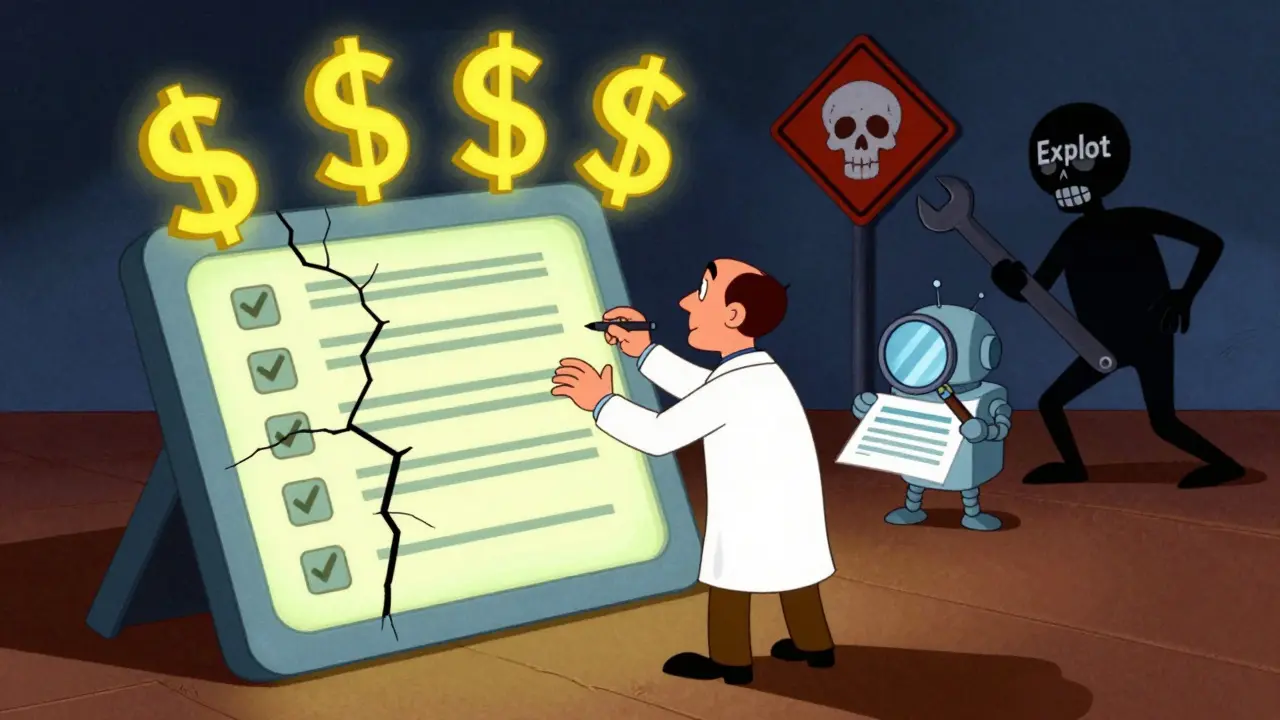
When you're building a blockchain application, one line of flawed code can cost millions. Unlike traditional software, where you can push a patch overnight, blockchain code is immutable. Once deployed, it’s locked in place - no undo button, no rollback, no second chances. That’s why code review isn’t just a step in the process - it’s your last line of defense.
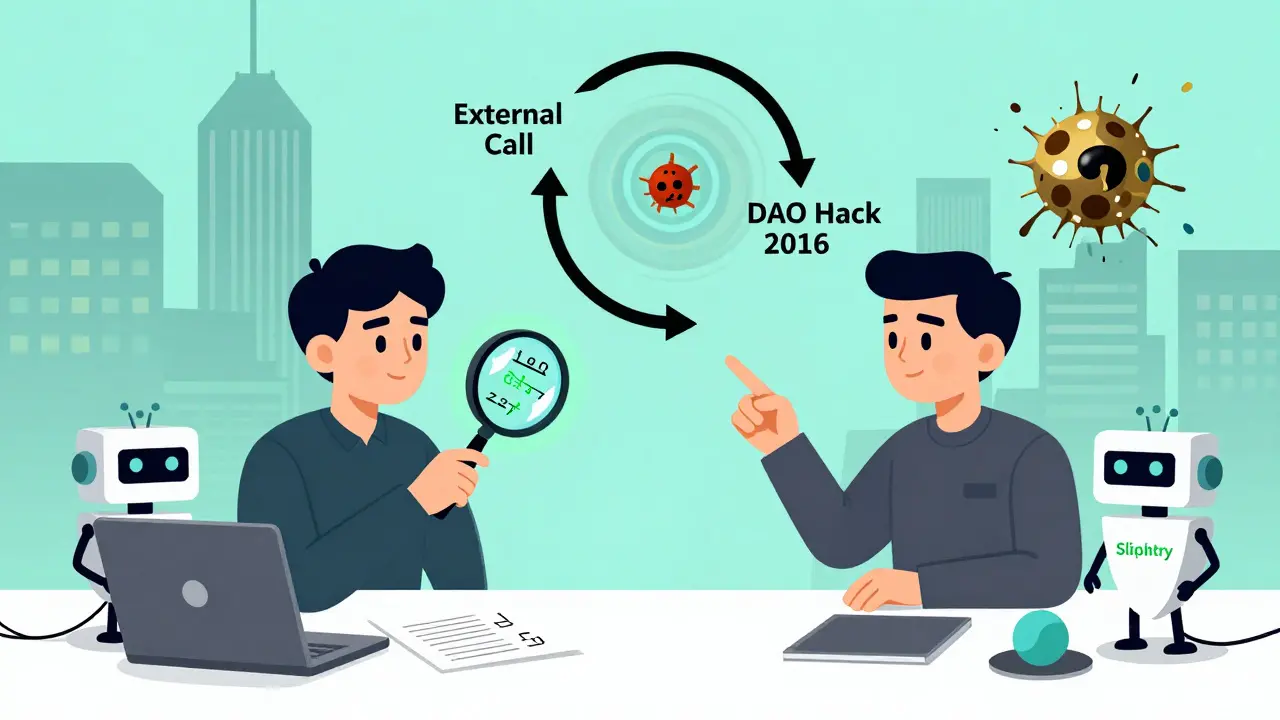
After the DAO hack in 2016 wiped out $60 million in Ether, the industry woke up. Since then, high-profile breaches like the Poly Network hack in 2021 (which lost $610 million) have shown that automated tools alone can’t catch everything. Human judgment, combined with smart tooling, is what separates secure systems from disaster.
Why Blockchain Code Review Is Different
Most developers are used to reviewing web apps or mobile code. But blockchain code? It’s a different beast. Here’s why:
- Immutable ledger: Once deployed, you can’t change the code. Bugs become permanent features.
- High-value targets: A single vulnerability can drain entire treasuries. There’s no insurance policy that covers every exploit.
- Complex logic: Smart contracts handle financial logic - token transfers, staking, voting, auctions. A tiny math error (like integer overflow) can break everything.
- Decentralized trust: No central authority means no one can fix it after the fact. The code *is* the law.
Traditional code reviews focus on readability, performance, and maintainability. Blockchain reviews? They’re about survival. You’re not just checking for bugs - you’re hunting for exploit vectors that attackers will find before you do.
The Two Approaches: Bottom-Up vs Top-Down
There are two main ways to approach reviewing blockchain code - and which one you use depends on your experience.
Bottom-Up is for beginners. Start with the smallest building blocks:
- Look at data structures - Are integers properly bounded? Are arrays sized correctly?
- Check basic functions - Token transfers, balance updates, ownership checks.
- Move to execution layer - How are transactions processed? Is the EVM (Ethereum Virtual Machine) handling gas correctly?
- Then examine consensus - How are blocks validated? Are signatures verified before execution?
This is the method recommended by Sigma Prime for new reviewers. It’s slow, but it builds deep understanding. You learn how the system works from the ground up.
Top-Down is for seasoned reviewers. Start at the entry points:
- Trace external calls - What functions can be triggered by users?
- Follow the call graph - Where does user input go? What paths lead to state changes?
- Look for high-risk functions - Any function that transfers funds, changes ownership, or alters critical parameters?
- Use tools to map dependencies - Tools like Foundry or Remix can help visualize execution paths.
This approach is faster and better for catching logic flaws that span multiple modules. But it demands experience. If you don’t know how the consensus layer works, you’ll miss the big picture.
Automated Tools Aren’t Enough - Here’s Why
You’ll hear people say, “Just run the scanner.” But here’s the truth: automated tools catch about 30-40% of vulnerabilities. That leaves 60-70% for humans to find.
Tools like SonarQube, OWASP ZAP, and Veracode are great for spotting:
- Missing input validation
- Hardcoded keys
- Unsecured API endpoints
- Deprecated libraries
But they can’t detect:
- Logic flaws in tokenomics - like allowing someone to mint infinite tokens by exploiting a rounding error
- Reentrancy bugs - where a function calls an external contract that calls it back
- Front-running risks - where bots can manipulate transaction order
- Time-based attacks - like manipulating block timestamps to trigger unfair outcomes
These require reading the code like a story. You have to ask: “What happens if this input is malicious?” “What if this function is called twice?” “What if the price feed goes to zero?”
That’s why Nethermind’s 2022 research found that 73% of smart contract vulnerabilities could be caught with proper manual review - but only if it’s done right.
The Must-Have Checklist
A good code review isn’t random. It’s systematic. Use this checklist every time:
- Input validation: Are all user inputs sanitized? Are lengths checked? Are types enforced?
- Math operations: Are you using SafeMath or OpenZeppelin’s checked arithmetic? Are overflows and underflows guarded?
- Access control: Is only the owner allowed to change critical parameters? Are role checks in place?
- Reentrancy: Are external calls made after state changes? Are mutexes or checks-effects-interactions patterns used?
- Gas optimization: Are loops unbounded? Are storage writes minimized? High gas costs can make a contract unusable.
- Event logging: Are all state changes logged? Can you trace what happened after the fact?
- Upgradeability: If this is a proxy contract, are the upgrade logic and admin keys secure?
- External dependencies: Are third-party libraries audited? Are you using the latest verified versions?
- Testing: Have you run integration tests? Fuzz tests? Have you simulated edge cases like zero balances or max uint256 values?
Devcom’s 2023 guidelines say this checklist must evolve. Don’t use the same one for every project. Update it after each audit, each exploit, each new vulnerability pattern.
How to Review Smart Contracts Like a Pro
Smart contracts are the heart of most blockchain apps. Here’s how to review them:
- Start with the purpose: What’s this contract supposed to do? If you don’t know, you can’t find the bugs.
- Look for common patterns: The DAO attack? Reentrancy. The Parity wallet hack? Poor access control. Learn from history.
- Test with fuzzing: Tools like Echidna or Foundry’s fuzzing generate random inputs. If the contract breaks, you found a flaw.
- Check for front-running: Can someone see your transaction before it’s mined and exploit it? Use commit-reveal schemes or VRFs if needed.
- Verify gas usage: A contract that costs $50 to interact with won’t get used. Optimize storage reads/writes.
- Use formal verification: Tools like Certora or Hardhat Verify can mathematically prove that certain conditions always hold - like “balance can never go negative.”
Nethermind predicts that by 2025, 60% of high-value contracts will use formal verification. It’s not magic - but it’s getting closer.
Team Collaboration and Tool Integration
Code reviews shouldn’t be a solo mission. The best teams:
- Use GitHub or GitLab pull requests with mandatory reviews
- Run automated scanners on every commit - 63% of teams now do this
- Hold weekly review sessions where one engineer walks through the code
- Document findings in a shared log - not just in comments
- Use LLMs for *initial* understanding - but never for final approval
Sigma Prime warns: “LLMs can mislead you. They’ll give you plausible-sounding advice that’s completely wrong.” Always trace the logic yourself.
Also, make sure your CI/CD pipeline includes:
- Static analysis (Slither, MythX)
- Unit tests (Mocha, Foundry)
- Fuzz tests
- Gas usage reports
Skipping any of these means you’re gambling with user funds.
What Happens When You Skip Reviews
The numbers don’t lie:
- 87% of enterprise blockchain projects now require third-party audits before going live.
- The blockchain security market will hit $15.68 billion by 2032 - because demand is exploding.
- The EU’s MiCA regulation now mandates standardized code reviews for crypto service providers.
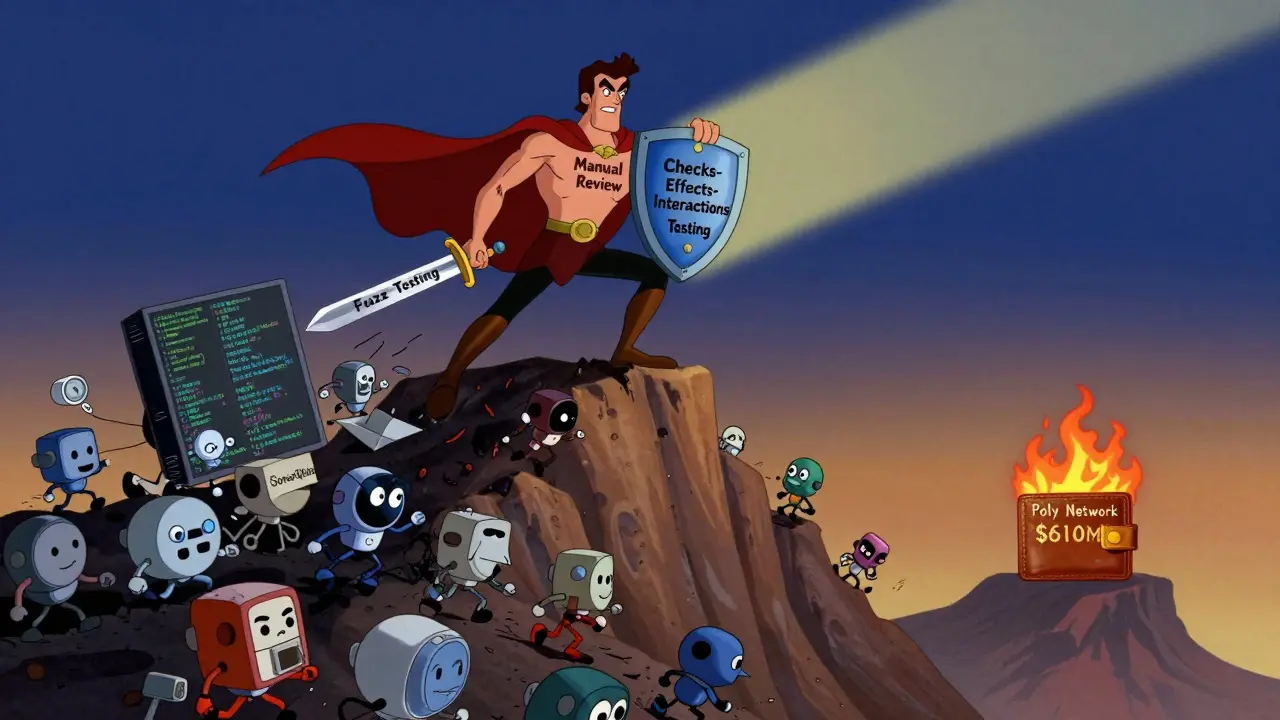
Companies that skip reviews aren’t saving time - they’re saving up for a headline. The Poly Network hack? $610 million gone because of a single missing check. The Beanstalk exploit? $180 million lost due to a flawed governance mechanism.
These weren’t “accidents.” They were avoidable.
Final Rule: Review Like Your Money Depends On It
Because it does.
Every line of code you review is a potential life raft for someone’s savings. Every bug you catch is a wallet that won’t be drained. Every checklist you follow is a shield against chaos.
There’s no shortcut. No magic tool. No AI that can replace human judgment when the stakes are this high.
So slow down. Read the code. Ask the hard questions. Test the edge cases. Double-check the math.
Because in blockchain, the code doesn’t just run - it holds value. And value, once lost, is gone forever.
Why can’t you patch blockchain code after deployment?
Blockchain code is stored on a distributed ledger that’s designed to be immutable. Once a smart contract is deployed, its bytecode cannot be changed without a hard fork - which requires consensus across the entire network. Most decentralized apps don’t have this luxury, so any flaw becomes permanent. That’s why pre-deployment review is non-negotiable.
Can automated tools fully replace manual code review?
No. Automated tools like SonarQube or Slither are great for catching common issues like reentrancy or gas inefficiencies, but they miss complex business logic flaws. For example, they won’t detect if a token minting function allows unlimited supply due to a flawed condition. Only human reviewers who understand the intent of the code can find these errors.
What’s the difference between a smart contract audit and a code review?
A code review is part of the development process - ongoing, iterative, and done by internal or peer developers. A smart contract audit is typically a formal, third-party assessment conducted before launch. Audits are deeper, often include formal verification, and produce a public report. Most serious projects do both.
How long should a blockchain code review take?
It depends on complexity. A simple ERC-20 token might take 1-2 days. A DeFi protocol with lending, borrowing, and governance could take 1-3 weeks. Most teams allocate 2-4 weeks for setup and review cycles. Rushing leads to missed flaws - and that’s when disasters happen.
Should I use LLMs like ChatGPT during code review?
Use them only for initial understanding - like explaining what a function does. Never rely on them for security decisions. LLMs can generate convincing but incorrect advice, such as suggesting unsafe patterns as “best practices.” Always verify every suggestion manually by tracing execution paths and checking against known exploit patterns.
7 Comments
Oh please. Another ‘review like your money depends on it’ sermon.
Let’s be real - 90% of these ‘blockchain security’ blog posts are just crypto bros rebranding basic software engineering as ‘esoteric wisdom.’
SafeMath? Been obsolete since Solidity 0.8.
Formal verification? Cool, if you’re writing a NASA rocket control system. For a DeFi yield aggregator? Overkill.
And don’t get me started on ‘manual review.’ You mean the same guy who wrote the contract, now reviewing it after a 3-hour nap?
Industry needs better tooling, not more checklist porn.
Also, ‘immutable ledger’? Tell that to the 17 forks that happened last year.
Stop romanticizing fragility.
- Ekaterina
I appreciate the depth of this post, and I truly believe that every developer working on blockchain should treat code review as a sacred duty.
It’s not just about preventing financial loss - it’s about preserving trust in a system that’s supposed to be transparent and fair.
When we skip reviews, we’re not just risking money - we’re betraying the people who believe in decentralized finance.
Every line of code is a promise. Break that promise, and you break lives.
Let’s stop treating blockchain like a casino and start treating it like infrastructure.
Thank you for this reminder - it’s needed.
LMAO this whole thing reads like a LinkedIn post written by a guy who got fired from a Web3 startup for not knowing what a nonce is.
You say ‘top-down review’ like it’s some genius tactic. Bro, if you don’t understand how the EVM works, you shouldn’t be touching a smart contract. Period.
And ‘LLMs can mislead you’? Newsflash - they’re already being used by 80% of dev teams to generate the initial draft. You’re just mad because you’re too slow to keep up.
Also, ‘$610 million lost’? Yeah, and? The market shrugged. That’s not a failure - that’s a feature.
Go touch grass. - Kaz
I have tears in my eyes.
Truly.
After reading this, I went back to my team’s latest contract - the one we deployed last week.
We skipped the gas optimization checklist.
We didn’t fuzz test the staking function.
We assumed the library was ‘well-known.’
And now?
I’m sitting here wondering if we just doomed hundreds of users.
This isn’t just a guide - it’s a wake-up call.
Thank you.
- Robbi
In my work across Southeast Asia and Latin America, I’ve seen how blockchain isn’t just tech - it’s lifeline.
For farmers in Colombia, remittance contracts are how they feed their kids.
For small merchants in Indonesia, tokenized loyalty systems are how they compete.
When we treat code review as a checkbox, we’re not just risking code - we’re risking dignity.
This post nails it.
Slow down. Read. Test. Care.
Because for someone, this isn’t abstract - it’s their future.
No patch. No rollback. No second chance. This is truth.
But you say manual review catches 73% of bugs.
What if the reviewer is corrupt?
What if the auditor is paid by the dev team?
What if the checklist is outdated?
What if the whole system is a trap?
Blockchain is not about code.
It is about control.
And control is always in the hands of the few.
- Gaurav
I just read this... and I'm crying. 😭
Why? Because I'm the guy who skipped the math check on the last contract...
And now... I'm scared. 😰
Like... really scared.
Like... I can't sleep scared.
And I don't even know who to tell.
...
Thanks for this.
...
I'm going back to the code.
Right now.
- Jeremy